GOQii

Blog

  • HOME
  • HEALTHY LIVING
  • FITNESS
  • HEALTHY RECIPES
  • USER STORIES
  • KARMA
  • BUY GOQii

Archives for November 2026

November 8, 2026 By GOQii Leave a Comment

Diwali Safety: First Aid for Burns and Firecracker Injuries, and Protecting Your Lungs from Smoke

Diwali night should end with sweets, family and lights, not a trip to casualty. Yet every year hospital emergency departments across India brace for the same injuries. On Diwali 2025, Delhi hospitals alone treated more than 250 burn cases, most of them from firecrackers. Safdarjung Hospital saw 129, and 24 of those patients were children under 12. Over the same festive period, AIIMS Delhi’s eye centre treated 190 firecracker-related eye injuries, 19% more than the year before, and around 60 children needed eye surgery. It isn’t only Delhi: in Bengaluru, four eye hospitals reported more than 90 cracker-related eye injuries in the first days of Deepavali 2025, more than half of them in children, and hospitals in other cities report the same pattern every year.

Most of these injuries are preventable, and for many of them what you do in the first few minutes makes a real difference. This guide covers the simple safety habits that prevent harm, the right first aid for burns and eye injuries (including the home remedies to skip), and how to protect your lungs and heart from the smoke that settles over towns and cities on Diwali night.

At a glance

  • For a burn, cool it under cool running water for 20 minutes. Start as soon as you can. Don’t use ice, toothpaste, ghee, butter, haldi or oil.
  • Then cover it loosely with cling film or a clean plastic bag. Don’t burst blisters or pull off anything stuck to the skin.
  • Get medical help for burns bigger than the injured person’s hand, deep or charred burns, burns on the face, hands, feet or genitals, and any burn in a young child or older adult.
  • For an eye injury, don’t rub, rinse or press the eye and don’t try to remove anything stuck in it. Shield it and go to hospital straight away.
  • Keep a bucket of water and sand nearby, let adults light crackers, stand well back, and never relight a dud.
  • Smoke is a health risk too. On Diwali 2025, PM2.5 levels in Delhi rose more than threefold. If you have asthma, COPD or heart disease, stay indoors during peak hours, keep your reliever inhaler close and know when to get help.
  • In an emergency in India, call 112. It connects to police, fire and ambulance services.

Before you light: simple habits that prevent most injuries

The best first aid is the injury that never happens. Doctors at AIIMS noted that most patients with firecracker eye injuries were boys and young men up to the age of 20, and that many children were hurt. Research from the American Academy of Ophthalmology has also found that many people injured by fireworks are bystanders, not the person lighting them. So safety is everyone’s job, not just the person holding the agarbatti.

Set up a safe spot

  • Burst crackers in an open area, away from buildings, parked vehicles, dry leaves and anything that can catch fire. Never burst them indoors, on a balcony or inside a crowded lane.
  • Keep two buckets ready: one of water and one of sand. Drop used sparklers and duds into the water.
  • Check local rules. In Delhi-NCR, for example, the Supreme Court has allowed only certified green crackers this Diwali, within set hours on 7 and 8 November, and none within 300 metres of hospitals, schools and old-age homes. Green crackers are designed to cut emissions, but they still burn and explode, so they need exactly the same care. Rules on timings and permitted crackers differ between states and cities, so check your local authority’s notice.

Dress for it

  • Wear close-fitting cotton clothes. Loose dupattas, saris, flowing sleeves and synthetic fabrics catch fire easily, and synthetics can melt onto the skin.
  • Tie back long hair and wear closed footwear, not chappals.
  • If you are lighting crackers, wear protective glasses. Ordinary spectacles help a little, but proper safety eyewear is better.

Light carefully

  • Adults should light crackers. Use a long agarbatti or a phuljhadi stick, keep your arm outstretched and your face turned away, then step back quickly.
  • Never hold a cracker in your hand while lighting it, and never bend over it.
  • Never relight or go back to a dud. Wait, then soak it in water.
  • Don’t put crackers in tins, bottles or pots, or throw them at people or animals.

Watch the children

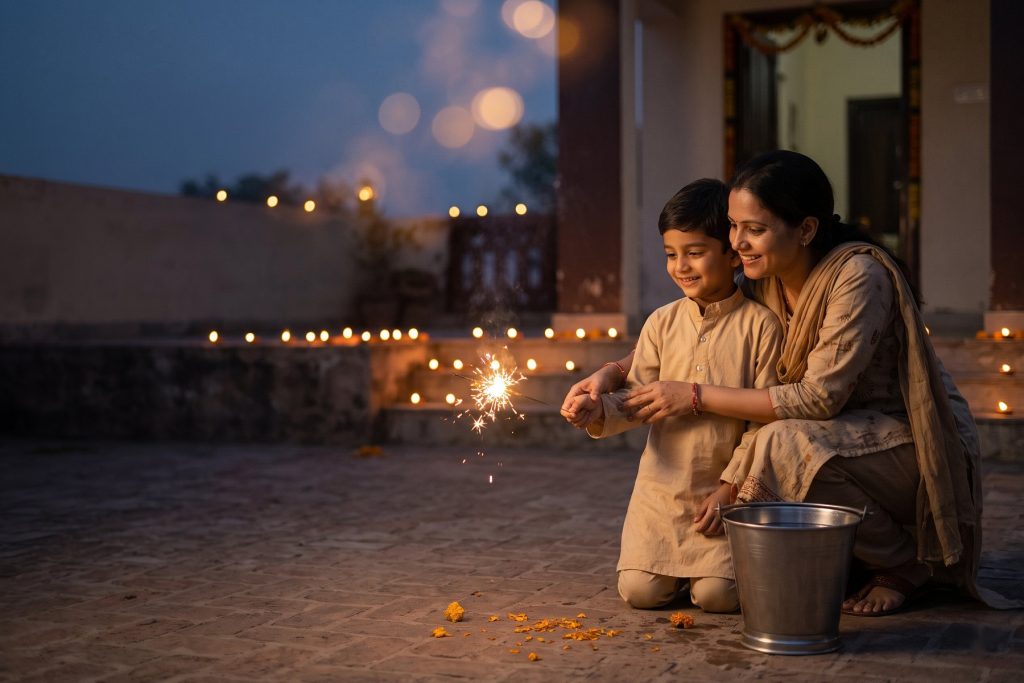
  • Sparklers feel harmless but burn at roughly 1,000°C or more, hot enough to melt some metals. Emergency doctors advise that young children shouldn’t hold them at all. If older children do, supervise closely, hold one at a time at arm’s length and drop finished ones straight into water.
  • Keep children well back from anything being lit, and keep unused crackers in a closed box away from them.
  • Steer clear of carbide guns. These homemade or market “guns” were a new cause of serious chemical and blast eye injuries at AIIMS in 2025, accounting for around 18–20 of the 190 cases.

Diyas, candles and rangoli

Diyas caused 11 of Safdarjung’s 129 Diwali burn cases in 2025. Place them on a stable, non-flammable surface, away from curtains, decorations and where children and pets run. Keep them off doorways where a sari or dupatta can brush past, and put them out before you go to sleep. Electric diyas and lights are a safer swap for corners you can’t watch.

Kitchen safety counts too. Diwali means extra frying and hot oil. Keep pan handles turned inward, keep children out of the kitchen while you fry, and never pour water onto burning oil. Turn off the gas and cover the pan with a lid instead.

First aid for burns: what to do, step by step

If clothing catches fire, remember stop, drop and roll. Stop where you are, drop to the ground, cover your face with your hands and roll until the flames are out. If it’s someone else, get them to the ground and smother the flames with a heavy cotton or woollen blanket, a rug or water. Don’t let them run, because running fans the flames.

Then follow these steps for any burn:

  1. Make it safe. Move the person away from the source of heat and any crackers still going off.
  2. Cool the burn under cool running tap water for 20 minutes. This is the single most useful thing you can do. The British Red Cross explains that cooling reduces pain, swelling and the risk of scarring, and the sooner you start, the better. Indian burns specialists, including doctors at the National Burns Centre and PGIMER Chandigarh, give the same advice: keep clean, cool water running over the burn rather than stopping as soon as it feels a little better. Water that feels cool is enough; it doesn’t need to be ice cold. If there is no running water, a bowl of clean cool water or even cold milk or a cold drink will do while you find some.
  3. Remove rings, bangles, watches and tight clothing near the burned area before it starts to swell, but don’t pull off anything that is stuck to the skin.
  4. Keep the person warm. Cool only the burn, not the whole body. Cold baths or long cold showers can drop body temperature dangerously, especially in children.
  5. Cover the burn loosely with a layer of cling film or a clean plastic bag (for a hand). Lay it on rather than wrapping it tightly. Don’t use cotton wool, fluffy cloth or sticky plasters, which can stick to the wound.
  6. Ease the pain with paracetamol or ibuprofen if needed, following the dose on the pack. Ask a pharmacist about the right dose for a child.

Home remedies to skip

Many of us grew up with a quick dab of toothpaste or ghee on a kitchen burn. They feel soothing for a moment, but they trap heat in the skin, can carry germs into the wound and make it harder for doctors to assess the burn. Doctors at the National Burns Centre specifically warn against haldi, toothpaste, ice and cow dung, and PGIMER Chandigarh against toothpaste, butter and ink. The same goes for:

  • ghee, oil or coconut oil
  • haldi (turmeric), atta or other powders
  • ink, mud or potato
  • ice or iced water, which can damage the skin further

Don’t burst blisters either. They protect the healing skin underneath.

When a burn needs a doctor

Many small, red, painful burns heal at home. Official UK guidance from NI Direct says to go to hospital emergency services for:

  • any burn bigger than the injured person’s hand
  • deep burns, including those that look white, waxy, leathery or charred, even if they don’t hurt (deep burns can damage nerves)
  • burns that blister on the face, hands, arms, feet, legs or genitals
  • chemical or electrical burns
  • anyone who has breathed in smoke, even if they seem fine at first

Get medical advice after any burn in children under 10, adults aged 50 and over, pregnant women and people with diabetes, heart, lung or liver disease, or a weakened immune system. Also see a doctor if a burn shows signs of infection over the following days: increasing pain, redness, swelling, pus, a bad smell or fever. If you can’t remember when you last had a tetanus jab, mention it to the doctor.

Eye injuries and other firecracker injuries

The eye injuries AIIMS sees on Diwali are often serious. In 2025, about 45% were open-globe injuries, where the wall of the eye is torn or punctured, and around half of patients had moderate or severe loss of vision. Getting to an eye specialist quickly gives the best chance of saving sight, and well-meaning first aid can make things worse.

If a spark, cracker or debris hits the eye

Eye specialists, including AIIMS Bhopal and the American Academy of Ophthalmology, advise the following:

  • Don’t rub the eye. Rubbing can push debris deeper or worsen a cut.
  • Don’t press on the eye or try to open it forcibly.
  • Don’t try to remove anything stuck in the eye, however small it looks.
  • Don’t rinse it if you suspect a cut, puncture or something embedded.
  • Don’t put in drops or ointments, including home remedies such as rose water, ghee or breast milk.
  • Shield the eye. Gently tape the bottom of a paper cup, or the cut-off base of a plastic bottle, over the eye so nothing presses on it. Ask the person to keep both eyes as still as possible.
  • Go to the nearest hospital with an eye department straight away. Don’t wait to see if it settles. Avoid giving food or drink in case surgery is needed.

The one exception is a chemical splash (for example from a carbide gun or cracker powder) with no sign of a cut or embedded object. Here, rinsing is the priority: hold the eye open and flush it gently with plenty of clean running water for at least 15 minutes, then go to hospital. If in doubt about which kind of injury it is, shield the eye and go.

Minor irritation from smoke or ash usually settles with blinking and a few splashes of clean water. If vision is blurred, the eye stays red and painful, or there’s sensitivity to light, get it checked.

Hand and ear injuries

A cracker that goes off in the hand can cause deep burns, cuts and broken bones. Cool the burns, press a clean cloth on any bleeding, raise the hand and go to hospital. Ringing in the ears after a loud bang usually fades within a day; see a doctor if it doesn’t, or if there’s pain, bleeding or hearing loss.

Protecting your lungs and heart from Diwali smoke

Firecrackers release a dense mix of fine particles (PM2.5), sulphur dioxide, nitrogen oxides and metal compounds. In much of north India, they arrive on top of seasonal smog, cold, still air and crop-residue smoke. On Diwali 2025, an analysis of Central Pollution Control Board data by Climate Trends found Delhi’s average PM2.5 rose more than threefold, from about 157 to 488 µg/m³, with the sharpest spike between 10 pm and 1 am. That’s many times the WHO’s guideline for daily exposure.

For most healthy adults, one smoky night causes sore eyes, a scratchy throat or a cough that settles. The people who need to take it seriously are:

  • people with asthma or COPD, for whom smoke can trigger a flare-up
  • people with heart disease or who have had a stroke, because short spikes in fine particles are linked to heart attacks and strokes
  • young children, whose lungs are still developing
  • older adults and pregnant women

We cover the wider health effects of smog in our guide to air pollution and your health.

Practical steps for Diwali night

  • Stay indoors during peak bursting hours, usually late evening until after midnight, and the following morning if the smog lingers. Keep doors and windows shut until the air clears.
  • Check the AQI on the government’s SAMEER app or a trusted air-quality app before going out, and plan errands and walks for the cleaner middle of the day.
  • Wear a well-fitting N95 or FFP2 mask if you do need to go out. Cloth and surgical masks don’t filter fine particles well.
  • Don’t add to indoor smoke. Go easy on incense, dhoop, camphor and heavy diya smoke indoors, and use the kitchen exhaust when frying.
  • Use an air purifier if you have one, in the room where you spend most time and where you sleep. It works best with doors and windows closed.
  • Skip outdoor exercise for a day or two after Diwali if air quality is poor. Do a yoga or strength session indoors instead.
  • Drink enough water. It won’t remove pollutants from your body, but it helps with a dry, irritated throat.

If you have asthma or COPD

Pulmonologists interviewed by Business Standard ahead of last year’s festive season advised:

  • keep taking your preventer inhaler every day as prescribed, even if you feel well
  • carry your reliever inhaler at all times, and check it isn’t empty or out of date
  • ask your doctor for a written action plan that says what to do if symptoms worsen
  • get checked if you’re using your reliever more than usual, or if symptoms last more than a week
  • keep your flu and pneumococcal vaccines up to date

Get urgent help if breathing becomes very difficult, your reliever isn’t helping or you need it more than every four hours, you can’t speak in full sentences, or your lips or fingertips look blue or grey.

If you have heart disease

Stay indoors during the worst hours, keep taking your medicines and don’t exert yourself in smoky air. Call 112 for chest pain or pressure, breathlessness, a cold sweat, or pain spreading to the arm, jaw or back. And know the signs of a stroke: if someone’s face drops, an arm goes weak or their speech is slurred, act FAST and call for help straight away.

Pets and street animals

Dogs and cats hear far more than we do, and Diwali can be terrifying for them. Humane World for Animals suggests walking dogs earlier in the day, keeping pets indoors in a familiar room with windows and curtains closed, staying with them for comfort and making sure they wear an ID tag in case they bolt. If your pet has severe noise anxiety, talk to your vet before Diwali. Never burst crackers near animals, shelters or cowsheds, or tie them to animals.

Emergency numbers and your Diwali first-aid kit

Numbers to save before Diwali

Number What it’s for
112 National emergency number for police, fire and ambulance (ERSS)
108 Ambulance (in most states)
101 Fire and rescue

The government is bringing the older numbers under 112, so if in doubt, call 112. Also save the number of your nearest hospital with a 24-hour emergency department, and find out in advance which nearby hospitals have a burns unit and an eye department. On Diwali night, roads are busy and minutes count.

Call an ambulance if someone has a large or deep burn, a burn to the face or airway, difficulty breathing after inhaling smoke, a serious eye injury, heavy bleeding or a severed finger, or if they’re confused, drowsy or unconscious. While you wait, keep cooling the burn and keep the person warm.

A simple Diwali first-aid kit

Keep these together in one place where every adult in the house knows to find them:

  • a bucket of water and a bucket of sand near where crackers are being burst
  • a roll of cling film and some clean plastic bags (for covering burns)
  • sterile non-stick dressings, gauze and a crepe bandage
  • medical tape and a few paper cups (for shielding an injured eye)
  • clean cotton cloths or towels
  • paracetamol or ibuprofen, in adult and children’s doses
  • a spare reliever inhaler for anyone with asthma, and N95 masks
  • a torch and a phone with emergency numbers saved
  • a small fire extinguisher, if you have one, and a fire blanket or thick cotton blanket

What you won’t need: toothpaste, ghee, haldi or burn “creams” for fresh burns.

The bottom line

A safe Diwali comes down to a few habits: adults light the crackers, everyone stands back, there’s water and sand within reach and nobody goes back to a dud. If a burn happens, cool running water for 20 minutes beats every home remedy. If an eye is hurt, shield it and go to hospital without rubbing or rinsing. And if you or someone at home has asthma, COPD or heart disease, plan to be indoors with your medicines to hand when the smoke is at its worst. For the rest of the festival, from sweets to sleep, see our guide to a healthy Diwali.

Pro Tip: Before Diwali night, save 112 and your nearest hospital’s number, and set your air-quality alerts. If smoke keeps you indoors over the festive days, log an indoor workout or yoga session in the GOQii App so your activity streak doesn’t slip. Your GOQii Personalised Health Coach can help you plan indoor routines and keep your asthma or heart-health habits on track through the smog season.

Frequently asked questions

What is the first thing to do for a firecracker burn?

Move away from the heat, then hold the burn under cool running water for 20 minutes. Remove rings or tight clothing near the burn, cover it loosely with cling film or a clean plastic bag, and get medical help if it is large, deep or on the face, hands, feet or genitals.

Should I put toothpaste, ghee or ice on a burn?

No. Toothpaste, ghee, butter, oil, haldi and ice can trap heat, damage the skin or introduce infection. Cool running water is the right first aid.

When should I take a burn to hospital?

Go to hospital for burns bigger than the injured person’s hand, deep burns that look white or charred, blistered burns on the face, hands, arms, feet, legs or genitals, chemical or electrical burns, and anyone who has inhaled smoke. Children under 10, adults aged 50 and over and pregnant women should get any burn checked.

What should I do if a firecracker injures someone’s eye?

Don’t rub, press or rinse the eye, and don’t try to remove anything stuck in it. Gently cover it with a shield such as a paper cup taped in place, and go to a hospital with an eye department straight away. For a chemical splash without a cut, flush the eye with clean water for at least 15 minutes, then go to hospital.

Are sparklers safe for children?

Sparklers burn at around 1,000°C, hot enough to cause serious burns. Young children shouldn’t hold them. Older children should be closely supervised, hold one at a time at arm’s length and drop used sparklers into a bucket of water.

How can people with asthma protect themselves on Diwali?

Stay indoors with windows closed during peak bursting hours, keep taking your preventer inhaler, carry your reliever inhaler, wear an N95 mask if you must go out and follow your asthma action plan. Seek urgent help if your reliever isn’t working or breathing becomes very difficult.

What is the emergency number in India for burns and fire?

Call 112, India’s single emergency number, which connects to police, fire and ambulance services. You can also call 108 for an ambulance in most states and 101 for the fire service.

#BeTheForce

Disclaimer: The information provided in this blog is for general awareness and educational purposes only. It is not intended to replace professional medical advice, diagnosis, or treatment. Always consult a qualified healthcare provider for personalised medical guidance or concerns related to your health.

November 7, 2026 By GOQii Leave a Comment

Cancer Screening: Which Tests You Need and When

Most of us know someone whose cancer was found “too late”. Screening exists to change that. For some cancers, a simple test can find changes years before symptoms appear, when treatment is easier and more likely to work. For cervical and bowel cancer, screening can even prevent cancer by finding and removing changes before they turn cancerous.
Yet screening is easy to put off. Guidelines differ between countries, and it isn’t always clear which tests you need, when, and which you don’t. This National Cancer Awareness Day, observed in India on 7 November, here’s a clear guide to the cancer screening tests that make a difference, based on WHO and national guidelines, with notes for India, the UK and the US.

At a glance

  • Screening is for people without symptoms. If you have a symptom, see a doctor now; don’t wait for a screening test.
  • Cervical cancer: an HPV test from age 25–30 every 5 years or so is one of the most effective screening tests there is. The WHO recommends HPV testing as the first-choice test.
  • Breast cancer: mammograms are typically offered every 2–3 years from age 40–50.
  • Bowel (colorectal) cancer: a simple home stool test or colonoscopy, usually from age 45–50.
  • Mouth cancer: a quick visual check of the mouth matters most for anyone who uses tobacco, gutka or alcohol.
  • Lung and prostate: screening is only for certain groups, after a discussion with your doctor.
  • In India, adults aged 30 and over can be screened for oral, breast and cervical cancer at government health centres.

What screening is, and what it isn’t

Screening means testing healthy people who have no symptoms to find cancer early, or to find changes that could become cancer. It’s different from a diagnostic test, which is done when you already have a symptom.

The benefits: finding cancer at an earlier stage, when treatment is simpler and survival is higher, and, for cervical and bowel cancer, preventing cancer altogether.

The trade-offs: no test is perfect. Screening can produce false alarms that lead to anxiety and further tests, occasionally miss a cancer, and sometimes find slow-growing cancers that would never have caused harm (overdiagnosis). That’s why guidelines recommend screening only for the cancers, age groups and intervals where the benefits clearly outweigh the harms, and why “full-body cancer scans” and tumour-marker blood tests aren’t recommended for healthy people.

Why it matters: cancer is a growing problem worldwide. India alone recorded an estimated 1.41 million new cancer cases in 2022, with breast, lip and mouth, and cervical cancer among the most common, and these are three of the cancers that screening can catch early.

Cervical cancer: an HPV test every 5 years or so

Almost all cervical cancers are caused by long-lasting infection with high-risk types of the human papillomavirus (HPV). Screening finds the virus or early cell changes, which can be treated before cancer develops, making this one of the most preventable cancers.

What the guidelines say:

  • WHO: an HPV DNA test is the preferred screening test, starting at age 30 and repeated every 5–10 years. Women living with HIV should start at 25 and repeat every 3–5 years. Self-collected samples, which you take yourself, can be used.
  • UK (NHS England): HPV screening from age 25 to 64. Since July 2025, people who test HPV-negative are invited every 5 years, instead of every 3 for those aged 25–49.
  • India: women aged 30 and over are offered screening, often with visual inspection with acetic acid (VIA), through the national NCD programme at government health centres.

What the test involves: a nurse or doctor takes a small sample of cells from the cervix with a soft brush. It takes a few minutes, and it may be a little uncomfortable but shouldn’t hurt. Where self-sampling is offered, you can take a vaginal swab yourself.

Prevention too: HPV vaccination, ideally for girls aged 9–14, prevents most cervical cancers. Vaccinated women still need screening.

Breast cancer: mammograms from your 40s or 50s

Breast cancer is the most common cancer in women worldwide, and in India it accounts for over a quarter of cancers in women. Survival is much higher when it’s found early.

What the guidelines say:

  • US (USPSTF, 2024): a mammogram every two years from age 40 to 74.
  • UK (NHS): a mammogram every three years from 50 up to 71; older women can ask to continue.
  • India: the national programme offers a clinical breast examination by a trained health worker for women aged 30 and over, with referral for a mammogram or ultrasound if anything is found.

If you’re at higher risk, for example with a strong family history of breast or ovarian cancer or a known BRCA gene change, you may need earlier or more frequent screening, sometimes with MRI. Ask your doctor.

Breast awareness matters at every age. Know how your breasts normally look and feel, and see a doctor promptly about a new lump, thickening, change in shape, skin dimpling, nipple changes or discharge. Most lumps aren’t cancer, but they should always be checked.

Bowel (colorectal) cancer: a home test or colonoscopy from 45–50

Bowel cancer usually starts as small growths called polyps, which can be found and removed before they turn cancerous.

What the guidelines say:

  • US (USPSTF, 2021): screen adults from age 45 to 75; for 76–85, decide case by case. Options include a home stool test (FIT) every year, or a colonoscopy every 10 years.
  • UK (NHS): a home FIT kit every two years, posted to people from their 50s up to 74. The starting age varies by nation.
  • India: bowel cancer is less common than in Western countries but rising, and there’s no national screening programme yet. Ask your doctor about a FIT test or colonoscopy from around 45–50, especially if you have a family history.

What the tests involve: FIT checks a tiny stool sample, collected at home, for hidden blood. If it’s positive, a colonoscopy follows, using a thin camera to look inside the bowel and remove any polyps.

Don’t wait for screening if you notice blood in your stool, a lasting change in bowel habits, unexplained weight loss or tummy pain.

Mouth (oral) cancer: a quick look that can save lives

Mouth cancer is common in South Asia, largely because of smokeless tobacco (gutka, khaini, paan with tobacco), smoking, areca nut and alcohol. In India, lip and mouth cancer is the second most common cancer overall.

Screening is simple: a trained health worker, dentist or doctor looks inside your mouth and feels your neck for lumps. In a large trial in Kerala, regular visual mouth checks cut oral cancer deaths by 34% among people who used tobacco or alcohol.

What the guidelines say:

  • India: an oral visual examination for adults aged 30 and over, through the national NCD programme.
  • Elsewhere: there’s no routine population programme in the UK or US, but dentists usually check the mouth at check-ups.

See a doctor or dentist about a mouth ulcer that hasn’t healed in three weeks, a white or red patch, a lump, difficulty opening your mouth, or unexplained pain or bleeding. And if you use tobacco in any form, quitting is the single biggest thing you can do to protect yourself.

Lung and prostate cancer: only for some people

Lung cancer: screening with a low-dose CT scan is recommended only for people at high risk because of smoking. In the US, that means adults aged 50–80 who have a 20 pack-year smoking history and still smoke or quit within the past 15 years. (A pack-year is one pack of 20 cigarettes a day for a year.) The NHS is rolling out targeted lung checks for people aged 55–74 who smoke or used to. India doesn’t have a lung screening programme, so if you’re a heavy smoker, ask your doctor whether a scan is right for you. Lung cancer also affects people who have never smoked, and air pollution is one of the risk factors.

Prostate cancer: the PSA blood test can find prostate cancer early, but it also finds many slow-growing cancers that would never cause harm, and it leads to false alarms, biopsies and treatments with side effects such as incontinence and erectile problems. The USPSTF advises that for men aged 55–69, screening should be an individual decision made with a doctor, and it recommends against routine PSA screening from 70. Men with a family history, or of Black African heritage, may benefit from discussing it earlier.

Not recommended for healthy people with no symptoms: full-body scans, tumour-marker blood tests (such as CA-125 or CEA) as a general screen, and ovarian, pancreatic or thyroid cancer screening. These can cause more harm than good when used routinely.

Your screening checklist

Guidelines vary by country and are updated over time, so use this as a starting point for a conversation with your doctor.

Cancer Who Test How often
Cervical Women from 25–30 to about 65 HPV test (or VIA where HPV testing isn’t available) Every 5 years if HPV-negative (WHO: 5–10)
Breast Women from 40–50 to about 71–74 Mammogram (clinical breast exam in India from 30) Every 2–3 years
Bowel Adults from 45–50 to 74–75 Home stool test (FIT) or colonoscopy FIT every 1–2 years; colonoscopy every 10 years
Mouth Adults 30+, especially tobacco or alcohol users Visual examination At health checks, or at least every few years
Lung Heavy current or former smokers, 50–80 Low-dose CT Yearly, if eligible
Prostate Men 55–69 PSA test Only after discussing benefits and harms

How to make it happen:

  • Ask your doctor which tests suit your age, sex, family history and lifestyle, and when you’re due.
  • Tell them about family history: cancer in close relatives, especially at a young age, can mean earlier screening.
  • In India, ask at your nearest Ayushman Arogya Mandir or government health centre about screening for adults 30 and over. A government campaign has aimed to screen everyone aged 30 and above for oral, breast and cervical cancer alongside diabetes and blood pressure.
  • Put reminders in your calendar for your next due date.

Symptoms never to ignore, at any age and whatever your last screening result: a new lump; unexplained weight loss; a cough or hoarseness lasting more than three weeks; blood in urine, stool or phlegm; bleeding after sex or after menopause; a mouth ulcer that won’t heal; or a mole that changes.

The bottom line

Cancer screening isn’t about testing for everything. It’s about doing the right tests at the right time: an HPV test for cervical cancer, mammograms for breast cancer, a stool test or colonoscopy for bowel cancer, and a mouth check if you use tobacco, plus lung and prostate screening for those who qualify. This National Cancer Awareness Day, check which tests you’re due for, book one, and remind someone you love to do the same. And remember: if you notice a symptom, don’t wait for a screening appointment.

Pro Tip: Add your screening due dates to the GOQii App so you never miss one, and keep up the everyday habits that lower cancer risk: being active, eating well and avoiding tobacco. Your GOQii Personalised Health Coach can help you build them, including support to quit tobacco.

Frequently asked questions

What cancer screening tests should I get?

Most adults should consider cervical screening (women), breast screening (women) and bowel screening, starting at the ages set by their country’s guidelines. People who use tobacco should have regular mouth checks. Lung and prostate screening are only for certain groups after discussing them with a doctor.

At what age should women start cervical cancer screening?

The WHO recommends starting HPV testing at age 30 (age 25 for women living with HIV). The UK starts at 25, and India’s national programme offers screening from 30. If your HPV test is negative, it’s usually repeated every 5 years.

When should I get my first mammogram?

It depends on where you live and your risk. The US recommends a mammogram every two years from age 40, and the UK every three years from 50. Women with a strong family history may need to start earlier, so ask your doctor.

How is bowel cancer screened?

Most programmes use a simple home stool test (FIT) that checks for hidden blood, usually every one to two years from around 45–50. If it’s positive, a colonoscopy follows. A colonoscopy every 10 years is another option.

Who should be screened for oral cancer?

Anyone who uses tobacco in any form, chews areca nut or drinks alcohol regularly should have their mouth checked. In India, adults aged 30 and over can get an oral examination at government health centres.

Should I get a full-body scan or tumour marker test to check for cancer?

No, not if you’re healthy and have no symptoms. These tests aren’t recommended for screening because they often give false alarms and can lead to unnecessary tests and worry.

Does a normal screening result mean I can’t get cancer?

No. Screening lowers risk but isn’t perfect, and cancer can develop between tests. Keep going for screening when invited, and see a doctor about any new or unusual symptoms.

#BeTheForce

Disclaimer: The information provided in this blog is for general awareness and educational purposes only. It is not intended to replace professional medical advice, diagnosis, or treatment. Always consult a qualified healthcare provider for personalised medical guidance or concerns related to your health.

November 6, 2026 By GOQii Leave a Comment

This Dhanteras, Invest in Your Health

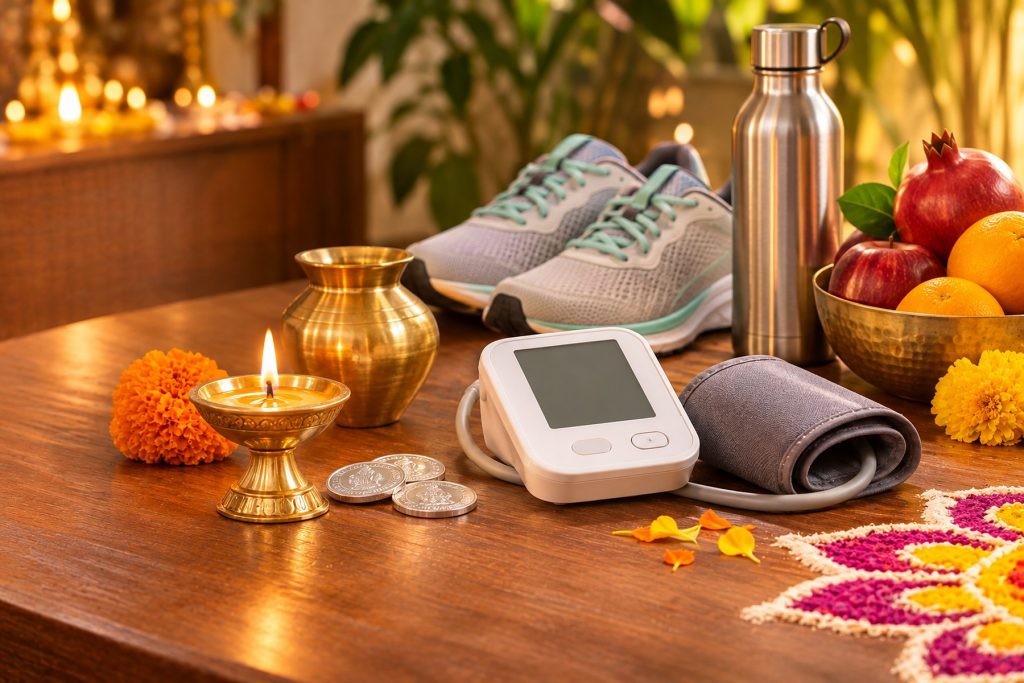
Dhanteras, which falls on Friday 6 November this year, is the day millions of families buy gold, silver, utensils or something new for the home, as a sign of prosperity for the year ahead. But the festival has another meaning that’s easy to forget. It honours Lord Dhanvantari, revered as the physician of the gods and associated with Ayurveda, a reminder that good health is the real wealth.

So this Dhanteras, alongside the coins and kitchenware, why not invest in your health too? It doesn’t have to cost much. Some of the best investments are a few routine tests, a handful of genuinely useful health buys, and habits that cost nothing at all.

At a glance

  • The best returns come from prevention: catching high blood pressure, raised blood sugar or high cholesterol early, before they cause problems.
  • Book the check-ups you’re due for: blood pressure, blood sugar, cholesterol and age-appropriate cancer screening.
  • Buy wisely: a validated upper-arm blood pressure monitor, good walking shoes or a water bottle can be worth more than expensive gadgets or supplements.
  • The free habits matter most: walking, sleep, home-cooked food, staying tobacco-free and time with people you love.
  • Give health as a gift: a check-up voucher, a fruit basket or an activity tracker can go further than another box of sweets.

1. Invest in check-ups

Many of the conditions that lead to heart attacks, strokes and kidney disease, such as high blood pressure, type 2 diabetes and high cholesterol, cause no symptoms for years. A simple test is often the only way to know. And in India, the numbers are large: the national ICMR–INDIAB study found that over 11% of adults have diabetes, 15.3% have prediabetes and 35.5% have high blood pressure, and many don’t know it.

Checks most adults should keep up to date:

Check Who and how often (typical guidance)
Blood pressure Every adult, at least once a year from your 30s, more often if it’s raised
Blood sugar (fasting glucose or HbA1c) From age 30, or earlier if you’re overweight or diabetes runs in your family; repeat every 1–3 years depending on your results
Cholesterol (lipid profile) Every few years from your 20s or 30s, more often if raised or if heart disease runs in your family
Weight and waist Once or twice a year at home or at the doctor
Cancer screening Cervical, breast and bowel screening at the ages your doctor or national programme advises; a mouth check if you use tobacco
Eyes and teeth Regular dental check-ups; an eye test every couple of years, and yearly if you have diabetes

Indians tend to develop diabetes and heart disease at younger ages and at lower body weights than many other populations, so starting checks in your 30s, or earlier with a family history, makes sense.

Where to get them:

  • Government health centres: Ayushman Arogya Mandirs and other government facilities offer screening for adults aged 30 and above for blood pressure, diabetes and oral, breast and cervical cancer.
  • Your employer or health insurance: many company health plans and insurance policies include a free annual check-up. It’s worth checking your policy before you pay for one.
  • Diagnostic labs: most offer home sample collection, which makes it easier to get tests done for older parents.
  • A tax benefit: under the old tax regime, payments for preventive health check-ups for yourself and your family can be claimed under Section 80D, up to ₹5,000 within the overall 80D limit, and even cash payments count. Check with your tax adviser for your situation.

A word on “full-body” packages: big check-up packages with dozens of tests aren’t always better. Unnecessary tests, such as cancer markers or scans in people without symptoms, can cause false alarms and worry. Ask your doctor which tests suit your age and history.

2. Health buys that are worth the money

If you’re shopping this Dhanteras anyway, these purchases can earn their keep:

  • A validated, upper-arm blood pressure monitor. Home readings help you and your doctor spot and manage high blood pressure. The British Heart Foundation advises choosing an independently validated, upper-arm monitor with a cuff that fits snugly, sit quietly with your back supported, and take two readings a few minutes apart.
  • Steel or clay cookware and a good non-stick pan, which let you cook with less oil. Steel and brass utensils are a traditional Dhanteras buy anyway.
  • Comfortable walking shoes. If they get you walking every day, they’re the best fitness equipment you’ll buy.
  • An activity tracker or step counter, if you’ll actually use it. A 2025 review in The Lancet Public Health found that about 7,000 steps a day, compared with 2,000, was linked to a much lower risk of early death, heart disease and dementia. Many of us need the nudge: a Lancet Global Health study found that nearly half of Indian adults (49.4%) weren’t active enough in 2022, rising to 57% among women.
  • A reusable water bottle to help you drink more water and fewer sugary drinks.
  • A digital thermometer and a basic first-aid kit, especially if you have children or older parents at home.
  • For diabetes: a glucometer, if your doctor wants you to check your sugar at home.

Think twice before spending on:

  • Multivitamins and “immunity boosters” for healthy adults. The US Preventive Services Task Force found insufficient evidence that multivitamins prevent heart disease or cancer, and it recommends against beta-carotene and vitamin E supplements. Take supplements only for a specific need your doctor has identified.
  • Detox kits, “fat-burning” products and miracle gadgets that promise quick results.
  • Expensive equipment you won’t use. A treadmill that becomes a clothes rack is no investment.

3. Free habits with the best returns

The biggest health “investments” cost nothing, and like a good savings plan, they pay off when you keep them up.

  • Move every day. The WHO recommends at least 150 minutes of moderate activity a week, such as brisk walking, plus muscle-strengthening on two days. Short bouts count too.
  • Sleep 7–9 hours. Regular sleep supports your weight, mood, blood sugar and immunity.
  • Eat mostly home-cooked food, with plenty of vegetables, fruit, pulses and whole grains, and less salt, sugar and fried food.
  • Stay tobacco-free, and drink less alcohol, or none.
  • Manage stress. A few minutes of slow breathing each day can help; try these breathing exercises to relieve anxiety.
  • Stay connected. Time with family and friends, which festivals are all about, is good for your mental and physical health.

This Diwali season, our guide to maintaining a healthy lifestyle during Diwali has more ideas for enjoying the festivities without overdoing it.

4. Give the gift of health

The Diwali gifting season is a chance to share health, not just sweets:

  • A health check-up voucher for parents or grandparents
  • A fruit and dry-fruit basket instead of another box of mithai
  • Homemade, lighter snacks, such as our baked and air-fried namkeen
  • A blood pressure monitor for an older relative, with a promise to help them use it
  • Walking shoes, a yoga mat or an activity tracker for someone trying to get fitter
  • Your time: a family walk, an evening without screens, or a promise to accompany a parent to their check-up

The bottom line

Dhanteras celebrates prosperity, and there’s no greater wealth than good health. This year, alongside the gold and the new utensils, book the check-up you’ve been putting off, buy something that helps you look after yourself, and commit to one free habit, like a daily walk, that will pay you back for years. That’s an investment worth making.

Pro Tip: Use the GOQii App to track your steps, sleep and blood pressure readings in one place, and set reminders for your next check-up. Your GOQii Personalised Health Coach can help you turn your Dhanteras resolution into a habit that lasts.

Frequently asked questions

What is the health significance of Dhanteras?

Dhanteras honours Lord Dhanvantari, revered as the physician of the gods and associated with Ayurveda. It’s a good reminder that health is the greatest wealth, and a natural time to invest in check-ups and healthy habits.

What health check-ups should I get every year?

Most adults should check their blood pressure at least once a year and keep up with blood sugar and cholesterol tests every few years, more often if results are borderline. Add age-appropriate cancer screening, dental check-ups and eye tests. Your doctor can tailor this to your age and family history.

Is a full-body check-up package worth it?

Not always. Large packages often include tests that aren’t needed for healthy people and can cause false alarms. It’s usually better to ask your doctor which tests suit your age, risk factors and family history.

Which blood pressure monitor should I buy for home use?

Choose an independently validated monitor that measures at the upper arm, with a cuff that fits your arm snugly. Take readings sitting quietly with your back supported and your arm resting on a table.

Should I buy multivitamins for my family?

Most healthy people who eat a varied diet don’t need a multivitamin. There’s insufficient evidence that multivitamins prevent heart disease or cancer. Take supplements only if your doctor finds a specific need, such as low vitamin D, B12 or iron.

How many steps a day should I aim for?

Around 7,000 steps a day is linked to a much lower risk of early death and heart disease than 2,000 steps, and more is generally better. The WHO recommends at least 150 minutes of moderate activity a week.

What are good health gifts for Diwali?

A health check-up voucher, a fruit or dry-fruit basket, homemade lighter snacks, a blood pressure monitor for older relatives, or walking shoes and an activity tracker all make thoughtful gifts.

#BeTheForce

Disclaimer: The information provided in this blog is for general awareness and educational purposes only. It is not intended to replace professional medical advice, diagnosis, or treatment. Always consult a qualified healthcare provider for personalised medical guidance or concerns related to your health.

November 5, 2026 By GOQii Leave a Comment

Jaggery vs Sugar: Is Gur Really Healthier?

Swapping white sugar for gur is one of the most common “healthy” changes people make before Diwali. Gur feels traditional, less processed and somehow kinder to the body. But your body handles jaggery much the way it handles sugar: it is mostly sucrose, it carries almost the same calories, and it raises blood glucose.


That doesn’t mean you need to give up your favourite gur chikki or til laddoo. It means treating jaggery as what it is, a sweet treat, and enjoying it in amounts that suit your health.

At a glance

  • Is jaggery healthier than sugar? Only slightly. It keeps traces of minerals that refining removes, but the amounts in a normal serving are too small to matter much.
  • Calories: about 375 kcal per 100 g for jaggery and close to 400 kcal for white sugar.
  • Blood sugar: both raise blood glucose. Jaggery is not a safe swap for people with diabetes.
  • How much is OK: WHO advises keeping free sugars, jaggery and honey included, below 10% of daily energy and ideally below 5%.
  • Best approach this Diwali: use less of any sweetener, choose smaller portions, and add flavour with nuts, cardamom, cinnamon and fruit.

Key takeaways

  • Jaggery is roughly 65–85% sucrose, the same sugar that makes up white sugar.
  • It contains some iron, potassium and magnesium, but you would need to eat a very large amount of jaggery to get a useful dose.
  • Studies disagree on jaggery’s glycaemic index, but none show that it protects blood sugar. Count it the same way you count sugar.
  • Honey, coconut sugar, panela and date syrup are also free sugars under WHO’s definition.
  • The healthiest change is to use less sweetener overall, not to switch from one sweetener to another.

What is jaggery?

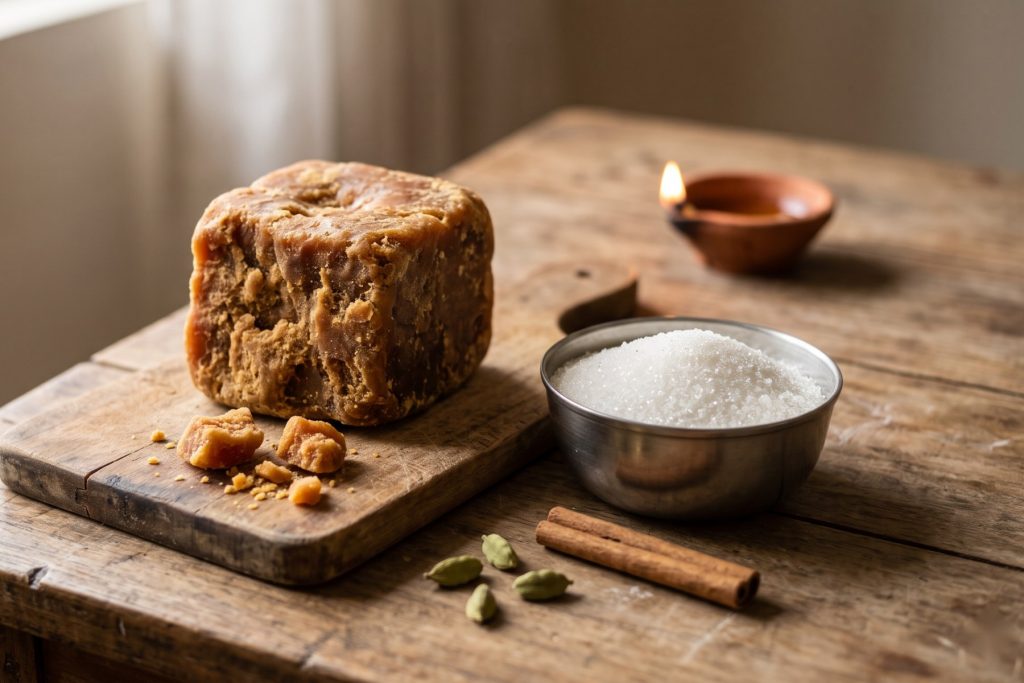
Jaggery (gur) is made by boiling sugarcane juice, or palm sap, until it thickens and sets. Unlike white sugar, it isn’t spun in a centrifuge to remove the molasses, which is why it’s called a non-centrifugal sugar. It goes by different names around the world: panela in Latin America, rapadura in Brazil and kokuto in Japan. India produces nearly 70% of the world’s jaggery.

Keeping the molasses gives jaggery its colour, its caramel flavour and its small amount of minerals. It is still a sugar.

Jaggery vs sugar: the nutrition, side by side

Per 100 g Jaggery White sugar
Sucrose 65–85 g about 99.5 g
Glucose and fructose 10–15 g trace
Energy about 375 kcal about 390–400 kcal
Iron about 11 mg (varies widely) trace
Calcium 40–100 mg under 5 mg
Magnesium 70–90 mg trace

Jaggery figures are from a review of jaggery products, as reported by The Week; refined sugar figures are from a 2021 review in the Journal of Food Science and Technology. Mineral levels vary a lot with the cane, the soil and how the jaggery is made. Some of the iron can come from the iron pans it is boiled in.

Do the minerals make a difference?

Not at the amounts people actually eat. A 10 g piece of jaggery, roughly a heaped teaspoon, gives you about 37 kcal and around 1 mg of iron. That’s a small fraction of what most adults need each day. To get 10 mg of iron from jaggery you would need about 90 g, which is more than 300 kcal of sugar.

Iron, calcium and magnesium are far better sourced from dals, green leafy vegetables, millets such as ragi, nuts, seeds and dairy. These come with protein and fibre, not just sugar.

Does jaggery raise blood sugar less than sugar?

No. Jaggery is mostly sucrose, so your body breaks it down into glucose and fructose just as it does white sugar. Both raise blood glucose.

Studies of jaggery’s glycaemic index (GI), which measures how quickly a food raises blood sugar, don’t agree. One review puts jaggery’s GI at about 84, which is higher than the usual figure of about 65 for table sugar. A 2022 Sri Lankan study in people with type 2 diabetes compared coconut jaggery with cane sugar. It found no significant difference in how much either raised blood glucose, and the authors concluded that coconut jaggery is not a healthy substitute for sugar. The results depend on the type of jaggery, how it is made and how it’s eaten. None of the studies show that jaggery is gentle on blood sugar.

If you have diabetes or prediabetes, count jaggery exactly as you would count sugar. Our guide to the glycaemic index explains how to build meals that keep blood sugar steadier. If you’re unsure where you stand, read about the early signs of diabetes and ask your doctor about a fasting glucose or HbA1c test.

What about honey, coconut sugar and dates?

WHO’s definition of free sugars includes honey and syrups as well as table sugar. That means most “natural” sweeteners count towards the same daily limit.

Sweetener What it is Counts as free sugar? Worth knowing
Jaggery (gur) / panela Unrefined cane sugar Yes Traces of minerals; same calories as sugar
Palm or coconut jaggery Set palm or coconut sap Yes Often marketed as low-GI; the evidence is mixed
Brown sugar White sugar with molasses added back Yes Nutritionally close to white sugar
Honey Sugars made by bees Yes Not suitable for babies under 1 year
Date syrup Concentrated dates Yes Most of the fibre in whole dates is lost
Whole dates Intact fruit No (when eaten whole) Fibre slows absorption, but dates are still sugar-dense
Stevia, monk fruit Non-nutritive sweeteners No Almost no calories; best used sparingly

Whole dates are a better choice than syrup because they keep their fibre, but they are still high in sugar. Our post on whether to eat dates covers how many to have. For calorie-free options, see our guides to stevia and artificial sweeteners.

How much sugar or jaggery is OK?

WHO recommends keeping free sugars below 10% of your daily energy, and ideally below 5%. In India, the ICMR-NIN Dietary Guidelines for Indians (2024) also call for keeping sugar below 5% of daily calories.

For an adult eating about 2,000 kcal a day, this works out to:

  • Under 10%: up to 50 g of free sugars a day.
  • Ideally under 5%: about 25 g a day, or roughly six level teaspoons.

That total includes the sugar, jaggery or honey in your tea, sweets, biscuits, sauces and drinks, not just what you add at the table. Two pieces of a jaggery-based sweet can use up most of a day’s allowance.

Smarter sweets this Diwali

You don’t have to skip festive sweets. A few simple changes help:

  1. Cut the sweetener by a quarter to a third. Most traditional recipes still taste good with less, especially when you add cardamom, cinnamon, saffron or nutmeg.
  2. Make smaller pieces. A laddoo half the size has half the sugar, and you still get to enjoy it.
  3. Add protein and fibre. Nuts, seeds, roasted chana, oats and millets slow digestion and keep you fuller for longer.
  4. Use fruit for sweetness. Mashed banana, grated apple or a few chopped whole dates can replace part of the sweetener in many recipes.
  5. Put sweets on the table, not on the run. Eat them slowly, with a meal, rather than picking at them all day.
  6. Balance the rest of the day. On a day with sweets, cut back on sweetened tea, soft drinks and packaged snacks.

Looking for ideas? Try our dates roll with seeds, our healthier Indian sweets and our baked and air-fried Diwali namkeen. If you love gur in winter, masala gur is best enjoyed in small pieces.

Pro Tip: Not sure how much sugar you eat in a day? Log your meals, sweets and drinks on the GOQii App for a week. The total often surprises people. A GOQii Personalised Health Coach can then help you plan a festive season that still includes your favourite sweets.

Frequently asked questions

Is jaggery better than sugar for weight loss?

No. Jaggery has almost the same calories as sugar, about 375 kcal per 100 g compared with roughly 390–400 kcal. What matters for weight is how much sweetener you eat in total, not which one you choose.

Can people with diabetes eat jaggery?

Jaggery raises blood sugar just as sugar does, so it is not a diabetes-friendly swap. If you have diabetes, count jaggery as sugar and agree on any sweet foods with your doctor or dietitian.

Does jaggery help with iron deficiency or anaemia?

Not in a useful way. A 10 g piece gives around 1 mg of iron, and getting meaningful amounts would mean eating a lot of sugar. If you think you may be low in iron, see a doctor for a blood test. Iron-rich foods such as dals, leafy greens and millets are a better everyday source.

Is jaggery good for digestion?

Eating a small piece of gur after meals is a long-standing tradition in many Indian homes, but there is little good-quality research showing it aids digestion. Fibre from whole grains, pulses, vegetables and fruit has much stronger evidence.

Is honey healthier than jaggery?

Neither is a health food. Both count as free sugars under WHO guidance, and both raise blood sugar. Choose whichever you enjoy, and use less of it.

How much jaggery can I eat in a day?

WHO advises keeping all free sugars, jaggery included, below 10% of daily energy and ideally below 5%. For most adults, 5% is about 25 g a day from every source combined, including tea, sweets and drinks.

#BeTheForce

Disclaimer: This article is for general information only and is not a substitute for medical advice. If you have diabetes, prediabetes or another health condition, talk to your doctor or a registered dietitian before changing your diet.

  • « Previous Page
  • 1
  • 2
  • 3
  • 4
  • 5
  • Next Page »

Search

Recent Posts

  • PCOS: diet, exercise and the myths to stop believing
  • Cholesterol numbers explained: LDL, HDL and triglycerides
  • International Men’s Day 2026: why men’s health is everyone’s business
  • World COPD Day 2026: Short of Breath? Think COPD – Why Early Diagnosis Matters
  • National Epilepsy Day 2026: Seizure First Aid – What to Do (and Not Do) When Someone Has a Seizure

Stay Updated

Archives

  • November 2026 (20)
  • October 2026 (23)
  • September 2026 (5)
  • August 2026 (8)
  • July 2026 (24)
  • June 2026 (22)
  • May 2026 (20)
  • April 2026 (24)
  • March 2026 (18)
  • February 2026 (14)
  • January 2026 (14)
  • December 2025 (19)
  • November 2025 (14)
  • October 2025 (17)
  • September 2025 (6)
  • August 2025 (5)
  • July 2025 (9)
  • June 2025 (18)
  • May 2025 (16)
  • April 2025 (22)
  • March 2025 (25)
  • February 2025 (21)
  • January 2025 (25)
  • December 2024 (21)
  • November 2024 (21)
  • October 2024 (15)
  • September 2024 (22)
  • August 2024 (27)
  • July 2024 (14)
  • June 2024 (23)
  • May 2024 (26)
  • April 2024 (27)
  • March 2024 (27)
  • February 2024 (23)
  • January 2024 (21)
  • December 2023 (14)
  • November 2023 (10)
  • October 2023 (18)
  • September 2023 (20)
  • August 2023 (16)
  • July 2023 (16)
  • June 2023 (21)
  • May 2023 (20)
  • April 2023 (19)
  • March 2023 (23)
  • February 2023 (19)
  • January 2023 (15)
  • December 2022 (11)
  • November 2022 (15)
  • October 2022 (15)
  • September 2022 (12)
  • August 2022 (9)
  • July 2022 (17)
  • June 2022 (11)
  • May 2022 (10)
  • April 2022 (6)
  • March 2022 (6)
  • February 2022 (13)
  • January 2022 (11)
  • December 2021 (7)
  • November 2021 (3)
  • October 2021 (6)
  • September 2021 (3)
  • August 2021 (8)
  • July 2021 (7)
  • June 2021 (15)
  • May 2021 (16)
  • April 2021 (10)
  • March 2021 (7)
  • February 2021 (4)
  • January 2021 (4)
  • December 2020 (3)
  • November 2020 (4)
  • October 2020 (10)
  • September 2020 (3)
  • August 2020 (3)
  • July 2020 (2)
  • June 2020 (4)
  • May 2020 (10)
  • April 2020 (12)
  • March 2020 (10)
  • February 2020 (4)
  • January 2020 (4)
  • December 2019 (3)
  • November 2019 (7)
  • October 2019 (5)
  • September 2019 (4)
  • August 2019 (9)
  • July 2019 (9)
  • June 2019 (11)
  • May 2019 (4)
  • April 2019 (8)
  • March 2019 (8)
  • February 2019 (9)
  • January 2019 (8)
  • December 2018 (9)
  • November 2018 (3)
  • October 2018 (3)
  • September 2018 (5)
  • August 2018 (10)
  • July 2018 (6)
  • June 2018 (13)
  • May 2018 (8)
  • April 2018 (17)
  • March 2018 (9)
  • February 2018 (8)
  • January 2018 (15)
  • December 2017 (12)
  • November 2017 (19)
  • October 2017 (13)
  • September 2017 (15)
  • August 2017 (4)
  • July 2017 (8)
  • June 2017 (7)
  • May 2017 (6)
  • April 2017 (8)
  • March 2017 (6)
  • February 2017 (7)
  • January 2017 (9)
  • December 2016 (10)
  • November 2016 (7)
  • October 2016 (7)
  • September 2016 (7)
  • August 2016 (11)
  • July 2016 (9)
  • June 2016 (9)
  • May 2016 (12)
  • April 2016 (17)
  • March 2016 (17)
  • February 2016 (8)
  • January 2016 (6)
  • December 2015 (2)
  • November 2015 (9)
  • October 2015 (7)
  • September 2015 (9)
  • August 2015 (11)
  • July 2015 (9)
  • June 2015 (11)
  • May 2015 (9)
  • April 2015 (13)
  • March 2015 (8)
  • February 2015 (5)
  • January 2015 (12)
  • December 2014 (14)
  • November 2014 (11)
  • October 2014 (6)
  • September 2014 (13)
  • August 2014 (12)
  • July 2014 (6)
  • June 2014 (2)
  • May 2014 (7)
  • April 2014 (4)

From Burnout to Balance: How Dr. Ranjit Reclaimed His Health

Dr Ranjit Bhatt has spent years tending to others. A practising doctor in Odisha, his days were packed with patients, surgeries, and emergencies. From the outside, it looked like a life lived in service. But on the inside, something wasn’t right. “I had no … [Read More...]

From Shimla’s Slopes to Chandigarh’s Sidewalks: Surinder Kaur Bhalla’s Journey from Chaos to Control

Some journeys start with a plan. Others begin with a stumble literally. Surinder Bhalla, a government professional, born and raised in the scenic hill town of Shimla, had always lived a life of movement. “In Shimla, you walked everywhere,” she reflects. “Walking was never an exercise. It was just life.” But after shifting to Chandigarh, […]

“I’ve Challenged Myself to Live 100 Years” – The Story of Chandubhai Savani’s Second Chance at Life

At 67, most people start slowing down. Not Chandubhai Savani. A resident of Surat, Chandubhai, thought life was on track. “My life was going well till I had my bypass surgery,” he says. That surgery, back in 2021, was a wake-up call.  Medication was routine, but exercise wasn’t. His diet? What he calls ‘normal.’ “I […]

Ananda Mukherjee Health Story

From Terminal Illness To Complete Wellness! Ananda Mukherjee Health Story

As we observe World Cancer Day under the powerful theme ‘United by Unique’ (2025-2027)**, we are reminded that every individual’s journey with cancer is distinct, yet united by shared resilience, hope, and the collective fight against this disease. This theme places people at the centre of care and their stories at the heart of the […]

  • HOME
  • HEALTHY LIVING
  • FITNESS
  • HEALTHY RECIPES
  • USER STORIES
  • KARMA
  • BUY GOQii

Copyright ©2016 GOQii