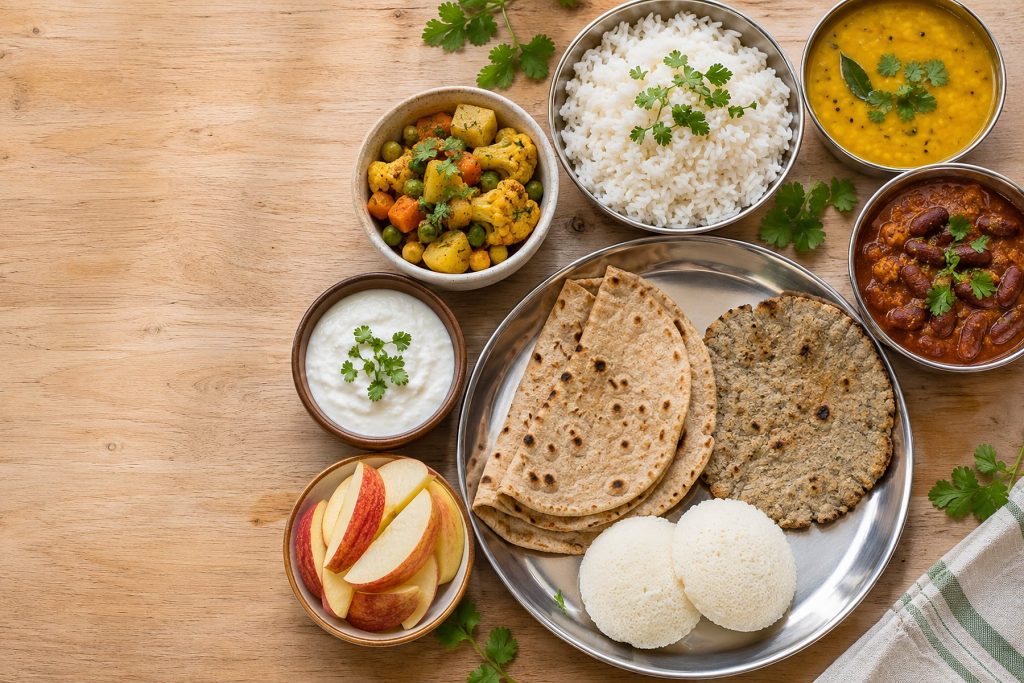
 Rice or roti? Idli or poha? Brown rice or white? If you’re managing diabetes or prediabetes, or simply trying to keep your energy steady through the day, you’ve probably heard that you should choose “low-GI” foods. But GI charts online often disagree, list Western foods you never eat, or give a single number for chapati as if every roti were the same.
This guide explains what the glycaemic index (GI) and glycaemic load (GL) actually mean, gives you a GI chart of common Indian foods based on published studies, and shows the simple changes, like how you cook, cool, combine and portion your food, that matter more than any single number.
At a glance
- What GI means: It measures how quickly a carbohydrate food raises blood sugar compared with pure glucose (GI 100). Low is 55 or less, medium is 56 to 69, and high is 70 or more.
- White rice is high GI: Studies put boiled white rice at about 67 to 79, with the International GI tables giving 73. Parboiled rice varieties tested in India were also high.
- Roti is usually medium, but it varies: Indian studies have found whole-wheat chapati anywhere from about 45 to 84, depending on the flour, how it’s made and how it’s tested.
- Pulses are low GI: Rajma, chana and lentils have a GI of about 24 to 32.
- Millets are lower than refined grains on average, with a mean GI of about 53 compared with about 72 for milled rice, though processing matters.
- The whole meal matters more than one number. Portion size, adding dal, vegetables, curd or protein, and how you cook food all change your blood sugar response.
- Glycaemic load (GL) accounts for portion size, which makes it more practical day to day.
What are glycaemic index and glycaemic load?
The glycaemic index (GI) ranks carbohydrate foods by how quickly and how much they raise blood sugar compared with pure glucose, which has a GI of 100. It’s measured in volunteers who eat a portion containing 50 g of available carbohydrate. According to Diabetes Canada, foods are grouped as:
| GI category | GI value | What it means |
| Low | 55 or less | Digested and absorbed slowly, giving a gentler rise in blood sugar |
| Medium | 56 to 69 | A moderate rise |
| High | 70 or more | Digested quickly, causing a faster, higher rise |
The glycaemic load (GL) takes GI one step further by considering how much carbohydrate is in the portion you actually eat (GL = GI × grams of carbohydrate in the portion ÷ 100). A GL of 10 or less is low, 11 to 19 is medium, and 20 or more is high. Watermelon, for example, has a high GI but a low GL in a normal serving, because it’s mostly water. As Dr V Mohan of the Madras Diabetes Research Foundation puts it, it’s more important to keep the glycaemic load in mind than the glycaemic index.
What GI can’t tell you
- Values vary between studies. The same food can get quite different GI values depending on the variety, how it’s processed and cooked, and the people tested. That’s why the chart below gives ranges where studies disagree.
- People respond differently. Your own blood sugar response depends on your body, your medicines and what else you’ve eaten.
- Low GI isn’t automatically healthy. Some low-GI foods are high in fat or sugar, while some higher-GI foods, like potatoes or watermelon, can still fit into a balanced diet in sensible portions.
- GI only applies to carbohydrate foods. Eggs, meat, fish, paneer, nuts and oils contain little or no carbohydrate, so they don’t have a meaningful GI. They aren’t “low GI”, but they can still help by slowing how quickly the carbohydrate in a meal is absorbed.
Glycaemic index chart of common Indian foods
The values below come from the International GI tables, a 2021 compendium of GI values for non-Western foods that includes many Indian studies, a 2021 review of millets, and a National Institute of Nutrition study of South Indian breakfast foods. Where studies disagree, we’ve given a range. Use the chart as a guide, not an exact measure.
Rice, roti and grains
| Food | GI (glucose = 100) | Category |
| White rice, boiled | 73 (South Asian studies: 67 to 79) | High |
| Parboiled rice (Sona Masuri, Ponni) | 70 to 77 | High |
| Brown rice | 58 to 68 | Medium |
| Basmati rice | About 55 in one Indian study; varies by variety | Low to medium |
| Chapati or roti, whole wheat | Usually 52 to 64 (range across studies: 45 to 84) | Medium |
| Millets (average across ragi, bajra, jowar and others) | About 53 | Low to medium |
| Ragi (finger millet) | About 61 | Medium |
| Bajra (pearl millet) | About 57 | Medium |
| Jowar (sorghum) | About 61 | Medium |
| Rolled oats porridge | 55 (instant oats: about 79, high) | Low |
| White bread | 75 | High |
| Wholemeal bread | 74 | High |
| Cornflakes | 81 | High |
Breakfast and tiffin foods
| Food | GI | Category |
| Rice dosa (plain) | 56 to 79 (NIN study: 79) | Medium to high |
| Idli | 62 to 67 | Medium |
| Upma (semolina) | 62 to 69 | Medium |
| Poha (rice flakes) | 74 | High |
| Pesarattu (green moong dosa) | 61 | Medium |
| Rice khichdi | 63 | Medium |
| Vada with sambar | 37 | Low |
Pulses, vegetables, fruit and dairy
| Food | GI | Category |
| Rajma (kidney beans) | 24 | Low |
| Chana (chickpeas) | 28 | Low |
| Lentils (dal) | 32 | Low |
| Potato, boiled | 78 | High |
| Sweet potato, boiled | 63 | Medium |
| Apple | 36 | Low |
| Orange | 43 | Low |
| Dates | 42 | Low, but sugar-dense, so keep to 2 or 3 |
| Banana | 51 | Low |
| Mango | 51 | Low |
| Watermelon | 76 | High (but low GL per serving) |
| Milk, full-fat | 39 | Low |
| Fruit yoghurt (usually sweetened; plain curd is the better everyday choice) | 41 | Low |
| Table sugar (sucrose) | 65 | Medium, but still limit added sugar |
| Glucose | 100 | Reference |
Notice the pattern: pulses, dairy and most whole fruits are low GI, while refined and flaked grains are high. Fermented and millet-based versions of idli, dosa and upma tested lower than rice or refined-wheat versions in several studies.
A low or medium GI doesn’t make a food a free choice. Table sugar, dates, mango and sweetened yoghurt still add sugar and calories, so keep portions small. The WHO advises keeping free sugars below 10% of daily energy, and ideally below 5%.
Rice or roti: which is better for blood sugar?
On average, whole-wheat roti has a lower GI than white rice, and the International GI tables list chapati at 52 to 62 against 73 for boiled white rice. But in practice, how much you eat and what you eat it with matter more than the choice itself:
- Portion size is key. Two medium rotis with dal and sabzi can have a smaller effect on blood sugar than a heaped plate of rice, but a small katori of rice with plenty of dal and vegetables can be better than four or five rotis.
- Whole grains beat refined ones. Brown rice, hand-pounded rice, millets and whole-wheat atta usually have a lower GI than polished white rice, maida and rice flakes.
- What’s on the rest of the plate counts. Dal, rajma, chana, curd, paneer, eggs, fish, vegetables and a little healthy fat all slow down how quickly the carbohydrate is absorbed.
What changes a food’s GI
- Processing: The more a grain is polished, ground or flaked, the faster it’s digested. A review of millet studies found millets had an average GI of about 53, compared with about 72 for milled rice and 74 for refined wheat, but polishing and heavy processing raised the GI.
- Cooking and cooling: Cooking starch makes it easier to digest. Cooking then cooling rice, potatoes or pasta increases resistant starch, which lowers the blood sugar effect. Leftover rice that’s been refrigerated and reheated may have a slightly gentler effect than freshly cooked rice. The difference is modest, and rice must be handled safely: cool it within an hour, keep it in the fridge, eat it within 24 hours and reheat it only once, until steaming hot all the way through.
- Ripeness: Riper bananas and mangoes have more sugar and a higher GI than firmer ones.
- Combining foods: Adding protein, fat, fibre or acid, like dal, curd, vegetables or a squeeze of lemon, lowers the overall glycaemic response of a meal.
- Eating order: Some experts suggest eating vegetables and protein before the carbohydrate part of a meal, which may help reduce the rise in blood sugar.
How to use GI in everyday Indian meals
- Fill half your plate with vegetables, a quarter with dal, chana, paneer, eggs, fish or chicken, and a quarter with rice, roti or millets.
- Swap some white rice for brown rice, hand-pounded rice, millets or a mix, and some maida-based foods for whole-wheat or millet versions.
- Make breakfast more balanced. Choose pesarattu, besan or moong chilla, vegetable-loaded upma or millet dosa, and add sambar, chutney with dal, curd or an egg. Poha and plain dosa are better with sprouts, peanuts or a side of curd.
- Eat whole fruit, not juice, and keep portions of very sweet fruits like mango and chikoo moderate.
- Watch portions of high-GI foods rather than cutting them out completely.
- Take a short walk after meals. A 10 to 15 minute walk after eating helps your muscles use glucose and can blunt the rise in blood sugar.
- Check your own response. If you have diabetes and use a glucose meter or a continuous glucose monitor, testing before and two hours after a meal can show how different foods affect you. Don’t change your medicines or insulin based on these readings without talking to your doctor.
- Low blood sugar is the exception. If you take insulin or tablets such as sulfonylureas (for example glimepiride or gliclazide) and your sugar drops low, you need fast-acting, high-GI carbohydrate, like glucose tablets, a small glass of fruit juice or a few teaspoons of sugar in water, not a low-GI snack. Recheck after 15 minutes and follow the plan your doctor has given you.
If you have diabetes, our World Diabetes Day guide to early action explains how to check your risk and when to get tested.
GI myths
Myth: Low-GI foods can be eaten in unlimited amounts. Fact: Portion size still matters. A large amount of a low-GI food can raise blood sugar more than a small amount of a high-GI food, which is why glycaemic load is more useful.
Myth: People with diabetes must never eat rice. Fact: Many people with diabetes can include a modest portion of rice, ideally with plenty of dal, vegetables and protein. Discuss what suits you with your doctor or dietitian.
Myth: Brown rice and roti don’t affect blood sugar. Fact: They usually raise blood sugar more slowly than white rice, but they’re still carbohydrate foods, and the amount you eat matters.
Myth: Sugar-free or “diabetic” snacks are always low GI. Fact: Many are made with refined flour or maida, which can have a high GI. Check the ingredients, not just the label.
Pro Tip
Don’t chase a perfect GI score. Build your plate first, with vegetables, protein and a modest portion of whole grains, then see how you feel and how your blood sugar responds. Small, consistent swaps, like mixing millets into your rice or adding a katori of dal to your poha, add up over time. The GOQii App lets you log meals and track your blood sugar readings in one place. A GOQii Personalised Health Coach can help you plan Indian meals that keep your blood sugar steadier, without giving up the foods you love.
Frequently asked questions
What is the glycaemic index of white rice?
Boiled white rice has a high glycaemic index, about 73 in the International GI tables, with South Asian studies finding values between about 67 and 79. Parboiled varieties such as Sona Masuri and Ponni were also high, at about 70 to 77.
What is the glycaemic index of roti or chapati?
Whole-wheat chapati usually falls in the medium range, about 52 to 64, though Indian studies have reported values from about 45 to 84 depending on the flour, preparation and testing method.
Is roti better than rice for diabetes?
On average, whole-wheat roti has a lower GI than white rice. But portion size and what you eat with it matter more. A modest portion of either, eaten with dal, vegetables and protein, is a better choice than a large portion of either on its own.
Which Indian foods have a low glycaemic index?
Pulses such as rajma, chana and lentils (GI about 24 to 32), milk and curd, and most whole fruits such as apples and oranges are low GI. Rolled oats, millets eaten whole and fermented or legume-based dishes also tend to be lower.
What is the difference between glycaemic index and glycaemic load?
Glycaemic index compares how quickly a fixed amount of carbohydrate raises blood sugar. Glycaemic load also takes into account how much carbohydrate is in the portion you eat, so it gives a more realistic picture of a food’s effect.
Do millets have a low glycaemic index?
On average, yes, they’re lower than refined grains. A 2021 review found millets had a mean GI of about 53, compared with about 72 for milled rice and 74 for refined wheat. Heavily polished or processed millets can have a higher GI.
Does cooling rice lower its glycaemic index?
Cooking and then cooling rice increases its resistant starch, which can lower its effect on blood sugar. The effect is modest. To keep it safe, cool cooked rice within an hour, refrigerate it, eat it within 24 hours and reheat it only once, until steaming hot.
#BeTheForce
Disclaimer: The information provided in this blog is for general awareness and educational purposes only. It is not intended to replace professional medical advice, diagnosis, or treatment. Always consult a qualified healthcare provider for personalised medical guidance or concerns related to your health.





I thought peanuts were low GI
Very wonderful story,