 Getting breathless on the stairs. A cough that never quite goes away, especially in winter. Feeling tired sooner than your friends on a walk. It’s easy to put these down to age, smog or being unfit. But for millions of people, they’re the early signs of chronic obstructive pulmonary disease, or COPD, and many go years without a diagnosis.
World COPD Day falls on Wednesday 18 November 2026. The Global Initiative for Chronic Obstructive Lung Disease (GOLD) has chosen the theme “Early Diagnosis and Management for a Better Life”, highlighting that COPD is common, preventable and treatable, but is often diagnosed late or misdiagnosed. It builds on last year’s call to action, “Short of breath, think COPD”.
The numbers are large. The WHO lists COPD as the third leading cause of death worldwide, with 3.4 million deaths in 2023, and nearly 90% of COPD deaths in people under 70 happen in low- and middle-income countries. In India, a 2025 national study that tested the lungs of more than 31,000 adults aged 45 and over found that about 1 in 7 (14.4%) had airflow obstruction of the kind seen in COPD. Many go undiagnosed: in a 2025 community study in Haryana, fewer than half of adults whose COPD was confirmed by a breathing test knew they had it. And many people with COPD in India have never smoked: cooking smoke, outdoor air pollution and past tuberculosis all play a part.
This guide explains what COPD is, why it’s so common in India, which symptoms mean you should get checked, the simple breathing test that diagnoses it, and how early treatment helps people live better.
At a glance
- COPD is a long-term lung condition that narrows the airways and damages the lungs, making it harder to breathe out. It can’t be cured, but it can be treated, and starting early helps.
- It’s not just a smoker’s disease. In India, smoke from cooking with wood, dung or coal, air pollution, workplace dust and past lung infections such as TB are major causes, especially in women.
- Get checked if you have breathlessness that’s gradually getting worse, a cough or phlegm for months, or frequent “chest infections” in winter, particularly if you’re over 40 and have smoked or been exposed to smoke or dust.
- Spirometry, a simple blowing test, confirms the diagnosis.
- Quitting smoking is the single most important step, at any age.
- Treatment works: the right inhalers used the right way, pulmonary rehabilitation, staying active, and flu and pneumonia vaccines.
- Get urgent help for severe breathlessness, blue lips, confusion, chest pain or breathlessness that doesn’t settle with your usual inhaler.
What is COPD, and why is it so common in India?
COPD is an umbrella term for long-term lung damage that blocks airflow out of the lungs. It includes chronic bronchitis, where the airways are inflamed and produce extra mucus, and emphysema, where the tiny air sacs are damaged. The damage builds up slowly over years, and it can’t be fully reversed, which is why catching it early matters.
The main causes
In high-income countries, smoking causes most COPD. In low- and middle-income countries like India, the WHO notes that tobacco accounts for only 30–40% of cases, and other exposures matter just as much:
- Tobacco smoke: cigarettes, bidis and hookah, and second-hand smoke. Vaping is not a safe alternative.
- Household air pollution: cooking or heating with wood, dung, crop waste, coal or kerosene. Pulmonologists see COPD in women who have cooked over firewood stoves for years, many of whom have never smoked.
- Outdoor air pollution: long-term exposure to traffic fumes, smog and dust in cities. Our guide to air pollution and your health explains how to reduce your exposure.
- Workplace dust and fumes: construction, mining, textiles, farming, factories and other jobs with regular exposure to dust, chemicals or smoke.
- Early-life factors: being born early or small, frequent chest infections or asthma in childhood, which can mean the lungs never reach their full capacity.
- Past lung infections: including tuberculosis, which can leave lasting lung damage.
- Genes: a rare inherited condition called alpha-1 antitrypsin deficiency. Doctors may test for it, especially if COPD appears before the age of 45.
GOLD’s message this year is that COPD can begin early in life and isn’t caused only by tobacco, so anyone with ongoing breathing symptoms deserves to be checked.
When breathlessness needs a check
COPD usually creeps up slowly. Many people unconsciously adjust, walking more slowly, taking the lift or avoiding stairs, and don’t realise how much their breathing has changed. The WHO lists the main symptoms as breathlessness, a chronic cough (sometimes with phlegm) and tiredness.
See a doctor if you have
- breathlessness that’s slowly getting worse, especially on exertion, such as climbing stairs, walking uphill or carrying shopping
- a cough that lasts for months, or keeps coming back, particularly in the mornings
- regular phlegm or mucus, often called a “smoker’s cough” but common in non-smokers too
- wheezing or a tight chest
- frequent chest infections, or a winter cold that always “goes to the chest” and takes weeks to clear
- getting tired more easily or doing less than you used to because of your breathing
This is especially important if you’re over 40, and you smoke or used to smoke, have cooked over a wood or coal fire, work around dust or fumes, live in a polluted city or have had TB. Pulmonologists suggest that people at high risk, including smokers, passive smokers and women exposed to cooking smoke, should be screened for COPD from age 45. International guidelines don’t recommend routine spirometry for people with no symptoms; testing is aimed at people with symptoms and risk factors, so tell your doctor about any breathlessness, cough or phlegm.
Breathlessness can have other causes too, including asthma, heart disease, anaemia, being overweight, thyroid problems and anxiety. That’s exactly why it deserves a proper check rather than a guess.
When to get urgent help
People with COPD can have flare-ups, when symptoms suddenly get worse, often triggered by a chest infection or polluted air. The American College of Emergency Physicians advises going to the emergency department, or calling 112 or 108 in India, if there is:
- trouble breathing or speaking
- chest pain or a racing heartbeat
- blue or grey lips or fingernails
- confusion, slurred speech or dizziness
- unusual sleepiness or difficulty waking
- fever, or prescribed treatment that isn’t helping and symptoms that are getting worse
Chest pain and sudden breathlessness can also be signs of a heart attack. Don’t wait to see if it settles.
Getting tested: the simple breathing test
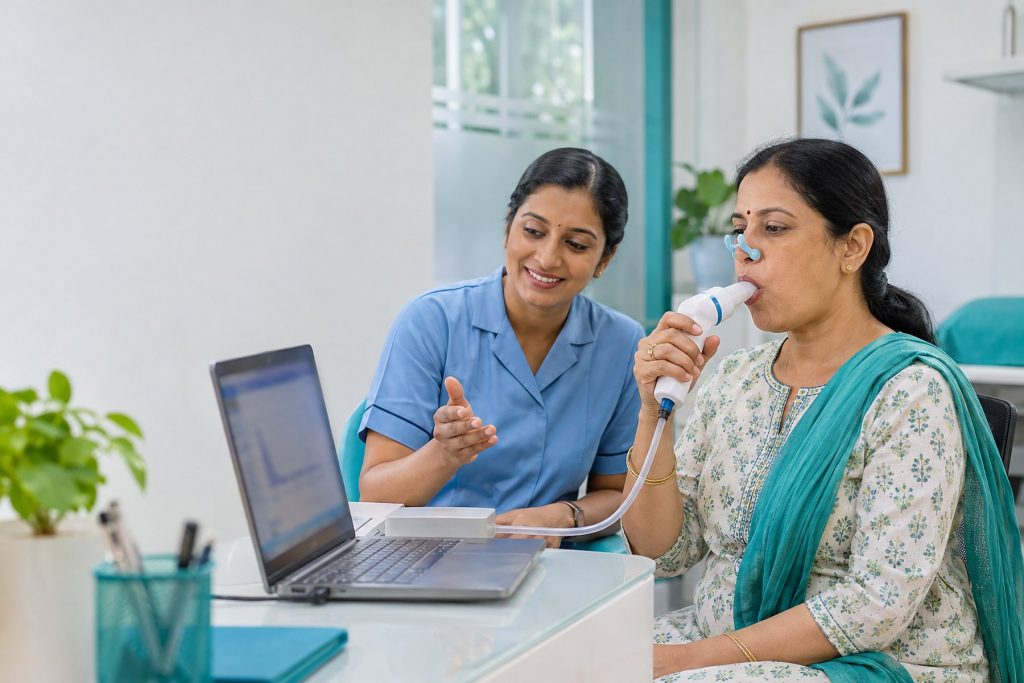
COPD is suspected from your symptoms and history, and the WHO notes that it’s confirmed with spirometry, a quick, painless breathing test. GOLD’s 2026 campaign calls for better access to spirometry precisely because so many people are diagnosed late or misdiagnosed without it.
What happens during spirometry
You take a deep breath in, seal your lips around a mouthpiece and blow out as hard and fast as you can until your lungs feel empty, usually two or three times. The machine measures:
- FEV1: how much air you can blow out in the first second
- FVC: the total amount of air you can blow out
If the proportion blown out in the first second (the FEV1/FVC ratio) is low, your airways are narrowed. You may then be given a reliever inhaler and asked to repeat the test after about 15–30 minutes. COPD is confirmed when the FEV1/FVC ratio stays below 0.7 even after the inhaler. If the narrowing clears completely, asthma is more likely, although some people with COPD also improve partly with an inhaler, so your doctor will look at the whole picture.
Before the test: your clinic will tell you which inhalers to skip beforehand. It also helps to avoid smoking, alcohol, a heavy meal and vigorous exercise for a few hours before.
Your doctor may also suggest a chest X-ray, blood tests or a pulse oximeter reading, and sometimes a CT scan, to rule out other causes and check for complications.
COPD, asthma or something else?
| COPD | Asthma | |
| Usual onset | Usually after 40 | Often in childhood or young adulthood, but can start at any age |
| Pattern | Slowly gets worse over years | Comes and goes; often worse at night, with exercise or triggers |
| Main causes | Smoking, cooking smoke, pollution, dust | Allergies, family history, triggers such as dust, pollen, cold air |
| On spirometry | Narrowing doesn’t fully reverse with an inhaler | Narrowing often improves a lot with an inhaler |
Some people have features of both. Getting the right diagnosis matters, because the treatments differ.
Living well with COPD: why early treatment matters
COPD can’t be cured, but GOLD stresses that earlier treatment can slow its progression, ease symptoms and prevent future flare-ups. The earlier you start, the more lung function you protect.
1. Stop smoking, and avoid smoke
Quitting smoking is the most important thing you can do at any stage, and the WHO lists it as the most important step for people with COPD. It’s never too late. Ask your doctor about nicotine replacement or other medicines that help. In India, the National Tobacco Quitline (1800-112-356) offers free support. Avoid second-hand smoke, and don’t switch to vaping.
2. Use the right inhalers, the right way
Inhalers are the mainstay of COPD treatment. Long-acting inhalers taken every day keep the airways open, and a short-acting reliever helps when you’re breathless. Some people, mainly those with frequent flare-ups, also need an inhaled steroid, which your doctor will decide based on your history and blood tests. Inhaler technique matters as much as the medicine: ask your doctor, pharmacist or educator to check yours, and consider a spacer if you find a puffer hard to use. Don’t stop your inhalers when you feel better.
3. Ask about pulmonary rehabilitation
Pulmonary rehabilitation is a supervised programme of exercise, breathing techniques and education, usually lasting at least a few weeks. A Cochrane review of 65 trials found it improved quality of life, walking distance, breathlessness and fatigue compared with usual care. Ask your pulmonologist whether a programme is available near you.
4. Stay active
Breathlessness makes many people avoid activity, but that weakens muscles and makes breathing harder over time. Regular walking, gentle strength exercises and breathing techniques such as pursed-lip breathing help. Start slowly and build up, ideally with advice from your doctor or physiotherapist.
5. Protect yourself from infections
Chest infections are a common trigger for flare-ups. The WHO recommends yearly flu, pneumonia and up-to-date COVID-19 vaccines for people with COPD. Our World Pneumonia Day guide explains the vaccines in more detail. Ask your doctor about RSV and whooping cough (Tdap) vaccines too, which international COPD guidelines also recommend for many adults with COPD. Wash your hands often and avoid close contact with people who have colds.
6. Cut your exposure to polluted air
- Switch to LPG or electric cooking if you can, and keep the kitchen well ventilated.
- Check the AQI, stay indoors on high-pollution days and wear a well-fitting N95 mask if you must go out.
- Avoid incense, mosquito coils and other indoor smoke.
- At work, use protective masks and ventilation where there’s dust or fumes.
7. Have a flare-up action plan
Work with your doctor on a written plan that says what to do if your symptoms get worse, which medicines to take, and when to seek urgent care. Look after your overall health too: eat well, keep a healthy weight, sleep well and get support for anxiety or low mood, which are common with long-term breathlessness.
8. Oxygen, if your doctor prescribes it
Some people with advanced COPD whose blood oxygen stays low need long-term oxygen therapy. Alongside stopping smoking, it’s one of the few treatments shown to help people with COPD live longer. It’s prescribed after blood oxygen tests. Don’t use oxygen at home without medical advice, and never smoke or use an open flame near it.
The bottom line
Breathlessness isn’t just part of getting older, and a cough that lasts for months isn’t something to live with. If you’re over 40 and you smoke or used to smoke, have cooked over a wood or coal fire, work around dust or live with polluted air, ask your doctor about a spirometry test. This year’s World COPD Day theme, “Early Diagnosis and Management for a Better Life”, sums it up: COPD is common, preventable and treatable, and the earlier it’s found, the more you can do to protect your lungs and keep doing the things you enjoy.
Pro Tip: Use the GOQii App to track your daily steps and activity, and notice if your walks are getting shorter or slower over time; that’s worth mentioning to your doctor. If you smoke, your GOQii Personalised Health Coach can support you to quit and build a gentle, regular activity routine that helps your breathing.
Frequently asked questions
What is the theme of World COPD Day 2026?
The theme for World COPD Day on 18 November 2026, set by the Global Initiative for Chronic Obstructive Lung Disease (GOLD), is “Early Diagnosis and Management for a Better Life”. It highlights that COPD is often diagnosed late and that earlier treatment can slow its progression.
What are the early signs of COPD?
The early signs are breathlessness that slowly gets worse, especially on exertion, a cough that lasts for months or keeps coming back, regular phlegm, wheezing and frequent chest infections. Many people put these down to age or being unfit.
Can non-smokers get COPD?
Yes. In India, smoke from cooking with wood, dung or coal, outdoor air pollution, workplace dust and past lung infections such as tuberculosis are major causes. Many women with COPD have never smoked.
How is COPD diagnosed?
COPD is diagnosed with spirometry, a simple breathing test in which you blow hard into a mouthpiece. It measures how much air you can breathe out and how quickly. Your doctor may also order a chest X-ray or other tests to rule out other causes.
What is the difference between COPD and asthma?
Asthma often starts earlier in life and symptoms come and go, while COPD usually develops after 40 and slowly gets worse. On spirometry, airway narrowing in asthma often improves a lot with an inhaler, but in COPD it doesn’t fully reverse.
Can COPD be cured?
COPD can’t be cured, but it can be treated. Stopping smoking, using the right inhalers correctly, pulmonary rehabilitation, staying active and getting flu and pneumonia vaccines can ease symptoms, slow progression and reduce flare-ups.
When should someone with COPD go to hospital?
Go to the emergency department or call 112 or 108 for trouble breathing or speaking, chest pain, a racing heart, blue or grey lips or fingernails, confusion, unusual sleepiness, or symptoms that keep getting worse despite treatment.
#BeTheForce
Disclaimer: The information provided in this blog is for general awareness and educational purposes only. It is not intended to replace professional medical advice, diagnosis, or treatment. Always consult a qualified healthcare provider for personalised medical guidance or concerns related to your health.




Leave a Reply