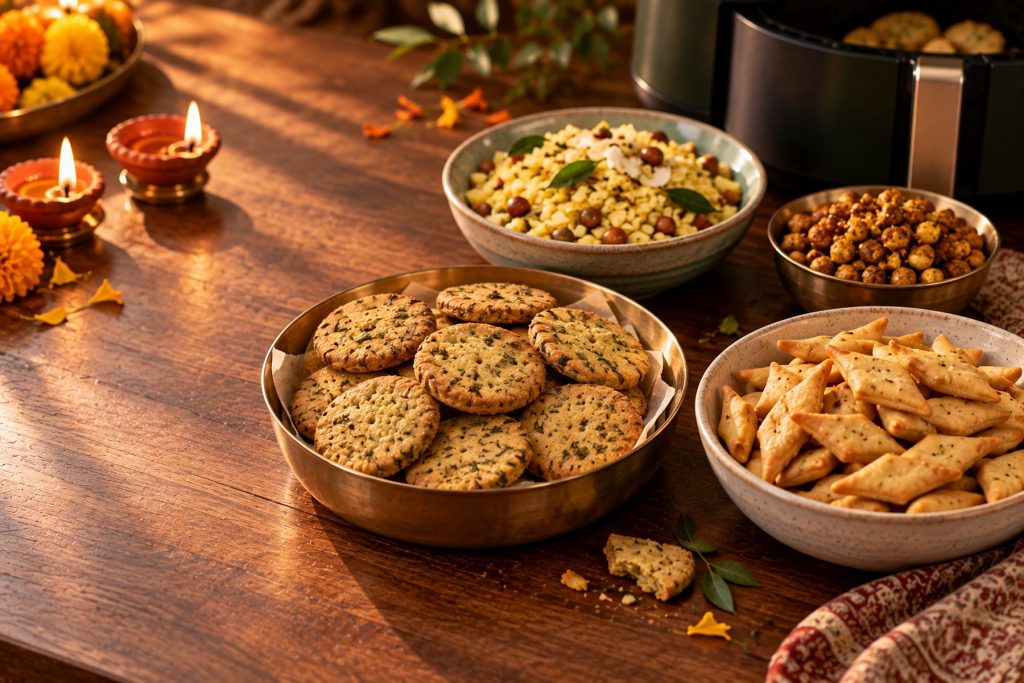
 In most Indian homes, Diwali smells of hot oil. Trays of chakli, mathri, sev and chivda come out of the kadhai a week before the festival, and the steel dabbas stay full until well after it. A handful here, a handful with every cup of chai, a box for every guest: it adds up quickly.
You don’t have to give up namkeen to eat better this Diwali. Baking, air-frying and dry-roasting can give you the crunch and the masala with a fraction of the oil, especially if you also go easy on salt and portions. Below are four simple recipes, plus what these methods do and don’t change.
At a glance
- Deep-fried namkeen is very energy-dense: a popular packaged aloo bhujia lists about 38 g of fat and 562 kcal per 100 g.
- Salt is the hidden problem: Indians eat about 11 g of salt a day, more than twice the WHO limit of 5 g, and namkeen is a common source.
- Baking and air-frying use far less oil: a teaspoon or two instead of a kadhai full.
- They aren’t magic: a baked snack is still a snack, and browning starchy foods too much can form acrylamide, so aim for golden, not dark brown.
- Avoid reusing frying oil: ICMR–NIN advises against frying again in used oil.
- Four recipes: baked methi mathri, air-fried whole wheat namak pare, roasted poha chivda and air-fried masala chana.
Why regular namkeen weighs heavy
There is nothing wrong with enjoying festive snacks. The issue is how they’re usually made and how much of them we eat over a fortnight of celebrations.
Deep-frying adds a lot of fat. Dough and batter soak up oil as they fry, which is why fried namkeen is so calorie-dense. Using the aloo bhujia label above as an example, a 50 g bowl (roughly two small katoris) provides about 280 kcal and 19 g of fat, before the chai and sweets alongside it.
Reused oil is a bigger worry. At home and at many sweet shops, the same kadhai of oil is often used batch after batch. Repeated heating breaks oil down and forms harmful compounds, including trans fats and free radicals. The ICMR–National Institute of Nutrition advises that oil used once for frying can be filtered and used for curries within a day or two, but shouldn’t be used for frying again.
Salt sneaks in. An ICMR–National Institute of Epidemiology analysis puts average intake in India at about 11 g of salt a day, and names namkeen, papad, pickles and chips among the hidden sources. The WHO recommends less than 5 g a day for adults. Too much salt raises blood pressure, the leading risk factor for stroke and heart disease.
Portions creep up. Namkeen is easy to eat without noticing: straight from the dabba, in front of the TV, at every house you visit. Over two weeks, those handfuls add up.
Baked, air-fried or fried: what really changes
What improves:
- Much less oil. An air fryer circulates very hot air around the food, so a recipe needs about a tablespoon of oil rather than the cups used for deep-frying, and studies of fries found the air-fried versions had substantially less fat. Baking works the same way. Dry-roasting in a kadhai, as for chivda, needs only a little oil for the tadka.
- No reused oil. Each batch starts with fresh oil, in teaspoons.
- More control. At home you choose the flour, the oil, the salt and the spices.
What doesn’t change:
- A baked mathri with a heaped teaspoon of salt is still salty. The recipes below use less salt than most, and lean on ajwain, methi, pepper, amchur and curry leaves for flavour.
- Baking maida-based snacks doesn’t add fibre. Swapping in whole wheat atta, besan, poha, makhana or chickpeas does.
- Lower-fat snacks are easy to eat in larger amounts. A small katori is still a sensible serving.
A note on browning. Starchy foods form acrylamide, a compound best kept low, when they’re cooked to a dark brown at high heat. A 2024 study found air-frying potatoes didn’t produce less acrylamide than deep- or oven-frying. Whatever the method, cook snacks to light golden, not dark brown, and throw away any burnt pieces.
4 healthier namkeen recipes for Diwali
Oven and air fryer temperatures vary, so check the first batch a few minutes early and adjust. All four keep well in an airtight container once fully cooled.
1. Baked methi mathri
Flaky, savoury and lightly bitter from the methi. Whole wheat atta and a little besan replace maida, and they’re baked instead of fried.
Makes: about 30 mathris | Prep: 15 minutes, plus 20 minutes resting | Bake: 15–20 minutes per tray
Ingredients
- 1 cup (120 g) whole wheat atta
- ¼ cup (30 g) besan
- 3 tbsp kasuri methi, crushed between your palms
- ½ tsp ajwain
- ½ tsp cumin seeds
- ¼ tsp turmeric
- ½ tsp red chilli powder
- ½ tsp salt
- 2 tbsp oil or ghee, plus ½ tsp for brushing
- About ⅓ cup (70–80 ml) water
Method
- Mix the atta, besan, methi, spices and salt. Add 2 tbsp oil or ghee and rub it in with your fingertips until the flour holds together when pressed.
- Add water a little at a time to make a stiff dough, firmer than roti dough. Cover and rest for 20 minutes.
- Preheat the oven to 180°C. Roll the dough to about 3 mm thick and cut 5 cm rounds. Re-roll the scraps.
- Prick each mathri several times with a fork so it doesn’t puff up. Place on a lined tray and brush very lightly with oil.
- Bake for 15–20 minutes, turning once halfway, until firm and light golden at the edges. They crisp up further as they cool on a rack.
Air fryer: 170°C for 8–10 minutes in a single layer, turning once.
2. Air-fried whole wheat namak pare
The classic diamond-shaped teatime crunch, made with atta and a little suji for bite.
Serves: 6 (a small katori each) | Prep: 15 minutes, plus 15 minutes resting | Cook: 10–12 minutes per batch
Ingredients
- 1 cup (120 g) whole wheat atta
- ¼ cup (40 g) fine suji (semolina)
- ½ tsp ajwain
- ¼ tsp crushed black pepper
- ½ tsp salt (scant)
- 1½ tbsp oil, plus 1 tsp for tossing
- About ⅓ cup (70–80 ml) water
Method
- Mix the atta, suji, ajwain, pepper and salt. Rub in 1½ tbsp oil, then add water gradually to make a stiff dough. Cover and rest for 15 minutes so the suji softens.
- Roll out to about 3 mm thick. Cut into 1.5 cm strips, then cut across at an angle to make small diamonds.
- Toss with 1 tsp oil so each piece has a light coating.
- Air-fry at 170°C for 10–12 minutes in a single layer, shaking the basket every 3–4 minutes, until golden and crisp. Cook in batches; crowding makes them chewy.
Oven: 180°C for 15–18 minutes on a lined tray, stirring halfway.
3. Roasted poha chivda
The Diwali staple, roasted instead of fried. Thin poha crisps up beautifully in a dry kadhai.
Makes: about 4 cups (8 servings of ½ cup) | Time: 20 minutes
Ingredients
- 2 cups (about 100 g) thin poha (patla or nylon poha)
- 2 tbsp (20 g) peanuts
- 2 tbsp (20 g) roasted chana dal (dalia)
- 1 tbsp oil
- ½ tsp mustard seeds
- 12–15 curry leaves
- 1–2 green chillies, slit
- ¼ tsp turmeric
- A pinch of hing
- ½ tsp salt
- ½ tsp amchur (optional)
Method
- Dry-roast the poha in a wide kadhai on low heat for 6–8 minutes, stirring constantly, until it’s crisp and crumbles when pressed. It shouldn’t brown. Tip it onto a plate.
- Heat the oil and roast the peanuts on low heat for 2–3 minutes. Add the dalia for a minute.
- Add the mustard seeds; when they splutter, add the curry leaves, chillies, turmeric and hing.
- Return the poha to the kadhai, sprinkle in the salt and amchur, and toss gently on low heat for 2 minutes to coat.
- Cool completely before storing, or it will turn soft.
Tip: for a crunchier mix with more protein, add roasted makhana and chana, as in the makhana chivda from our trending healthy recipes.
4. Air-fried masala chana
Crunchy chickpeas with real protein and fibre, and a good swap for fried dal moth.
Serves: 4 | Prep: overnight soaking, plus 20 minutes | Cook: 15–20 minutes
Ingredients
- 1 cup (about 200 g) dried kabuli chana, soaked for 8 hours
- 2 tsp oil
- ½ tsp red chilli powder
- ½ tsp roasted cumin powder
- ½ tsp amchur
- ¼ tsp black pepper
- ¼ tsp salt, or to taste
Method
- Pressure-cook the soaked chana for 2–3 whistles until just tender but holding their shape. Mushy chana won’t crisp.
- Drain and spread on a clean kitchen towel. Pat completely dry and leave for 15 minutes; any surface moisture stops them crisping.
- Toss with the oil and air-fry at 190°C for 15–20 minutes, shaking every 5 minutes, until they’re crunchy and rattle in the basket.
- Toss with the spices and salt while still warm.
Oven: 200°C for 30–40 minutes on a lined tray in a single layer, stirring every 10 minutes.
Tip: roasted chana lose their crunch within a day or two. Store them airtight and re-crisp for 3–4 minutes in the air fryer if needed. Pulses like chana are a great everyday food too; read more about why pulses are good for you.
Smart snacking through the festive season
- Serve, don’t graze. Put a small katori on a plate instead of eating from the dabba. About 30 g (a small handful) is a sensible serving of most namkeen.
- Pair it with protein or fibre. A bowl of roasted chana or a few mathris with a plate of cut fruit or cucumber is more filling than namkeen alone.
- Go lighter on salt everywhere else that day if you’ve had a few snacks: less pickle and papad at dinner, and no extra salt on the salad.
- Mind the chaat masala. It’s mostly salt (including black salt), so a sprinkle on top can double the salt in a snack.
- Keep portions for guests small, and offer fruit, dry fruit or a lighter homemade sweet, such as our dates roll with seeds, alongside the namkeen.
- Store well. Cool everything completely before closing the jar, and keep it airtight. Roasted chivda and baked mathri keep for 1–2 weeks; roasted chana are best within a few days.
Buying ready-made namkeen?
Turn the pack over and check the nutrition table, not just the front label. Compare products per 100 g: look for lower fat, lower sodium and fewer ingredients you don’t recognise. Words like “baked”, “roasted” or “multigrain” on the front don’t guarantee less salt, and many still use refined flour and palm oil. Check the serving size too; a small pack is often more than one serving.
The bottom line
Diwali namkeen doesn’t have to mean a kadhai of reused oil. Baking, air-frying and dry-roasting keep the crunch and the masala with a fraction of the fat, and making snacks at home puts you in charge of the flour and the salt. Just remember that a healthier snack is still a snack: serve it in a katori, enjoy it slowly, and save the extra handful for tomorrow. For more ideas you can make in minutes after the festivities, try these 5-minute healthy snacks for work and home.
Pro Tip: Log your festive snacks and meals in the GOQii App to keep an eye on portions and salt through the celebrations. Your GOQii Personalised Health Coach can help you plan a balanced Diwali week, so you can enjoy every get-together without the post-festival slump.
Frequently asked questions
Is baked namkeen healthier than fried namkeen?
Generally, yes. Baked namkeen uses far less oil, so it’s lower in fat and calories, and it avoids reused frying oil. But it can be just as salty, so check the salt and keep portions small.
Is air-fried food healthy?
Air-frying uses much less oil than deep-frying, which cuts fat and calories. It’s a healthier cooking method, but what you cook still matters: an air-fried snack made with refined flour and lots of salt isn’t automatically healthy.
Does air-frying cause acrylamide?
Acrylamide can form when starchy foods are cooked to a dark brown at high heat, whether they’re air-fried, baked or deep-fried. Cook snacks to light golden rather than dark brown and discard burnt pieces.
Which Diwali namkeen is the healthiest?
Snacks made from whole foods and cooked with little oil are the best choices, such as roasted chana, roasted makhana, dry-roasted poha chivda and baked whole wheat mathri. Watch the salt in all of them.
How much namkeen can I eat in a day?
There’s no fixed limit, but about 30 g, a small handful or katori, is a sensible serving. Remember that namkeen adds to your daily salt, which the WHO advises keeping below 5 g for adults.
Can people with diabetes or high blood pressure eat namkeen?
In small portions, homemade low-salt versions such as roasted chana or baked mathri can fit into most meal plans. Packaged and fried namkeen are often high in salt, fat and refined flour, so keep those occasional. Check with your doctor or dietitian about your own plan.
How long does homemade baked namkeen last?
Cooled completely and stored in an airtight container, baked mathri, namak pare and roasted poha chivda usually keep for one to two weeks. Air-fried chana are best eaten within a few days.
#BeTheForce
Disclaimer: The information provided in this blog is for general awareness and educational purposes only. It is not intended to replace professional medical advice, diagnosis, or treatment. Always consult a qualified healthcare provider for personalised medical guidance or concerns related to your health.




Leave a Reply