GOQii

Blog

  • HOME
  • HEALTHY LIVING
  • FITNESS
  • HEALTHY RECIPES
  • USER STORIES
  • KARMA
  • BUY GOQii

Search Results for: weight

April 30, 2026 By GOQii Leave a Comment

The GOQii India Fit Report 2026: Unmasking the Gender Health Divide

When we talk about the “Healthspan Gap” the years lost to preventable chronic illness we often look at the national average. However, peeling back the layers of the GOQii India Fit Report 2026 reveals a stark reality: the burden of unhealthy ageing does not fall equally.

In India, women live longer than men. On paper, that looks like success. In reality, it masks a troubling truth: women spend more of those extra years in poor health. This is the Gender Health Divide. It is a complex web of biology, societal expectations, nutritional gaps, and chronic stress that quietly erodes women’s health over decades.

Quick Takeaways: The Female Healthspan Penalty

  • The Longevity Paradox: Women generally outlive men but suffer from higher rates of multi-morbidity (having two or more chronic conditions) in their later years.
  • The Caregiver’s Toll: Unpaid caregiving heavily restricts women’s time for personal preventive health, driving up chronic stress and sleep disruption.
  • The Silent Deficiencies: Rates of thyroid disorders and dangerous visceral fat accumulation remain disproportionately high among Indian women.
  • The Menopause Blindspot: The midlife transition accelerates cardiovascular and metabolic risks, yet remains one of the least supported phases in women’s healthcare.

The Staggering Reality in Numbers

Before we look at the causes, we must look at the outcomes. The data exposes the toughest truth in India’s health landscape: women are now almost twice as unhealthy as men.
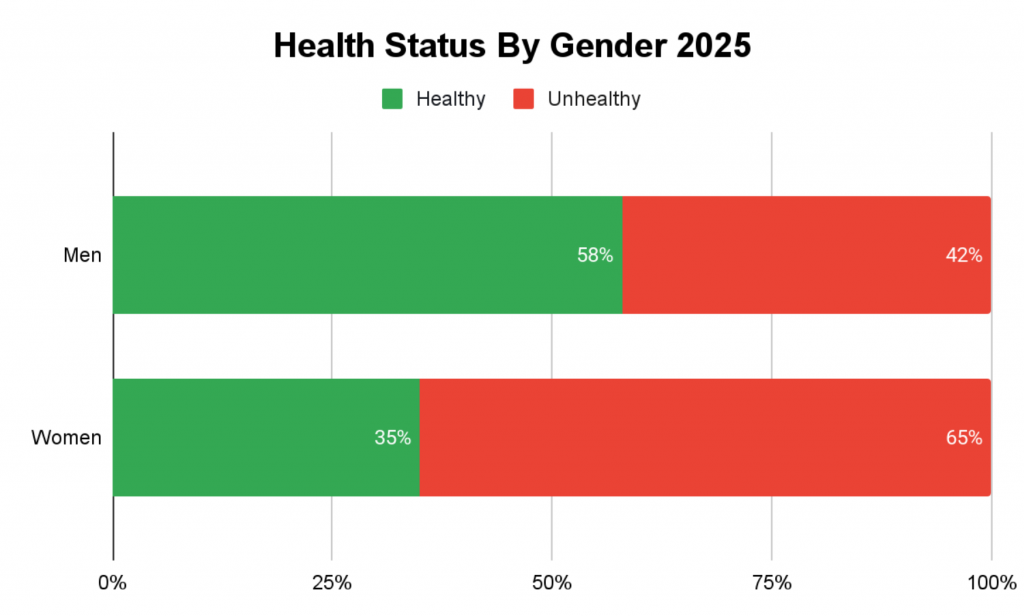
In 2025, only 35% of women fall into the healthy category, compared to 58% of men. Flip that around, and the picture is even starker: 65% of women are unhealthy, while men stay at 42%. This gap didn’t emerge overnight, and it has nothing to do with biology. Women are not getting sicker because their bodies are weaker; they are getting sicker because their lives are heavier.

The Caregiver’s Burnout: When “Caring for Others” Costs Your Health

One of the most defining factors of the gender health divide is the unequal distribution of caregiving. From early adulthood onward, women shoulder a disproportionate share of unpaid labour: caregiving for children, elders, and extended family, managing households, and balancing paid work alongside all of this.

This constant state of responsibility leaves little room for rest, recovery, or preventive care.
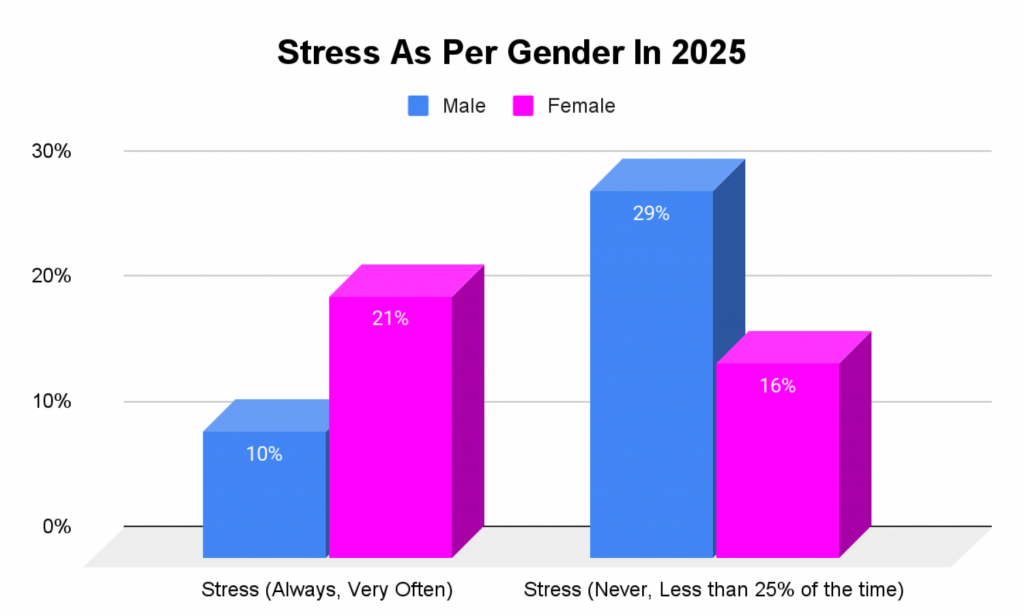
The numbers tell a stark story: 21% of women report feeling stressed “always or very often,” more than double the 10% of men who say the same.

  • Time Poverty: Women delay doctor visits because someone else needs attention first.
  • Chronic Stress: Persistent stress floods the body with cortisol, disrupting sleep and impairing metabolic health.
  • Sleep Disruption: Women are not just sleeping less; they are sleeping worse. Only 50% of women report sleeping well most of the time, compared to 61% of men.

The Nutritional, Diagnostic, and Metabolic Gap

When stress and exhaustion are normalised as part of “just managing life,” the body eventually keeps score. It shows up as thyroid imbalance, hypertension, insulin resistance, and burnout.
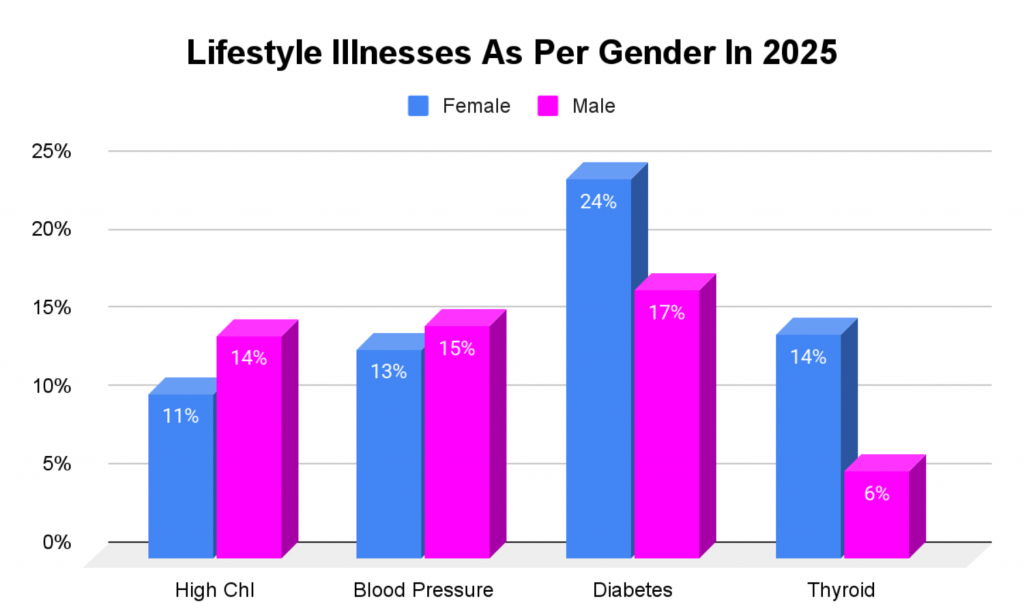
The GOQii data proves that lifestyle illnesses are gender-shaped:

  • Diabetes and Thyroid: 24% of women are affected by diabetes (versus 17% of men), and 14% struggle with thyroid disorders (versus 6% of men).
  • Dangerous Visceral Fat: Almost one in two women in India carries dangerous visceral fat. Staggeringly, 43.7% of women are in the “very high-risk” waist range, compared to just 12.7% of men. This is the kind of fat linked directly to diabetes, PCOS, heart disease, and early stroke.

Midlife and Menopause: The Critical Metabolic Window

Perhaps the most overlooked phase in women’s health is menopause. For decades, it has been treated purely as a reproductive transition. The data demands an immediate shift in this perspective.

Menopause is a long biological transition that reshapes metabolism, muscle mass, bone density, cardiovascular risk, and emotional health. Yet in India, very few women receive guidance on nutrition, strength training, sleep, or stress management during this phase. As a result, what could have been a powerful prevention window instead becomes a tipping point where weight gain accelerates, diabetes risk rises, and bone loss begins.

Closing the Divide: A Call for Self-Advocacy

Closing the gender health divide requires a fundamental shift in mindset and systems. It means recognising unpaid labour as a health risk factor, designing preventive care that accounts for hormonal transitions, and encouraging women to seek care early, without guilt.

The future of India’s health depends on the health of its women. It is time to put yourself back on your own priority list.

Click Here to Download the Full GOQii India Fit Report 2026 to explore the data on women’s health, understand the vital role of preventive screenings, and learn how to build a resilient healthspan.

Frequently Asked Questions (FAQs)

  1. What is the gender health divide?
    The gender health divide refers to the discrepancy in health outcomes between men and women. While Indian women typically have a longer lifespan than men , they often experience a shorter healthspan, spending their later years dealing with higher rates of obesity, chronic stress, thyroid disorders, and bone loss. Currently, 65% of Indian women are classified as unhealthy, compared to 42% of men.
  2. Why does menopause affect metabolic health?
    Menopause is not just a reproductive shift; it fundamentally alters a woman’s metabolism, muscle mass, bone density, and cardiovascular risk. If not managed actively with nutrition and exercise, it acts as a tipping point where weight gain accelerates and diabetes risk rises sharply.
  3. How does caregiving impact women’s healthspan?
    Unpaid caregiving creates immense time poverty and emotional strain. The constant state of responsibility leaves little room for rest, recovery, or preventive care, leading women to delay doctor visits and normalise exhaustion. This results in chronic stress, which is reported “always or very often” by 21% of women, compared to just 10% of men.

#BeTheForce

Disclaimer: The content provided in this blog, including all statistics, insights, and recommendations, is based on the findings of the GOQii India Fit Report 2026. This information is intended for educational and general informational purposes only and should not be construed as professional medical advice, diagnosis, or treatment. Every individual’s health journey is unique. Always consult with a qualified healthcare provider or a certified medical professional before making any significant changes to your diet, exercise routine, sleep schedule, or lifestyle, especially if you have pre-existing medical conditions. GOQii does not guarantee specific health outcomes or results based on the information shared in this report.

April 29, 2026 By GOQii Leave a Comment

International Dance Day: Why Dancing is the Ultimate Workout for Your Body and Mind

DancingLet’s be honest: sometimes, the sheer thought of lacing up your shoes, hitting the gym, or staring at a treadmill screen feels like a chore. When you are already exhausted from a long workday or stressed about your to-do list, finding the motivation to “workout” can be incredibly tough.


But what if your workout didn’t feel like a workout at all?

Every year on April 29th, the world celebrates International Dance Day. Created by the International Theatre Institute to revel in the universality of this art form, it is the perfect reminder that movement doesn’t have to be rigid, repetitive, or boring. Dancing is not just an expression of joy—it is a full-body, mind-healing powerhouse of a workout.

If you have been struggling to break free from a sedentary lifestyle, here is why dancing might just be the exact medicine you need.

  1. The Ultimate “Accidental” Cardio

When your favorite song comes on and you start moving to the beat, you aren’t counting reps or watching the clock. Yet, your heart rate is climbing, your lungs are working harder, and your blood is circulating faster.

Dancing is a fantastic cardiovascular workout. Depending on the intensity and style, whether it’s Bhangra, Zumba, Hip-Hop, or just jumping around your living room you can burn anywhere from 200 to 500 calories in an hour. It improves cardiovascular endurance, helping to combat the exact heart health risks associated with sitting at a desk all day.

  1. A Powerful Antidote to Stress and Anxiety

As we highlighted in the GOQii India Fit Report 2026, stress and low mood are reaching alarming levels across the country. Dancing offers an immediate, natural remedy.

When you dance, your brain releases a massive rush of endorphins (the “feel-good” hormones) while simultaneously lowering cortisol (the stress hormone). Furthermore, because dancing requires coordination and rhythm, it forces your brain to stay entirely in the present moment. It is nearly impossible to ruminate over an anxious thought or a stressful email when you are trying to catch the beat.

  1. It Builds Better Balance and Bones

Unlike walking or running, which are linear movements, dancing forces your body to move in all directions forward, backward, side-to-side, and rotational.

This multi-directional movement engages minor muscle groups that traditional workouts often miss. It sharpens your coordination, improves your posture, and actively strengthens your core. Because it is a weight-bearing activity, regular dancing also helps maintain bone density, which is crucial for preventing osteoporosis as we age.

How to Add More Dance to Your Day (No Skills Required!)

The best part about dancing? There is zero barrier to entry. You don’t need a gym membership, you don’t need expensive equipment, and you absolutely do not need to be a “good” dancer.

Here are three simple ways to celebrate International Dance Day and build more joyful movement into your routine:

  • The 10-Minute Morning Playlist: Create a playlist of 3 uplifting songs. Play them while you are making your morning tea or getting dressed, and just let yourself move. It completely changes the trajectory of your day.
  • The “Chores” Dance Party: Sweeping, folding laundry, or cooking? Put on your headphones and turn routine household chores into a mini cardio session.
  • Take a Class: If you thrive on community energy, sign up for a local Zumba, Bollywood aerobics, or salsa class. The shared energy of a group is infectious and keeps you accountable.

Our bodies were designed to move, and our minds were designed to experience joy. Dancing bridges the gap between the two.

This International Dance Day, don’t worry about burning calories, hitting a step count, or looking perfect. Just turn up the volume, let go of the stress of the day, and let your body do what it naturally wants to do.

Takeaway: Dancing is a zero-equipment, highly effective way to boost your cardiovascular health, melt away anxiety, and break the cycle of a sedentary lifestyle.

What is your absolute favorite song to dance to when nobody is watching? Tell us in the comments!

Frequently Asked Questions (FAQs)

  1. When is International Dance Day?
    International Dance Day is celebrated globally every year on April 29th. It was created by the Dance Committee of the International Theatre Institute (ITI) to celebrate the art of dance and its ability to cross all political, cultural, and ethnic barriers.
  2. Is dancing considered a good workout?
    Absolutely! Dancing is a highly effective cardiovascular workout. It elevates your heart rate, burns calories, improves lung capacity, and engages multiple muscle groups. Because it involves multi-directional movement, it also greatly improves your balance, agility, and core strength.
  3. Does dancing help with mental health?
    Dancing is a powerful mood booster. The physical exertion releases endorphins (happiness hormones) and reduces cortisol (stress hormones). Additionally, focusing on rhythm and movement helps distract the mind from anxious thoughts, acting as a form of moving meditation.

#BeTheForce #InternationalDanceDay

Disclaimer: The content provided in this blog is for educational and informational purposes only and should not be construed as professional medical advice, diagnosis, or treatment. Always consult with a qualified healthcare provider or a certified medical professional before starting any new cardiovascular exercise or fitness routine, especially if you have pre-existing joint issues, heart conditions, or other medical concerns.

April 28, 2026 By Aruna Bhatia 4 Comments

Summer Health Hazards You Need To Be Aware Of (And How to Prevent Them)

summer health hazardsIndian summers were always hot, but they are increasingly turning lethal. Studies indicate that average temperatures across many districts in India are projected to rise by two degrees Celsius over the next few decades.

With the heat index climbing, our population is exposed to a much higher risk of seasonal illnesses. Surviving the summer is no longer just about staying indoors; it is about actively managing your body’s response to extreme heat.

Here are the 3 most common summer health hazards you need to watch out for, along with practical ways to prevent and manage them.

  1. Dehydration: The Silent Energy Killer

Dehydration occurs when more water and fluids leave the body (through sweat and urine) than enter it. Because the human body is roughly 75% water, even a slight drop in hydration levels can disrupt your entire system.

  • Symptoms to Watch For: Increased thirst, profound fatigue, blurred vision, sudden headaches, dark-colored urine, and muscle cramps.

How can you prevent it?

  • The Hydration Formula: Always make sure you drink enough water. A good rule of thumb is to drink approximately 35ml per kilogram of your body weight daily during these scorching months.
  • Smart Replenishments: Plain water is great, but replacing lost electrolytes is even better. Opt for coconut water, aloe vera juice, amla juice, vegetable juice, buttermilk (chaas), or sugarcane juice.
  • Dilute Your Sugars: If you are drinking fruit juices or commercial electrolyte drinks, dilute them to half-strength with water to moderate your sugar and salt intake.
  • What to Avoid: Limit drinks containing alcohol or high amounts of caffeine (like strong coffee or energy drinks), as these act as diuretics and actually dehydrate the body further.

2. Heat Stroke: A True Medical Emergency

Heat stroke (or sunstroke) occurs from extreme, prolonged exposure to heat and sunlight. Your body loses its ability to regulate its core temperature, which can spike to dangerous levels in a matter of minutes.

  • Symptoms to Watch For: Dizziness, nausea, a throbbing headache, vomiting, flushed/dry skin (lack of sweating), rapid breathing, and fainting.

How can you prevent it?

  • Dress Smart: Choose lightweight, light-colored, loose-fitting, and breathable cotton clothing.
  • Time Your Outings: Stay indoors during peak sunlight hours (typically 12:00 PM to 4:00 PM). Schedule your outdoor activities or workouts for the early morning or late evening.
  • Pre-Hydrate: Take a good amount of fluids and hydrate well before stepping out into the sun, not just after.
  • Natural Coolants: If you feel mildly overheated, settling teas like chamomile, peppermint, or fennel seeds work wonders. Traditional Indian coolers like Aam Panna are exceptional for rapidly cooling the body and restoring lost electrolytes.

3. Food Poisoning: The Heat Breeds Bacteria

Summer heat drastically raises the risk of food-borne diseases. Food poisoning cases peak during these months because bacteria multiply much faster in warm, humid weather.

  • Symptoms to Watch For: Severe stomach cramps, nausea, vomiting, diarrhea, and a low-grade fever.

How can you prevent it?

  • Mind What You Eat Raw: Eat only freshly cut salads and fruits. Do not consume raw food that has been sitting out in the open for hours at a buffet or street vendor.
  • The 2-Hour Rule: Do not leave cooked food outside for long. Try to refrigerate all leftovers as soon as the steam stops rising from them (ideally within two hours of cooking).
  • Consume Quickly: Make sure you eat only well-cooked food and try to consume it as soon as possible once it’s prepared.

Ample rest, rigorous hydration, eating light, and moving your body safely are your best defenses against summer health hazards. Prevention remains the absolute key, as a lack of awareness is the primary reason these easily preventable hazards turn near-fatal.

Takeaway: Don’t wait until you are thirsty to drink water, avoid the midday sun, and refrigerate your food promptly. A little preparation guarantees a safe and healthy summer!

Want us to cover more seasonal hazards? Did we miss out on your favorite summer health tip? Let us know in the comments below!

Get more summer safety tips here or speak directly to a GOQii Coach by subscribing for Personalised Health Coaching here. 

Frequently Asked Questions (FAQs)

  1. How much water should I drink during the Indian summer?
    While 8 glasses a day is a common baseline, a more accurate formula during extreme heat is to drink approximately 35ml of water per kilogram of your body weight. For example, if you weigh 60 kg, you should aim for at least 2.1 liters of hydrating fluids, increasing this amount if you are sweating heavily outdoors.
  2. What is the difference between heat exhaustion and heat stroke?
    Heat exhaustion is the precursor to a heat stroke and involves heavy sweating, weakness, and a rapid pulse. If left untreated, it progresses to a heat stroke, where the body completely stops sweating, the skin becomes hot and dry, and the person may lose consciousness. Heat stroke is a severe medical emergency requiring immediate hospitalization.
  3. Why is food poisoning more common in the summer?
    Bacteria thrive in warm, moist environments. During the summer, the “danger zone” for food (the temperature range where bacteria multiply fastest) is easily reached if food is left un-refrigerated. Food left on a counter can spoil rapidly, making prompt refrigeration essential.

#BeTheForce 

Disclaimer: The content provided in this blog is for educational and informational purposes only and should not be construed as professional medical advice, diagnosis, or treatment. Heat stroke and severe dehydration are medical emergencies. If you or someone else experiences fainting, extreme confusion, or an inability to keep fluids down, seek emergency medical assistance immediately. Always consult with a qualified healthcare provider for personalized medical advice.

April 24, 2026 By Divya Thampi 1 Comment

3 Super Simple Ways to Overcome Anxiety Induced Procrastination

overcome anxiety induced procrastination

procrastination

/prə(ʊ)ˌkrastɪˈneɪʃ(ə)n/

(noun) the action of delaying or postponing something.

Amit wakes up with a feeling of dread. Even before his mind can tell him what is wrong, he can feel anxiety and guilt start to overpower him. Then it registers. He’s woken up late! Yet again!!

He was supposed to wake up at 6:00 AM, do his yoga, meditate, get a few chores done, and get started with work at 8:30 AM. Instead, here he was, staring at the hands of the clock insisting that it was 8:30 AM, and feeling miserable.

“I have ruined the day before it even started!!” he moans.

Trying to salvage the rest of his day, he quickly brushes his teeth, rushes through part of his morning routine, and sits down at his desk at 10:00 AM. As he starts wondering what tasks he needs to get done during the day, his mind comes up with one really important task.

As soon as he gets ready to work on the first task, his mind reminds him about the deadline for sending in suggestions for his team meeting. So he closes the file he had opened and goes on to open his email. And before he can get to the email with the attachment he is looking for, he is greeted by a deluge of new, unread emails waiting to be opened. His heart beats faster, his breath gets quicker, and despite the cool morning, his palms get clammy with perspiration.overcome anxiety induced procrastination

The Spiral of Self-Talk

As he tries to quickly skim through the unread emails, his mind keeps reminding him that he is already behind with the things he’s supposed to get done today. It simultaneously points out that had he woken up on time, he would have been done with at least two of these tasks.

Once again, he experiences a surge of hopelessness. Guilt and shame wash through him. He gives into the routine of berating himself, thinking of all the times he has done this before, and hears his mind say things like:

“Who are you trying to fool? You know very well that this is who you really are—this lazy, undisciplined, good-for-nothing failure who is never going to amount to much! Stop telling yourself that you will somehow turn a new leaf, become disciplined overnight, and transform into the epitome of efficiency. Just accept that this is never going to change.”

Inexplicably, Amit feels exhausted. He turns to his phone and thoughtlessly opens up Instagram. He scrolls down thinking that he will just check out a couple of posts. But the next time he looks at the clock, it is already 12:00 noon. Feeling totally dejected, he decides to have some snacks and polishes off a large packet of wafers in no time. He spends the rest of the day feeling lethargic and getting very little done.

The Real Root of the Problem

Does all this sound familiar? If it does, you are not alone. Even the most capable and intelligent people experience this every once in a while, and more people than you could imagine deal with this regularly.

But let’s take a closer look at what’s going on here. If you are thinking that the issue is Amit’s habit of waking up late, you are wrong. That is not the primary issue.

While good sleep habits are important and need to be managed, life will invariably throw you curveballs that will disrupt your plan one way or the other. In this case, waking up late led to Amit losing about an hour of personal preparation time and 90 minutes of work time, which totals 150 minutes. If he had gone on to use the rest of the day well, he would have lost only about 2.5 hours of productive time.

But the issue was that anxiety, guilt, and shame overpowered him and made it impossible for him to utilise the rest of his time. He lost over 5 hours instead of 2.5.

The biggest problem in most situations is not the interruption of plans, but our inability to manage our self-talk and the resultant anxiety. Here are 3 simple steps you can take to overcome anxiety-induced procrastination.

3 Simple Steps To Overcome Anxiety Induced Procrastination 

  1. Identify Three Top Tasks for the Next Day: Before you finish for the day, write down the things that you’d like to get done the next day. Now, circle the three most important things on the list.
  • Be Specific: Instead of writing “Get started on the report,” you could write “Have the first draft of the report ready.” * Rank and Estimate: Rank them in the order you’d like to get them done and write down an approximate amount of time you expect each task to take.

When you are ready to start in the morning, your mind is in action mode. If you give it the job of deciding what to do, it takes up precious energy and working memory space, leaving very little focus to actually get the job done. However, at the end of the day when your mind is still in work mode, it is far easier to plan. The next morning, you can channel all your enthusiasm straight into execution.

  1. Tackle the Anxiety Head-On: If things aren’t panning out the way you planned them to, take a few minutes to become aware of the self-talk trying to thrash you. Acknowledge the need behind the anxiety: the need to get things done.
  • Ground Yourself: Focus on your breath for a few minutes. Remind yourself that plans getting waylaid is a common occurrence. Ditch the “All or Nothing” thinking.
  • Schedule “Worry Time”: If you were to stay calm, you could still achieve a big part of what you set out to do. If you notice the anxiety reappearing, schedule 30 minutes of “worry time” towards the evening—a slot of time where you give free rein to your anxiety. Each time anxious thoughts return during the day, remind your mind that you will do the worrying during the allocated half-hour, not before or after.
  1. Time Your Tasks and Take Breaks: Look at your task list and start with Task No. 1, with a timer set to 30 minutes by your side.
  • Manage Distractions: If your mind comes up with distractive thoughts while you are at the task, note the thought down in a physical or digital notepad so you can look at it later.
  • Handle Interruptions: Getting a phone call? Send a text that you will call them back in half an hour. Reminded of an email response? Jot down a reminder and get back to the task.
  • The 30/5 Rule: When you have put in a solid half-hour of focus, take a 5-minute break. Do any quick calls or messaging from your notepad list, then get back to working for another 30 minutes with a timer. This will help your mind remain super focused.

You Are Not Lazy

Whether you are a working professional, a student, a consultant, a homemaker, or an entrepreneur, these steps are applicable to you. Procrastination is not caused by laziness; rather, it is the mind’s way of coping with increasing anxiety.

The steps above are healthier ways to overcome anxiety-induced procrastination, making it possible to take action and progress toward your goals.

We hope this article on 3 simple ways to overcome anxiety-induced procrastination helps you! Do let us know your thoughts in the comments below. For more articles like this, check out Healthy Reads.

Frequently Asked Questions (FAQs)

  1. Is procrastination a sign of laziness?
    No, procrastination is rarely about laziness. It is usually the mind’s way of coping with increasing anxiety, overwhelm, or negative self-talk. When a task feels daunting or when plans go wrong, the brain seeks immediate relief from the negative emotions by avoiding the task altogether.
  2. How can I stop procrastinating when I feel anxious?
    The best way to stop is to ground yourself and structure your time. Acknowledge your anxious thoughts, ditch “all or nothing” thinking, and break your work into 30-minute timed intervals with 5-minute breaks. Keep a notepad nearby to jot down any distracting thoughts so you can address them later.
  3. Why should I plan my tasks the night before?
    In the morning, your brain is ready for execution. If you force it to decide what to do, you drain precious mental energy and working memory. By picking your top three specific tasks the night before, you allow your morning brain to dive straight into action without decision fatigue.

#BeTheForce 

Disclaimer: The content provided in this blog is for educational and informational purposes only and should not be construed as professional medical or mental health advice, diagnosis, or treatment. Everyone’s mental health journey is unique. Always consult with a qualified mental health professional, therapist, or healthcare provider before making significant changes to your wellness routine or if you are struggling with severe anxiety, depression, or chronic procrastination.

  • « Previous Page
  • 1
  • …
  • 25
  • 26
  • 27
  • 28
  • 29
  • …
  • 277
  • Next Page »

Search

Recent Posts

  • 6 Health Benefits of Playing Sports
  • Foods to Manage Blood Sugar Naturally: A Complete Guide to Better Blood Sugar Control
  • The Lazy Person’s Guide to Staying Healthy: 5 Micro-Habits That Take Less Than 2 Minutes
  • Healthy Eating: Comforting Chilli Bean Soup Recipe for the Monsoon
  • The Truth About the ‘Beer Belly’: What Alcohol Really Does to Your Metabolism

Stay Updated

Archives

  • August 2026 (8)
  • July 2026 (25)
  • June 2026 (22)
  • May 2026 (20)
  • April 2026 (24)
  • March 2026 (18)
  • February 2026 (14)
  • January 2026 (14)
  • December 2025 (19)
  • November 2025 (15)
  • October 2025 (20)
  • September 2025 (6)
  • August 2025 (6)
  • July 2025 (9)
  • June 2025 (18)
  • May 2025 (16)
  • April 2025 (22)
  • March 2025 (26)
  • February 2025 (21)
  • January 2025 (25)
  • December 2024 (22)
  • November 2024 (22)
  • October 2024 (20)
  • September 2024 (22)
  • August 2024 (27)
  • July 2024 (15)
  • June 2024 (23)
  • May 2024 (26)
  • April 2024 (27)
  • March 2024 (27)
  • February 2024 (23)
  • January 2024 (21)
  • December 2023 (14)
  • November 2023 (10)
  • October 2023 (19)
  • September 2023 (21)
  • August 2023 (16)
  • July 2023 (16)
  • June 2023 (21)
  • May 2023 (20)
  • April 2023 (19)
  • March 2023 (23)
  • February 2023 (19)
  • January 2023 (15)
  • December 2022 (11)
  • November 2022 (15)
  • October 2022 (15)
  • September 2022 (12)
  • August 2022 (9)
  • July 2022 (17)
  • June 2022 (11)
  • May 2022 (10)
  • April 2022 (6)
  • March 2022 (6)
  • February 2022 (13)
  • January 2022 (11)
  • December 2021 (7)
  • November 2021 (3)
  • October 2021 (6)
  • September 2021 (3)
  • August 2021 (8)
  • July 2021 (7)
  • June 2021 (15)
  • May 2021 (16)
  • April 2021 (10)
  • March 2021 (7)
  • February 2021 (4)
  • January 2021 (4)
  • December 2020 (3)
  • November 2020 (4)
  • October 2020 (10)
  • September 2020 (3)
  • August 2020 (3)
  • July 2020 (2)
  • June 2020 (4)
  • May 2020 (10)
  • April 2020 (12)
  • March 2020 (10)
  • February 2020 (4)
  • January 2020 (4)
  • December 2019 (3)
  • November 2019 (7)
  • October 2019 (5)
  • September 2019 (4)
  • August 2019 (9)
  • July 2019 (9)
  • June 2019 (11)
  • May 2019 (4)
  • April 2019 (8)
  • March 2019 (8)
  • February 2019 (9)
  • January 2019 (8)
  • December 2018 (9)
  • November 2018 (3)
  • October 2018 (3)
  • September 2018 (5)
  • August 2018 (10)
  • July 2018 (6)
  • June 2018 (13)
  • May 2018 (8)
  • April 2018 (17)
  • March 2018 (9)
  • February 2018 (8)
  • January 2018 (15)
  • December 2017 (12)
  • November 2017 (19)
  • October 2017 (13)
  • September 2017 (15)
  • August 2017 (4)
  • July 2017 (8)
  • June 2017 (7)
  • May 2017 (6)
  • April 2017 (8)
  • March 2017 (6)
  • February 2017 (7)
  • January 2017 (9)
  • December 2016 (10)
  • November 2016 (7)
  • October 2016 (7)
  • September 2016 (7)
  • August 2016 (11)
  • July 2016 (9)
  • June 2016 (9)
  • May 2016 (12)
  • April 2016 (17)
  • March 2016 (17)
  • February 2016 (8)
  • January 2016 (6)
  • December 2015 (2)
  • November 2015 (9)
  • October 2015 (7)
  • September 2015 (9)
  • August 2015 (11)
  • July 2015 (9)
  • June 2015 (11)
  • May 2015 (9)
  • April 2015 (13)
  • March 2015 (8)
  • February 2015 (5)
  • January 2015 (12)
  • December 2014 (14)
  • November 2014 (11)
  • October 2014 (6)
  • September 2014 (13)
  • August 2014 (12)
  • July 2014 (6)
  • June 2014 (2)
  • May 2014 (7)
  • April 2014 (4)

From Burnout to Balance: How Dr. Ranjit Reclaimed His Health

Dr Ranjit Bhatt has spent years tending to others. A practising doctor in Odisha, his days were packed with patients, surgeries, and emergencies. From the outside, it looked like a life lived in service. But on the inside, something wasn’t right. “I had no … [Read More...]

From Shimla’s Slopes to Chandigarh’s Sidewalks: Surinder Kaur Bhalla’s Journey from Chaos to Control

Some journeys start with a plan. Others begin with a stumble literally. Surinder Bhalla, a government professional, born and raised in the scenic hill town of Shimla, had always lived a life of movement. “In Shimla, you walked everywhere,” she reflects. “Walking was never an exercise. It was just life.” But after shifting to Chandigarh, […]

“I’ve Challenged Myself to Live 100 Years” – The Story of Chandubhai Savani’s Second Chance at Life

At 67, most people start slowing down. Not Chandubhai Savani. A resident of Surat, Chandubhai, thought life was on track. “My life was going well till I had my bypass surgery,” he says. That surgery, back in 2021, was a wake-up call.  Medication was routine, but exercise wasn’t. His diet? What he calls ‘normal.’ “I […]

Ananda Mukherjee Health Story

From Terminal Illness To Complete Wellness! Ananda Mukherjee Health Story

As we observe World Cancer Day under the powerful theme ‘United by Unique’ (2025-2027)**, we are reminded that every individual’s journey with cancer is distinct, yet united by shared resilience, hope, and the collective fight against this disease. This theme places people at the centre of care and their stories at the heart of the […]

  • HOME
  • HEALTHY LIVING
  • FITNESS
  • HEALTHY RECIPES
  • USER STORIES
  • KARMA
  • BUY GOQii

Copyright ©2016 GOQii