GOQii

Blog

  • HOME
  • HEALTHY LIVING
  • FITNESS
  • HEALTHY RECIPES
  • USER STORIES
  • KARMA
  • BUY GOQii

Search Results for: disease

January 30, 2019 By Anusha Subramanian 1 Comment

Lifestyle diseases: An epidemic among young Indians

riseinlifestylediseases

You must have heard the term “Lifestyle Disease” before, but have you ever wondered what it is? As the name suggests, they’re diseases which are linked to your way of life. For example, if someone is leading a sedentary lifestyle, with minimal or no physical activity, that person is more susceptible to diseases like Diabetes, Cholesterol, High Blood Pressure etc. On the other hand, a physically active individual has lower chances of contracting these diseases. Unhealthy eating and lack of physical activity are the main reasons behind lifestyle diseases. Let’s take a look at the trend of Lifestyle Diseases in India as per the GOQii India Fit Report 2019.

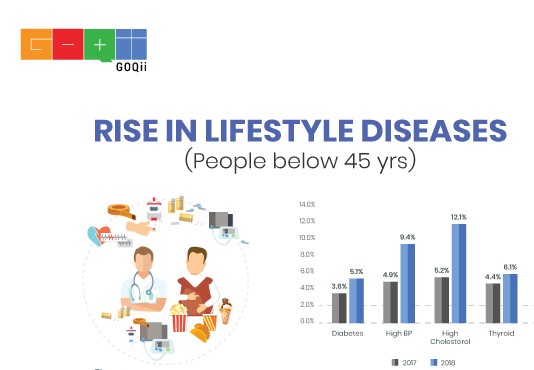
Image: “Since last year, there has been a rise in the number of lifestyle diseases among people overall.” – India Fit Report 2019

According to the report, there has been a rise in Lifestyle Diseases since last year among individuals who are below the age of 45. This is an alarming trend as it clearly shows the rise of an unhealthy lifestyle among the younger generation. Let’s take a look at the major lifestyle diseases affecting India, namely High Blood pressure, Diabetes, Cholesterol and Thyroid.

Cholesterol
Since last year, the percentage of cholesterol among Indians has increased from 10.1% to 14.1% as per the Report. It also says that 68.9% of the affected individuals take no medication to tackle the condition but aim to overcome cholesterol by making changes to their lifestyle. Since cholesterol is a condition that can be cured by lifestyle changes, it is something the rest should aim to achieve. Currently, Kolkata (18.2%), Delhi (17.3%) and Bengaluru (15.3%) are the major cities with the highest number of people suffering from Cholesterol.

High Blood Pressure (HBP)
High Blood Pressure is another serious condition which is often overlooked by Indians. 34% of the population has HBP running in their families. This data alone shows how serious this condition is in India. HBP has increased from 9% to 12% over the last year and about 44% of the affected individuals look to tackle the condition without the help of medication. Kolkata (21.9%), Mumbai (13.7%) and Delhi (13.6%) are the cities that have high concerns of HBP as per the Report.

Diabetes
We are all familiar with Diabetes as it is one of the most common lifestyle diseases out there. Chances are that at least one individual in your family is suffering from Diabetes. As surprising as it sounds, the rise of Diabetes in India has decreased from 7.9% to 7.1% since the last year. The increased awareness is one of the reasons behind this dip. Research indicates that 33.7% of the people affected by Diabetes are looking to tackle this condition without the help of medication. Like HBP, Diabetes is also a condition that usually runs in the family.

“31.8% of the users claim a family history of Diabetes. Thus, it is a key illness to watch out for in the future” – India Fit Report 2019

Thyroid
Thyroid issues, unlike other diseases, has remained the same at 6.8% of the total population. Mainly women face this issue and they also deal with fluctuating weight caused by it. About 9.6% of the population reported a history of thyroid issues in the family.

The only thing good about these conditions is that they can be tackled by living a healthier and active lifestyle. Exercise, quality sleep and proper nutrition are extremely necessary in order to overcome these diseases. It is no secret that as you get older, you tend to succumb to more diseases.

According to the GOQii India Fit Report 2019, 30% of 20-30-year-olds reported some kind of medical issue, 48% of 31-45-year-olds and 74.6% of the users above the age of 60 reported some issues medically. It is very important to follow a good lifestyle from a very young age so that you can avoid these diseases in the future. As the old adage says, “Prevention is better than cure!”
September 29, 2017 By Anusha Subramanian 2 Comments

The Heart Truth: ‘Let heart disease be a new beginning’

dr_blogimg

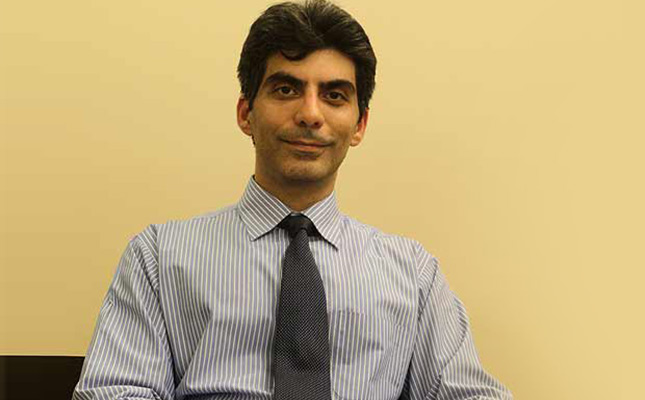
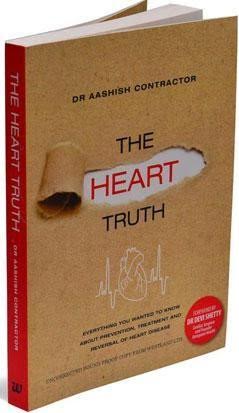
Widely recognized as a pioneer of Cardiac rehabilitation in India, Dr Aashish Contractor is a valuable information resource for the layperson to understand the various dimensions of coronary complications, their prevention and resolution. He just does not believe in leading a sedentary lifestyle. He is a marathoner and was the medical director at Standard Chartered Mumbai Marathon from 2004-14. In his book ‘The Heart Truth’, Dr Contractor has summed up his 18 years of medical experience to provide inputs and tips on how to take care of the heart. This is not a doctor prescribing from the pulpit but a heart expert sharing his knowledge as a friend would. The intention of the book is to spell things out with clarity. Anusha Subramanian met up with Dr Contractor to know all about ‘The Heart Truth’. Here are excerpts from the Interview.

  • What prompted you to write this book?

The Heart TruthHeart Disease is the leading cause of death among men and women worldwide and even in India. I have found that even among people who have suffered a heart disease, the lack of knowledge about the disease is astounding. With the amount of information we have today, I would expect people to be more aware but they aren’t. Funnily enough, there is lots of alternative information floating around and what’s app just amplifies it. Which is why I called the book- ‘The Heart Truth’ and decided let’s stick to facts and put it out. Secondly, I wanted to share a lot of real-life examples in order to show that after suffering a heart disease life does not end in fact in my opinion it begins. One starts a new chapter in life. My philosophy is one should get better than before and not just get back to where they were before. Through these real-life examples, many of whom have gone on to run marathons or climb mountains. One of them even had a turnaround just 200-300 meters from Mt Everest Summit only because of bad weather. Through the book, the idea was to showcase these real-life examples and inspire people to turn their lives and let heart disease be a new beginning.
  • What has led India to face this heart disease epidemic? We are already called the world Capital of Diabetes and we are not far from being called the World Capital of Heart Disease. Any particular reason why India’s are more prone to heart disease?

You are absolutely right, the trend of heart disease in India is rapidly on the increase. The statistics show that from 1990-2000 there has been a rapid upward curve for the disease and we are getting close to being called the world capital of heart disease and there are multifactorial reasons for this. According to me earlier many were dying of infectious diseases. I guess, the life expectancy during the early 50s and 60s was also less. Most were not living long enough to suffer from heart disease. As we are getting better and taking care of infectious diseases we are living longer. And with better diagnostic, we are understanding what the health issues are. Earlier, probably people were suffering heart diseases but one did not know or diagnosed and just died. Hence, we did not label it as dying of heart disease. There is a gross underestimation of the no. of heart disease deaths in the past. Now we are getting better in measuring this. Secondly, as we have got economically better off, our lifestyle has also changed. There is more processed food in our diet now than it was before, one is indulging in far less physical activity on a daily basis or there is no activity at all. Indian’s are genetically more prone to developing insulin resistance, metabolic syndrome, and higher triglycerides and more prone to developing belly fat and all of these conditions are a boiling pot which makes Indians more susceptible to heart disease.

  • When you say Indians are more susceptible to insulin resistance, higher triglycerides and other areas of diseases.. is it because of our diet?

One aspect could be a diet but, we should not isolate genes. Genetics or family risk for heart disease is a potent risk factor.  How much would they affect, it is difficult to say. Some people’s genes are so ‘bad’ they may get it no matter what but there is a difference. If they take all the care, they may get an attack at 60, that too, a mild one than getting a fatal attack at 45. So it is not that if your genes are bad, you are doomed, there are a lot of other things that you can do. We are genetically prone and Indians are affected a decade earlier than our western counterparts.

  • What according to you is the best way to detect Cardiac Ailment? As a layperson, if I do not want to go to a doctor but yet know if have a cardiac ailment?

There is no best way to detect. Once you become an adult you should keep a track of your BMI, height, weight, waist circumference on a regular basis. Once a year you should get a medical checkup done to know your basic lipid, cholesterol, BP and blood sugar levels. If the values are normal then it’s very good and you should get your tests done regularly once a year and if they are not then you must take the necessary action and make sure you go for follow-ups. If you feel any sort of discomfort, heaviness, breathlessness, chest pain, pain in the arms, in the right, in the left, back, jaw, exhaustion related kind of pain could be related to heart disease, exhaustion in your daily activity which you were doing easily at one point in time could be a symptom. These are warning signs and in most cases, these symptoms do occur before the full-blown attack it’s just that people ignore these symptoms.

  • Are Bypass and Angioplasty the only cure or are there alternative therapies?

Talking about heart disease or blockages, depending on where and what type of blockages these are. The kind of risk profile and symptoms the patient has, the medical management the patient has undergone, whether it is a bypass surgery or angioplasty? Bypass and Angioplasty are not the only cure. All the above questions have to be built on good lifestyle management. Whether you do A B or C you still need to maintain a good lifestyle. In addition to all of this, you may be fine just taking medicines or you might need a surgery or an angioplasty. Considering avoiding bypass and telling will manage through good lifestyle is not an alternative therapy. It’s a misnomer. True alternative therapies are external counterpulsation (ECP). ECP is meant for a specific subset of patients who have had stable angina after best medical management and stable angina still remains then ECP might work on them. This is generally done over 35 sittings, for an hour each. The goal of the therapy is to create collateral circulation by opening up small channels of blood. ECP is a good therapy for some patients with angina and for patients with heart failure. However, it’s not appropriate for every person with heart disease.

  • Can we reverse heart disease without surgery?

The term reversal of heart disease needs to be understood properly. We think that there is an artery with 90% block and you do something and it reduces to 60% but, it doesn’t work that way. The block doesn’t shrink to 60%, the only thing that is reduced is the chance of an event. So it is a physiological reversal but it is not an anatomical reversal. When you take care of all these factors, a reversal is possible. That is what we also do in our cardiac rehab program. He has ‘a method’, we have ‘a method’ but the principles are the same

  • There is a huge confusion on the fact that fit people are succumbing to a heart attack. Case in point is Dr Rakesh Sinha who was fit and a marathoner and he suddenly one day had a heart attack and died. And on the other hand, you have people who are completely unfit and doing all sorts of vices and yet survive longer a with no ailments

This is a concept of Risk Factors. Different factors go into your risk to develop heart disease. My classic example is driving a car; there are many factors that are in consideration when making a car accident-free. You cannot just say that my breaks were running fine and still I had an accident. That is exactly like saying I am fit and I still got a heart attack. It is good that one is fit but it is just one factor, being fit doesn’t give you immunity against other factors.

  • Two things that women need to know about Heart Disease.

One of the main thing that women need to know is that heart disease is one of the main cause of deaths among women, not breast cancer. Secondly, awareness is important as women often do not get diagnosed and this is a fact world over which is they get less care than men. The symptoms such as breathlessness in women are never considered to be a risk towards heart disease and hence not be considered for diagnosis. Sadly, women’s health is the most neglected.

  • Dr Contractor how do you keep yourself fit

I run, cycle and gym at least four to 5 days a week. It’s a mix and match of all the activities during the week.

  • How do you keep yourself away from getting stress?

Stress is part of normal life. I do believe that exercising regularly is a great stress buster for me. I would like to think that I take on a fairly positive attitude and this helps. It’s about how you deal with it. Some people really react to it negatively while some people deal with it calmly.

  • What are the three main things that people should keep in mind?

1st thing- you do not have to run a marathon or climb a mountain to be healthy. That you should do for achievements and not for health. First thing is to build a good baseline. Basic routine for few months then after that you can go for your huge goal of running a marathon or other extreme activities.

2nd Make a good plan and 3rd stick to that plan and gradually build on it. Believe me, there is nothing that you cannot do. Everybody can do everything.

  • Your Parting comments

Overall take care of yourself. Nobody needs to do anything dramatic. Consistency gets people results. As supposed to doing a dramatic program… push hard for 3-6 months and then after that, the motivation fades away. Remember, always stick to your plan. 42-43 weeks out of 52 weeks in a year helps.

Follow the ABCD principle-A- active, B- Blood pressure, C-Cholesterol and D-Good balanced diet, take care of Diabetes and do not smoke and get adequate sleep daily.

It’s not the end of the road. After suffering a heart ailment you can still come back and live a good life.

August 14, 2026 By Rashmi Deshpande Leave a Comment

Foods to Manage Blood Sugar Naturally: A Complete Guide to Better Blood Sugar Control

The Big Question – Can the foods you eat every day help improve your blood sugar levels naturally?
If you’ve been diagnosed with prediabetes or Type 2 diabetes—or you’re simply trying to prevent blood sugar spikes you’ve probably wondered whether changing your diet can really make a difference.

The answer is yes.

While food alone isn’t a cure for diabetes, the right dietary choices, combined with regular physical activity, quality sleep, stress management and medical guidance when needed, can significantly improve blood sugar control and support long-term metabolic health.

The good news? You don’t need a restrictive diet or expensive superfoods. Simple, everyday ingredients can help your body manage blood sugar more effectively.

Quick Answer – Which foods help manage blood sugar naturally?

Foods rich in dietary fibre, lean protein, healthy fats and complex carbohydrates help slow digestion and reduce rapid blood sugar spikes. Leafy green vegetables, whole grains, legumes, nuts, seeds, healthy fats and low-glycaemic fruits can all support better blood sugar management when eaten as part of a balanced lifestyle.

Why Blood Sugar Management Matters

Every time you eat, carbohydrates are broken down into glucose, which enters your bloodstream.

Insulin a hormone produced by the pancreas helps move this glucose into your cells where it is used for energy.

In people with insulin resistance or diabetes, this process becomes less efficient, causing glucose to remain in the bloodstream for longer.

Over time, consistently high blood sugar can increase the risk of:

  • Heart disease
  • Kidney disease
  • Vision problems
  • Nerve damage
  • Poor wound healing

Managing blood sugar isn’t just about avoiding sugar it’s about building meals that keep glucose levels steady throughout the day.

8 Foods That Help Manage Blood Sugar Naturally

  1. Leafy Green Vegetables

Spinach, fenugreek (methi), amaranth, kale and other leafy greens are packed with vitamins, minerals, antioxidants and fibre while being naturally low in digestible carbohydrates.

These vegetables also provide vitamin C and antioxidants such as lutein and zeaxanthin, which support eye health particularly important for people living with diabetes.

Easy ways to include them:

  • Vegetable sabzi
  • Soups
  • Salads
  • Stuffed rotis
  • Smoothies
  • Chutneys
  1. Whole Grains and Millets

Refined grains digest quickly and can cause larger blood sugar spikes.

Instead, choose fibre-rich whole grains such as:

  • Oats
  • Brown rice
  • Quinoa
  • Jowar
  • Bajra
  • Ragi
  • Barley

These release glucose more gradually, helping maintain steady energy levels.

  1. Legumes and Pulses

Beans, lentils, chickpeas and rajma are rich in plant protein and fibre.

They digest slowly, improve satiety and support better blood sugar control.

Aim to include legumes several times each week.

  1. Nuts

Nuts provide healthy fats, protein and fibre that slow digestion and help reduce post-meal glucose spikes.

Choose unsalted varieties such as:

  • Almonds
  • Walnuts
  • Pistachios
  • Pecans
  • Hazelnuts

A small handful makes an excellent snack.

  1. Seeds

Seeds are nutritional powerhouses rich in omega-3 fats, fibre and plant protein.

Include:

  • Flaxseeds
  • Chia seeds
  • Pumpkin seeds
  • Sunflower seeds
  • Sesame seeds

They can be sprinkled over oats, yoghurt, salads or smoothies.

  1. Lean Protein

Protein helps keep you fuller for longer while slowing carbohydrate absorption.

Good choices include:

  • Eggs
  • Fish
  • Chicken
  • Paneer
  • Greek yoghurt
  • Tofu
  • Lentils

Try including a protein source in every meal.

  1. Healthy Fats

Healthy fats improve satiety and help slow digestion.

Choose:

  • Avocados
  • Olive oil
  • Groundnuts
  • Walnuts
  • Seeds

Remember that healthy fats are still calorie-dense, so portion control matters.

  1. Low-Glycaemic Fruits

Fruit can absolutely be part of a diabetes-friendly diet.

Choose whole fruits such as:

  • Apples
  • Pears
  • Berries
  • Guava
  • Oranges

Avoid fruit juices, which remove fibre and cause faster blood sugar rises.

Foods to Limit

No food needs to be completely banned, but these are best enjoyed occasionally:

  • Sugary drinks
  • Packaged fruit juices
  • Sweets
  • Cakes and pastries
  • White bread
  • Refined flour products
  • Sugary breakfast cereals
  • Highly processed snacks
  • Deep-fried foods

Small, consistent changes often produce better long-term results than extreme restrictions.

Smart Eating Habits That Help

It’s not only what you eat but how you eat.

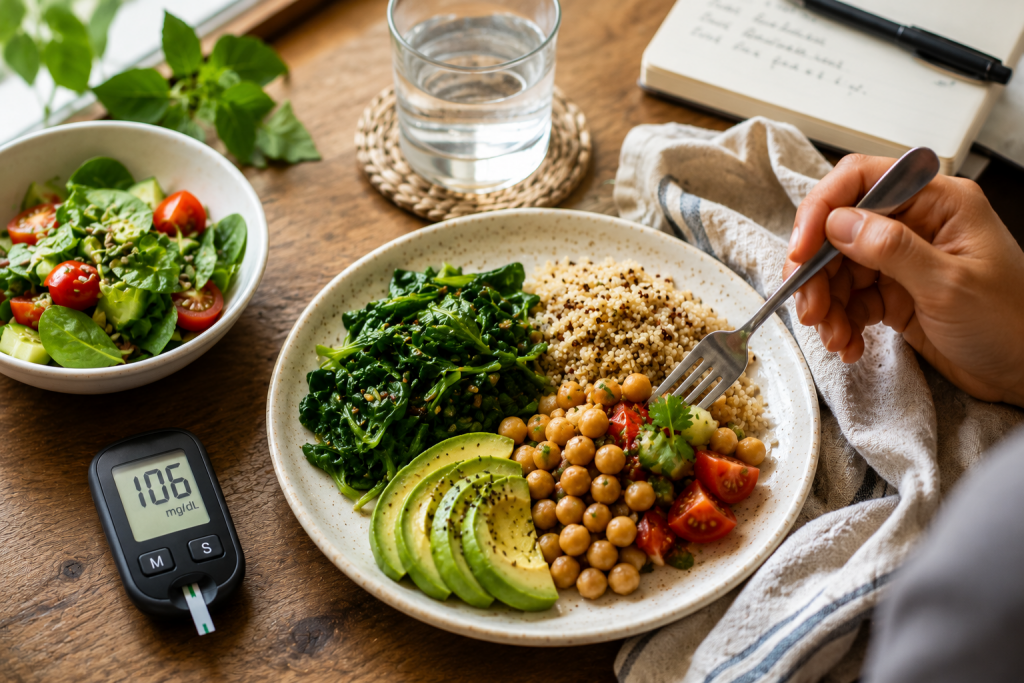
Build a Balanced Plate

Aim for:

  • Half your plate: Non-starchy vegetables
  • One-quarter: Lean protein
  • One-quarter: Whole grains or complex carbohydrates

Eat Slowly

Eating slowly gives your body time to recognise fullness, helping prevent overeating.

Don’t Skip Meals

Skipping meals can lead to larger blood sugar fluctuations later in the day.

Regular, balanced meals are generally more effective than long periods without food.

Watch Portion Sizes

Even healthy carbohydrates can raise blood sugar when consumed in excessive amounts.

Moderation remains important.

Lifestyle Habits That Support Blood Sugar Control

Nutrition is only one part of the equation.

Other habits matter just as much.

Stay Active

A 20–30 minute walk after meals helps muscles use glucose more efficiently.

Strength training also improves insulin sensitivity over time.

Sleep Well

Poor sleep affects hormones that regulate blood sugar and appetite.

Aim for 7–9 hours of quality sleep each night.

Manage Stress

Chronic stress raises cortisol, which can increase blood glucose levels.

Meditation, breathing exercises, yoga and regular physical activity can all help.

Stay Hydrated

Water supports healthy circulation and helps your body function optimally.

Choose water over sugary beverages whenever possible.

What If Your Blood Sugar Drops Too Low?

People taking insulin or certain diabetes medications may occasionally experience hypoglycaemia (low blood sugar).

Common symptoms include:

  • Sweating
  • Shaking
  • Hunger
  • Dizziness
  • Confusion

If this happens, follow your healthcare provider’s advice. A commonly recommended approach is the 15-15 rule:

  • Consume approximately 15 grams of fast-acting carbohydrate (such as glucose tablets, fruit juice or regular soft drink).
  • Recheck your blood sugar after 15 minutes.
  • Repeat if necessary.

Always discuss recurring episodes of low blood sugar with your doctor.

Managing blood sugar isn’t about following a perfect diet—it’s about building sustainable habits that support your metabolism every day.

Focus on fibre-rich vegetables, whole grains, lean proteins, healthy fats and regular physical activity.

Small changes, practised consistently, can make a meaningful difference to your long-term health.

Pro Tip – Understanding how your meals affect your blood sugar is the first step towards better metabolic health. Use the GOQii App to track your meals, activity, hydration and sleep. A GOQii Personalised Health Coach can help you build a nutrition plan tailored to your health goals, lifestyle and medical needs.

Frequently Asked Questions (FAQs)

  1. Which foods help lower blood sugar naturally?

Leafy vegetables, legumes, whole grains, nuts, seeds, lean proteins and healthy fats can support better blood sugar management as part of a balanced diet.

  1. Can people with diabetes eat fruit?

Yes. Whole fruits such as apples, berries, guava and oranges provide fibre, vitamins and antioxidants. Portion control is important, and fruit juices should generally be limited.

  1. Are carbohydrates bad for diabetes?

No. The type and quantity of carbohydrates matter more than eliminating them completely. Choosing fibre-rich whole grains over refined carbohydrates helps support steadier blood sugar levels.

  1. Is walking after meals beneficial?

Yes. Even a short walk after eating can help your muscles use glucose more efficiently and reduce post-meal blood sugar spikes.

  1. Can lifestyle changes help prevent Type 2 diabetes?

For many people with prediabetes, healthy eating, regular physical activity, weight management and quality sleep can significantly reduce the risk of developing Type 2 diabetes.

#BeTheForce 

Disclaimer: This article is intended for educational purposes only and should not replace professional medical advice. Dietary needs vary from person to person. If you have diabetes, prediabetes or any other medical condition, consult your physician or a qualified healthcare professional before making significant dietary or lifestyle changes. Continue taking prescribed medications unless advised otherwise by your healthcare provider.

August 7, 2026 By GOQii Leave a Comment

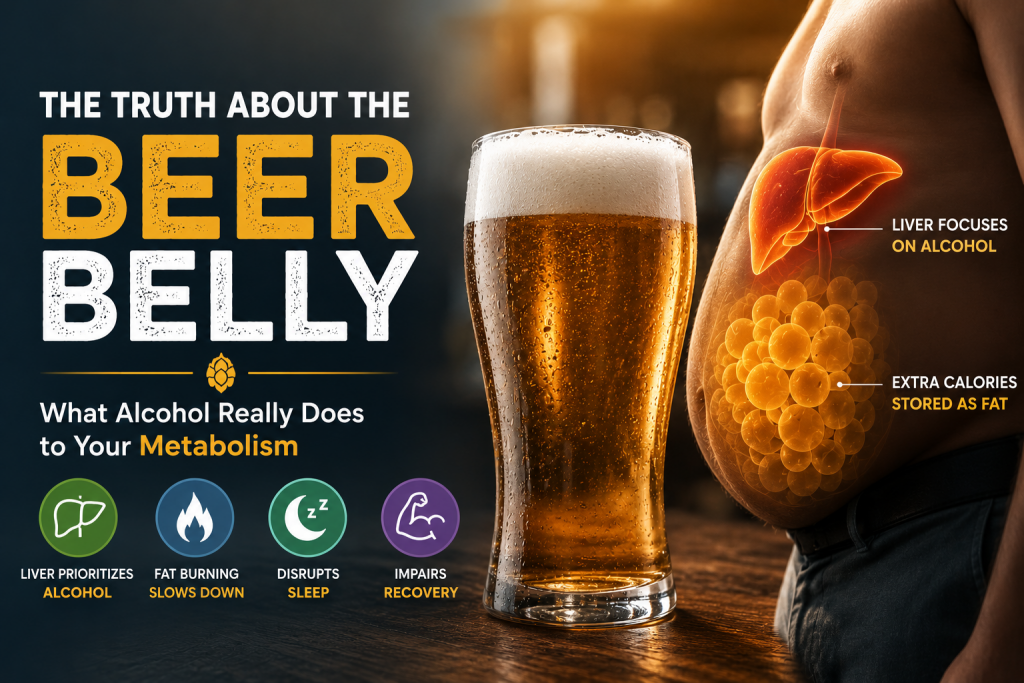
The Truth About the ‘Beer Belly’: What Alcohol Really Does to Your Metabolism

The Big Question – Can understanding how alcohol affects your metabolism help you make healthier choices?



International Beer Day provides an opportunity to look beyond the social aspect of drinking and better understand what alcohol actually does inside the body. Whether you enjoy an occasional drink or choose not to drink at all, knowing how alcohol influences your metabolism, recovery and overall health can help you make informed lifestyle decisions.

At GOQii, we believe preventive healthcare starts with awareness. Sustainable health isn’t built on extreme restrictions it’s built on understanding your body, making informed choices and staying consistent with healthy habits.

Let’s separate myth from fact and uncover the science behind alcohol, metabolism and the so-called “beer belly.”

Quick Answer – Does drinking beer really cause a beer belly?

A “beer belly” isn’t caused by beer alone. Weight gain occurs when calorie intake consistently exceeds calorie expenditure. Alcohol contributes because it is calorie-dense, temporarily reduces fat oxidation while your body prioritises metabolising alcohol, and often leads to overeating. Over time, these factors can contribute to increased abdominal fat, particularly when combined with poor diet, inactivity and inadequate sleep.

Why Alcohol Changes Your Metabolism

Your body normally uses carbohydrates, fats and proteins as sources of energy.

Alcohol changes that priority.

Unlike carbohydrates or fat, alcohol cannot be stored for later use. Because it is recognised as a substance that needs to be broken down and eliminated, your liver immediately prioritises metabolising alcohol.

During this period, fat oxidation is significantly reduced, meaning your body becomes temporarily less efficient at using fat as fuel.

If you’ve also consumed calorie-rich foods especially fried or processed snacks commonly eaten while drinking those excess calories are more likely to contribute to weight gain over time.

The Hidden Calories in Alcohol

Alcohol contains 7 calories per gram, making it almost as calorie-dense as fat.

Unlike nutrient-rich foods, alcoholic beverages contribute calories with very little nutritional value.

Approximate Calories Per Drink

Beverage Approximate Calories   
Light Beer (330 ml) 100–120
Regular Beer (330 ml) 150–220
Glass of Wine (150 ml) 120–130
Whisky (30 ml) ~70
Sugary Cocktail 250–500+

Three regular beers can easily provide the calories of a full meal without supplying the nutrients your body needs.

Why Drinking Often Leads to Overeating

Alcohol affects more than just calorie intake.

It can also reduce inhibitions and temporarily interfere with your body’s normal appetite regulation, making it easier to overeat.

This is one reason why drinking is often followed by cravings for:

  • Pizza
  • Burgers
  • Fried foods
  • Sugary desserts
  • Late-night takeaways

The combination of alcohol and calorie-dense foods often contributes more to weight gain than alcohol alone.

Alcohol, Exercise and Recovery

Regular exercise supports muscle growth and metabolic health – but alcohol can interfere with recovery.

Muscle Repair

Alcohol may reduce muscle protein synthesis, the process responsible for repairing and rebuilding muscle tissue after exercise.

Glycogen Replenishment

It can also slow the replenishment of muscle glycogen, which is essential for restoring energy after training.

Hydration

Because alcohol has a diuretic effect, it increases fluid loss and can contribute to dehydration, especially if adequate water intake is neglected.

Alcohol and Sleep

Although alcohol may make you feel sleepy initially, it often reduces overall sleep quality.

Research shows alcohol can:

  • Reduce REM sleep
  • Fragment sleep during the second half of the night
  • Affect recovery
  • Reduce concentration the next day
  • Increase fatigue

Quality sleep is one of the foundations of good metabolic health, and regular alcohol consumption can compromise that recovery process.

Can You Drink Alcohol and Still Lose Weight?

Weight loss depends on maintaining a sustainable calorie deficit while supporting your body with healthy lifestyle habits.

Occasional alcohol consumption doesn’t automatically prevent weight loss, but frequent or excessive drinking can make it more difficult by increasing calorie intake, disrupting sleep, affecting recovery and encouraging overeating.

Consistency in your daily habits matters far more than occasional indulgences.

If Alcohol Is Part of Your Lifestyle

From a health perspective, limiting alcohol consumption is the safest choice.

However, if you choose to drink occasionally, these strategies may help reduce some of the short-term health impacts.

Stay Hydrated

Drink a glass of water alongside every alcoholic beverage.

Eat Before Drinking

A balanced meal containing protein, fibre and healthy fats may help slow alcohol absorption and reduce overeating later.

Choose Lower-Calorie Options

If drinking, choose beverages with less added sugar and be mindful of portion sizes.

Plan Ahead

Avoid making food decisions late at night when judgement may be impaired.

Beyond the Beer Belly

Weight gain is only one aspect of alcohol’s impact on health.

Regular excessive alcohol consumption has been linked to an increased risk of:

  • Liver disease
  • High blood pressure
  • Cardiovascular disease
  • Certain cancers
  • Mental health disorders
  • Poor sleep quality

Understanding these risks allows you to make more informed decisions about your long-term wellbeing.

The Bottom Line

Good health isn’t determined by one meal, one workout or one social occasion.

It’s built through consistent choices over time.

Whether you drink alcohol or not, understanding its effects on metabolism, recovery and overall health empowers you to make decisions that support your long-term wellness goals.

At GOQii, our focus isn’t on restriction it’s on helping you make informed lifestyle choices that improve your health, one habit at a time.

Pro Tip: Your overall lifestyle matters far more than a single social occasion. Track your hydration, sleep, activity levels and nutrition using the GOQii App. A GOQii Personalised Health Coach can help you build sustainable habits that support your health goals while fitting into your everyday life.

Frequently Asked Questions (FAQs)

  1. Is light beer healthier than regular beer?

Light beer generally contains fewer calories and a lower alcohol content than regular beer. However, moderation remains important, as alcohol still affects metabolism and recovery.

  1. Does alcohol stop fat burning?

Alcohol temporarily reduces fat oxidation because your liver prioritises metabolising alcohol first. Once the alcohol has been processed, normal metabolism gradually resumes.

  1. Can I exercise after drinking alcohol?

Avoid high-intensity exercise if you’re dehydrated or recovering from alcohol consumption. Focus on hydration and allow your body adequate time to recover before returning to strenuous workouts.

  1. Is non-alcoholic beer a healthier alternative?

Non-alcoholic beer generally contains significantly less alcohol and often fewer calories than regular beer, although nutritional content varies between products.

  1. Is there a completely safe amount of alcohol?

Current evidence suggests that no level of alcohol consumption is entirely risk-free. If you choose to drink, doing so infrequently and in moderation is associated with lower health risks than regular or excessive drinking.

#BeTheForce

Disclaimer: This article is intended for educational and informational purposes only. GOQii does not promote or encourage alcohol consumption. If you choose to drink alcohol, do so responsibly, in moderation and only if you are of legal drinking age in your country. Never drink and drive. Excessive alcohol consumption is associated with serious health conditions, including liver disease, cardiovascular disease, certain cancers and mental health disorders. If you have concerns about your alcohol consumption, seek guidance from a qualified healthcare professional.

  • « Previous Page
  • 1
  • 2
  • 3
  • 4
  • 5
  • 6
  • …
  • 139
  • Next Page »

Search

Recent Posts

  • Foods to Manage Blood Sugar Naturally: A Complete Guide to Better Blood Sugar Control
  • The Lazy Person’s Guide to Staying Healthy: 5 Micro-Habits That Take Less Than 2 Minutes
  • Healthy Eating: Comforting Chilli Bean Soup Recipe for the Monsoon
  • The Truth About the ‘Beer Belly’: What Alcohol Really Does to Your Metabolism
  • Benefits of Meditation: How One Daily Habit Can Transform Your Mental Wellbeing

Stay Updated

Archives

  • August 2026 (7)
  • July 2026 (25)
  • June 2026 (22)
  • May 2026 (20)
  • April 2026 (24)
  • March 2026 (18)
  • February 2026 (14)
  • January 2026 (14)
  • December 2025 (19)
  • November 2025 (15)
  • October 2025 (20)
  • September 2025 (6)
  • August 2025 (6)
  • July 2025 (9)
  • June 2025 (18)
  • May 2025 (16)
  • April 2025 (22)
  • March 2025 (26)
  • February 2025 (21)
  • January 2025 (25)
  • December 2024 (22)
  • November 2024 (22)
  • October 2024 (20)
  • September 2024 (22)
  • August 2024 (28)
  • July 2024 (15)
  • June 2024 (23)
  • May 2024 (26)
  • April 2024 (27)
  • March 2024 (27)
  • February 2024 (23)
  • January 2024 (21)
  • December 2023 (14)
  • November 2023 (10)
  • October 2023 (19)
  • September 2023 (21)
  • August 2023 (16)
  • July 2023 (16)
  • June 2023 (21)
  • May 2023 (20)
  • April 2023 (19)
  • March 2023 (23)
  • February 2023 (19)
  • January 2023 (15)
  • December 2022 (11)
  • November 2022 (15)
  • October 2022 (15)
  • September 2022 (12)
  • August 2022 (9)
  • July 2022 (17)
  • June 2022 (11)
  • May 2022 (10)
  • April 2022 (6)
  • March 2022 (6)
  • February 2022 (13)
  • January 2022 (11)
  • December 2021 (7)
  • November 2021 (3)
  • October 2021 (6)
  • September 2021 (3)
  • August 2021 (8)
  • July 2021 (7)
  • June 2021 (15)
  • May 2021 (16)
  • April 2021 (10)
  • March 2021 (7)
  • February 2021 (4)
  • January 2021 (4)
  • December 2020 (3)
  • November 2020 (4)
  • October 2020 (10)
  • September 2020 (3)
  • August 2020 (3)
  • July 2020 (2)
  • June 2020 (4)
  • May 2020 (10)
  • April 2020 (12)
  • March 2020 (10)
  • February 2020 (4)
  • January 2020 (4)
  • December 2019 (3)
  • November 2019 (7)
  • October 2019 (5)
  • September 2019 (4)
  • August 2019 (9)
  • July 2019 (9)
  • June 2019 (11)
  • May 2019 (4)
  • April 2019 (8)
  • March 2019 (8)
  • February 2019 (9)
  • January 2019 (8)
  • December 2018 (9)
  • November 2018 (3)
  • October 2018 (3)
  • September 2018 (5)
  • August 2018 (10)
  • July 2018 (6)
  • June 2018 (13)
  • May 2018 (8)
  • April 2018 (18)
  • March 2018 (9)
  • February 2018 (8)
  • January 2018 (15)
  • December 2017 (12)
  • November 2017 (19)
  • October 2017 (13)
  • September 2017 (15)
  • August 2017 (4)
  • July 2017 (8)
  • June 2017 (7)
  • May 2017 (6)
  • April 2017 (8)
  • March 2017 (6)
  • February 2017 (7)
  • January 2017 (9)
  • December 2016 (10)
  • November 2016 (7)
  • October 2016 (7)
  • September 2016 (7)
  • August 2016 (11)
  • July 2016 (9)
  • June 2016 (9)
  • May 2016 (12)
  • April 2016 (17)
  • March 2016 (17)
  • February 2016 (8)
  • January 2016 (6)
  • December 2015 (2)
  • November 2015 (9)
  • October 2015 (7)
  • September 2015 (9)
  • August 2015 (11)
  • July 2015 (9)
  • June 2015 (11)
  • May 2015 (9)
  • April 2015 (13)
  • March 2015 (8)
  • February 2015 (5)
  • January 2015 (12)
  • December 2014 (14)
  • November 2014 (11)
  • October 2014 (6)
  • September 2014 (13)
  • August 2014 (12)
  • July 2014 (6)
  • June 2014 (2)
  • May 2014 (7)
  • April 2014 (4)

From Burnout to Balance: How Dr. Ranjit Reclaimed His Health

Dr Ranjit Bhatt has spent years tending to others. A practising doctor in Odisha, his days were packed with patients, surgeries, and emergencies. From the outside, it looked like a life lived in service. But on the inside, something wasn’t right. “I had no … [Read More...]

From Shimla’s Slopes to Chandigarh’s Sidewalks: Surinder Kaur Bhalla’s Journey from Chaos to Control

Some journeys start with a plan. Others begin with a stumble literally. Surinder Bhalla, a government professional, born and raised in the scenic hill town of Shimla, had always lived a life of movement. “In Shimla, you walked everywhere,” she reflects. “Walking was never an exercise. It was just life.” But after shifting to Chandigarh, […]

“I’ve Challenged Myself to Live 100 Years” – The Story of Chandubhai Savani’s Second Chance at Life

At 67, most people start slowing down. Not Chandubhai Savani. A resident of Surat, Chandubhai, thought life was on track. “My life was going well till I had my bypass surgery,” he says. That surgery, back in 2021, was a wake-up call.  Medication was routine, but exercise wasn’t. His diet? What he calls ‘normal.’ “I […]

Ananda Mukherjee Health Story

From Terminal Illness To Complete Wellness! Ananda Mukherjee Health Story

As we observe World Cancer Day under the powerful theme ‘United by Unique’ (2025-2027)**, we are reminded that every individual’s journey with cancer is distinct, yet united by shared resilience, hope, and the collective fight against this disease. This theme places people at the centre of care and their stories at the heart of the […]

  • HOME
  • HEALTHY LIVING
  • FITNESS
  • HEALTHY RECIPES
  • USER STORIES
  • KARMA
  • BUY GOQii

Copyright ©2016 GOQii
