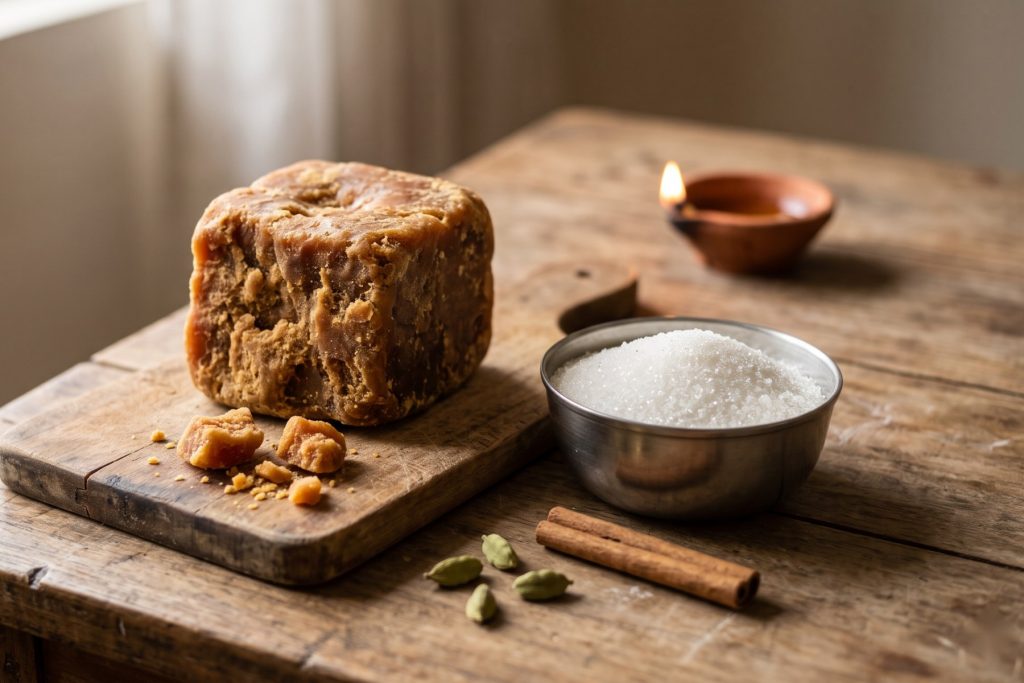
 Swapping white sugar for gur is one of the most common “healthy” changes people make before Diwali. Gur feels traditional, less processed and somehow kinder to the body. But your body handles jaggery much the way it handles sugar: it is mostly sucrose, it carries almost the same calories, and it raises blood glucose.
That doesn’t mean you need to give up your favourite gur chikki or til laddoo. It means treating jaggery as what it is, a sweet treat, and enjoying it in amounts that suit your health.
At a glance
- Is jaggery healthier than sugar? Only slightly. It keeps traces of minerals that refining removes, but the amounts in a normal serving are too small to matter much.
- Calories: about 375 kcal per 100 g for jaggery and close to 400 kcal for white sugar.
- Blood sugar: both raise blood glucose. Jaggery is not a safe swap for people with diabetes.
- How much is OK: WHO advises keeping free sugars, jaggery and honey included, below 10% of daily energy and ideally below 5%.
- Best approach this Diwali: use less of any sweetener, choose smaller portions, and add flavour with nuts, cardamom, cinnamon and fruit.
Key takeaways
- Jaggery is roughly 65–85% sucrose, the same sugar that makes up white sugar.
- It contains some iron, potassium and magnesium, but you would need to eat a very large amount of jaggery to get a useful dose.
- Studies disagree on jaggery’s glycaemic index, but none show that it protects blood sugar. Count it the same way you count sugar.
- Honey, coconut sugar, panela and date syrup are also free sugars under WHO’s definition.
- The healthiest change is to use less sweetener overall, not to switch from one sweetener to another.
What is jaggery?
Jaggery (gur) is made by boiling sugarcane juice, or palm sap, until it thickens and sets. Unlike white sugar, it isn’t spun in a centrifuge to remove the molasses, which is why it’s called a non-centrifugal sugar. It goes by different names around the world: panela in Latin America, rapadura in Brazil and kokuto in Japan. India produces nearly 70% of the world’s jaggery.
Keeping the molasses gives jaggery its colour, its caramel flavour and its small amount of minerals. It is still a sugar.
Jaggery vs sugar: the nutrition, side by side
| Per 100 g | Jaggery | White sugar |
| Sucrose | 65–85 g | about 99.5 g |
| Glucose and fructose | 10–15 g | trace |
| Energy | about 375 kcal | about 390–400 kcal |
| Iron | about 11 mg (varies widely) | trace |
| Calcium | 40–100 mg | under 5 mg |
| Magnesium | 70–90 mg | trace |
Jaggery figures are from a review of jaggery products, as reported by The Week; refined sugar figures are from a 2021 review in the Journal of Food Science and Technology. Mineral levels vary a lot with the cane, the soil and how the jaggery is made. Some of the iron can come from the iron pans it is boiled in.
Do the minerals make a difference?
Not at the amounts people actually eat. A 10 g piece of jaggery, roughly a heaped teaspoon, gives you about 37 kcal and around 1 mg of iron. That’s a small fraction of what most adults need each day. To get 10 mg of iron from jaggery you would need about 90 g, which is more than 300 kcal of sugar.
Iron, calcium and magnesium are far better sourced from dals, green leafy vegetables, millets such as ragi, nuts, seeds and dairy. These come with protein and fibre, not just sugar.
Does jaggery raise blood sugar less than sugar?
No. Jaggery is mostly sucrose, so your body breaks it down into glucose and fructose just as it does white sugar. Both raise blood glucose.
Studies of jaggery’s glycaemic index (GI), which measures how quickly a food raises blood sugar, don’t agree. One review puts jaggery’s GI at about 84, which is higher than the usual figure of about 65 for table sugar. A 2022 Sri Lankan study in people with type 2 diabetes compared coconut jaggery with cane sugar. It found no significant difference in how much either raised blood glucose, and the authors concluded that coconut jaggery is not a healthy substitute for sugar. The results depend on the type of jaggery, how it is made and how it’s eaten. None of the studies show that jaggery is gentle on blood sugar.
If you have diabetes or prediabetes, count jaggery exactly as you would count sugar. Our guide to the glycaemic index explains how to build meals that keep blood sugar steadier. If you’re unsure where you stand, read about the early signs of diabetes and ask your doctor about a fasting glucose or HbA1c test.
What about honey, coconut sugar and dates?
WHO’s definition of free sugars includes honey and syrups as well as table sugar. That means most “natural” sweeteners count towards the same daily limit.
| Sweetener | What it is | Counts as free sugar? | Worth knowing |
| Jaggery (gur) / panela | Unrefined cane sugar | Yes | Traces of minerals; same calories as sugar |
| Palm or coconut jaggery | Set palm or coconut sap | Yes | Often marketed as low-GI; the evidence is mixed |
| Brown sugar | White sugar with molasses added back | Yes | Nutritionally close to white sugar |
| Honey | Sugars made by bees | Yes | Not suitable for babies under 1 year |
| Date syrup | Concentrated dates | Yes | Most of the fibre in whole dates is lost |
| Whole dates | Intact fruit | No (when eaten whole) | Fibre slows absorption, but dates are still sugar-dense |
| Stevia, monk fruit | Non-nutritive sweeteners | No | Almost no calories; best used sparingly |
Whole dates are a better choice than syrup because they keep their fibre, but they are still high in sugar. Our post on whether to eat dates covers how many to have. For calorie-free options, see our guides to stevia and artificial sweeteners.
How much sugar or jaggery is OK?
WHO recommends keeping free sugars below 10% of your daily energy, and ideally below 5%. In India, the ICMR-NIN Dietary Guidelines for Indians (2024) also call for keeping sugar below 5% of daily calories.
For an adult eating about 2,000 kcal a day, this works out to:
- Under 10%: up to 50 g of free sugars a day.
- Ideally under 5%: about 25 g a day, or roughly six level teaspoons.
That total includes the sugar, jaggery or honey in your tea, sweets, biscuits, sauces and drinks, not just what you add at the table. Two pieces of a jaggery-based sweet can use up most of a day’s allowance.
Smarter sweets this Diwali
You don’t have to skip festive sweets. A few simple changes help:
- Cut the sweetener by a quarter to a third. Most traditional recipes still taste good with less, especially when you add cardamom, cinnamon, saffron or nutmeg.
- Make smaller pieces. A laddoo half the size has half the sugar, and you still get to enjoy it.
- Add protein and fibre. Nuts, seeds, roasted chana, oats and millets slow digestion and keep you fuller for longer.
- Use fruit for sweetness. Mashed banana, grated apple or a few chopped whole dates can replace part of the sweetener in many recipes.
- Put sweets on the table, not on the run. Eat them slowly, with a meal, rather than picking at them all day.
- Balance the rest of the day. On a day with sweets, cut back on sweetened tea, soft drinks and packaged snacks.
Looking for ideas? Try our dates roll with seeds, our healthier Indian sweets and our baked and air-fried Diwali namkeen. If you love gur in winter, masala gur is best enjoyed in small pieces.
Pro Tip: Not sure how much sugar you eat in a day? Log your meals, sweets and drinks on the GOQii App for a week. The total often surprises people. A GOQii Personalised Health Coach can then help you plan a festive season that still includes your favourite sweets.
Frequently asked questions
Is jaggery better than sugar for weight loss?
No. Jaggery has almost the same calories as sugar, about 375 kcal per 100 g compared with roughly 390–400 kcal. What matters for weight is how much sweetener you eat in total, not which one you choose.
Can people with diabetes eat jaggery?
Jaggery raises blood sugar just as sugar does, so it is not a diabetes-friendly swap. If you have diabetes, count jaggery as sugar and agree on any sweet foods with your doctor or dietitian.
Does jaggery help with iron deficiency or anaemia?
Not in a useful way. A 10 g piece gives around 1 mg of iron, and getting meaningful amounts would mean eating a lot of sugar. If you think you may be low in iron, see a doctor for a blood test. Iron-rich foods such as dals, leafy greens and millets are a better everyday source.
Is jaggery good for digestion?
Eating a small piece of gur after meals is a long-standing tradition in many Indian homes, but there is little good-quality research showing it aids digestion. Fibre from whole grains, pulses, vegetables and fruit has much stronger evidence.
Is honey healthier than jaggery?
Neither is a health food. Both count as free sugars under WHO guidance, and both raise blood sugar. Choose whichever you enjoy, and use less of it.
How much jaggery can I eat in a day?
WHO advises keeping all free sugars, jaggery included, below 10% of daily energy and ideally below 5%. For most adults, 5% is about 25 g a day from every source combined, including tea, sweets and drinks.
#BeTheForce
Disclaimer: This article is for general information only and is not a substitute for medical advice. If you have diabetes, prediabetes or another health condition, talk to your doctor or a registered dietitian before changing your diet.




Leave a Reply