GOQii

Blog

  • HOME
  • HEALTHY LIVING
  • FITNESS
  • HEALTHY RECIPES
  • USER STORIES
  • KARMA
  • BUY GOQii

Search Results for: lungs

November 8, 2026 By GOQii Leave a Comment

Diwali Safety: First Aid for Burns and Firecracker Injuries, and Protecting Your Lungs from Smoke

Diwali night should end with sweets, family and lights, not a trip to casualty. Yet every year hospital emergency departments across India brace for the same injuries. On Diwali 2025, Delhi hospitals alone treated more than 250 burn cases, most of them from firecrackers. Safdarjung Hospital saw 129, and 24 of those patients were children under 12. Over the same festive period, AIIMS Delhi’s eye centre treated 190 firecracker-related eye injuries, 19% more than the year before, and around 60 children needed eye surgery. It isn’t only Delhi: in Bengaluru, four eye hospitals reported more than 90 cracker-related eye injuries in the first days of Deepavali 2025, more than half of them in children, and hospitals in other cities report the same pattern every year.

Most of these injuries are preventable, and for many of them what you do in the first few minutes makes a real difference. This guide covers the simple safety habits that prevent harm, the right first aid for burns and eye injuries (including the home remedies to skip), and how to protect your lungs and heart from the smoke that settles over towns and cities on Diwali night.

At a glance

  • For a burn, cool it under cool running water for 20 minutes. Start as soon as you can. Don’t use ice, toothpaste, ghee, butter, haldi or oil.
  • Then cover it loosely with cling film or a clean plastic bag. Don’t burst blisters or pull off anything stuck to the skin.
  • Get medical help for burns bigger than the injured person’s hand, deep or charred burns, burns on the face, hands, feet or genitals, and any burn in a young child or older adult.
  • For an eye injury, don’t rub, rinse or press the eye and don’t try to remove anything stuck in it. Shield it and go to hospital straight away.
  • Keep a bucket of water and sand nearby, let adults light crackers, stand well back, and never relight a dud.
  • Smoke is a health risk too. On Diwali 2025, PM2.5 levels in Delhi rose more than threefold. If you have asthma, COPD or heart disease, stay indoors during peak hours, keep your reliever inhaler close and know when to get help.
  • In an emergency in India, call 112. It connects to police, fire and ambulance services.

Before you light: simple habits that prevent most injuries

The best first aid is the injury that never happens. Doctors at AIIMS noted that most patients with firecracker eye injuries were boys and young men up to the age of 20, and that many children were hurt. Research from the American Academy of Ophthalmology has also found that many people injured by fireworks are bystanders, not the person lighting them. So safety is everyone’s job, not just the person holding the agarbatti.

Set up a safe spot

  • Burst crackers in an open area, away from buildings, parked vehicles, dry leaves and anything that can catch fire. Never burst them indoors, on a balcony or inside a crowded lane.
  • Keep two buckets ready: one of water and one of sand. Drop used sparklers and duds into the water.
  • Check local rules. In Delhi-NCR, for example, the Supreme Court has allowed only certified green crackers this Diwali, within set hours on 7 and 8 November, and none within 300 metres of hospitals, schools and old-age homes. Green crackers are designed to cut emissions, but they still burn and explode, so they need exactly the same care. Rules on timings and permitted crackers differ between states and cities, so check your local authority’s notice.

Dress for it

  • Wear close-fitting cotton clothes. Loose dupattas, saris, flowing sleeves and synthetic fabrics catch fire easily, and synthetics can melt onto the skin.
  • Tie back long hair and wear closed footwear, not chappals.
  • If you are lighting crackers, wear protective glasses. Ordinary spectacles help a little, but proper safety eyewear is better.

Light carefully

  • Adults should light crackers. Use a long agarbatti or a phuljhadi stick, keep your arm outstretched and your face turned away, then step back quickly.
  • Never hold a cracker in your hand while lighting it, and never bend over it.
  • Never relight or go back to a dud. Wait, then soak it in water.
  • Don’t put crackers in tins, bottles or pots, or throw them at people or animals.

Watch the children

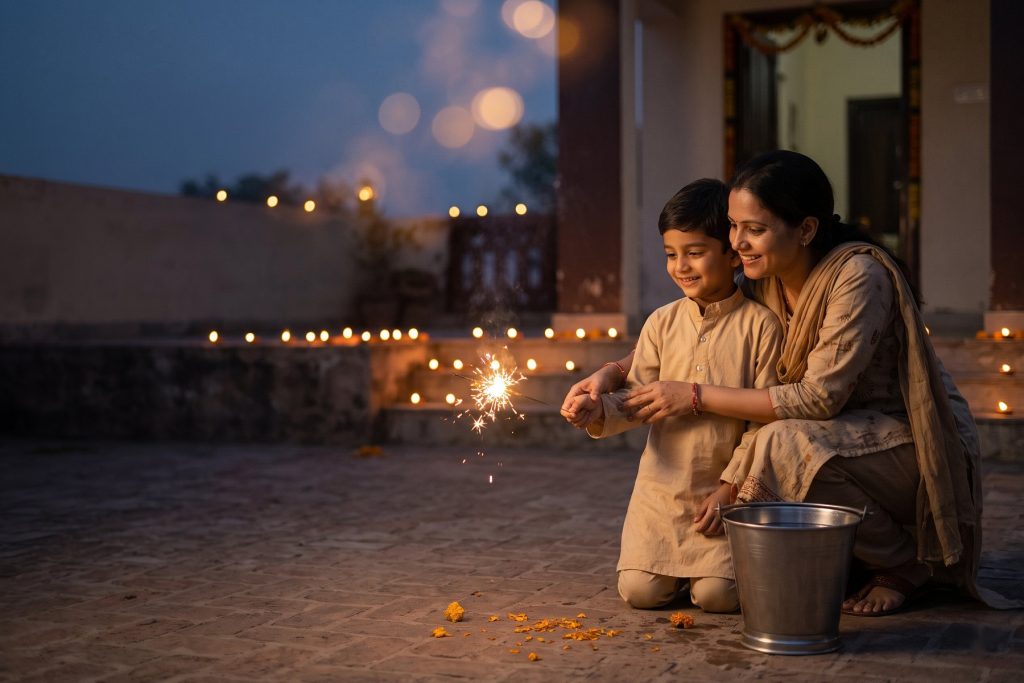
  • Sparklers feel harmless but burn at roughly 1,000°C or more, hot enough to melt some metals. Emergency doctors advise that young children shouldn’t hold them at all. If older children do, supervise closely, hold one at a time at arm’s length and drop finished ones straight into water.
  • Keep children well back from anything being lit, and keep unused crackers in a closed box away from them.
  • Steer clear of carbide guns. These homemade or market “guns” were a new cause of serious chemical and blast eye injuries at AIIMS in 2025, accounting for around 18–20 of the 190 cases.

Diyas, candles and rangoli

Diyas caused 11 of Safdarjung’s 129 Diwali burn cases in 2025. Place them on a stable, non-flammable surface, away from curtains, decorations and where children and pets run. Keep them off doorways where a sari or dupatta can brush past, and put them out before you go to sleep. Electric diyas and lights are a safer swap for corners you can’t watch.

Kitchen safety counts too. Diwali means extra frying and hot oil. Keep pan handles turned inward, keep children out of the kitchen while you fry, and never pour water onto burning oil. Turn off the gas and cover the pan with a lid instead.

First aid for burns: what to do, step by step

If clothing catches fire, remember stop, drop and roll. Stop where you are, drop to the ground, cover your face with your hands and roll until the flames are out. If it’s someone else, get them to the ground and smother the flames with a heavy cotton or woollen blanket, a rug or water. Don’t let them run, because running fans the flames.

Then follow these steps for any burn:

  1. Make it safe. Move the person away from the source of heat and any crackers still going off.
  2. Cool the burn under cool running tap water for 20 minutes. This is the single most useful thing you can do. The British Red Cross explains that cooling reduces pain, swelling and the risk of scarring, and the sooner you start, the better. Indian burns specialists, including doctors at the National Burns Centre and PGIMER Chandigarh, give the same advice: keep clean, cool water running over the burn rather than stopping as soon as it feels a little better. Water that feels cool is enough; it doesn’t need to be ice cold. If there is no running water, a bowl of clean cool water or even cold milk or a cold drink will do while you find some.
  3. Remove rings, bangles, watches and tight clothing near the burned area before it starts to swell, but don’t pull off anything that is stuck to the skin.
  4. Keep the person warm. Cool only the burn, not the whole body. Cold baths or long cold showers can drop body temperature dangerously, especially in children.
  5. Cover the burn loosely with a layer of cling film or a clean plastic bag (for a hand). Lay it on rather than wrapping it tightly. Don’t use cotton wool, fluffy cloth or sticky plasters, which can stick to the wound.
  6. Ease the pain with paracetamol or ibuprofen if needed, following the dose on the pack. Ask a pharmacist about the right dose for a child.

Home remedies to skip

Many of us grew up with a quick dab of toothpaste or ghee on a kitchen burn. They feel soothing for a moment, but they trap heat in the skin, can carry germs into the wound and make it harder for doctors to assess the burn. Doctors at the National Burns Centre specifically warn against haldi, toothpaste, ice and cow dung, and PGIMER Chandigarh against toothpaste, butter and ink. The same goes for:

  • ghee, oil or coconut oil
  • haldi (turmeric), atta or other powders
  • ink, mud or potato
  • ice or iced water, which can damage the skin further

Don’t burst blisters either. They protect the healing skin underneath.

When a burn needs a doctor

Many small, red, painful burns heal at home. Official UK guidance from NI Direct says to go to hospital emergency services for:

  • any burn bigger than the injured person’s hand
  • deep burns, including those that look white, waxy, leathery or charred, even if they don’t hurt (deep burns can damage nerves)
  • burns that blister on the face, hands, arms, feet, legs or genitals
  • chemical or electrical burns
  • anyone who has breathed in smoke, even if they seem fine at first

Get medical advice after any burn in children under 10, adults aged 50 and over, pregnant women and people with diabetes, heart, lung or liver disease, or a weakened immune system. Also see a doctor if a burn shows signs of infection over the following days: increasing pain, redness, swelling, pus, a bad smell or fever. If you can’t remember when you last had a tetanus jab, mention it to the doctor.

Eye injuries and other firecracker injuries

The eye injuries AIIMS sees on Diwali are often serious. In 2025, about 45% were open-globe injuries, where the wall of the eye is torn or punctured, and around half of patients had moderate or severe loss of vision. Getting to an eye specialist quickly gives the best chance of saving sight, and well-meaning first aid can make things worse.

If a spark, cracker or debris hits the eye

Eye specialists, including AIIMS Bhopal and the American Academy of Ophthalmology, advise the following:

  • Don’t rub the eye. Rubbing can push debris deeper or worsen a cut.
  • Don’t press on the eye or try to open it forcibly.
  • Don’t try to remove anything stuck in the eye, however small it looks.
  • Don’t rinse it if you suspect a cut, puncture or something embedded.
  • Don’t put in drops or ointments, including home remedies such as rose water, ghee or breast milk.
  • Shield the eye. Gently tape the bottom of a paper cup, or the cut-off base of a plastic bottle, over the eye so nothing presses on it. Ask the person to keep both eyes as still as possible.
  • Go to the nearest hospital with an eye department straight away. Don’t wait to see if it settles. Avoid giving food or drink in case surgery is needed.

The one exception is a chemical splash (for example from a carbide gun or cracker powder) with no sign of a cut or embedded object. Here, rinsing is the priority: hold the eye open and flush it gently with plenty of clean running water for at least 15 minutes, then go to hospital. If in doubt about which kind of injury it is, shield the eye and go.

Minor irritation from smoke or ash usually settles with blinking and a few splashes of clean water. If vision is blurred, the eye stays red and painful, or there’s sensitivity to light, get it checked.

Hand and ear injuries

A cracker that goes off in the hand can cause deep burns, cuts and broken bones. Cool the burns, press a clean cloth on any bleeding, raise the hand and go to hospital. Ringing in the ears after a loud bang usually fades within a day; see a doctor if it doesn’t, or if there’s pain, bleeding or hearing loss.

Protecting your lungs and heart from Diwali smoke

Firecrackers release a dense mix of fine particles (PM2.5), sulphur dioxide, nitrogen oxides and metal compounds. In much of north India, they arrive on top of seasonal smog, cold, still air and crop-residue smoke. On Diwali 2025, an analysis of Central Pollution Control Board data by Climate Trends found Delhi’s average PM2.5 rose more than threefold, from about 157 to 488 µg/m³, with the sharpest spike between 10 pm and 1 am. That’s many times the WHO’s guideline for daily exposure.

For most healthy adults, one smoky night causes sore eyes, a scratchy throat or a cough that settles. The people who need to take it seriously are:

  • people with asthma or COPD, for whom smoke can trigger a flare-up
  • people with heart disease or who have had a stroke, because short spikes in fine particles are linked to heart attacks and strokes
  • young children, whose lungs are still developing
  • older adults and pregnant women

We cover the wider health effects of smog in our guide to air pollution and your health.

Practical steps for Diwali night

  • Stay indoors during peak bursting hours, usually late evening until after midnight, and the following morning if the smog lingers. Keep doors and windows shut until the air clears.
  • Check the AQI on the government’s SAMEER app or a trusted air-quality app before going out, and plan errands and walks for the cleaner middle of the day.
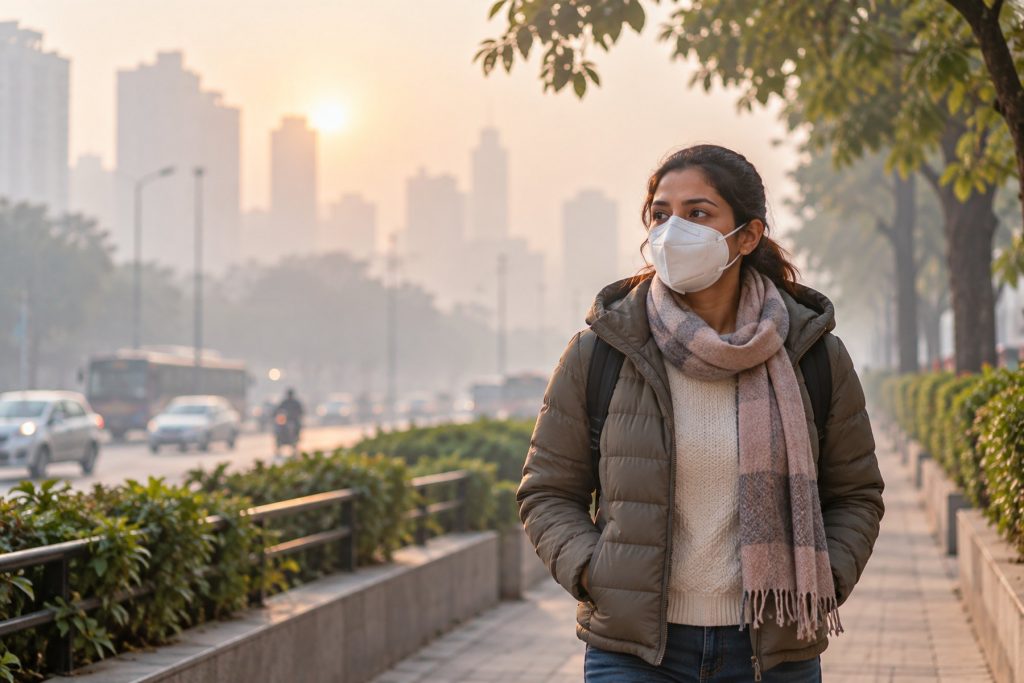
  • Wear a well-fitting N95 or FFP2 mask if you do need to go out. Cloth and surgical masks don’t filter fine particles well.
  • Don’t add to indoor smoke. Go easy on incense, dhoop, camphor and heavy diya smoke indoors, and use the kitchen exhaust when frying.
  • Use an air purifier if you have one, in the room where you spend most time and where you sleep. It works best with doors and windows closed.
  • Skip outdoor exercise for a day or two after Diwali if air quality is poor. Do a yoga or strength session indoors instead.
  • Drink enough water. It won’t remove pollutants from your body, but it helps with a dry, irritated throat.

If you have asthma or COPD

Pulmonologists interviewed by Business Standard ahead of last year’s festive season advised:

  • keep taking your preventer inhaler every day as prescribed, even if you feel well
  • carry your reliever inhaler at all times, and check it isn’t empty or out of date
  • ask your doctor for a written action plan that says what to do if symptoms worsen
  • get checked if you’re using your reliever more than usual, or if symptoms last more than a week
  • keep your flu and pneumococcal vaccines up to date

Get urgent help if breathing becomes very difficult, your reliever isn’t helping or you need it more than every four hours, you can’t speak in full sentences, or your lips or fingertips look blue or grey.

If you have heart disease

Stay indoors during the worst hours, keep taking your medicines and don’t exert yourself in smoky air. Call 112 for chest pain or pressure, breathlessness, a cold sweat, or pain spreading to the arm, jaw or back. And know the signs of a stroke: if someone’s face drops, an arm goes weak or their speech is slurred, act FAST and call for help straight away.

Pets and street animals

Dogs and cats hear far more than we do, and Diwali can be terrifying for them. Humane World for Animals suggests walking dogs earlier in the day, keeping pets indoors in a familiar room with windows and curtains closed, staying with them for comfort and making sure they wear an ID tag in case they bolt. If your pet has severe noise anxiety, talk to your vet before Diwali. Never burst crackers near animals, shelters or cowsheds, or tie them to animals.

Emergency numbers and your Diwali first-aid kit

Numbers to save before Diwali

Number What it’s for
112 National emergency number for police, fire and ambulance (ERSS)
108 Ambulance (in most states)
101 Fire and rescue

The government is bringing the older numbers under 112, so if in doubt, call 112. Also save the number of your nearest hospital with a 24-hour emergency department, and find out in advance which nearby hospitals have a burns unit and an eye department. On Diwali night, roads are busy and minutes count.

Call an ambulance if someone has a large or deep burn, a burn to the face or airway, difficulty breathing after inhaling smoke, a serious eye injury, heavy bleeding or a severed finger, or if they’re confused, drowsy or unconscious. While you wait, keep cooling the burn and keep the person warm.

A simple Diwali first-aid kit

Keep these together in one place where every adult in the house knows to find them:

  • a bucket of water and a bucket of sand near where crackers are being burst
  • a roll of cling film and some clean plastic bags (for covering burns)
  • sterile non-stick dressings, gauze and a crepe bandage
  • medical tape and a few paper cups (for shielding an injured eye)
  • clean cotton cloths or towels
  • paracetamol or ibuprofen, in adult and children’s doses
  • a spare reliever inhaler for anyone with asthma, and N95 masks
  • a torch and a phone with emergency numbers saved
  • a small fire extinguisher, if you have one, and a fire blanket or thick cotton blanket

What you won’t need: toothpaste, ghee, haldi or burn “creams” for fresh burns.

The bottom line

A safe Diwali comes down to a few habits: adults light the crackers, everyone stands back, there’s water and sand within reach and nobody goes back to a dud. If a burn happens, cool running water for 20 minutes beats every home remedy. If an eye is hurt, shield it and go to hospital without rubbing or rinsing. And if you or someone at home has asthma, COPD or heart disease, plan to be indoors with your medicines to hand when the smoke is at its worst. For the rest of the festival, from sweets to sleep, see our guide to a healthy Diwali.

Pro Tip: Before Diwali night, save 112 and your nearest hospital’s number, and set your air-quality alerts. If smoke keeps you indoors over the festive days, log an indoor workout or yoga session in the GOQii App so your activity streak doesn’t slip. Your GOQii Personalised Health Coach can help you plan indoor routines and keep your asthma or heart-health habits on track through the smog season.

Frequently asked questions

What is the first thing to do for a firecracker burn?

Move away from the heat, then hold the burn under cool running water for 20 minutes. Remove rings or tight clothing near the burn, cover it loosely with cling film or a clean plastic bag, and get medical help if it is large, deep or on the face, hands, feet or genitals.

Should I put toothpaste, ghee or ice on a burn?

No. Toothpaste, ghee, butter, oil, haldi and ice can trap heat, damage the skin or introduce infection. Cool running water is the right first aid.

When should I take a burn to hospital?

Go to hospital for burns bigger than the injured person’s hand, deep burns that look white or charred, blistered burns on the face, hands, arms, feet, legs or genitals, chemical or electrical burns, and anyone who has inhaled smoke. Children under 10, adults aged 50 and over and pregnant women should get any burn checked.

What should I do if a firecracker injures someone’s eye?

Don’t rub, press or rinse the eye, and don’t try to remove anything stuck in it. Gently cover it with a shield such as a paper cup taped in place, and go to a hospital with an eye department straight away. For a chemical splash without a cut, flush the eye with clean water for at least 15 minutes, then go to hospital.

Are sparklers safe for children?

Sparklers burn at around 1,000°C, hot enough to cause serious burns. Young children shouldn’t hold them. Older children should be closely supervised, hold one at a time at arm’s length and drop used sparklers into a bucket of water.

How can people with asthma protect themselves on Diwali?

Stay indoors with windows closed during peak bursting hours, keep taking your preventer inhaler, carry your reliever inhaler, wear an N95 mask if you must go out and follow your asthma action plan. Seek urgent help if your reliever isn’t working or breathing becomes very difficult.

What is the emergency number in India for burns and fire?

Call 112, India’s single emergency number, which connects to police, fire and ambulance services. You can also call 108 for an ambulance in most states and 101 for the fire service.

#BeTheForce

Disclaimer: The information provided in this blog is for general awareness and educational purposes only. It is not intended to replace professional medical advice, diagnosis, or treatment. Always consult a qualified healthcare provider for personalised medical guidance or concerns related to your health.
November 2, 2026 By GOQii Leave a Comment

Air Pollution and Your Health: Protecting Your Lungs and Heart

Every winter, much of North India wakes up to a grey haze that stings the eyes and catches in the throat. But polluted air isn’t only a Delhi problem. Traffic fumes in London, wildfire smoke in California and Canada, coal and dust in parts of China and Africa, and smoke from cooking fires in millions of homes all affect the air we breathe. According to the World Health Organization, 99% of the world’s population lives in places where air quality falls short of its guidelines.
You can’t control the air outside, but you can reduce how much of it you breathe in. This guide explains what’s in polluted air, how it affects your lungs, heart and more, and the practical steps that actually help.

At a glance

  • It’s the world’s biggest environmental health risk: air pollution contributed to about 9 million deaths in 2023, nearly 9 in 10 of them from heart disease, stroke, lung disease and other non-communicable diseases.
  • Fine particles (PM2.5) are the main concern: they’re small enough to reach deep into the lungs and the bloodstream.
  • It affects the heart as much as the lungs: short spells of high pollution can trigger heart attacks and strokes in people at risk.
  • Check the AQI daily and plan outdoor time around it.
  • What helps: a well-fitted N95 or FFP2 mask outdoors on bad days, a HEPA air purifier in the room you use most, and cutting indoor smoke.
  • What doesn’t: cloth masks, jaggery “lung cleanses” and detox drinks.

What’s in polluted air?

Air pollution is a mix of particles and gases from vehicles, industry, power plants, construction dust, crop and rubbish burning, wildfires and household fuels. The main ones to know:

  • 5: fine particles less than 2.5 micrometres across, about 30 times thinner than a human hair. They’re the most harmful because they travel deep into the lungs and can enter the bloodstream.
  • PM10: coarser particles such as dust and pollen, which mostly irritate the nose, throat and airways.
  • Nitrogen dioxide (NO₂): mainly from traffic, especially diesel engines. It inflames the airways.
  • Ozone (O₃): forms when sunlight reacts with other pollutants, so it peaks on hot, sunny afternoons.

In 2021, the WHO made its air quality guidelines much stricter, because evidence showed harm at lower levels than previously thought.

Pollutant WHO 24-hour guideline WHO annual guideline
PM2.5 15 µg/m³ 5 µg/m³
PM10 45 µg/m³ 15 µg/m³
NO₂ 25 µg/m³ 10 µg/m³

To put that in context, PM2.5 in some cities, including parts of North India, can reach 10 to 20 times the 24-hour guideline on bad winter days. As the American Heart Association has put it, there is no known “safe” level of PM2.5; lower is always better.

Indoor air counts too. Around 2.1 billion people still cook with wood, dung, crop waste, coal or kerosene, and household air pollution was linked to about 3.2 million deaths in 2020. Incense, mosquito coils, frying, cigarette smoke and burning candles also add to indoor PM2.5.

How air pollution affects your body

Lungs and airways. In the short term, polluted air can cause coughing, a scratchy throat, wheezing and breathlessness, and it can set off asthma attacks and COPD flare-ups. Over years, it’s linked to reduced lung function, chronic obstructive pulmonary disease (COPD), lung infections and lung cancer, including in people who have never smoked.

Heart and blood vessels. This is the part many people don’t realise. Fine particles promote inflammation, raise blood pressure and make blood more likely to clot. An American Heart Association scientific statement concluded that PM2.5 exposure over hours to days can trigger heart attacks, strokes and irregular heartbeats in susceptible people, and that long-term exposure shortens life expectancy. Air pollution is now one of the leading risk factors for stroke worldwide; read our guide on how to spot the signs of a stroke and act FAST.

Brain and beyond. Research also links long-term exposure to type 2 diabetes, low birth weight and preterm birth, and dementia. The State of Global Air 2025 report estimated that air pollution-related dementia caused over 625,000 deaths in 2023.

Who is most at risk?

  • Children, whose lungs are still developing and who breathe faster
  • Older adults
  • Pregnant women
  • People with asthma, COPD, heart disease, previous stroke or diabetes
  • Outdoor workers, such as traffic police, street vendors, delivery riders and construction workers
  • People who cook with solid fuels or live near busy roads

Read the AQI before you step out

The Air Quality Index (AQI) turns pollutant levels into one number and a colour, so you can see at a glance how risky the air is today. Most weather apps show it, and countries publish official readings: SAMEER and the CPCB website in India, AirNow in the US, and the Met Office and UK-AIR in the UK.

Scales differ between countries, so always read the category label, not just the number. India’s national AQI, for example, uses six bands:

AQI Category Possible health impact
0–50 Good Minimal
51–100 Satisfactory Minor breathing discomfort for sensitive people
101–200 Moderate Breathing discomfort for people with lung or heart disease
201–300 Poor Breathing discomfort for most people on prolonged exposure
301–400 Very poor Respiratory illness on prolonged exposure
401–500 Severe Serious effects even in healthy people

Using it day to day:

  • Good to moderate: normal activity for most people. If you have asthma or heart disease, watch for symptoms in the moderate range.
  • Poor: cut down on long or strenuous outdoor exercise; sensitive groups should move it indoors.
  • Very poor or severe: keep outdoor time short, wear a well-fitted N95 or FFP2 mask if you must go out, and keep indoor air as clean as possible.

Pollution usually peaks in the early morning and late evening in winter, when cold, still air traps it near the ground. Ozone is the exception, peaking on sunny afternoons.

How to protect yourself: what actually works

Outdoors

Choose the right mask, and wear it properly. On high-pollution days, an N95, FFP2 or KN95 respirator can filter most fine particles, but only if it seals well. Experts advise choosing a snug size: the mask should pull in slightly when you breathe in and puff out when you breathe out. If air leaks around the edges, you’re breathing unfiltered air. Beards stop a good seal. Surgical masks offer some protection, and cloth masks very little. Masks with a valve protect the wearer but not people nearby. Respirators aren’t designed for young children, and people with heart or lung disease should check with their doctor, as breathing through one takes more effort.

Keep exercising, but be smart about it. Physical activity is so good for you that, in modelling of cities around the world, its benefits outweighed the harm from pollution in most places. In very polluted cities, though, the safe amount of outdoor cycling dropped to around 45 minutes a day. On bad days:

  • move workouts indoors, or exercise when AQI is lowest (often late morning or early afternoon in winter)
  • walk or run in parks or on quieter streets, away from heavy traffic
  • choose lower-intensity activity, as you breathe in more air when you push hard

Movement also helps your mood through the gloomy smog season; read more on how exercise impacts mental health.

On the road: in a car, keep the windows up and set the air to recirculate in heavy traffic.

Indoors

  • Close windows and doors when outdoor AQI is poor or worse, and air your home when the air is better, usually around midday.
  • Use a HEPA air purifier in the room where you spend the most time, usually the bedroom. In one study, HEPA air cleaners roughly halved indoor PM2.5. Choose one sized for your room (check its clean air delivery rate, or CADR), keep doors closed while it runs, and change filters on time. Avoid ozone-producing “ionisers”.
  • Cut indoor smoke: don’t smoke indoors, and cut back on incense, dhoop, mosquito coils and candles on bad days.
  • Cook cleaner: use LPG, PNG or electric cooking where possible, switch on the kitchen chimney or exhaust fan, and keep lids on pans.
  • Clean with a damp cloth or mop rather than sweeping, which stirs up dust.

If you have asthma, COPD or heart disease, keep reliever and regular medicines handy, follow your action plan, and talk to your doctor before the smog season about whether your treatment needs adjusting.

Food, remedies and myths

Every smog season brings forwards and messages promising that a food or drink will “clean your lungs”. Here’s what the evidence says.

  • Jaggery (gur): the claim rests mainly on a 1994 study in rats exposed to coal dust. A pulmonologist quoted by Business Standard notes there’s no human trial showing jaggery cleans human lungs. It’s still sugar, so enjoy it as a treat, not a treatment.
  • Detox drinks, kadhas and “lung cleanses”: your lungs clear particles with their own natural defences. No drink or herb has been shown to remove inhaled pollution, and some herbal products can interact with medicines.
  • Steam inhalation: may soothe a blocked nose or irritated throat for a while, but it doesn’t remove particles from the lungs. Take care to avoid scalds, especially with children.
  • Plants as air purifiers: houseplants are pleasant, but you’d need an impractical number to make a measurable difference to PM2.5.

What a healthy diet can do: eating plenty of fruit, vegetables, pulses, nuts and whole grains supports your body’s antioxidant defences and overall heart and lung health. It’s a sensible foundation, but it can’t replace reducing exposure. Researchers are studying supplements such as vitamins C and E and omega-3 fats, but none is a proven shield, so don’t rely on them, and check with your doctor before starting any.

When to see a doctor

Mild throat irritation or a cough on smoggy days is common. See a doctor if you notice:

  • a cough that lasts more than three weeks, or coughing up blood
  • breathlessness, wheezing or chest tightness that’s new or getting worse
  • asthma or COPD symptoms that need your reliever inhaler more often than usual
  • a child who is breathing fast, wheezing or struggling to feed

Get emergency help immediately (call 108 or 112 in India, 999 in the UK, or 911 in the US) for:

  • severe breathlessness, or lips or face turning blue
  • chest pain or pressure, especially if it spreads to the arm, jaw or back
  • signs of a stroke: a drooping face, a weak arm or slurred speech

The bottom line

Air pollution harms the heart as much as the lungs, and nobody is fully immune to it. You can’t clean the air outside on your own, but you can lower your exposure: check the AQI daily, time your outdoor activity, wear a well-fitted N95 when the air is bad, keep one room clean with a HEPA purifier, and cut smoke at home. Keep blood pressure, cholesterol and conditions like asthma under control too, because a healthy heart and lungs cope better on bad-air days. And skip the miracle cures; the basics are what work.

Pro Tip: On high-AQI days, swap your outdoor walk for an indoor workout and track it in the GOQii App so your activity streak doesn’t slip. Your GOQii Personalised Health Coach can help you plan indoor routines and heart-healthy habits for the smog season.

Frequently asked questions

How does air pollution affect your health?

Air pollution, especially fine particles called PM2.5, irritates the airways, triggers asthma and COPD flare-ups and, over time, is linked to lung disease and lung cancer. It also raises the risk of heart attacks and strokes, and it has been linked to diabetes, dementia and problems in pregnancy.

What is a safe AQI level?

The lower the better. AQI categories of good or satisfactory are safe for most people, while people with asthma or heart disease may notice symptoms in the moderate range. From poor upwards, limit time outdoors. There is no known completely safe level of PM2.5.

Which mask is best for air pollution?

A well-fitted N95, FFP2 or KN95 respirator filters most fine particles. It must seal snugly around your nose and mouth to work. Surgical masks give some protection, and cloth masks very little.

Should I exercise outdoors when pollution is high?

On poor, very poor or severe AQI days, move exercise indoors or keep it short and gentle, away from traffic. On cleaner days, the benefits of outdoor exercise outweigh the risks for most people.

Do air purifiers really work?

HEPA air purifiers can substantially lower indoor PM2.5. In one study, they roughly halved it. Choose one sized for your room, keep windows and doors closed while it runs, and replace the filters on time.

Does jaggery clean your lungs from pollution?

There’s no human evidence that jaggery cleans the lungs. The claim comes mainly from an old study in rats. Jaggery is still sugar, so it’s best enjoyed in small amounts rather than as a remedy.

Who is most at risk from air pollution?

Children, older adults, pregnant women, people with asthma, COPD, heart disease or diabetes, outdoor workers and people who cook with solid fuels are most at risk and should take extra precautions on high-pollution days.

#BeTheForce

Disclaimer: The information provided in this blog is for general awareness and educational purposes only. It is not intended to replace professional medical advice, diagnosis, or treatment. Always consult a qualified healthcare provider for personalised medical guidance or concerns related to your health.

November 20, 2024 By GOQii 5 Comments

3 Breathing Exercises To Strengthen Your Lungs

breathing exercisesHave you ever thought about the number of breaths you take in a lifetime? On average, we take about 675 million breaths in 80 years. Breathing patterns vary throughout our lives, influenced by age, environment, lifestyle, and health conditions such as COPD (Chronic Obstructive Pulmonary Disease). For those managing COPD or looking to maintain lung health, strengthening lung function is essential for overall well-being.

Our lungs are responsible for oxygen (O2) and carbon dioxide (CO2) exchange, ensuring that our body functions smoothly. Lung capacity and efficiency are key to respiratory health, and certain breathing exercises can help enhance this capacity. Here are three effective techniques to support lung function and improve breathing, especially beneficial for individuals with respiratory challenges like COPD.

1. Pursed Lip Breathing

This simple exercise helps slow down breathing and completely empties the lungs, which is particularly helpful during moments of shortness of breath—common among those with COPD.

How to Do it:

  • Sit comfortably, relax your shoulders, neck, and close your eyes gently.
  • Inhale through your nose for 2–3 seconds.
  • Purse your lips as if blowing out a candle, then exhale slowly through them for 4–6 seconds.
  • Repeat for about 5 minutes to experience relief and improved lung capacity.

This technique is beneficial during or after physical activity, as it lets plenty of air flow through the lungs, restoring normal breathing patterns.

2. Diaphragmatic or Belly breathing

How often in a day do we pay attention to our breathing pattern? Do you do shallow breathing or deep breathing? The diaphragm is the main sheet of muscle in between the chest and the abdomen that helps in respiration. But, usually, we develop the habit of breathing through chest, neck and shoulder muscles which limits the amount of air filling in and out of our lungs. Belly breathing strengthens the diaphragm and enhances the pulmonary efficiency. Here is the best way to train yourself for diaphragmatic breathing.

How to Do it:

  • Lie down on your back on a flat surface with the knees bent or sit comfortably on a chair with neck, shoulder and head relaxed
  • Place your one hand lightly on your abdomen and the other hand on the chest
  • Inhale deeply through the nose for 2-3 seconds as you fill all the air towards your abdomen
  • Pay attention to the hand on the abdomen moving up while making sure hand on the chest is not moving up
  • Now exhale all the air through the mouth (Pursed lips) while tightening the abdomen inwards. Make sure the hand on your abdomen is moving down
  • Repeat this breathing for 5-10 minutes to get the maximum benefits

3. Alternate Nostril breathing

This is a type of deep and slow breathing in Yoga in which inhaling, and exhaling happens through alternate nostrils.  Long term practice of this breathing improves the total capacity of the lungs while boosting the pulmonary function markers. It is also meant to purify the lungs and the circulatory system throughout the body.

How to Do it:

  • Sit straight on a flat surface with relaxed shoulders and neck
  • Start with deep inhalation and slow exhalation couple of times or for a minute
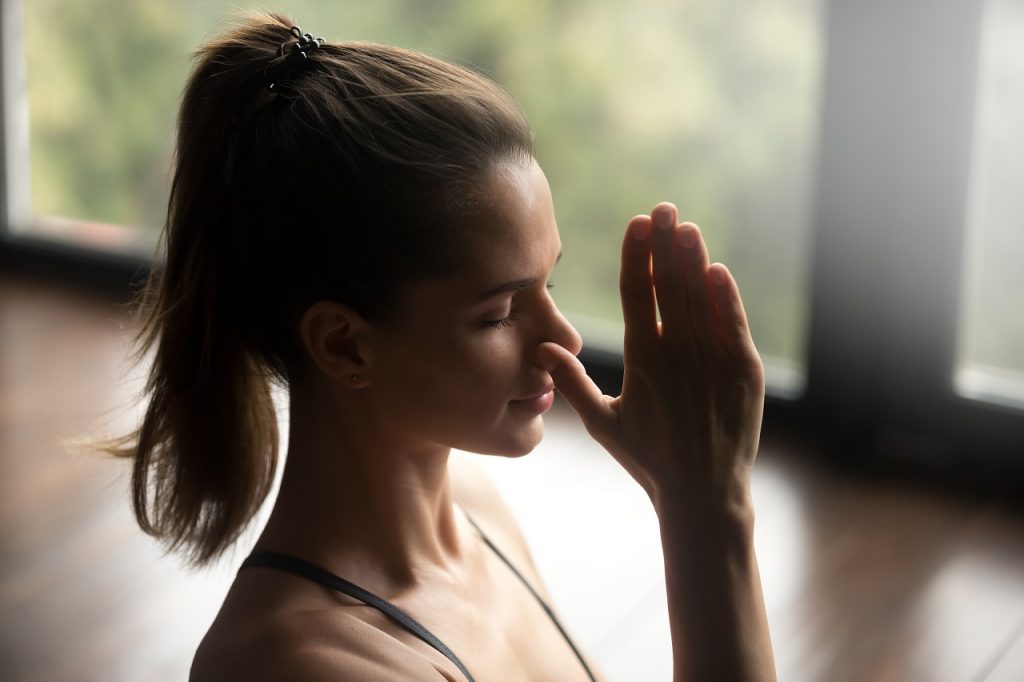
  • While folding the index and middle fingers of the right hand, make Vishnu mudra to close the right nostril with right thumb and left nostril with ring finger
  • At first, close the right nostril and slowly exhale through left nostril
  • Keep the right nostril closed and slowly inhale through the left nostril and feel all the air going upwards while filling all the air deep down till the abdomen
  • Once you inhale all the air possible, pause briefly for 2 seconds
  • Now close the left nostril with the ring finger and release thumb to open the right nostril
  • Exhale out all the air through the right nostril with a pause of 2 second at the end
  • As your still closing the left nostril, inhale slowly through the right nostril letting all the air into right side of the body with a short pause of 2 seconds at the end
  • Again, close the right nostril and open the left nostril to exhale all the air out

This is considered as one round of alternate nostril breathing. Continue this pattern for 5-10 minutes to get the maximum benefits.

Enhancing Lung Health with Breathing Exercises

Consistently practicing one or more of these breathing techniques on an empty stomach can help build lung strength and may aid in boosting immunity. These simple yet effective exercises can support your lung function, whether you’re managing COPD or simply aiming to breathe better.

Find more breathing exercises, meditation techniques and yoga here. You can also get these tips directly from your GOQii Coach by subscribing to Personalised Health Coaching here.

#BeTheForce

Disclaimer: The information provided in this blog is for general awareness and educational purposes only. It is not intended to replace professional medical advice, diagnosis, or treatment. Always consult a qualified healthcare provider for personalised medical guidance or concerns related to your health.

September 25, 2024 By Sunita Arora Leave a Comment

5 Ways To Keep Your Lungs Healthy

keep your lungs healthyWhile the heart often gets much attention, healthy lungs are equally important for overall well-being. Lung infections can arise as complications of other chronic conditions, and maintaining lung health is critical. According to the World Health Organization (WHO), exposure to air pollution contributes to 4.2 million deaths worldwide each year. Additionally, cigarette smoking is responsible for one in every five deaths in the United States. Although the body has natural defenses to protect the lungs, there are additional steps we can take to keep them functioning optimally.


How To Keep Your Lungs Healthy 

1. Practice Deep Breathing
Lung capacity tends to diminish as we age, but specific deep breathing exercises can help maintain lung function. Breathing exercises benefit both healthy individuals and those with respiratory issues. Two effective techniques include:

  • Diaphragmatic breathing: This technique helps build lung capacity and is particularly beneficial for individuals with COPD. Inhale through your nose for two seconds, allowing air to fill the abdomen, and exhale for two seconds.
  • Pursed-lip breathing: Inhale through your nose and exhale slowly through pursed lips. This technique can help improve air exchange.

2. Detox Your Lungs
Though our lungs are self-cleaning organs, a few simple practices can enhance lung function:

  • Garlic and honey: Start your day with 1-2 crushed cloves of garlic with a tsp of raw honey to help break down mucus.
  • Lemon water and cayenne pepper: Drink 250ml of lemon water with a pinch of cayenne pepper in the morning to loosen mucus. 
  • Fenugreek seed water: Drinking fenugreek seed water and chewing the soaked seeds can aid in clearing mucus. 
  • Steam inhalation: Inhale steam with peppermint and eucalyptus oil for 5 minutes twice daily.
  • Castor oil massage: Massaging your chest with warm castor oil can help alleviate congestion and clear mucus.

3. Get Fit & Stay Active
Regular exercise strengthens the muscles and increases the body’s need for oxygen, leading to an increased breathing rate. This process improves circulation and helps the body eliminate excess carbon dioxide produced during exercise. Staying active keeps your lungs healthy and enhances overall respiratory function.

4. Stay Hydrated
Keeping your airways moist is essential for optimal lung function, especially for those with breathing problems. Staying well-hydrated ensures the mucosal lining in the lungs remains thin, allowing them to function more effectively.

5. Prevent Infection & Avoid Exposure To Pollutants
Sometimes respiratory infections become very serious. To safeguard your lungs from various infections you should: 

  • Wash your hands often with soap and water or use alcohol-based sanitizer
  • Maintain good oral hygiene, brush your teeth twice a day and see your dentist every six months
  • Avoid crowded places during cold and flu season. Get yourself vaccinated against influenza and pneumonia every year
  • Minimize exposure to outdoor air if the quality is not good and avoid exercising outdoors on bad air days
  • Don’t exercise near heavy traffic to avoid inhaling polluted air
  • Avoid exposure to indoor pollutants which worsen lung disease. Make your home and car smoke-free
  • Dust the furniture at least twice a week. Keep your home clean as much you can, use natural cleaning products and make sure you have adequate air ventilation at home.
  • Instead of using synthetic air fresheners and candles, you can use an aromatherapy diffuser, essential oils like lavender oil, peppermint oil, rosemary oil, etc.
  • Stop smoking as soon as possible because it causes chronic inflammation in the lungs and destroys lung tissues which can lead to chronic bronchitis and lung cancer.

In addition to these practices, incorporating anti-inflammatory and antioxidant-rich foods into your diet can further support lung health. Include foods like turmeric, green tea, cherries, blueberries, olives, walnuts, beans, and lentils to help reduce lung inflammation.

We hope this article helps you. To know more ways to keep your lungs healthy, check out Healthy Reads or speak to a certified expert by subscribing to GOQii’s Personalised Health Coaching here.

#BeTheForce 

Disclaimer: The information provided in this blog is for general awareness and educational purposes only. It is not intended to replace professional medical advice, diagnosis, or treatment. Always consult a qualified healthcare provider for personalised medical guidance or concerns related to your health.

  • 1
  • 2
  • 3
  • …
  • 25
  • Next Page »

Search

Recent Posts

  • How to Improve Sleep Quality Naturally: 12 Science-Backed Tips for Better Sleep
  • Post-Diwali Reset: Getting Back on Track Without Crash Diets
  • Diwali Safety: First Aid for Burns and Firecracker Injuries, and Protecting Your Lungs from Smoke
  • Cancer Screening: Which Tests You Need and When
  • This Dhanteras, Invest in Your Health

Stay Updated

Archives

  • November 2026 (10)
  • October 2026 (23)
  • September 2026 (5)
  • August 2026 (8)
  • July 2026 (24)
  • June 2026 (22)
  • May 2026 (20)
  • April 2026 (24)
  • March 2026 (18)
  • February 2026 (14)
  • January 2026 (14)
  • December 2025 (19)
  • November 2025 (14)
  • October 2025 (17)
  • September 2025 (6)
  • August 2025 (5)
  • July 2025 (9)
  • June 2025 (18)
  • May 2025 (16)
  • April 2025 (22)
  • March 2025 (25)
  • February 2025 (21)
  • January 2025 (25)
  • December 2024 (21)
  • November 2024 (21)
  • October 2024 (15)
  • September 2024 (22)
  • August 2024 (27)
  • July 2024 (14)
  • June 2024 (23)
  • May 2024 (26)
  • April 2024 (27)
  • March 2024 (27)
  • February 2024 (23)
  • January 2024 (21)
  • December 2023 (14)
  • November 2023 (10)
  • October 2023 (18)
  • September 2023 (20)
  • August 2023 (16)
  • July 2023 (16)
  • June 2023 (21)
  • May 2023 (20)
  • April 2023 (19)
  • March 2023 (23)
  • February 2023 (19)
  • January 2023 (15)
  • December 2022 (11)
  • November 2022 (15)
  • October 2022 (15)
  • September 2022 (12)
  • August 2022 (9)
  • July 2022 (17)
  • June 2022 (11)
  • May 2022 (10)
  • April 2022 (6)
  • March 2022 (6)
  • February 2022 (13)
  • January 2022 (11)
  • December 2021 (7)
  • November 2021 (3)
  • October 2021 (6)
  • September 2021 (3)
  • August 2021 (8)
  • July 2021 (7)
  • June 2021 (15)
  • May 2021 (16)
  • April 2021 (10)
  • March 2021 (7)
  • February 2021 (4)
  • January 2021 (4)
  • December 2020 (3)
  • November 2020 (4)
  • October 2020 (10)
  • September 2020 (3)
  • August 2020 (3)
  • July 2020 (2)
  • June 2020 (4)
  • May 2020 (10)
  • April 2020 (12)
  • March 2020 (10)
  • February 2020 (4)
  • January 2020 (4)
  • December 2019 (3)
  • November 2019 (7)
  • October 2019 (5)
  • September 2019 (4)
  • August 2019 (9)
  • July 2019 (9)
  • June 2019 (11)
  • May 2019 (4)
  • April 2019 (8)
  • March 2019 (8)
  • February 2019 (9)
  • January 2019 (8)
  • December 2018 (9)
  • November 2018 (3)
  • October 2018 (3)
  • September 2018 (5)
  • August 2018 (10)
  • July 2018 (6)
  • June 2018 (13)
  • May 2018 (8)
  • April 2018 (17)
  • March 2018 (9)
  • February 2018 (8)
  • January 2018 (15)
  • December 2017 (12)
  • November 2017 (19)
  • October 2017 (13)
  • September 2017 (15)
  • August 2017 (4)
  • July 2017 (8)
  • June 2017 (7)
  • May 2017 (6)
  • April 2017 (8)
  • March 2017 (6)
  • February 2017 (7)
  • January 2017 (9)
  • December 2016 (10)
  • November 2016 (7)
  • October 2016 (7)
  • September 2016 (7)
  • August 2016 (11)
  • July 2016 (9)
  • June 2016 (9)
  • May 2016 (12)
  • April 2016 (17)
  • March 2016 (17)
  • February 2016 (8)
  • January 2016 (6)
  • December 2015 (2)
  • November 2015 (9)
  • October 2015 (7)
  • September 2015 (9)
  • August 2015 (11)
  • July 2015 (9)
  • June 2015 (11)
  • May 2015 (9)
  • April 2015 (13)
  • March 2015 (8)
  • February 2015 (5)
  • January 2015 (12)
  • December 2014 (14)
  • November 2014 (11)
  • October 2014 (6)
  • September 2014 (13)
  • August 2014 (12)
  • July 2014 (6)
  • June 2014 (2)
  • May 2014 (7)
  • April 2014 (4)

From Burnout to Balance: How Dr. Ranjit Reclaimed His Health

Dr Ranjit Bhatt has spent years tending to others. A practising doctor in Odisha, his days were packed with patients, surgeries, and emergencies. From the outside, it looked like a life lived in service. But on the inside, something wasn’t right. “I had no … [Read More...]

From Shimla’s Slopes to Chandigarh’s Sidewalks: Surinder Kaur Bhalla’s Journey from Chaos to Control

Some journeys start with a plan. Others begin with a stumble literally. Surinder Bhalla, a government professional, born and raised in the scenic hill town of Shimla, had always lived a life of movement. “In Shimla, you walked everywhere,” she reflects. “Walking was never an exercise. It was just life.” But after shifting to Chandigarh, […]

“I’ve Challenged Myself to Live 100 Years” – The Story of Chandubhai Savani’s Second Chance at Life

At 67, most people start slowing down. Not Chandubhai Savani. A resident of Surat, Chandubhai, thought life was on track. “My life was going well till I had my bypass surgery,” he says. That surgery, back in 2021, was a wake-up call.  Medication was routine, but exercise wasn’t. His diet? What he calls ‘normal.’ “I […]

Ananda Mukherjee Health Story

From Terminal Illness To Complete Wellness! Ananda Mukherjee Health Story

As we observe World Cancer Day under the powerful theme ‘United by Unique’ (2025-2027)**, we are reminded that every individual’s journey with cancer is distinct, yet united by shared resilience, hope, and the collective fight against this disease. This theme places people at the centre of care and their stories at the heart of the […]

  • HOME
  • HEALTHY LIVING
  • FITNESS
  • HEALTHY RECIPES
  • USER STORIES
  • KARMA
  • BUY GOQii

Copyright ©2016 GOQii