GOQii

Blog

  • HOME
  • HEALTHY LIVING
  • FITNESS
  • HEALTHY RECIPES
  • USER STORIES
  • KARMA
  • BUY GOQii

September 20, 2023 By Anusha Subramanian 3 Comments

Why is it Difficult to Make a Lifestyle Change?

lifestyle
In a user story I recently wrote, the player said, “Making a lifestyle change is easy. What is difficult is the commitment to follow through with determination”. Rightly so, it’s indeed considered a tall order and hence, many give it up midway. Most consider it forced, rather than a positive change to bring about within themselves.

This very attitude and constant cribbing of people around me prompted me to write this piece on why is it so difficult to make a lifestyle change?

Many of us have tried it at some point in our lives. Some of us have succeeded, while many have found it extremely taxing. Making a lifestyle change is challenging, especially when you want to transform many things at once. Lifestyle changes are a process that takes time and requires support and lots of patience.
lifestyle1

Here are a few tips that you could follow from my personal experience:

1. Start Small

After you’ve identified realistic short-term and long-term goals, break them into small steps that are well defined, that can be managed and measured. If your long term goal (6-8 months) is to lose 20 kilos, then a good goal would be to reduce about 2 kilos a month in a healthy way.

Physiologically smaller goals give you a sense that it’s achievable and keep you motivated for the long term goal. Look at healthy eating options. Eat smaller, balanced meals at regular intervals. Replace a dessert with a healthier option, like Yoghurt. At the end of the month, you’ll feel successful knowing you met your goal.

2. Change One Behavior at a Time

It is said that old habits die hard. It is simply because behaviors develop over the course of time. Replacing then will take a while. Focus on one goal at a time. If need be, get professional help to understand what changes you need to bring within yourself to become healthy and fit. The problem arises when you try to change things really fast. Take it slow!

3. Have a Buddy, a Personal Coach or a Trainer

It can be anyone from a friend, to a  family member, a co-worker or your personal trainer. Your buddy and you can go for a walk, cycle or run together and keep each other motivated and charged. You can challenge each other to create some excitement in your training and make sure that it is not boring. Having someone with whom you can share your struggles and success makes the work easier and the mission less intimidating.

4. Make a Plan That You Will Stick To

You will have to devise a plan in such a way that it will be your guide. Think out of the box and have things in your plan which you have never done before. For instance, an adventure or sports climbing (artificial wall climbing). But, don’t go haywire and be specific. Manage time well.

Detail the time of the day when you want to exercise, how long you want to exercise or when you can take walks and how long you’ll walk. Maintain a diary in which all your tasks are jotted down and ask yourself if these activities and goals are realistic for you. If not, then start with baby steps.

5. Have Support Around You

Having people around you to support you while you are on your journey will keep you away from slacking. Don’t feel shy to ask for support wherever and whenever needed. If you feel you are unable to meet your goals on your own, get help!

6. Self-Motivation

All the above points will help you in your journey to change your lifestyle. But the biggest factor of all and one of the most important factor is being self-motivated. No matter how many buddies you have, no matter what support your dear and near ones will give you, no matter how good a plan you make, none of this will be effective till the time you are self-motivated and want to make the change.

Do it for yourself, do it on your own and feel good at the end of it all!

Making the changes that you want takes time and commitment. You can do it! Just remember that no one is perfect. You will have occasional lapses. Be kind to yourself. When you eat a brownie or skip the gym, don’t give up. Minor bumps on the road to your goals are normal and okay. Resolve to recover and get back on track.

If you find yourself in need of a little extra support and motivation on your journey to a healthier lifestyle, then subscribe to GOQii’s Personalised Health Coaching here. And, if you’re looking for more tips and advice on improving your overall well-being, you can find a bunch of helpful articles here.

#BeTheForce

September 12, 2023 By Mamta Joshi 3 Comments

Your Guide to Growing Microgreens

microgreens

Growing your own plants can be a therapeutic experience but most of us don’t have that luxury due to lack of space. What do you do then? The answer lies in microgreens! With a little effort, you can not only add new aesthetics to your home with minimum space requirement but also enhance your health and wellbeing.

What Are Microgreens?

Microgreens are basically seedlings of vegetables and herbs. When they are grown up to 2-3 inches tall, they contain more nutrition than their grown up counterparts. They are harvested at a very early stage unlike mature vegetables or herbs.  Those mini nutrient dense plants are called microgreens. Microgreens, like other indoor plants, play a vital role in providing a pleasant and soothing environment one can live, work and relax within. Microgreens can be grown from any herb or vegetable.

Some commonly grown ones include:  

  • Amaranth
  • Basil
  • Broccoli
  • Coriander
  • Fenugreek
  • Fennel
  • Garlic
  • Mint
  • Mustard
  • Onion
  • Radish
  • Wheat

What Benefits Do They Provide? 

  • Microgreens contain 4 to 40 times more nutrients than their mature counterparts.
  • They are incredibly rich in nutrients such as vitamins, minerals, carotenoids, essential amino acids, enzymes, antioxidants that boost the immune system, improve cardiovascular health, and lower inflammation.
  • Expensive multivitamins, minerals and other supplements to promote health will no longer be required if we add a variety of microgreens to our regular diet. Just a few grams of microgreens can be enough to get your daily dose of essential nutrients.
  • Growing microgreens at home is inexpensive, requires less space and low attendance. More so, you reap something of high nutritional value which is free from toxic chemicals and pesticides
  • Microgreens give a distinctive flavor and can make any dish exotic.

How Do We Use Microgreens? 

There are many ways in which you can use microgreens. Some of them include: 

  1. Blending them in a smoothie 
  2. Make a soup with other veggies
  3. Use them in a salad
  4. Add to lentils in Khichdi 
  5. Use them as dressings or garnish 
  6. Add them to flour for some tasty vegetable chapati instead of a regular one 
  7. Use them in sandwiches, pizzas, burgers or tacos

How Can You Grow Them at Home?  

Growing your own microgreens isn’t a difficult ordeal. All you need is just soil, a pack of seeds, a tray or a pot or any disposable small container. 

Steps to follow: 

  1. Take a clean container or 10×20 tray and make holes in the bottom to provide proper drainage.
  2. Cover the bottom with moisturized soil or potting mix, putting 1 or 2 inches of it.
  3. Even the surface out and make sure you don’t press the soil too hard.
  4. Spread the seeds over the soil and press them gently with your fingers.
  5. Cover the seeds with another thin layer of soil. 
  6. Cover the container with a lid or plastic wrap and keep it in the shade so it can germinate. 
  7. After a couple of days, your seeds will have germinated. Take the lid off and expose it to sunlight. 
  8. Around a week after you uncover your trays, they should be ready to harvest.

They are pretty nice on pots as well as palatable on your plate. So get free of those expensive ornamental plants and get to grow these versatile ones. Growing your own plants and consuming them provides a different kind of satisfaction. 

Which microgreen are you keen on growing? Let us know in the comments below! For more guidance on growing your own microgreens ask a GOQii Coach by subscribing for Personalised Health Coaching here.

#BeTheForce  

September 11, 2023 By GOQii 9 Comments

2 Breathing Techniques For Better Sleep

breathing techniques for better sleep

Do you have trouble getting sleep despite the fact that you are tired? Sleeping well is an art. It needs a perfect blend of healthy habits and control of mind. A clean body and mind, relaxed mood, physical exercises, and perfect dietary control are some of the basic sleep-inducing methods. However, one of the best ways to bring the body into its relaxed state is – BREATHING! How do breathing techniques for better sleep work? Let’s find out!

Breathing Techniques For Better Sleep

Breathing deeply has been proven to affect the heart, the brain, digestion, the immune system and even the expression of genes. Research has shown that breathing exercises like Pranayama can have immediate effects by altering the pH of the blood, or changing blood pressure. But, more importantly, they can be used as a method to train the body’s reaction to stressful situations and dampen the production of harmful stress hormones and help induce sleep.

Here are 2 important breathing methods to calm the mind and induce sleep naturally.

1.  The 4-7-8 Technique

How To Do It?
This process is recommended by Dr. Andrew Weil, a practitioner and teacher of integrative medicine for the last thirty years. To do this exercise, sit up in bed with your back straight or lie down on a straight back and press the tip of your tongue on the roof of your mouth right behind your front teeth. Maintaining that position, close your mouth and inhale through your nose for four counts, hold that breath for seven counts, and then exhale through your mouth around your tongue for eight counts. Repeat this pattern until you have completed four full breaths.

How It Works?
The 4-7-8 breathing technique is effective because it encourages the fast removal of carbon dioxide. Doing so equates into a better preservation of the bicarbonate pool; our reservoirs for helping maintain an appropriate pH balance. Also, it allows the lungs to become fully charged with air, allowing more oxygen into the body, which promotes a state of calm.

2. Left Nostril Breathing 

How To Do It?
Simply take your right hand and with your fingers outstretched, block off your right nostril by putting gentle pressure on it with your right thumb.  Be sure to keep the rest of your fingers straight and pointing up. With a long, slow, deep breath, gently inhale through your left nostril.  Then, just as gently, exhale long, slowly and completely, again through the left nostril. Do this for at least 3 minutes; chances are you might doze of even before that!

How It Works?
When we’re under stress or feeling anxious, we tend to breathe mostly out of our right nostril, which is connected to our left brain. This activates our sympathetic nervous system, the channel responsible for the classic stress response – dilated pupils, increased core temperature, sweating, and increased heart rate and blood pressure. And when we start breathing through the left nostril the parasympathetic system gets activated which slows us down and helps our body automatically run its day to day jobs of digestion, elimination, sleep cycles and more.

Apart from these 2 breathing techniques for better sleep, you can also try meditation or mindfulness by just observing your breath as it goes in and as it comes out. Connecting with this rise and fall of the breath, and noticing where you feel that breath move within the body can help you begin the process of relaxing tense muscles and create a coherent heart pattern which brings an instant state of tranquil and helps you drift off to peaceful deep sleep.

We hope this article helps you sleep better! Do you meditate before you go to bed? What helps you sleep better? Leave your thoughts in the comments below! For more articles on sleep, check out Healthy Reads or you can get tips directly from a GOQii Coach by subscribing for Personalised Health Coaching here.

#BeTheForce

August 20, 2023 By Dr. Viral Thakkar 2 Comments

Don’t Be Bitten! Fight the Mosquito Bite!

mosquitoBetaab, a 12 year old, cheerful and active boy loved playing with his friends in the evening. One fine day, he caught a fever with chills. His parents thought it was mere fever due to overexertion. However, soon the fever spiked, and he had to rush to the emergency department at the hospital. His condition was serious. He was suffering from dengue, with an extremely low platelet count.


There are numerous such cases where fever conditions are ignored, especially post monsoons. Many of us think that mosquito borne diseases will go away after the rains! This is not true. Mosquitoes breed in clean, stagnant waters.

That little flying mosquito at houses, in the parks seem harmless, but a few species from these are considered to be extremely harmful. Areas with hot & humid climatic conditions are worse affected by mosquitoes since it provides the apt atmosphere for breeding.

While it’s impossible to identify mosquitoes and their breed with naked eyes, it is best to know they can be dangerous! Having these creatures in and around your vicinity can be dangerous for your health as well.

Diseases & Symptoms

  1. Dengue: Its symptoms include high fever, rashes, headache, muscle and joint ache as well as serious bleeding in certain cases.
  2. Chikungunya: The symptoms of this disease include fever, joint pain initially followed by muscle pain, headaches, fatigue and even a rash.
  3. Malaria: is a life threatening disease that plagues 219 million people in 87 different countries every year. Symptoms are first seen a couple of weeks after the bite, and they include chilling sensations, fever and excess sweating.
  4. Japanese Encephalitis: Common in rural and agricultural areas of Asia and the west Pacific, this disease can cause brain swelling and sudden headaches. It is not a long term disease, but in the short period, may even cause high fever and disorientation. A vaccine is available, which has a 90% effectiveness rate.
  5. Zika: While the epidemic is over, you must be aware of this disturbing virus. It can cause a fever, rashes, joint pains and red eyes. All of this may be accompanied by prolonged fatigue, loss of appetite, headache and vomiting.
  6. Lymphatic Filariasis: Spread through parasitic worms on mosquitoes, this disease, also known as Elephantiasis plagues a significant number of people across the country. While a lot of the cases may be symptomless, and hard to spot, in the long run, this disease leads to extreme swelling in the legs, arms and genitals.
  7. Kala-Azar: Also known as Black Fever, this disease is carried by infected sandflies. While treatment is possible, if untreated, it can be fatal. About 5000 cases are reported every year in the subcontinent alone. Common symptoms include abdominal pain, fever, swelling of the liver, and loss of appetite.

What Can Be Done About Mosquito Bites?

mosquito

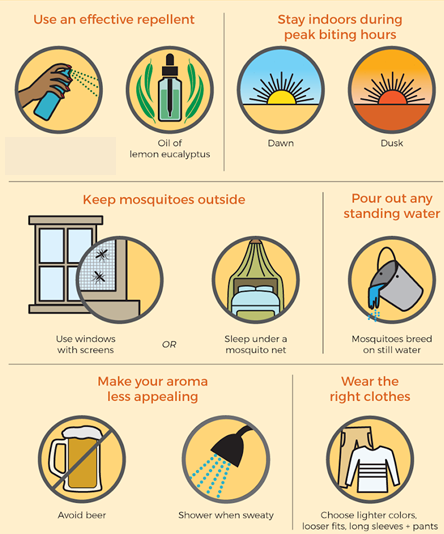
  1. Drain any long standing water: Check flower pots, gutters, bird bath, etc. Ensure there is no water collected inside or near your house. Mosquitoes breed in clean stagnant water.
  2. Many people collect water in the fear of not getting water. This collected clean water is often forgotten overtime and becomes a breeding ground for mosquitoes.
  3. Prevent mosquitoes from coming inside your house. Try using screens on windows, and nets on the bed.
  4. While you cannot stop children from playing outside, make them use the mosquito repellent.
  5. Use Natural Repellents: My grandmother swears by using mustard oil instead of a repellent. Neem oil, putting the Neem oil on a dispenser also seems to act as an excellent organic repellent. See what suits your skin!
  6. Colours, odors and other smells seem to have an impact on attracting the mosquitoes! Since we can’t change that about our bodies, it is best to wear loose, covered clothing during the high breeding seasons.
  7. Citronella mosquito repellent plant, (Citrosum plants) help repel mosquitoes. This plant grows in the form of grass and is 5 to 6 feet tall. It can be planted in the ground or can be kept in large pots.

In case if you notice a high fever along with chills, rashes/ body ache or any bleeding tendencies consult your physician for a correct diagnosis & management. Remember to hydrate yourself (or the person impacted), try to keep the body temperature low by using wet-cold packs on the forehead. While these are emergency measures, it is best to avoid getting into such a situation and taking the necessary precautions.

Prevention is the cure in such situations!

We hope this article helps you stay safe! Do share your thoughts in the comments below! For more on prevention, preventive healthcare and healthy living, check out Healthy Reads. To get guidance and motivation from experts, subscribe to GOQii’s Personalised Health Coaching here.

#BeTheForce

  • « Previous Page
  • 1
  • …
  • 8
  • 9
  • 10
  • 11
  • 12
  • …
  • 19
  • Next Page »

Search

Recent Posts

  • Immunity-Boosting Kadhas: Why Natural Defense Matters During the Monsoon
  • Healthy Eating: Crispy Monsoon Corn Tikkis
  • Antenatal Exercises: Your Guide to a Fit and Healthy Pregnancy
  • Managing Type 2 Diabetes: Dietary Choices and Lifestyle Adjustments for Better Blood Sugar Control
  • Hormones and Longevity: Why Midlife Health Depends on Hormonal Balance

Stay Updated

Archives

  • July 2026 (22)
  • June 2026 (22)
  • May 2026 (20)
  • April 2026 (24)
  • March 2026 (18)
  • February 2026 (14)
  • January 2026 (14)
  • December 2025 (19)
  • November 2025 (15)
  • October 2025 (20)
  • September 2025 (6)
  • August 2025 (6)
  • July 2025 (10)
  • June 2025 (18)
  • May 2025 (16)
  • April 2025 (22)
  • March 2025 (26)
  • February 2025 (21)
  • January 2025 (25)
  • December 2024 (22)
  • November 2024 (22)
  • October 2024 (20)
  • September 2024 (22)
  • August 2024 (28)
  • July 2024 (16)
  • June 2024 (23)
  • May 2024 (26)
  • April 2024 (27)
  • March 2024 (27)
  • February 2024 (23)
  • January 2024 (21)
  • December 2023 (14)
  • November 2023 (10)
  • October 2023 (19)
  • September 2023 (22)
  • August 2023 (16)
  • July 2023 (18)
  • June 2023 (21)
  • May 2023 (20)
  • April 2023 (19)
  • March 2023 (23)
  • February 2023 (19)
  • January 2023 (15)
  • December 2022 (11)
  • November 2022 (15)
  • October 2022 (15)
  • September 2022 (12)
  • August 2022 (9)
  • July 2022 (17)
  • June 2022 (11)
  • May 2022 (10)
  • April 2022 (6)
  • March 2022 (6)
  • February 2022 (13)
  • January 2022 (11)
  • December 2021 (7)
  • November 2021 (3)
  • October 2021 (6)
  • September 2021 (3)
  • August 2021 (8)
  • July 2021 (7)
  • June 2021 (15)
  • May 2021 (16)
  • April 2021 (10)
  • March 2021 (7)
  • February 2021 (4)
  • January 2021 (4)
  • December 2020 (3)
  • November 2020 (4)
  • October 2020 (10)
  • September 2020 (3)
  • August 2020 (3)
  • July 2020 (2)
  • June 2020 (4)
  • May 2020 (10)
  • April 2020 (12)
  • March 2020 (10)
  • February 2020 (4)
  • January 2020 (4)
  • December 2019 (3)
  • November 2019 (7)
  • October 2019 (5)
  • September 2019 (4)
  • August 2019 (9)
  • July 2019 (9)
  • June 2019 (11)
  • May 2019 (4)
  • April 2019 (8)
  • March 2019 (8)
  • February 2019 (9)
  • January 2019 (8)
  • December 2018 (9)
  • November 2018 (3)
  • October 2018 (3)
  • September 2018 (5)
  • August 2018 (10)
  • July 2018 (6)
  • June 2018 (13)
  • May 2018 (8)
  • April 2018 (18)
  • March 2018 (9)
  • February 2018 (8)
  • January 2018 (15)
  • December 2017 (12)
  • November 2017 (19)
  • October 2017 (13)
  • September 2017 (15)
  • August 2017 (4)
  • July 2017 (8)
  • June 2017 (7)
  • May 2017 (6)
  • April 2017 (8)
  • March 2017 (6)
  • February 2017 (7)
  • January 2017 (9)
  • December 2016 (10)
  • November 2016 (7)
  • October 2016 (7)
  • September 2016 (7)
  • August 2016 (11)
  • July 2016 (9)
  • June 2016 (9)
  • May 2016 (12)
  • April 2016 (17)
  • March 2016 (17)
  • February 2016 (8)
  • January 2016 (6)
  • December 2015 (2)
  • November 2015 (9)
  • October 2015 (7)
  • September 2015 (9)
  • August 2015 (11)
  • July 2015 (9)
  • June 2015 (11)
  • May 2015 (9)
  • April 2015 (13)
  • March 2015 (8)
  • February 2015 (5)
  • January 2015 (12)
  • December 2014 (14)
  • November 2014 (11)
  • October 2014 (6)
  • September 2014 (13)
  • August 2014 (12)
  • July 2014 (6)
  • June 2014 (2)
  • May 2014 (7)
  • April 2014 (4)

From Burnout to Balance: How Dr. Ranjit Reclaimed His Health

Dr Ranjit Bhatt has spent years tending to others. A practising doctor in Odisha, his days were packed with patients, surgeries, and emergencies. From the outside, it looked like a life lived in service. But on the inside, something wasn’t right. “I had no … [Read More...]

From Shimla’s Slopes to Chandigarh’s Sidewalks: Surinder Kaur Bhalla’s Journey from Chaos to Control

Some journeys start with a plan. Others begin with a stumble literally. Surinder Bhalla, a government professional, born and raised in the scenic hill town of Shimla, had always lived a life of movement. “In Shimla, you walked everywhere,” she reflects. “Walking was never an exercise. It was just life.” But after shifting to Chandigarh, […]

“I’ve Challenged Myself to Live 100 Years” – The Story of Chandubhai Savani’s Second Chance at Life

At 67, most people start slowing down. Not Chandubhai Savani. A resident of Surat, Chandubhai, thought life was on track. “My life was going well till I had my bypass surgery,” he says. That surgery, back in 2021, was a wake-up call.  Medication was routine, but exercise wasn’t. His diet? What he calls ‘normal.’ “I […]

Ananda Mukherjee Health Story

From Terminal Illness To Complete Wellness! Ananda Mukherjee Health Story

As we observe World Cancer Day under the powerful theme ‘United by Unique’ (2025-2027)**, we are reminded that every individual’s journey with cancer is distinct, yet united by shared resilience, hope, and the collective fight against this disease. This theme places people at the centre of care and their stories at the heart of the […]

  • HOME
  • HEALTHY LIVING
  • FITNESS
  • HEALTHY RECIPES
  • USER STORIES
  • KARMA
  • BUY GOQii

Copyright ©2016 GOQii