At a glance
- The link is real. Across 12 long-term studies, the risk of obesity rose by about 9% for each hour of sleep below seven.
- It is mostly about eating more, not burning less. In pooled trial data, people ate around 385 kcal more per day when their sleep was cut short. The energy they burned barely changed.
- Belly fat seems especially affected. Two weeks of four-hour nights raised deep abdominal fat by 11% in one tightly controlled study.
- More sleep helps. Adults who extended their sleep by about 1.2 hours ate roughly 270 kcal less per day, without any diet advice.
- It runs both ways. Excess weight raises the risk of sleep apnoea, which then disrupts sleep.
- Sleep supports weight management. It does not replace it. It has not yet been shown that sleeping more, with nothing else changed, produces large or lasting weight loss.
Most weight advice comes down to two things: what you eat and how much you move. Sleep usually gets whatever time is left once work, the commute, dinner and the phone have taken theirs, even though sleep and weight gain are closely tied.
That ordering deserves a second look. Over the past two decades, research on sleep and weight gain has moved from noticing that short sleepers tend to weigh more to testing the idea directly: cutting people’s sleep under controlled conditions and measuring what happens to their appetite, their activity and their body fat. The results are consistent enough to act on, and more modest than the headlines suggest.
Does poor sleep cause weight gain?
Yes, it can. Regularly sleeping less than about seven hours a night is linked to a higher risk of gaining weight, and controlled trials show that at least part of that link is cause and effect.
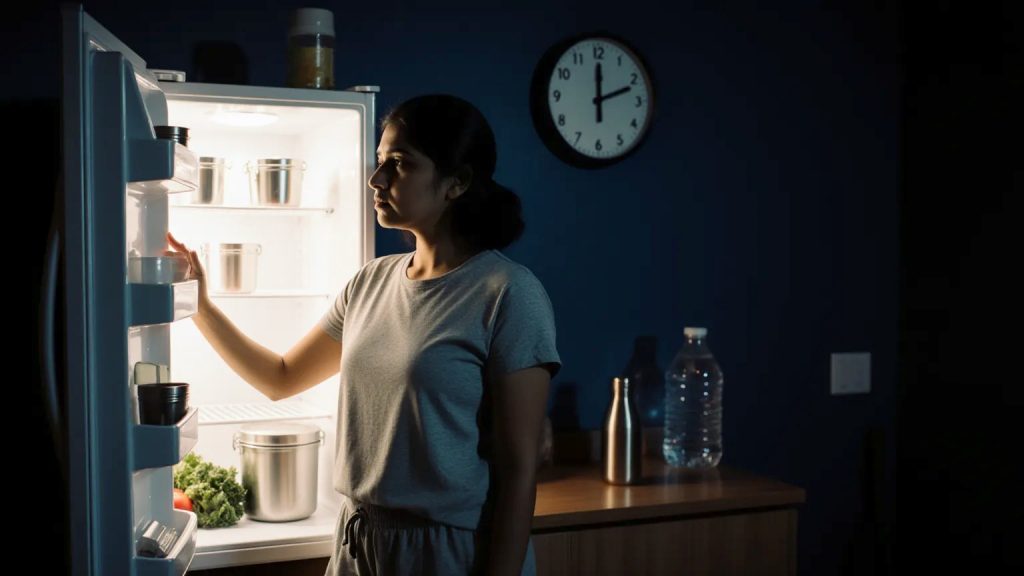
The main route is appetite. People who are short on sleep eat more the next day, particularly in the evening, while burning roughly the same amount of energy. Over weeks, some of that surplus is stored as fat around the abdomen.
Sleep is one of several everyday habits that contribute to weight gain. Diet, physical activity, genetics, age, medicines and medical conditions all influence weight, and a full night’s sleep does not cancel any of them out. What sleep does is make the other things easier or harder to do.
What the research shows
Two kinds of evidence point the same way: large studies that follow people for years, and small experiments that change how long people sleep.
Long-term studies
A 2019 analysis in Sleep and Breathing pooled 12 studies that tracked sleep and weight over time. Obesity risk was lowest at seven to eight hours a night. Below seven, it rose by about 9% for each hour lost. Sleeping longer than that was not clearly linked to obesity either way.
Studies like these cannot prove cause. People who sleep little often differ in other ways: more stress, shift work, illness or low mood. Many also relied on people reporting their own sleep, which is not very accurate.
Sleep experiments
Trials deal with that problem by changing sleep and watching what follows.
| Study | What was changed | What happened |
| Al Khatib et al., 2017: pooled analysis of 11 trials, 172 people | Sleep partly restricted, across several trial designs | Ate about 385 kcal more per day. Energy burned did not change significantly. |
| Covassin et al., 2022: 12 healthy adults living in a research unit | Four hours in bed instead of nine, for 14 nights | Ate over 300 kcal more per day. Gained about 0.5 kg. Deep abdominal fat rose 11%. |
| Zuraikat et al., 2026: 95 adults at home | Bedtime pushed back for six weeks, losing about 80 minutes a night | Gained about 0.45 kg. Was sedentary for 17 minutes longer each day. |
| Tasali et al., 2022: 80 adults with overweight, at home | Sleep extended by about 1.2 hours for two weeks | Ate about 270 kcal less per day than the comparison group. |
How to read these numbers
The effect on any one person in any one week is small. Half a kilogram in six weeks is easy to miss. The concern is the slow drift when short nights become the routine for years.
The trials have limits too. Most are small and brief, and several used far harsher sleep loss than most people live with. The 2026 study matters because it tested something ordinary: going to bed about an hour and a half late.
How lack of sleep leads to weight gain
Short sleep does not act through one switch. Several small changes push in the same direction.
1. You eat more, and mostly late
More hours awake means more chances to eat, and the extra tends to arrive at night. In a 2013 study in Sleep, adults limited to four hours in bed, from 4 am to 8 am, ate an average of 553 extra kcal during the late-night hours.
This is the most consistent finding in the field. It is also the most useful one, because it is something you can plan around, for example by eating in line with your body clock.
2. High-calorie food becomes harder to resist
Tiredness changes what you want, not only how much. In a brain-imaging study of 23 adults, a night without sleep dulled activity in frontal regions involved in weighing up choices and heightened the response of the amygdala, a region involved in how appealing something feels.
Participants wanted high-calorie foods more. Their reported hunger did not change. That fits a familiar experience: after a bad night you are not hungrier for dal and vegetables, you are drawn to biscuits, namkeen and something sweet with your chai.
3. Hunger hormones may shift, though the evidence is mixed
This is the explanation you will read most often: sleep loss lowers leptin, which signals fullness, and raises ghrelin, which signals hunger. It comes from a well-known 2004 experiment in 12 young men. After two nights of four hours in bed, leptin fell 18%, ghrelin rose 28% and appetite rose 24%.
Later studies have not always agreed. A 2025 meta-analysis of six randomised trials concluded that sleep deprivation “does not consistently affect leptin and ghrelin levels”. A 2021 review found leptin reported as lower, unchanged and higher across studies.
Hormones probably play a part. The evidence that tired people eat more is much firmer than the evidence for exactly why.
4. You move a little less
In the 2026 trial, people were sedentary for about 17 minutes longer each day during the weeks of shorter sleep. That is a small amount, repeated daily. A planned workout is also easier to skip when you are tired.
5. Your body handles sugar less well
In a two-week study of 36 healthy adults, five-hour nights reduced insulin sensitivity by 13%. Lower insulin sensitivity is an early step on the road to type 2 diabetes.
6. More of the extra is stored around the abdomen
In the Mayo Clinic study, total abdominal fat rose 9% and visceral fat, the deep fat around the organs, rose 11% compared with normal sleep. Body weight went up by only about half a kilogram, so the scales alone would have missed it.
This matters in India in particular. In the ICMR-INDIAB national survey, 39.5% of adults had abdominal obesity, a pattern closely tied to heart disease and diabetes.
Weight can disrupt sleep too
The link runs in both directions. Obesity is one of the main risk factors for obstructive sleep apnoea, in which the airway narrows during sleep and breathing repeatedly stops and starts.
Each pause briefly rouses the brain, often without the person knowing. The result is a full night in bed and very little rest, followed by a tired day that makes activity harder and snacking easier.
The NHS lists these signs of sleep apnoea:
- Breathing that stops and starts during sleep
- Gasping, snorting or choking noises
- Loud snoring
- Waking often in the night
- Feeling very tired in the day, with poor concentration or headaches on waking
A partner usually notices before you do. Sleep apnoea is treatable, and losing weight can improve it, so the loop can be broken from either side.
When to speak to a doctor
Book an appointment if any of these apply:
- You have the signs of sleep apnoea listed above.
- You have struggled to fall asleep or stay asleep for three months or more.
- You sleep seven hours or more and still feel exhausted.
- Your weight has changed noticeably without a clear reason.
Several medical conditions and some medicines affect both sleep and weight. A doctor can check for these. Do not stop a prescribed medicine without advice.
Can sleeping more help you lose weight?
It can help, and it is not a weight-loss method in its own right. Three findings show where the benefit lies.
Sleeping longer reduced how much people ate. In the University of Chicago trial, 80 adults with overweight who slept under six and a half hours had one counselling session on sleep habits. They slept about 1.2 hours longer and ate around 270 kcal less per day than the comparison group. Nobody gave them diet advice. The trial lasted two weeks and was not designed to measure weight loss.
Short sleep made a diet less effective. In a small study of 10 adults on a reduced-calorie diet, people lost about 3 kg in two weeks whether they had 8.5 or 5.5 hours in bed. With less sleep, only about 0.6 kg of that was fat, against 1.4 kg with more sleep. The rest was lean tissue, including muscle, which is one reason sleep matters for muscle recovery. They also felt hungrier.
Weekend lie-ins did not undo the week. In the two-week study of 36 adults, one group slept five hours on work nights and as long as they liked over the weekend. They still gained about 1.4 kg, the same as the group kept on five hours throughout, and their late-night snacking returned as soon as the short nights did.
Put together: enough sleep, most nights, makes eating sensibly and staying active easier, and helps a diet take fat instead of muscle. Longer-term trials are still needed to show how much weight this shifts over years.
What to do about it
For general advice, see our 12 science-backed tips for better sleep. The steps below are aimed at the specific ways short sleep affects weight.
- Find your real number. Track your sleep for two weeks with a wearable or a simple diary, then look at the average, not your best night. Sleep experts recommend seven or more hours for adults. If you are well short, that gap is your target.
- Fix the wake-up time first. Get up at the same time every day, then move bedtime earlier in steps of 15 to 20 minutes. Small shifts tend to be easier to keep than a sudden jump of an hour.
- Give the kitchen a closing time. The extra calories arrive late, so decide in advance when eating ends, ideally two to three hours before bed. If work keeps you up, plan one proper snack in place of open-ended grazing.
- Expect the cravings after a bad night. You will want sweet, salty and fried food more than usual. Knowing this helps. Eat your normal meals on time, keep snacks out of arm’s reach and avoid ordering in while tired.
- Move anyway, at lower intensity. Tired days are when sitting creeps up. A 15-minute walk after lunch and dinner is worth more than a missed workout you meant to do.
- Keep weekends close to weekdays. Aim to stay within about an hour of your usual times. Catch-up sleep feels good and does not fully clear a week of sleep debt.
- Protect the last hour. Caffeine after mid-afternoon, alcohol near bedtime and a phone in bed can all cut into sleep. Put the phone to charge outside the bedroom if you can.
If your schedule is not in your hands
Shift workers, new parents and carers cannot simply go to bed earlier. A review of 28 studies found night-shift workers had a 23% higher risk of overweight or obesity, with the strongest link for abdominal obesity.
If this is you, the same priorities apply in a different order. Protect one main block of sleep in a dark, quiet room. Plan what you will eat before the shift starts, so the small hours are not left to the vending machine or the delivery app. Take naps when you can get them.
None of this is a failure of willpower. Being short of sleep makes food harder to manage for everyone.
The takeaway
Sleep will not do the work of a balanced diet and regular movement. It decides how hard that work feels. If your weight has been creeping up and your nights have been getting shorter, the two may be connected, and sleep is a reasonable place to start.
Pro Tip: Not sure how much you sleep? Use the GOQii App to track your sleep, activity and meals side by side for two weeks. Your GOQii Personalised Health Coach can help you spot how short nights show up in your eating and build a routine that suits your schedule.
Frequently asked questions
How many hours of sleep do I need to avoid weight gain?
Most adults need seven or more hours a night. In long-term studies, obesity risk was lowest at seven to eight hours. Needs vary between people, and those studies found no added benefit for weight from sleeping longer.
Does lack of sleep slow your metabolism?
Not by much. In pooled trial data, the energy people burned did not change significantly when sleep was restricted. The weight gain comes mainly from eating more, about 385 kcal a day on average.
Can lack of sleep cause belly fat?
It appears to contribute. In a controlled study, two weeks of four-hour nights increased visceral fat by 11% compared with normal sleep, even though body weight rose by only about half a kilogram. The study was small, with 12 participants.
Why do I crave junk food when I am tired?
Sleep loss changes how the brain responds to food. Brain scans show weaker activity in regions that weigh up choices and a stronger response in a region tied to how appealing food feels. People want richer food without necessarily feeling hungrier.
Will sleeping more help me lose weight?
It can support weight loss and is unlikely to cause it alone. In one trial, adults who slept about 1.2 hours longer ate around 270 kcal less per day. Whether that leads to lasting weight loss has not yet been tested in long-term trials.
Can I catch up on sleep at the weekend?
Only partly. In a two-week study, people who slept in over the weekend after five-hour weeknights still gained weight and still showed reduced insulin sensitivity. Regular sleep through the week works better.
Can sleeping too much cause weight gain?
The evidence is weak. In a pooled analysis of long-term studies, longer sleep was not significantly linked to obesity. Regularly needing much more sleep than usual, or sleeping long and still feeling tired, is worth raising with a doctor.
#BeTheForce
Disclaimer: This article is for general information and education only. It is not a substitute for professional medical advice, diagnosis or treatment. If you have ongoing sleep problems, symptoms of sleep apnoea, unexplained changes in weight or a long-term health condition, please speak to a qualified healthcare professional before making changes to your routine.
 What makes your morning better? Is it the bright morning sun, ushering in a new day with its warm rays? Or the melodious chirping of birds? Is it the fresh aromas of flowers or morning dew? If you thought of a freshly brewed cup of coffee, a newspaper and sitting under a blue sky, then we have a lot in common!
 The Big Question – Can understanding how alcohol affects your metabolism help you make healthier choices?


