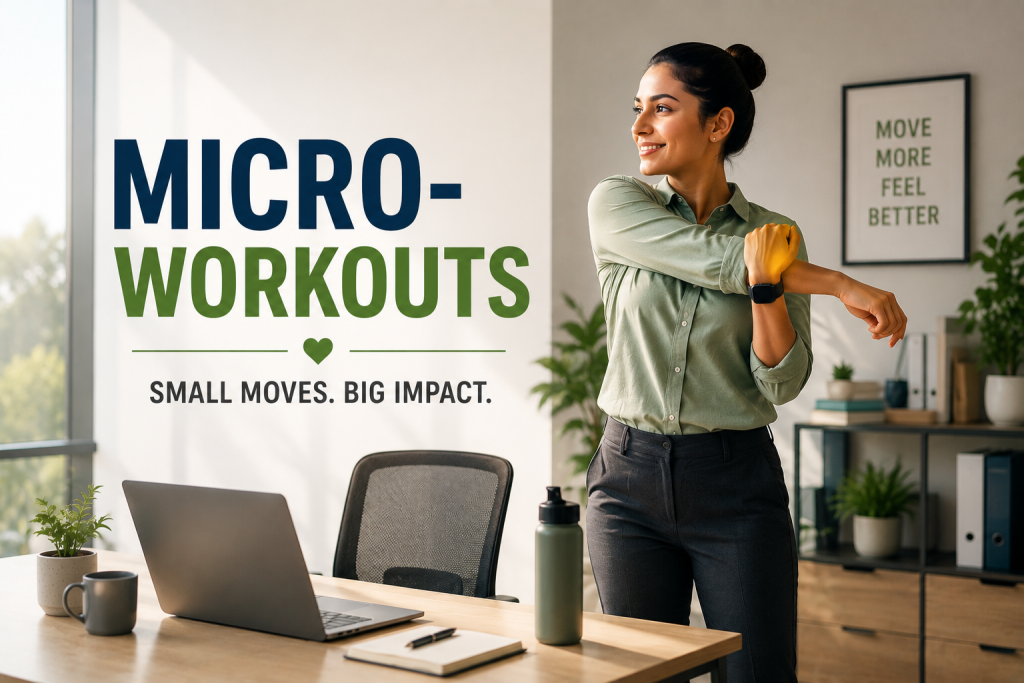
 The Big Question: If you don’t have time for a 60-minute gym session, is skipping your workout entirely the only other option?
For many people, staying active feels like an all-or-nothing commitment. When a busy schedule pushes a long run or a structured fitness class off your priority list, it is easy to assume the day is a total fitness loss. However, cutting-edge exercise physiology is completely redefining that narrative. You do not need a massive block of free time to protect your body. Brief, intentional bursts of movement distributed throughout your day frequently called micro-workouts or exercise snacks can radically improve your metabolic health, clear away brain fog, and lower the cellular damage caused by a desk-bound lifestyle.
Between tight work deadlines, family responsibilities, long daily commutes, and endless screen time, finding a dedicated hour for fitness can often feel nearly impossible.
But what if improving your physical health didn’t require a full, exhaustive workout? What if just a few minutes of low-impact movement, repeated consistently throughout the day, could create a powerful, long-term difference?
While they may seem minor in isolation, these micro-workouts can be seamlessly woven into your existing routine. Over time, they add up to powerful health benefits, serving as an exceptional defense system in a world where many of us spend the vast majority of our waking hours sitting still.
The Hidden Problem with Sitting All Day
Modern professional and personal lifestyles have made human beings more sedentary than ever before. Many of us spend consecutive hours sitting at a desk, attending virtual meetings, driving, scrolling through smartphones, and relaxing in front of a television screen after a long day.
Even if you manage to squeeze in a highly disciplined workout before or after your workday, prolonged periods of uninterrupted sitting can still silently work against your health.
Clinical research has consistently linked excessive, unbroken sedentary behavior with a significantly higher risk of:
- Type 2 diabetes and severe insulin resistance
- Chronic cardiovascular disease and poor circulation
- Stubborn visceral weight gain around the abdomen
- General downregulation of metabolic flexibility
- Premature all-cause mortality
This does not mean your morning gym session or evening run is useless far from it. Regular structured training is fantastic for building muscular strength and aerobic capacity. However, emerging research in lifestyle medicine demonstrates that what you choose to do during the other 23 hours of the day matters just as much for your longevity.
Why One Workout Isn’t Always Enough
Imagine a typical day: you spend nine hours sitting relatively motionless at your office desk, followed by a one-hour weight-lifting or cardio session in the evening. While that evening workout is undeniably beneficial, your body has still spent roughly 90% of its daylight hours completely inactive.
Our skeletal muscles and circulatory systems are biologically designed to move regularly. When you remain seated and uninterrupted for hours at a time, your glucose tracking receptors, known as GLUT4 pathways, essentially go to sleep. This causes blood sugar spikes to linger and slows your overall metabolism.
By inserting a short micro-workout into your day, you trigger immediate muscle contractions that force those receptors to pull sugar straight out of your bloodstream without needing insulin at all, giving your body a vital chemical reset.
This is why preventive health experts are increasingly encouraging people to focus not only on structured exercise but also on actively reducing prolonged periods of total inactivity. The ultimate goal isn’t simply to exercise more intensely; it is to sit less and move more often throughout the day.
What Exactly Are Micro-Workouts?
Micro-workouts are short, bite-sized bursts of physical activity that typically last anywhere between 30 seconds and 10 minutes. Instead of forcing yourself to block out a single, large chunk of time in your schedule, you elegantly spread your physical movement across the entire day.
The absolute beauty of micro-workouts is their complete simplicity. They require no expensive gym memberships, no specialized exercise equipment, and no complicated programming. They are simply intentional moments of functional human movement.
The Compounding Power of Everyday Movement (NEAT)
One of the most overlooked aspects of metabolic health is something known as Non-Exercise Activity Thermogenesis (NEAT). NEAT refers to all the energy and calories your body burns performing everyday tasks outside of structured sports or gym workouts.
This includes common daily actions such as:
- Walking over to a colleague’s desk instead of sending an email
- Choosing to take the stairs instead of riding an escalator
- Carrying your own groceries to the car
- Alternating to a standing posture while working at your desk
- Completing basic household chores and stretching out your limbs
These movements may not feel like formal exercise, but collectively they contribute significantly to your daily energy expenditure and overall cardiovascular vitality. In many cases, consistently increasing your daily NEAT through micro-workouts is far more sustainable and less stressful on your joints than relying solely on high-intensity workout sessions.
Why Exercise Snacks Work for Busy Professionals
The number one barrier to a consistent lifestyle routine is a perceived lack of time. Micro-workouts completely remove that mental obstacle because they fit effortlessly into the small gaps that already exist within your day.
They don’t require you to change your clothes, travel to a fitness facility, or disrupt your calendar. A quick two-minute stair climb between tasks, a five-minute walk after eating lunch, or ten bodyweight squats while waiting for a video call to connect are small actions that are highly sustainable. When it comes to protecting your long-term health, consistency almost always beats perfection.
5 Easy Micro-Workouts You Can Start Today
To transform your day from sedentary to active, try introducing these five simple “exercise snacks” into your normal routine:
- The Post-Meal Walk: Take a brisk 5-to-10-minute walk immediately after finishing a meal to help your muscles naturally absorb glucose and flatten blood sugar spikes.
- The Staircase Option: Commit to completely skipping the elevator whenever a flight of stairs is available.
- The Hourly Movement Alarm: Set a silent reminder on your phone to prompt you to stand up every 60 minutes and perform 10 bodyweight squats or 10 calf raises.
- The Mobile Meeting: If a phone call or virtual meeting doesn’t require you to look at a presentation screen, use that time to pace around your room or office while you talk.
- The Waiting Window: While waiting for your morning coffee or kettle to boil, use that open minute to perform light upper-body stretches or march dynamically in place.
Structured Exercise vs. Continuous Daily Movement
| Metric | Structured Gym Training | Micro-Workout Movement (NEAT) |
| Primary Goal | Builds raw athletic strength and aerobic stamina | Lowers sedentary risk and stabilizes blood sugar |
| Time Investment | 60 continuous minutes | 1 to 5 minutes distributed hourly |
| Equipment Need | Weights, machines, or specialized facilities | None—uses natural body weight |
Many people assume that physical health improvements can only be earned through grueling, intense gym sessions. The scientific truth is much simpler: long-term health is built through small, consistent habits repeated over time.
A person who moves regularly throughout the day provides their circulatory and metabolic systems with a more consistent health benefit than someone who exercises intensely for an hour but remains completely stationary for the remaining hours.
This doesn’t mean you should abandon your current gym routine. Rather, think of micro-workouts as a powerful, necessary complement to your existing fitness habits. The combination of regular exercise and frequent daily movement is where true metabolic health happens. Every single minute counts!
Pro Tip: Successfully shifting to a more active lifestyle requires clear awareness of your daily habits. Use the GOQii App to track your total daily steps and log your active movement patterns across the day. You can easily share this data with your GOQii Personalised Health Coach to identify hidden opportunities for movement and co-create an easy, highly sustainable micro-workout plan built perfectly around your professional schedule!
Frequently Asked Questions (FAQs)
- Can a routine of micro-workouts completely replace my standard gym sessions?
Not entirely. Traditional, longer workouts are required to build maximum muscular strength, bone density, and peak cardiorespiratory fitness. Micro-workouts are specifically designed to reduce sedentary time, keep your circulation flowing, and optimize blood sugar processing throughout your working hours. For the best longevity results, use them together.
- How many micro-workouts should I realistically aim to complete each day?
A highly effective strategy is to aim to break up your seated desk time once every 60 to 90 minutes. Completing between 3 to 5 short movement snacks (lasting anywhere from 2 to 5 minutes each) across a standard 8-hour workday is enough to provide massive improvements to your metabolic health markers.
- Do I need to buy any specialized resistance bands or equipment for this?
No, absolutely not. The core philosophy of an exercise snack is zero friction. You utilize your own natural body weight and your immediate physical surroundings—such as walking down hallways, using stairwells, or doing standard bodyweight squats, desk lunges, and standing stretches.
- Are micro-workouts safe and appropriate for older adults?
Yes, they are exceptional for older adults. Because micro-workouts are short and easily controlled, the intensity and choice of movement can be adapted to perfectly match any fitness level, balance capability, or pre-existing joint condition. It is a fantastic, low-stress way to maintain daily mobility.
#BeTheForce
Disclaimer: This article is intended for educational and informational purposes only. It is not intended to replace professional medical advice, clinical diagnosis, or treatment. Always consult your primary care physician or a qualified healthcare specialist before making major changes to your physical activity levels, especially if you have an underlying chronic health condition.




Leave a Reply