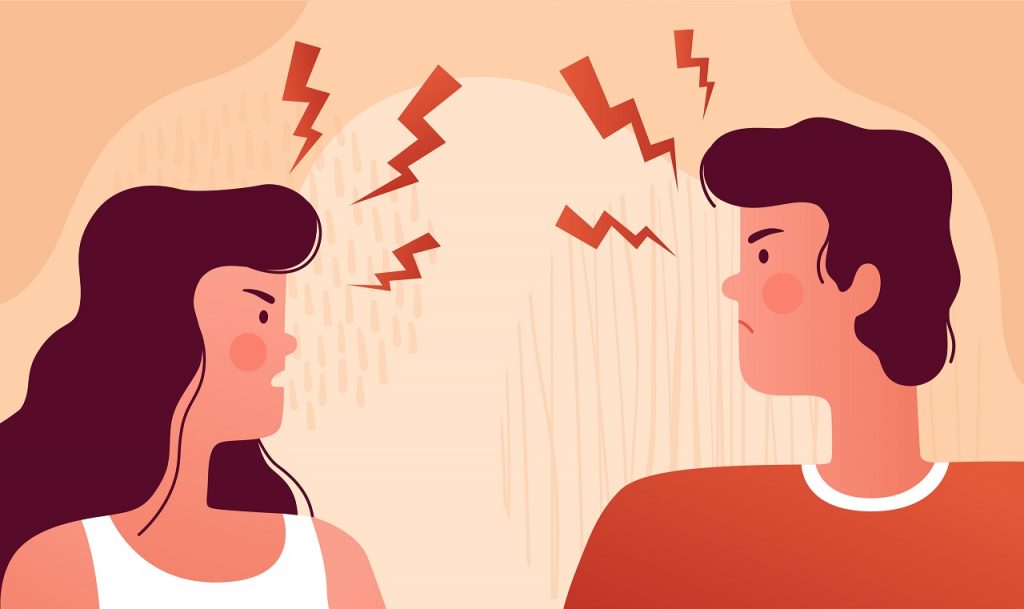
 The Big Question: How does a forgotten chore or a delayed text message suddenly spiral into a multi-day emotional cold war?
Human relationships are deeply subjective networks built on individual perceptions. When a misunderstanding occurs, the primitive threat centers of the brain view a partner’s differing viewpoint as an emotional attack, triggering a cascade of defensive adrenaline. Arguments escalate not because of the literal issue at hand, but because the minor incident triggers deep-seated core wounds of feeling unseen, unappreciated, or abandoned. Breaking this cycle requires moving away from defensive “mind-reading” and establishing a structured framework of emotional attunement and mutual curiosity.
Have you ever found yourself in the middle of a screaming match or a heavy, silent standoff with your partner, only to wonder hours later: “How on earth did something so incredibly small turn into such a massive fight?”
Perhaps the spark was entirely trivial—a forgotten phone call on the way home, an unplanned household decision made without consulting you, a delayed text message, or a casual comment that was interpreted through a defensive lens.
What begins as a minor miscommunication can snowball into intense hurt feelings, profound frustration, and days of painful emotional distance. The underlying truth of relationship therapy is that the vast majority of conflicts are not sparked by major betrayals or sudden, catastrophic events. They are fueled by everyday couple misunderstandings that get out of hand.
While these disconnects are a natural byproduct of intimacy, how you choose to handle them dictates whether your partnership grows apart or builds a stronger bond.
Why Misunderstandings Are Wired Into Relationships
One of the most destructive myths popularized by romantic culture is the idea that if two people truly love each other, they should instinctively and naturally understand one another’s minds.
In reality, every single individual steps into a relationship carrying a massive, invisible suitcase filled with unique life experiences, core values, unvoiced expectations, family-of-origin blueprints, and distinct communication styles. What feels completely normal and logical to one person can easily feel neglectful, chaotic, or confusing to another.
Consider these common psychological mismatches:
- The Emotional Processor vs. The Rejection Alarm: One partner utilizes silence as a constructive, necessary tool to de-escalate their nervous system and process heavy emotions internally. The other partner, however, interprets that exact same silence as cold emotional abandonment and active rejection.
- The Independent Decider vs. The Inconsiderate Tag: One partner makes independent daily choices because they were raised in an environment that heavily rewarded self-reliance. The other partner interprets that exact same behavior as a selfish, inconsiderate disregard for the team.
In these everyday scenarios, neither individual is factually wrong or behaving maliciously. They are simply viewing the exact same reality through entirely different psychological lenses.
The Real Reason Minor Disagreements Hurt So Much
To break the cycle of escalating arguments, couples must understand that the fight is almost never about the surface topic. It is entirely about what that topic represents on a deeper, symbolic level.
A forgotten anniversary or a missed dinner reservation isn’t a rational debate about scheduling; it triggers an internal narrative of: “I am invisible. My presence doesn’t matter to you.” A partner arriving home late without sending a quick text rolls into the subconscious mind as: “My time and my feelings are completely unimportant to you.”
When your partner misunderstands your words or actions, your brain doesn’t just register slight irritation—it triggers a profound sense of isolation. One of the absolute deepest human imperatives is the primal desire to be accurately “seen,” heard, and emotionally validated by the people we love. When that attunement fails, the ego immediately builds a wall of defensive armor to protect itself from further pain.
5 Core Habits to Stop the Conflict Spiral
If you want to transform moments of sudden friction into catalysts for emotional closeness, integrate these five core relational habits into your daily life:
-
Accept That Misunderstandings Are Biologically Inevitable
Stop treating the presence of an argument as definitive proof that your relationship is failing or that you are inherently incompatible. Misunderstandings are a statistical certainty whenever two complex human minds merge their lives.
When a disconnect happens, shift your internal questioning away from a defensive, panicked mode (“Why are we fighting again?”) and lean into a constructive framework: “What underlying expectation or past wound is this disagreement trying to reveal to us?”
-
Move From a Stance of Self-Defense to Radical Curiosity
The exact moment conflict erupts, your body’s sympathetic nervous system fires up, and you instinctively begin compiling a mental legal defense to protect your character. You focus entirely on explaining your good intentions, rationalizing your behavior, or proving why your point of view is the objective truth. This defensive posturing guarantees your partner feels dismissed.
To break this pattern, pause, take a deep breath to ground your body, and choose curiosity over self-defense. Use validating, open-ended questions to learn what parts of your actions felt most upsetting, look at the situation from their side of the room, and discover what you might be missing about their experience.
-
Replace Mind-Reading Stories with Direct Questions
The human brain is a prediction machine that absolutely despises ambiguity. When your partner behaves in a way that leaves an informational blank, your mind will automatically fill in that blank with a highly dramatic story—usually written with the ink of your deepest personal insecurities.
When your partner exhibits ambiguous behavior, your mind naturally rushes to fill in the blanks with a protective “mind-reading” story, which quickly drives up emotional reactivity and escalates the conflict. Breaking this downward spiral requires a mindful pause and a deep breath to calm your nervous system. By replacing your internal assumptions with an open, clarifying question, you instantly introduce structural clarity into the conversation and open the door for genuine data-gathering.
-
Speak Your Raw Experience—Not Your Summary Judgments
One of the fastest ways to guarantee an argument escalates into a screaming match is to launch a character attack. Labeling your partner forces them into an aggressive defensive posture.
When raising a grievance, always utilize strict “I” statements that anchor the conversation to your immediate emotional reality rather than your global conclusions about their character. Instead of using sweeping accusations like “You are an incredibly selfish person who never thinks about anyone else,” speak strictly to your raw vulnerability: “I felt incredibly hurt, unseen, and overwhelmed when that decision was finalized without us discussing it together first.”
-
Establish a Baseline Assumption of Benevolence
Not every human mistake is a calculated act of disrespect. Not every conversational misfire is a sign of rejection. Unless you are dealing with a toxic dynamic, operate under the unshakeable premise that the person you chose to build a life with is not actively plotting to hurt your feelings.
They may be under intense professional stress, highly distracted, completely exhausted, or simply unaware of the structural impact of their actions. Before assigning a malicious motive, pause and actively ask yourself: “What is an alternative, charitable explanation for why they behaved this way?”
Recognizing the Hidden Fuel: Stress and Exhaustion
Many couples burn through thousands of hours trying to fix their communication skills, when the real culprit isn’t their relationship at all—it is their depleted physiological state.
Your capacity for emotional regulation, patience, perspective-taking, and marine communication lives entirely in your brain’s prefrontal cortex. When you are operating under conditions of chronic sleep restriction, intense work pressure, or emotional burnout, your prefrontal cortex suffers from a profound energy deficit. As a result, your hyper-reactive emotional center—the amygdala—takes complete control.
When your biological reserves are empty, a minor misunderstanding that you would normally laugh off on a relaxed weekend feels like a direct attack on your security. Relationship health and personal physical wellbeing are deeply intertwined. Managing your daily sleep architecture, hydration, and central nervous system stress is a foundational requirement for having calm, loving conversations with your partner.
The Relational Repair Framework
| The Destructive Communication Spiral | The Restorative Rebalancing Tool |
| Defensive Armor & Cross-Complaining | Step out of the courtroom. Swap proving you are “right” for learning why your partner is hurt. |
| Mind-Reading & Fabricated Stories | Leave the assumption warehouse. Ask open-ended, clarifying questions to gather real data. |
| Character Assassination & “You” Attacks | Focus entirely on your experience. Speak your vulnerability, not your absolute conclusions. |
A thriving, resilient relationship is not defined by an artificial absence of arguments; it is defined by the speed, safety, and depth of your emotional repair. Disagreements are an expected element of sharing a life with another human being.
The goal of your partnership shouldn’t be to avoid conflict at all costs, but to prevent emotional disconnection. By replacing judgment with curiosity, accusations with open questions, and character attacks with vulnerable sharing, you can transform moments of intense frustration into profound anchors of mutual trust, lasting intimacy, and safety.
Pro Tip: Emotional regulation and relationship harmony are deeply bound to your lifestyle choices. Use the GOQii App to log your daily stress indicators, track your sleep cycles, and record your mindfulness minutes. Taking just 5 to 10 minutes to calm your own nervous system before addressing a sensitive topic with your partner ensures you communicate from a place of grounded clarity rather than reactive exhaustion!
Frequently Asked Questions (FAQs)
- Is it normal for a happy, healthy couple to have misunderstandings on a regular basis?
Yes, absolutely. Having regular misunderstandings is a completely normal aspect of any healthy long-term relationship. Two unique individuals with different family upbringings, personality matrices, and neurological wiring cannot align perfectly 100% of the time. What separates healthy couples from distressed ones is not the absence of misunderstandings, but their shared commitment to repairing them calmly without resorting to contempt or character attacks.
- Why do small household issues frequently explode into massive arguments?
Small issues explode because the argument isn’t actually about the dishes, the laundry, or the late text message. The small event acts as a trigger for a much deeper, unvoiced emotional concern. To your subconscious mind, the physical oversight gets translated into a painful relational story, such as: “I am not important to you,” or “My contribution to this team is invisible.” The fight escalates because both partners are reacting to the hidden emotional injury rather than the surface event.
- How can I train my brain to stop automatically assuming the worst about my partner’s motives?
To break this defensive habit, implement a mandatory cognitive pause the moment you feel your chest tighten during a disagreement. Before you speak or react, explicitly tell yourself: “I am creating a story in my head right now. Let me gather real data before I launch an attack.” Then, replace your accusation with a vulnerable inquiry: “When you didn’t respond to my call, my anxiety spiked and I started telling myself you were ignoring me. Can you tell me what was going on on your end?”
- Can chronic lifestyle stress and lack of sleep genuinely ruin a relationship’s communication?
Yes, profoundly. When you are chronically sleep-deprived or suffering from professional burnout, your brain’s prefrontal cortex loses its capacity to regulate emotions and govern your impulse control. This leaves your amygdala in charge, driving you into an immediate fight-or-flight response. Under these physiological conditions, your patience drops to zero, and your brain is heavily wired to view any ambiguous comment from your partner as a direct threat, dramatically increasing the frequency of explosive fights.
#BeTheForce
Disclaimer: This article is intended for educational and informational purposes only. It is not intended to replace professional relationship counseling, clinical marriage therapy, or medical mental health advice. If your relationship is experiencing severe emotional distress, persistent hostility, psychological abuse, or safety concerns, please immediately consult a licensed relationship therapist or a certified family counselor.




Thank you very much for this amazing post. I admire your inspiring and motivating works and I would love to read more of your great article.