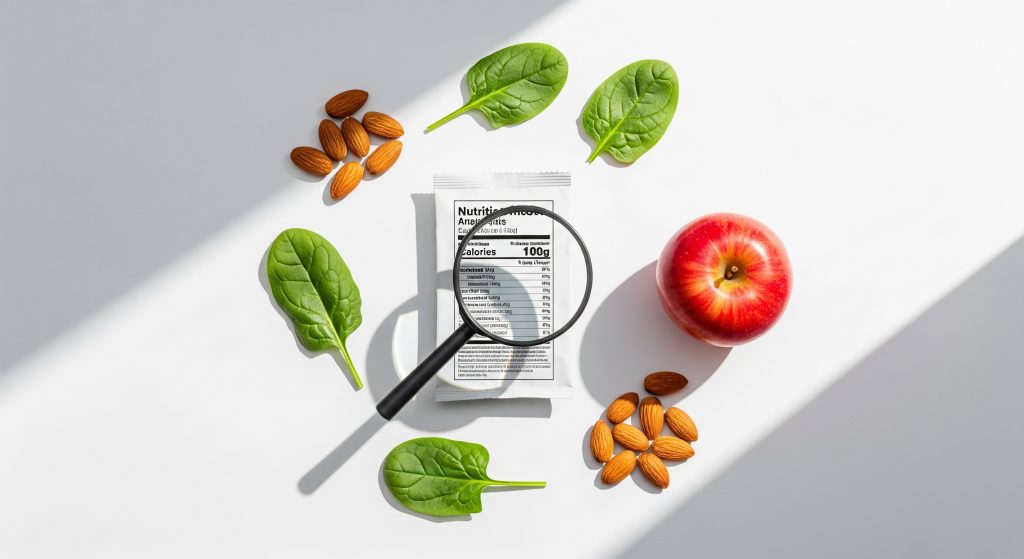
 Walking down the supermarket aisle, you’re bombarded with choices—”low fat,” “high protein,” “sugar-free,” “natural.” But what do these claims really mean? How do you know if a product is genuinely healthy or just smartly marketed? The answer lies in the fine print: the food label.
Reading food labels can feel like cracking a code, but once you know what to look for, it becomes second nature—and empowers you to make healthier, smarter decisions for yourself and your family.
Let’s break it down into simple, actionable steps with a few nutritionist-approved pro tips!
-
Start With the Ingredients List 📝
This is where the truth of the product lies. Ingredients are listed in order of quantity, from most to least. If sugar, salt, or refined flour are among the first three, it’s a red flag.
- Choose products with whole, recognisable ingredients.
- Fewer ingredients usually mean less processing.
💡 Pro Tip: Ingredients like high fructose corn syrup, maltose, dextrose, or anything ending in “-ose” are forms of sugar. The same goes for hydrogenated oils, which signal unhealthy trans fats.
-
Serving Size vs. Reality 🍿
The label might say 120 calories per serving—but what’s a serving? 5 crackers? Half a chocolate bar? Often, the serving size is much smaller than what we typically consume.
- Always check the number of servings per package.
- If you eat double the serving size, you’re getting double the calories, fat, and sugar.
💡 Pro Tip: For single-serve snacks, don’t assume the whole pack is one serving. Check to avoid underestimating your intake.
-
Understanding Nutrition Per 100g vs. Per Serving 📊
Many labels show nutrition per 100g and per serving.
- Use per 100g to compare products easily.
- Use per serving to track your intake.
💡 Pro Tip: If you’re comparing two products, always use the per 100g column to avoid being misled by serving sizes that vary between brands.
-
Know Your Daily Reference Intakes (RI) 📅
Labels often list percentages of nutrients based on a daily reference intake (also called Daily Value). These help you understand how much of a nutrient you’re getting per portion.
- Aim for high %RI in fibre, protein, vitamins, and minerals.
- Aim for low %RI in saturated fat, sugar, and salt.
💡 Pro Tip: A %RI of 5% or less is low; 20% or more is high. Use this to gauge whether a food is helping or hindering your goals.
-
Nutrients to Prioritise ✅
- Fibre: Go for 3g or more per serving. Fibre keeps you full, supports digestion, and stabilises blood sugar.
- Protein: Helps with satiety and muscle maintenance—look for at least 5-10g per serving in snacks.
- Vitamins & Minerals: Check for iron, calcium, vitamin D, and B vitamins. These often get overlooked!
-
Nutrients to Watch Out For ⚠️
- Added Sugars: Ideally less than 5g per serving. Sugar is often hidden in “healthy” foods like yoghurt and granola.
- Saturated Fat: Keep this below 1.5g per 100g for a healthy heart.
- Salt (Sodium): Aim for less than 0.3g per 100g. High salt intake can raise blood pressure.
💡 Pro Tip: Some products list sodium instead of salt. Multiply sodium by 2.5 to get the salt equivalent.
-
Don’t Fall for Buzzwords ❌
“Natural,” “low fat,” “no added sugar”—these claims can be misleading.
- “Low fat” might mean high sugar.
- “No added sugar” doesn’t mean sugar-free—fruit concentrates count!
- “Gluten-free” doesn’t mean healthy—many such products are high in fat or sugar.
-
Example: Comparing Two Granola Bars 🍫 vs. 🥜
|
Nutrient |
Bar A | Bar B |
| Calories | 200 | 160 |
| Sugar | 12g | 5g |
| Fibre | 2g | 5g |
| Protein | 3g | 6g |
✔ Bar B wins—lower sugar, higher fibre and protein, fewer calories. Always check beyond the front label!
Understanding food labels helps you cut through the noise, take control of your health, and make empowered choices. It’s not about perfection—it’s about making informed swaps that add up over time.
Next time you shop, take a closer look. Your future self will thank you for every smarter bite.
💬 Do you check labels regularly? What’s the biggest surprise you’ve found? Let us know in the comments!
#BeTheForce
Disclaimer: The information provided in this blog is for general awareness and educational purposes only. It is not intended to replace professional medical advice, diagnosis, or treatment. Always consult a qualified healthcare provider for personalised medical guidance or concerns related to your health.
 Polycystic Ovary Syndrome (PCOS) is more common than you might think. Affecting 1 in 10 women of reproductive age globally, it’s a hormonal condition that can often go undiagnosed for years—leaving many to silently struggle with irregular periods, weight gain, acne, or mood swings, without truly knowing why.