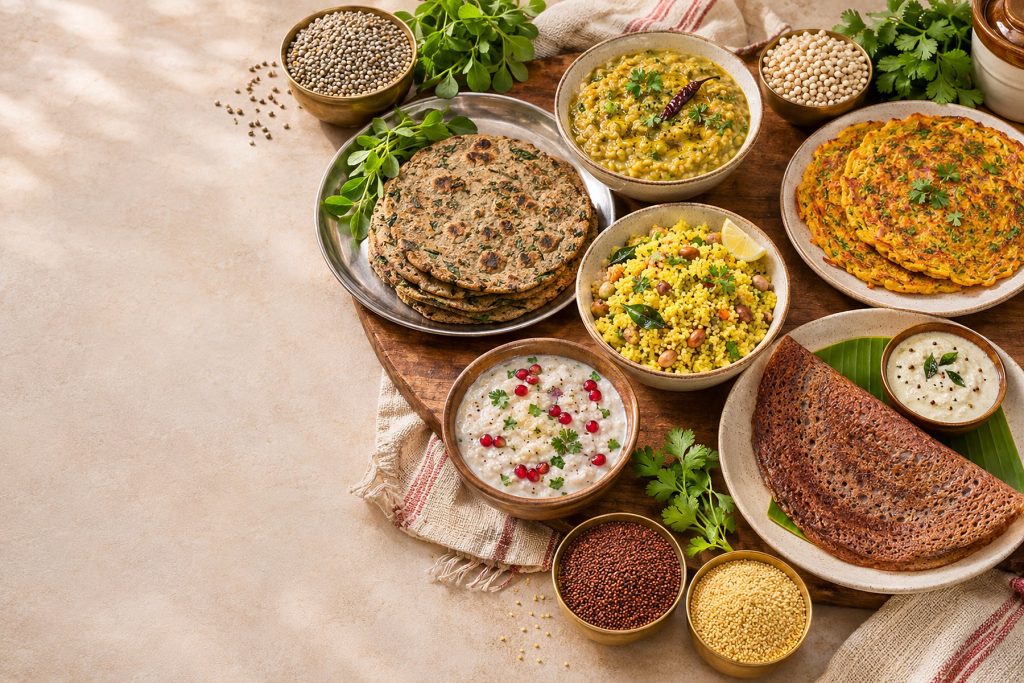
Bajra roti with a dollop of white butter, jowar bhakri with pitla, ragi mudde with saaru: for generations, millets were everyday food across much of India, long before anyone called them a superfood. Then polished rice and refined wheat took over our plates. Now millets are back, and for good reason. They’re rich in fibre and minerals, they tend to raise blood sugar more gently than white rice, and they’re hardy crops that need less water to grow.
The hard part isn’t knowing that millets are good for you. It’s knowing what to do with a bag of foxtail millet or jowar flour on a busy weekday. This guide explains what each millet offers, how to cook them so they taste good and digest easily, and gives you six simple Indian recipes to start with.
At a glance
- What millets are: Small-seeded grains such as bajra (pearl millet), jowar (sorghum), ragi (finger millet), and the small millets: foxtail, little, kodo, barnyard and proso.
- Why they’re worth eating: Most millets have several times more fibre than polished white rice, and ragi is one of the richest plant sources of calcium.
- Blood sugar: A large 2021 review found millets had an average glycaemic index of about 53, roughly a third lower than milled rice and refined wheat.
- Gluten-free, with a catch: Millets are naturally gluten-free, but they can be contaminated with wheat during milling, so people with coeliac disease should choose certified gluten-free products.
- Cook them well: Soaking, fermenting and sprouting make millets easier to digest and help your body absorb their iron and zinc.
- Start slowly: Swap millets in for one meal a day, mix them with rice or atta at first, and drink enough water as you increase fibre.
- Variety wins: No single millet is a miracle food. Rotate them with other whole grains, pulses and vegetables.
Millets explained: what each one offers
Millets are usually grouped into major millets, like bajra, jowar and ragi, which are often eaten as rotis, bhakris and porridges, and small millets, like foxtail, little, kodo, barnyard and proso, which can be cooked whole like rice. The Government of India now promotes them as Shree Anna, and the UN declared 2023 the International Year of Millets.
The table below shows the nutrition of each millet per 100 g of raw grain, from figures compiled by scientists at the ICAR–Indian Institute of Millets Research using India’s official food composition tables (Malathi et al., Indian Farming, 2023). For comparison, polished white rice has about 2.8 g of fibre per 100 g (Anitha et al., 2024).
| Millet | Protein (g) | Fibre (g) | Calcium (mg) | Iron (mg) | Good for |
| Bajra (pearl millet) | 11.0 | 11.5 | 27 | 6.4 | Rotis, khichdi, winter dishes |
| Jowar (sorghum) | 10.0 | 10.2 | 28 | 3.9 | Bhakri, rotis, upma, chillas |
| Ragi (finger millet) | 7.2 | 11.2 | 364 | 4.6 | Dosa, porridge, mudde, baking |
| Foxtail millet (kangni) | 12.3 | 10.7 | 31 | 2.8 | Pulao, lemon rice, dosa |
| Little millet (kutki) | 10.1 | 7.7 | 16 | 1.3 | Curd rice, upma, khichdi |
| Kodo millet | 8.9 | 6.4 | 15 | 2.3 | Pulao, khichdi, idli |
| Barnyard millet (sanwa) | 6.2 | 12.6 | 20 | 5.0 | Khichdi, vrat dishes |
| Proso millet (chena) | 11.5 | 9.6 | 30 | 2.0 | Upma, pulao |
Values are for raw grain and vary by variety, soil and processing.
A few things stand out:
- Ragi is the calcium standout. At about 364 mg per 100 g, it has many times more calcium than other grains, which makes it useful for people who eat little dairy.
- Bajra is the best everyday source of iron among the major millets, at about 6.4 mg per 100 g.
- Little millet isn’t the iron powerhouse it’s often said to be. Many websites quote about 9 mg of iron per 100 g from older tables, but India’s 2017 food composition tables list about 1.3 mg.
- Protein is modest. Millets have similar or slightly more protein than wheat and rice, but they’re not a protein food. Pair them with dal, curd, paneer, eggs or sprouts.
What the evidence says
Much of the research on millets in human health comes from systematic reviews led by ICRISAT, an international crop research institute that promotes millets. The findings are encouraging, but most studies were small and short, so treat them as promising rather than proven.
- Blood sugar: A review of 80 studies found millets had an average GI of 52.7, about 36% lower than milled rice and refined wheat. In people with diabetes, eating millets regularly lowered fasting and after-meal blood sugar by about 12 to 15% (University of Reading, 2021).
- Iron and anaemia: Another review of 22 human studies found eating millets raised haemoglobin by up to 13.2%. Fermenting, malting, sprouting and dehulling greatly increased how much iron the body could absorb (EurekAlert, 2021).
- Cholesterol: A third review found eating millets for three weeks to four months lowered total cholesterol by about 8% and LDL cholesterol by about 10% (Anitha et al., Frontiers in Nutrition, 2021).
These benefits come from replacing refined grains with millets as part of a balanced diet, not from adding millet on top of everything else. Want to see how millets compare with rice, roti and other Indian staples? See our glycaemic index chart of Indian foods.
How to cook millets so they taste good
Most people who give up on millets do so because of one dry roti or a pot of gluey, bitter grain. A few simple habits make a big difference.
- Rinse well. Wash whole millets in 3 or 4 changes of water until it runs clear, to remove dust and any bitterness.
- Soak whole small millets. Soak foxtail, little, kodo, barnyard and proso millets for 4 to 6 hours, or overnight. This shortens cooking time, improves texture and makes them easier to digest. Soaking, sprouting and fermenting also reduce phytates, compounds that can block the absorption of iron and zinc.
- Get the water right. As a rough guide, use about 2 to 2½ cups of water for 1 cup of soaked small millet for separate grains, as for pulao or lemon rice, and 3 to 4 cups for a soft, khichdi-style texture. Pressure cook for 2 whistles, or simmer covered for 15 to 20 minutes, then rest for 10 minutes before fluffing.
- Dry roast for flavour. Roasting the grain or flour for a few minutes before cooking brings out a nutty taste.
- Ferment where you can. Adding millet to idli and dosa batter is one of the easiest ways to eat more of it, and fermentation improves mineral absorption.
- Mix before you switch. Start with half rice and half millet, or add a quarter of jowar or bajra flour to your usual atta. Your family is more likely to stick with it.
- Make rotis with warm water. Millet flours have no gluten, so the dough doesn’t stretch. Knead each portion just before cooking with warm water, and pat it out by hand or roll it between two sheets of butter paper.
- Buy fresh flour, in small amounts. Bajra flour in particular goes rancid quickly because of its higher fat content. Buy small packs, store them in an airtight container in a cool place or the fridge, and use within a few weeks.
- Go slowly with fibre. If you’re not used to high-fibre grains, start with one millet meal a day and drink enough water to avoid bloating or constipation.
6 easy millet recipes for every day
These recipes use familiar Indian flavours, so they fit into meals you already cook. Each one pairs millet with a protein source, like dal, besan, curd or peanuts, to make a more balanced meal.
1. Bajra methi roti (pearl millet and fenugreek flatbread)
A winter favourite from Rajasthan and Gujarat, and a good way to start with bajra.
Makes: 6 rotis | Time: 30 minutes
Ingredients
- 1 cup bajra flour
- ½ cup whole-wheat atta (optional, makes rolling easier; leave it out for a gluten-free roti)
- 1 cup fresh methi leaves, finely chopped
- 1 tsp sesame seeds
- ½ tsp ajwain
- 1 green chilli and 1 tsp ginger, finely chopped
- A pinch of turmeric and salt to taste
- Warm water, as needed
Method
- Mix everything except the water in a bowl.
- Add warm water a little at a time and knead to a soft dough. Don’t make the whole batch at once if you’re using only bajra flour. Knead enough for one or two rotis at a time.
- Pat each ball into a roti between your palms, or roll it gently between two sheets of butter paper.
- Cook on a hot tawa for a minute or so on each side, pressing the edges with a cloth so it puffs.
- Serve hot with curd, dal or a vegetable sabzi, with just a little ghee or white butter if you like.
2. Bajra moong dal khichdi
A warming one-pot meal. Bajra and moong together give you fibre, iron and protein.
Serves: 3 | Time: 40 minutes, plus soaking
Ingredients
- ½ cup whole bajra, soaked for 6 to 8 hours or overnight
- ½ cup yellow moong dal, rinsed and soaked for 30 minutes
- 1 cup chopped vegetables, such as carrot, beans, peas and spinach
- 1 tsp ghee or oil, 1 tsp cumin seeds, a pinch of hing
- 1 tsp ginger, 1 green chilli, ½ tsp turmeric, salt to taste
- 4 to 4½ cups water
Method
- Drain the bajra and pulse it a few times in a mixer so the grains crack. This helps it cook evenly.
- Heat the ghee in a pressure cooker. Add cumin, hing, ginger and chilli.
- Add the bajra, moong dal, vegetables, turmeric, salt and water.
- Pressure cook for 5 to 6 whistles on medium heat, until soft.
- Serve with curd or kadhi and a salad.
3. Jowar besan vegetable chilla
A quick, savoury pancake for breakfast or a light dinner. The besan adds protein.
Makes: 6 chillas | Serves: 2 or 3 | Time: 25 minutes
Ingredients
- ½ cup jowar flour
- ½ cup besan (gram flour)
- 1 small onion, 1 tomato and ½ cup grated carrot or bottle gourd
- 2 tbsp chopped coriander, 1 green chilli
- ½ tsp ajwain or cumin, a pinch of turmeric, salt to taste
- ¾ to 1 cup water
- A little oil for cooking
Method
- Whisk the flours with the water into a smooth, pourable batter. Rest it for 10 minutes.
- Stir in the vegetables, herbs and spices.
- Pour a ladleful onto a hot, lightly oiled tawa and spread it thinly.
- Cook on medium heat for 2 to 3 minutes on each side, until golden.
- Serve with green chutney or curd. For extra protein, add a little crumbled paneer or tofu before folding.
4. Instant ragi dosa
No fermenting needed, so it’s ideal for weekday mornings.
Makes: 6 to 8 dosas | Time: 25 minutes
Ingredients
- 1 cup ragi flour
- ¼ cup rice flour
- ¼ cup fine rava (semolina)
- ½ cup curd
- 1½ to 2 cups water
- 1 small onion, 1 green chilli, a few curry leaves and coriander, finely chopped
- ½ tsp cumin seeds, salt to taste
Method
- Whisk the flours, curd and water into a thin, runny batter, like rava dosa batter. Rest for 15 minutes.
- Stir in the onion, chilli, herbs, cumin and salt.
- Heat a tawa well and pour the batter from a height, starting at the edges and filling in the gaps. Don’t spread it.
- Drizzle a few drops of oil and cook until crisp. There’s no need to flip.
- Serve with coconut-dal chutney or sambar for protein.
5. Foxtail millet lemon pulao
A swap for chitranna or lemon rice that keeps all the flavour.
Serves: 3 | Time: 30 minutes, plus soaking
Ingredients
- 1 cup foxtail millet, rinsed and soaked for 4 to 6 hours
- 2 to 2½ cups water
- 1 tbsp oil
- 1 tsp mustard seeds, 1 tsp chana dal, 1 tsp urad dal
- 2 tbsp peanuts
- 10 curry leaves, 1 or 2 green chillies, 1 tsp grated ginger
- ½ tsp turmeric, a pinch of hing, salt to taste
- ½ cup green peas or sprouted moong
- Juice of 1 lemon, chopped coriander
Method
- Drain the millet and cook it with the water and a pinch of salt for 2 whistles, or simmer covered for 15 minutes. Rest for 10 minutes, then fluff with a fork and let it cool a little so the grains stay separate.
- Heat oil and add mustard seeds. When they splutter, add chana dal, urad dal and peanuts and fry until golden.
- Add curry leaves, chillies, ginger, hing, turmeric and the peas or sprouts. Cook for 2 to 3 minutes.
- Turn off the heat, add the millet, lemon juice and coriander, and mix gently.
- Serve with curd or raita.
6. Little millet curd bowl
A cooling, gut-friendly take on curd rice that works for lunch boxes too.
Serves: 2 | Time: 25 minutes, plus soaking and cooling
Ingredients
- ½ cup little millet, rinsed and soaked for 4 hours
- 1½ to 2 cups water
- 1 cup fresh curd, plus 2 to 3 tbsp milk
- ½ cucumber and ½ carrot, grated
- 2 tbsp pomegranate seeds (optional)
- 1 tsp oil, ½ tsp mustard seeds, 1 tsp urad dal, a few curry leaves, 1 green chilli, 1 tsp grated ginger
- Salt to taste and chopped coriander
Method
- Cook the millet with the water until very soft, about 3 whistles. Mash lightly and cool completely.
- Mix in the curd, milk, salt, cucumber and carrot.
- Heat oil and add mustard seeds, urad dal, curry leaves, chilli and ginger. Pour this over the millet.
- Top with pomegranate and coriander.
- If packing for lunch, keep it cool and eat it the same day.
Looking for more ideas? Try our summer millet recipes, including jowar upma, kodo millet pulao and foxtail millet dosa, or this warming bajra millet soup.
Millet myths and who should take care
Myth: Millets are a cure for diabetes. They can help with blood sugar control when they replace refined grains, but they’re still carbohydrate foods. Portion size matters, and a large plate of millet can raise blood sugar as much as rice. Ragi flour products and puffed or flaked millets can also have a higher GI than whole, cooked grains. If you take medicines for diabetes, check your blood sugar when you change your diet, and talk to your doctor before adjusting doses.
Myth: Millets cause thyroid problems. Some animal studies found compounds in pearl millet can affect the thyroid, but those used raw millet or diets of almost nothing else. A 2024 systematic review concluded the evidence isn’t strong enough to say pearl millet eaten as part of a balanced diet causes goitre (Anitha et al., Frontiers in Nutrition, 2024). Eat a variety of grains and use iodised salt. If you have a thyroid condition, there’s no need to avoid millets, but mention any big diet change to your doctor.
Myth: Millets are always safe for coeliac disease. Millets are naturally gluten-free, but they can pick up gluten during milling. A National Institute of Nutrition study in southern India found gluten above permitted levels in about a third of naturally gluten-free grain products, including 32% of ragi samples (FoodNavigator, 2020). If you have coeliac disease, choose millets and flours labelled gluten-free.
Check with your doctor or dietitian first if you:
- have chronic kidney disease, as millets contain more phosphorus and potassium than polished rice and your diet may need adjusting
- have been told to follow a low-oxalate diet for kidney stones
- have irritable bowel syndrome or a sensitive gut, as a sudden increase in fibre can cause bloating
- are planning millet-based foods for a baby or young child, or are pregnant
For everyone else, millets are a safe and healthy part of a varied diet. Just don’t swap one monotonous grain for another. Rotating millets with whole wheat, brown or hand-pounded rice, oats and pulses gives you the widest range of nutrients.
Pro Tip
Don’t try to change every meal at once. Pick one swap this week, like bajra roti for dinner twice a week or foxtail millet instead of rice in your lemon rice, and build from there. Keep using your usual dals, sabzis and masalas, so the meal still feels like home. The GOQii App lets you log your meals and see how your eating changes over time. A GOQii Personalised Health Coach can help you plan millet swaps that suit your family’s tastes and your health goals.
Frequently asked questions
Which millet is best for diabetes?
Most millets, eaten as whole grains, have a low to medium glycaemic index and can help with blood sugar control when they replace polished rice or maida. Foxtail, little, kodo and barnyard millets cooked whole, and jowar and bajra rotis, are good choices. Portion size still matters, so pair millets with dal, vegetables and protein.
Which millet is best for weight loss?
No single millet causes weight loss. Millets are high in fibre, which helps you feel full, so swapping them for refined grains can make it easier to eat less overall. Keep portions moderate and go easy on ghee and fried toppings.
Can I eat millets every day?
Yes, most people can eat millets every day as part of a balanced diet. It’s best to rotate different millets and other whole grains rather than eating only one type, and to increase them gradually if you’re not used to high-fibre food.
Do millets need to be soaked before cooking?
Soaking isn’t essential, but it helps. Soaking whole small millets for 4 to 6 hours shortens cooking time, improves texture and digestion, and reduces phytates, which can block the absorption of iron and zinc.
Is ragi good for calcium?
Yes. Ragi (finger millet) has about 364 mg of calcium per 100 g, far more than other cereals, which makes it a useful source for people who eat little dairy. Ragi dosa, porridge and rotis are easy ways to include it.
Are millets gluten-free?
Millets are naturally gluten-free, but they can be contaminated with wheat during milling and processing. If you have coeliac disease, choose millets and millet flours labelled gluten-free.
Can millets cause thyroid problems?
There isn’t strong evidence that millets eaten as part of a balanced diet cause thyroid problems. Concerns come mainly from animal studies using raw millet or millet-only diets. Eat a variety of grains, use iodised salt, and talk to your doctor if you have a thyroid condition and are making big changes to your diet.
#BeTheForce
Disclaimer: The information provided in this blog is for general awareness and educational purposes only. It is not intended to replace professional medical advice, diagnosis, or treatment. Always consult a qualified healthcare provider for personalised medical guidance or concerns related to your health.




Leave a Reply