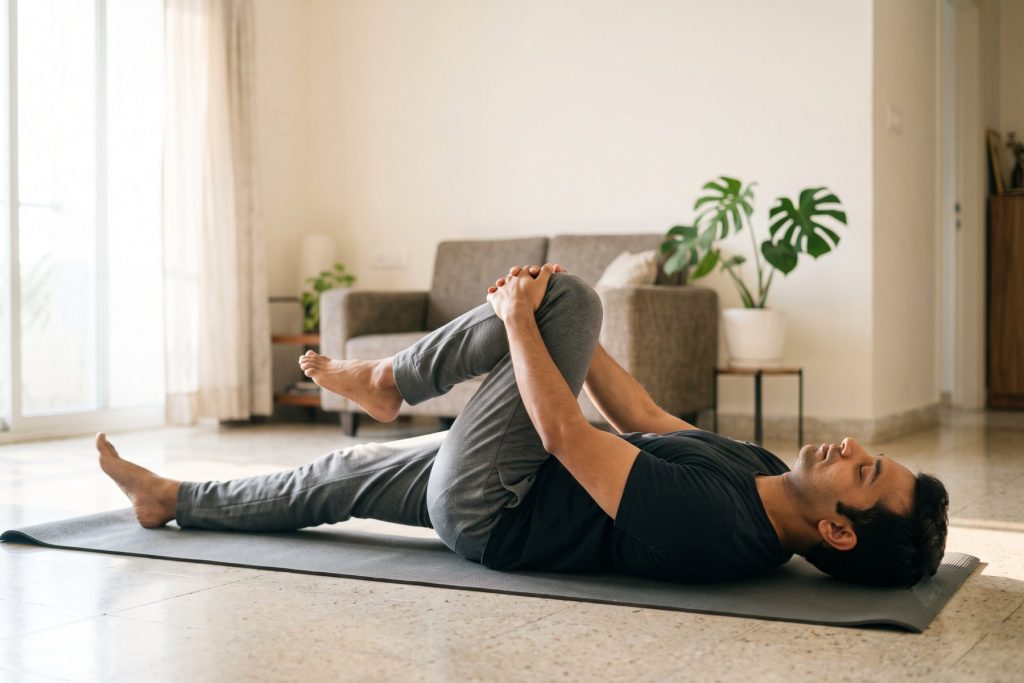
A few gentle stretches a day can ease lower back stiffness and help keep pain from coming back. They work best as part of staying active, not as a replacement for it.
Lower back pain is the leading cause of disability worldwide, affecting around 619 million people. Long hours at a desk, long commutes and too little movement all play a part. In about 90% of cases there is no specific disease or injury behind it. Doctors call this non-specific low back pain, and it usually improves with time and movement.
The five stretches below are simple, need no equipment, and take about 10 minutes. They suit everyday stiffness and mild, non-specific back pain. If your pain is severe, follows an injury or comes with other symptoms, read the safety section first.
Lower back pain at a glance
- Most back pain is not serious. It usually improves within a few weeks and isn’t caused by damage.
- Movement helps, bed rest doesn’t. Staying active is the main advice from the NHS and WHO.
- Exercise reduces pain. A large Cochrane review of 249 trials found it eases chronic low back pain more than no treatment.
- Gentle is enough. Stretches may feel a little uncomfortable, but they shouldn’t make your pain clearly worse.
- Little and often works best. About 10 minutes, once or twice a day.
- Know the warning signs. Numbness, leg weakness or bladder changes need urgent care, not stretching.
Before you start
These stretches are safe for most people with everyday back stiffness. A few simple rules keep them that way:
- Move slowly. No bouncing or jerking. Ease into each stretch until you feel a gentle pull.
- Mild discomfort is fine; sharp pain is not. NHS physiotherapy advice is that exercises may feel uncomfortable but shouldn’t significantly increase your symptoms. If one does, skip it and try the others.
- Breathe normally. Don’t hold your breath during a stretch.
- Use a mat or carpet. Most of these are done lying down.
- Check first if you need to. If you are pregnant, have had back surgery, or have a diagnosed spine condition such as osteoporosis or a slipped disc, ask your doctor or physiotherapist which stretches suit you.
Don’t stretch, get help
Stop and get urgent medical help if your back pain comes with any of these warning signs:
- Numbness, tingling or weakness in both legs
- Numbness around your genitals or bottom
- New difficulty passing urine, or losing control of your bladder or bowels
- Chest pain, fever or feeling generally unwell
- Pain that started after a fall or accident
These can be signs of a serious problem that needs prompt treatment.
The 5 stretches
The first four are stretches and the fifth gently strengthens the muscles that support your back. The knee-to-chest stretch, knee rolls and bridge all appear in NHS physiotherapy advice for low back pain. Cat–cow and child’s pose are gentle mobility stretches widely used in physiotherapy and yoga.
The evidence supports regular exercise in general rather than any single move. The largest review, covering 249 trials, found that exercise reduced chronic low back pain more than no treatment, but it didn’t single out one type as best. So pick the stretches that feel good for you and do them regularly.
1. Knee-to-chest stretch
Good for: easing tightness across the lower back.
- Lie on your back with your knees bent and feet flat on the floor.
- Hold your knees, or behind your thighs if that is more comfortable for your knees, and gently draw both knees towards your chest.
- Stop when you feel a comfortable stretch in your lower back. Keep your head and shoulders relaxed on the floor.
- Hold for 20–30 seconds, breathing slowly, then lower your feet one at a time.
Repeat: 3 times. Easier version: bring one knee up at a time.
Avoid: yanking your knees in hard, or lifting your head. The stretch should come from a gentle hug, not force.
2. Knee rolls
Good for: gently loosening the lower back and hips with a twisting movement.
- Lie on your back with your knees bent, feet flat, and arms out to the sides.
- Keeping your knees together and both shoulders on the floor, slowly roll your knees to one side.
- Go only as far as is comfortable, pause for a breath, then roll back to the middle.
- Repeat on the other side.
Repeat: 8–10 times each side.
Avoid: letting your shoulders lift off the floor, or dropping your knees quickly.
3. Cat–cow
Good for: moving the whole spine gently, especially after sitting.
- Start on your hands and knees, with hands under your shoulders and knees under your hips.
- Breathe in and let your belly drop gently while you lift your chest and tailbone (cow).
- Breathe out and round your back up towards the ceiling, tucking your chin and tailbone (cat).
- Move slowly between the two, in time with your breath.
Repeat: 8–10 times. If your wrists hurt: rest on your fists or forearms.
Avoid: forcing either end of the movement. Work within a range that feels easy.
4. Child’s pose
Good for: a gentle stretch along the back and hips, and a calm way to finish.
- From hands and knees, sit your hips back towards your heels.
- Walk your hands forward and rest your forehead on the floor or a cushion.
- Let your back and shoulders relax, and breathe into your lower back.
- Hold for 20–30 seconds, or longer if comfortable.
Repeat: 2–3 times. Easier version: widen your knees, or put a pillow between your hips and heels.
Avoid: this one if it hurts your knees. Do an extra knee-to-chest stretch instead.
5. Glute bridge
Good for: strengthening the buttock and core muscles that support your lower back.
- Lie on your back with your knees bent, feet flat and hip-width apart, and arms by your sides.
- Tighten your stomach muscles gently and squeeze your buttocks.
- Lift your hips until your shoulders, hips and knees form a straight line.
- Hold for 3–5 seconds, then lower slowly.
Repeat: 8–10 times.
Avoid: arching your back or lifting too high. The work should come from your buttocks, not your lower back.
Your 10-minute daily routine
| Order | Stretch | How much | Time |
| 1 | Cat–cow | 8–10 slow rounds | 1 min |
| 2 | Knee rolls | 8–10 each side | 2 min |
| 3 | Knee-to-chest | 3 × 20–30 seconds | 2 min |
| 4 | Glute bridge | 8–10 lifts, 2 sets | 2–3 min |
| 5 | Child’s pose | 2–3 × 20–30 seconds | 2 min |
Do it once or twice a day. The NHS leaflet suggests little and often, morning and afternoon.
Making it a habit
- Tie it to something you already do. Straight after waking, after your evening walk, or before bed.
- Start small. Even three of the five stretches is better than none on a busy day.
- Use desk breaks. A seated cat–cow (slowly arching and rounding your back in your chair) and a standing side bend are easy to do at work after long sitting.
- Expect gradual change. Stiffness often eases within days; it can take a few weeks of regular practice to notice less pain.
Beyond stretching: what else keeps your back healthy
Walk more
Walking is one of the simplest ways to keep back pain away. In a 2024 trial in The Lancet, 701 adults who had just recovered from low back pain followed a gradual walking programme with some physiotherapist guidance. They went a median of 208 days before their pain came back, compared with 112 days for those who didn’t. A daily walk pairs well with your stretching routine.
Keep moving, even when it hurts a little
During a flare-up, it is tempting to rest in bed. The NHS advises the opposite: stay active and keep up your normal activities as far as you can. Long bed rest tends to make stiffness worse.
Break up long sitting
No single posture is perfect, and there is little evidence that sitting a certain way causes back pain on its own. What helps most is changing position often. Stand up or walk for a minute or two every 30–45 minutes, and try a few simple office stretches between meetings. A comfortable desk setup, with your screen at eye level and your feet supported, makes long workdays easier.
Build strength
Stronger buttock, hip and core muscles help support your back. The bridge is a good start. Over time, add squats, step-ups or pilates-style exercises. WHO guidance recommends exercise programmes for chronic low back pain, and does not recommend back belts or braces for most people.
Look after sleep, stress and weight
Poor sleep and stress can make back pain feel worse and last longer, and WHO lists good sleep, activity and a healthy diet among the lifestyle changes that help. Keeping to a healthy weight also eases the load on your back.
When to see a doctor or physiotherapist
Most back pain gets better within a few weeks. See a doctor if your back pain:
- doesn’t improve after a few weeks of home care, or stops you doing everyday activities
- is worse at night or doesn’t ease with rest
- comes with unexplained weight loss, fever or feeling unwell
- gets worse when you cough, sneeze or go to the toilet
- spreads down one leg, with numbness or tingling
- worries you, or you’re finding it hard to cope
A physiotherapist can check what is going on and give you an exercise plan tailored to you. This is especially useful if your pain keeps coming back.
Go to A&E or call emergency services straight away for the warning signs listed in Before you start, such as numbness around your genitals or bottom, weakness in both legs, or changes in bladder or bowel control.
The bottom line
For most people, lower back pain is common, not serious, and gets better with movement. Ten minutes of gentle stretching a day, plus regular walking and fewer long stretches of sitting, is one of the simplest ways to ease stiffness and keep pain from returning. Go gently, stop anything that makes your pain clearly worse, and get help quickly if you notice any warning signs.
Pro Tip: A routine only helps if you keep it up. Use the GOQii App to track your steps, activity and sleep, and set a daily reminder for your stretches. Your GOQii Personalised Health Coach can help you build a movement plan around your work day, so back-friendly habits become part of your routine.
Frequently Asked Questions (FAQs)
- How often should I do these stretches?
Once or twice a day is a good aim. Little and often works better than a long session once a week. The full routine takes about 10 minutes.
- Should I stretch if my back already hurts?
Gentle movement usually helps, even during a flare-up. Stretches may feel a little uncomfortable, but they shouldn’t make your pain clearly worse. If one does, skip it. Don’t stretch through sharp pain, and see a doctor if the pain is severe or followed an injury.
- How long should I hold each stretch?
Hold static stretches such as knee-to-chest and child’s pose for 20–30 seconds. Moving stretches such as cat–cow and knee rolls are done slowly, 8–10 times.
- Is it better to rest or stay active with back pain?
Stay active. The NHS advises keeping up normal activities as far as you can, because long bed rest tends to make back pain and stiffness worse.
- Can stretching prevent back pain from coming back?
Regular exercise lowers the chances of back pain returning, and walking has some of the best evidence. In one large trial, a walking programme nearly doubled the time before people’s back pain came back. Stretching works best as part of staying generally active.
- Can I do these stretches at work?
A seated cat–cow, slowly arching and rounding your back in your chair, and a standing side bend are easy to do during a break. The floor stretches are better at home, before or after work. Standing up and moving every 30–45 minutes also helps.
- When should I see a doctor about lower back pain?
See a doctor if your pain doesn’t improve after a few weeks, stops you doing everyday things, is worse at night, or comes with fever or weight loss. Get urgent help for numbness around your genitals or bottom, weakness in both legs, or changes in bladder or bowel control.
#BeTheForce
Disclaimer: The information provided in this blog is for general awareness and educational purposes only. It is not intended to replace professional medical advice, diagnosis, or treatment. Always consult a qualified healthcare provider for personalised medical guidance or concerns related to your health.

Leave a Reply