
GOQii

Blog

  • HOME
  • HEALTHY LIVING
  • FITNESS
  • HEALTHY RECIPES
  • USER STORIES
  • KARMA
  • BUY GOQii

Search Results for: mental health

March 12, 2024 By Divya Thampi Leave a Comment

Getting Along with Difficult Family Members

difficult family members

When a friendship gets toxic or it starts to impact one’s peace of mind, one can choose to move on and change the status of the relationship from “friends” to “not friends anymore”, but family relations are a different story altogether. Whether you like them, dislike them, find them needy, toxic or frustrating, the relationship is often there to stay. Family relationships can be complicated with their unique histories and their potential to significantly impact the quality of our lives. So how do you deal with close family members who drive you mad?

First, every relationship involves two people and if we are talking about a relationship of your life then YOU are a 50% stakeholder. While it may seem like your relationship is like a car with the other person driving it and you relegated to being a hapless passenger, in reality, a relationship is more like a boat that requires two people to row, to keep it moving. So, despite how you feel, you do have an influential role to play in the ongoing and future quality of the relationship. Here’s a list of 7 steps that you can take to make things better:

1. Stop trying to change this person

When we witness the family member behave, repeatedly, in ways that we disapprove of, we would inevitably want to change them. There are three reasons why this strategy will bomb. One, it is practically impossible to change the behavior of another person unless they are motivated to change. Secondly, the constant need to change someone and the equally consistent failure to do so, can leave you feeling deeply frustrated and deteriorate the situation further. Thirdly, the more you point out mistakes or make suggestions for improvement, the more they will see it as your way of rejecting them and they could feel resentful or inadequate. Hence a better strategy would be to consider modifying your own thoughts and responses, so as to feel more at peace.

2. Recognize the trigger points and refuse to rise to the bait

There are bound to be certain topics that tend to drive you and probably even the other person into a tizzy. Identify these in advance and reflect on how you would ideally want to respond to them whenever they come up. Steer clear of engaging in heated arguments around these subjects. Whenever it does come up, pay attention to your breath and the rising temptation to react emotionally. Keep breathing deeply and exhaling completely and allow the moment to pass without an outward reaction. If possible convey to the other person in an even and firm tone that you would prefer not to talk about the matter or that you would prefer to do it later, when you are in a better frame of mind. If the other person still continues, repeat your message and move away physically.

3. Slowly wipe out the toxicity in the relationship

It may have been weeks or months or even years since you had a happy or positive interaction with the family member in question. But it doesn’t have to stay that way. Take out time to list down the things that you like or had liked about this person, including the smallest and most insignificant of their positive characteristics. You may not be very motivated to think about this person’s positive traits but make the list anyway. Whether it is their warmth towards kids, trusting you with their finances, keeping things tidy, remembering dates important to you, getting repair work done, every single thing counts. Once you have the list, make a note every time you see these behaviors and genuinely appreciate these acts. Start small by acknowledging it to yourself and slowly progress towards expressing the appreciation to them verbally. Initially it may feel awkward. But as you continue it will feel more natural and easier. Genuine appreciation and acknowledgment are powerful ways of making people feel more valued and loved and create connection.

4. Review the story you are telling yourself

Thinking “My sister always makes fun of me because she loves putting me down and feeling superior” will make one feel resentful and hurt; A thought like “my husband keeps nagging me because he doesn’t trust me to do a good job” could lead to feelings of sadness and helplessness; Another thought like “my daughter doesn’t spend time with me because she thinks I am boring and stupid” may leave one feeling upset and powerless. The fact that your sister jokes about you may have nothing to do with you and may be her way of trying to keep things light; a nagging spouse may be doing so to hold on to a sense of connection. Similarly, the daughter’s indifference may have little to do with your capabilities as a parent and more to do with her preoccupation with what’s going on in college. Write down your assumptions and question their validity. As you can see, changing the narrative inside our heads has the power to change the way we feel. Opting for the most charitable interpretation of the other person’s actions can be empowering for you and lead to more harmony.

5. Listen deeply

Especially with family members we do not use our listening skills well. We judge them far more than the people we meet less often. Hence, even before they have completed a sentence we jump to conclusions about their message and their intent. Try to really listen. Don’t interrupt. Instead of thinking up of a fitting comeback, pay attention to what they are trying to convey. What are they feeling as they are speaking? What emotional need are they wanting fulfilled? Listening is a fundamental way of making a person feel respected and valued. This helps the speaker to calm down, become less defensive and if they feel fully listened to, they may even be willing to listen to your point of view. Good listening goes a long way in calming things down.

6. Have compassion – for yourself and for them

Charity begins at home and compassion begins with self. When you try to attempt the above steps there will be times when you don’t succeed and feeling frustrated as a result is only expected. Whenever you feel frustrated, remind yourself that you are suffering too. Offer yourself words of empathy, love and comfort. Here’s an example of how to offer yourself compassion – silently say to yourself, “This is painful for you. You are human and all humans make mistakes. I am here for you and I love you!”

When you practice compassion with yourself, it becomes easier to feel compassionate to others. Remember that they are doing the best they can, based on what they know and believe. They too want to live a good life and feel loved and valued by others.

7. The “Brahmastra” (ultimate weapon)

There are those times when a family member will keep saying hurtful things and/or continue to ceaselessly complain despite your repeated requests to stop. At this point, visualize the pain inside of that person and mentally keep sending them love and blessings. It may sound counterintuitive and silly. But this one method cannot fail you. As they continue with their rants, keep repeating words of love or blessings like “I love you, I love, I love you” or “May you find peace, healing and joy. May you find peace, healing and joy”, mentally. Visualize a loving energy flowing from your heart to theirs while doing that. You will feel a change in them, as well as yourself.

If all else fails and you still feel triggered by this family member, consider shifting your residence (if that is an option), at least temporarily. Even close family relationships may sometimes be beyond repair. In such cases the kindest thing you can do to yourself and the other, is to move away and with time forgive them and yourself. Remember that it is not people who are difficult, but contradictory views and behaviors that get challenging. At times the change required may be in you and not the other. It is easier to blame others for our frustrations than to bring about change in ourselves. Staying a victim can be a subconscious coping mechanism to avoid taking responsibility. That is not always the case though.

In conclusion people are designed to be different. These differences have the potential to make life more meaningful and interesting. Conflicts and disagreements, thus give us opportunities to widen our world view, transform our relationships and help us grow.

We hope this article helps you! Do leave your thoughts in the comments below. For more on Mental Health and Emotional Wellness, check out Healthy Reads or speak to a certified expert by subscribing to GOQii’s Personalised Health Coaching here.

#BeTheForce 

December 15, 2023 By Mubasheera Chaiwala 2 Comments

Pranayama To Detoxify The Body, Mind And Vital Organs

detox your body with pranayama

Pranayama is the yogic practice of breath control. It means the ability to expand our health by controlling the breath. There are various ways and positions to practice yogic breathing.

The combination of pranayama and meditation has positive effects in curing various problems like acidity, stress, anxiety, skin diseases, improved blood circulation, and managing lifestyle disorders such as thyroid, PCOS, controlling blood sugar and blood pressure. 

We breathe daily, right? So what is pranayama? Why Pranayama? 

Pranayama is slow, deep breathing, in a rhythm. The breathing that we do normally is not in rhythm and is non-harmonic. It is in pranayama that gets our mind and organs in sync. There are various pranayama practices which you can do daily. 

1. Kapalbhati Pranayama
This is a famous pranayama practice also known as The Skull Shining Breathing Technique. Kapalbhati has  physiological effects on cardiovascular, digestive and nervous systems.

Benefits of Kapalbhati Pranayama: 

  • It Generates heat in the system to help dissolve toxins and waste matter.
  • Daily practice helps in adding luster to your face and you get glowing skin
  • Improves digestion and can help alleviate gastrointestinal problems like acidity, indigestion and flatulence.
  • Improves the function of kidneys and liver as it provides a gentle massage to the organs.
  • If practiced daily helps in reducing belly fat.
  • Kapalbhati helps reduce stress in the eyes, thus reduces dark circles around the eyes.
  • It triggers your abdominal region, so it’s beneficial for diabetic patients.
  • It improves the blood circulation problem in whole body parts.

2. Anulom Vilom
Also known as Alternate nostril breathing, it has various benefits for the body internally and externally. Oxygen is pure and required by the body for every single process to take place and therefore, it is vital for us to breath right and Anulom Vilom serves the purpose. It is the best way of balancing the Tri Dosas (Tri means “three” and the meaning of dosas is impurities) in our body i.e. Vaat, Pitta and Kaffa. All three are the cause of all diseases. So, it is important to balance them. Our body gets ill when Tri Dosas are not in harmony.

Benefits of Anulom Vilom Pranayama

  • It can provide some relief from mental health problems like Depression, Anxiety, Stress, Tension, etc.
  • Improves the working of the lungs, beneficial for  most respiratory problems like (Bronchitis, Asthma), etc.
  • Best breathing technique for boosting your memory – makes your brain sharper, increases concentration and gathers focus.
  • Improves your immune system, so it can cure general issues like cough & cold.
  • Alternate nostril breathing is an ideal breathing technique for maintaining your heart healthy.

3. Sheetali Pranayama
The meaning of the word “Sheetali” is cooling down. This pranayama practice is a process to cool your body down. It gives the feeling of coldness by decreasing the body temperature, thereby having a positive impact on our nervous system and endocrine glands. Extremely helpful during the summer season.

Benefits of Sheetali Pranayama

  • It is useful in managing disorders related to tongue, mouth and throat.
  • It is very beneficial in treating diseases of the spleen.
  • Helpful in fever by cooling the system down.
  • Controls and manages high blood pressure.
  • It purifies the blood.
  • Improves sleep quality and is best for fighting Insomnia.
  • It calms the mind, as it is an effective stress buster. Once our mind is calm, we can easily deal with negative emotions like  anger and anxiety.
  • Effective in hyperacidity. Excellent for people who have GERD and face issues with acidity and indigestion.

There is another breathing practice similar to Sheetali, known as Sheetkari pranayama. 

Both are similar, the only difference is the way of breathing. In Sheetali, we breathe in by folding the tongue and breathe out from the nose. In Sheetkari, we inhale through the teeth and exhale from the nose.

Benefits of Sheetkari Pranayama

  • Effective against dental problems like bad breath, bleeding gums and pyorrhea.
  • Balances body temperature.
  • Calms the mind, reduces emotional excitation and mental tension.
  • Can help you manage depression, anxiety and panic attacks. 

As a yoga instructor, I get these questions a lot of time: What is the best time to do pranayama? Generally, morning is the best time for a breathing exercise as it helps us activate our organs. Plus, on an empty stomach, we achieve optimum benefits. To know why morning yoga is beneficial, you can have a look at my previous article: https://goqii.com/blog/benefits-of-practicing-morning-yoga-at-home. 

We hope this article helps you! For more on yoga, check out Healthy Reads. You can also get tips and learn more about yoga and pranayama from experts by subscribing for GOQii’s Personalised Health Coaching here:

#BeTheForce 

September 16, 2023 By Shehnaz Shaikh 3 Comments

Do Children Need Exercise and Nutritional Care?

exercise and nutrition for childrenExercise/Physical activity is important for everyone, but more so for children and adolescents as it plays a key role in the development of their personality. Hence, it has increasingly become important to encourage a healthy lifestyle among them. Having said this how much children need to exercise depends on age.

Why Is Exercise Important For Children & Adolescents?

Exercise for children is important for both their physical and mental well-being. By staying physically active, children and adolescents can reduce the risk of stress, depression and other mental health issues. Physical activity can also help teenagers maintain a positive body image because physical activity is beneficial to the human body.

How Does Exercise Benefit Children?

  • It improves immunity
  • Helps in building better focus
  • It helps in strengthening the lungs and the cardiovascular system
  • Keeps the children in a happy mood due to the release of feel-good hormones called endorphins
  • Helps in maintaining good brain health and also helps in enhancing memory
  • Decreases the risk of developing certain diseases, including obesity, type 2 diabetes, and high blood pressure in later years
  • Helps in maintaining a healthy weight
  • Exercise can help children of all ages and can prevent weak bones (osteoporosis) in later years by strengthening bones and joints
  • Helps in performing well in sports

How Long Should Children Exercise For?

Children and adolescents should do 60 minutes or more of physical activity each day. Children and adolescents are often active in short bursts of time rather than for sustained periods of time, and these short bursts can add up to meet physical activity needs. Physical activities for children and adolescents should be developmentally-appropriate, fun, and offer variety.

Having a balanced exercise routine is good. let’s take a look at 

The three parts of a balanced exercise routine are Aerobic exercise, strength training and flexibility training.

  1. Aerobic exercises

Aerobic exercises increase the heart rate and breathing rate. When you give your heart and lungs this kind of workout regularly, they get stronger. Aerobic exercises should be fun and easy exercises for children that they will love to engage in. Some of the aerobic exercises that your children will enjoy include Swimming, Skating, Cycling, Jogging, Dancing, Skipping, Football, etc. Some team sports that provide a great aerobic workout are basketball, hockey, rowing, cricket and badminton.

  1. Strength Training

Go for exercises that strengthen bones and muscles. Experts recommend that children and adolescents, ages 6 to 17, should get at least one hour of moderate to high-intensity aerobic exercise every day. Strength-training activities that build muscle should also be part of a 60-minute exercise routine on at least three days of the week.

Young people ages 13 to 17 should do a variety of moderate to vigorous physical activity for 60 minutes each day. Along with aerobic exercises like running, jogging, fast walking, circuit training, one should also include sit-ups, push-ups, lunges and squats.

Some of the Exercises Include: 

  1. Lunges: Children can improve their balance and strengthen their legs with some lunges
  2. Squats: are the best for building quads, hamstrings, and glutes, and they help to strengthen your child’s lower back as well
  3. Push-ups: can also be done on the knees or on the feet, according to the child’s ability. Don’t worry if they don’t have the form right initially

Encourage your child to Warm up before exercise and cool down after exercise to prevent muscle soreness and injury.

Warm up before exercise: Warming up before exercise prevents injury by softening the muscles and making them supple. Some warm-up exercises you can do are:

  • Slow jogging or walking
  • Stretching all the muscles they’re going to use (hold each and stretch for 8 to 10 seconds, but never until it hurts)

Cool down after exercise: Cooling down after high-intensity exercise is important for relaxing and softening the muscles. Cool down or ballistic stretch begins to lower the heart rate, improves flexibility and will speed up recovery from a workout.

Some Cool Down Examples Include: 

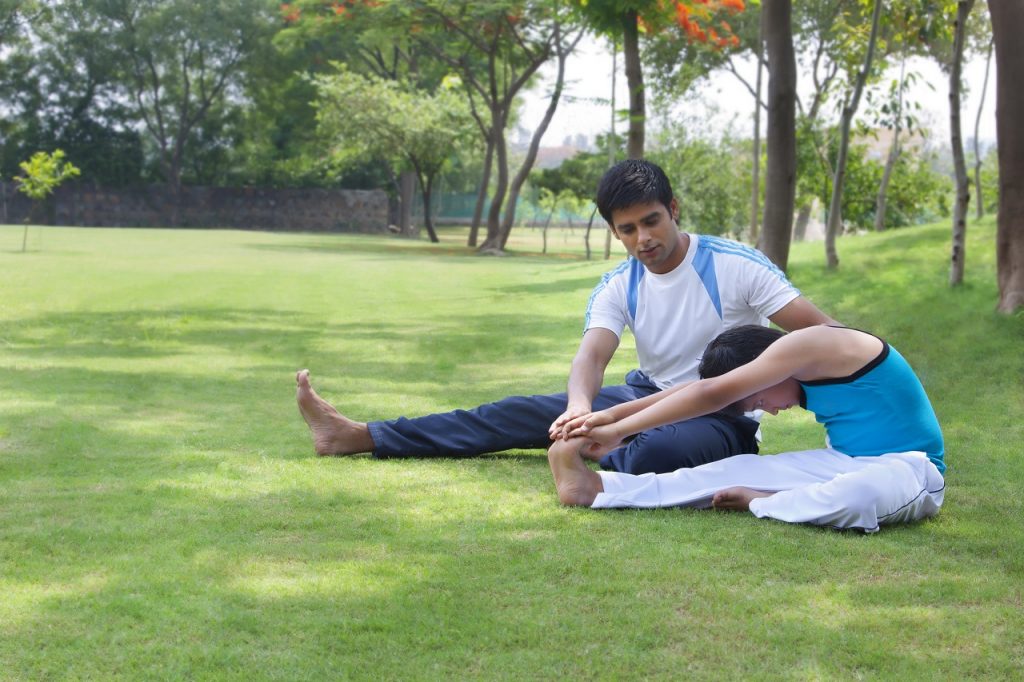
  1. Hamstring Stretch: The stretch helps Hamstring muscles that are on the back of the thigh 2
  2. Side Lunge: This stretch works the inner thighs
  3. Calf Stretch: This stretch feels good after running or walking.
  4. Butterfly Stretch: Children are usually quite adept to the butterfly stretch and it relaxes them well after a good physical activity.

Nutrition is Equally Important When You Exercise 

While exercise is very important, nutrition is equally important for children and adolescents to lead an active and healthy life.

Children who eat healthy, well-balanced meals and snacks will get the nutrients needed to perform well in sports. Kids and teens who play a sport that can involve 1½ to 2 hours or more of activity in a day, in particular, may need to consume more balanced nutrition to keep up with increased energy and fluid demands.

We trust that this article on exercise and nutrition for children assists you in making informed decisions about your child’s health. Do let us know your thoughts in the comments below. For more on Kid’s Health check out Healthy reads. To get expert advice, speak to a GOQii Coach by subscribing for Personalised Health Coaching here.

August 4, 2023 By Dr Darshana Salve 2 Comments

Tired All The Time? Here’s What’s Causing It!

fatigueThe alarm is set for 6 am to go for a morning walk, filled with determination to start on a routine walk from the next morning, she went to sleep early. But, like any other day, the alarm went off, but as usual, she couldn’t get out of bed. With each passing day, it got difficult to even get up for work. This happened almost for 2-3 months when Ananya realized this was not just laziness but something beyond and decided to see a doctor. Ananya described that she had no energy to wake up in the morning and felt tired and exhausted by the end of the day. Sounds familiar? Yes! This happens to many around us or even to us. This syndrome is called Fatigue.

What is Fatigue?

Fatigue is generally defined as a feeling of lack of energy and motivation that can be physical, mental or both. Fatigue is very common. Fatigue can be caused by Physical (around 60%) as well as Mental causes (40%). Unfortunately, it can also occur in normal individuals who experience intense physical or mental activity (or both).

However, in contrast to fatigue that occurs with some diseases and syndromes, normal fatigue in healthy individuals is quickly relieved in few hours to about a day when the physical or mental activity is reduced and adequate rest is taken.

What Causes It?

  • Sleep Problems: Sleep Apnea, insomnia, working in shifts or work shift changes, pregnancy, extra night hours at “work”, gadget time, etc. can cause fatigue. For such problems, including foods like nuts or milk that are rich in tryptophan (sleep inducing hormone) can help get better sleep.
  • Dysglycemia: Skipping breakfast, long gaps between meals is known to cause irregular fluctuations in sugar levels. To avoid such irregularities one must have a healthy breakfast every day preferably within one hour of waking up. Always plan for a mid-meal snack especially when the gap exceeds 5 hours.
  • Nutritional Deficiency: Eating a healthy, balanced diet (proteins, carbohydrates, fats and fiber) is an important part of maintaining good health. It can help you feel your best. Include fruits, whole grains, and protein rich foods and avoid junk food, processed/packaged food.
  • Gut Disturbances: An acidic body doesn’t allow oxygen to be absorbed and in turn causes fatigue. Gastric issues such as bloating, constipation, food sensitivity/allergy, leaky gut (gastric reflux) all create havoc in our body resulting in physical and mental fatigue. Including adequate quantity of fiber, probiotics like curd and a good intake of water keep your gut happy and healthy.
  • Caffeine Overload: Limit tea/coffee/green tea to 2 cups/day. Avoid having it post sunset and near bed time.
  • Dehydration: When dehydrated, the fluid loss causes a drop in blood volume, which makes the heart work harder to push oxygen and nutrients through the bloodstream to the brain, skin, and muscles. Maintaining a water intake to 2.5-3 litre is adequate for the majority of the population.
  • Metabolic/Endocrine causes: Vitamin D deficiency, Hypothyroidism, Diabetes, Electrolyte abnormalities, kidney disease, Liver disease can all cause varying degrees of fatigue.
  • Anemia (Iron deficiency, Vitamin B12 deficiency): It is one of the most common reasons of fatigue or tiredness in India and especially common among women.
  • Infectious Diseases: Viral infections, Hepatitis, Tuberculosis, cytomegalovirus (CMV), HIV infection, Influenza (flu), Malaria and many other infectious diseases can cause fatigue.
  • Medications: It might come as a surprise to you but many drugs like antidepressants, anti-anxiety medications, sedatives, antihistamines, steroids and even some blood pressure medications can cause fatigue.
  • Mental Health: Stress, Depression, Anxiety, Drug abuse, Alcohol abuse, eating disorders, (for example bulimia/anorexia), Grief and Bereavement are all few of the most ignored causes of fatigue. Awareness and proactive management of mental disorders is a must for living healthy.

Depending on the above reasons, the right treatment must be decided as it is important that the root cause of fatigue be treated and not just the symptom.

In the case of Ananya, on taking a proper history and some blood tests, she was found to have nutritional and Vitamin D deficiency. Once these were corrected she felt strong and active enough to start with her healthy regime.

Fatigue is a natural part of our lives, because of which we tend to ignore it and instead learn to live with it. This causes more trouble in the long run. We must look out for tell-tale signs of things we could do earlier but can’t do anymore, unrelated aches and pains or headaches and if found positive we must seek the right help. Don’t let feeling tired today ruin your attempt to feel healthy tomorrow!

If you’re looking to relax, meditate or practice yoga to ward off fatigue, ask your GOQii Coach directly by subscribing for Personalised Health Coaching here.

#BeTheForce
  • « Previous Page
  • 1
  • …
  • 36
  • 37
  • 38
  • 39
  • 40
  • …
  • 101
  • Next Page »

Search

Recent Posts

  • 6 Health Benefits of Playing Sports
  • Foods to Manage Blood Sugar Naturally: A Complete Guide to Better Blood Sugar Control
  • The Lazy Person’s Guide to Staying Healthy: 5 Micro-Habits That Take Less Than 2 Minutes
  • Healthy Eating: Comforting Chilli Bean Soup Recipe for the Monsoon
  • The Truth About the ‘Beer Belly’: What Alcohol Really Does to Your Metabolism

Stay Updated

Archives

  • August 2026 (8)
  • July 2026 (25)
  • June 2026 (22)
  • May 2026 (20)
  • April 2026 (24)
  • March 2026 (18)
  • February 2026 (14)
  • January 2026 (14)
  • December 2025 (19)
  • November 2025 (15)
  • October 2025 (20)
  • September 2025 (6)
  • August 2025 (6)
  • July 2025 (9)
  • June 2025 (18)
  • May 2025 (16)
  • April 2025 (22)
  • March 2025 (26)
  • February 2025 (21)
  • January 2025 (25)
  • December 2024 (22)
  • November 2024 (22)
  • October 2024 (20)
  • September 2024 (22)
  • August 2024 (27)
  • July 2024 (15)
  • June 2024 (23)
  • May 2024 (26)
  • April 2024 (27)
  • March 2024 (27)
  • February 2024 (23)
  • January 2024 (21)
  • December 2023 (14)
  • November 2023 (10)
  • October 2023 (19)
  • September 2023 (21)
  • August 2023 (16)
  • July 2023 (16)
  • June 2023 (21)
  • May 2023 (20)
  • April 2023 (19)
  • March 2023 (23)
  • February 2023 (19)
  • January 2023 (15)
  • December 2022 (11)
  • November 2022 (15)
  • October 2022 (15)
  • September 2022 (12)
  • August 2022 (9)
  • July 2022 (17)
  • June 2022 (11)
  • May 2022 (10)
  • April 2022 (6)
  • March 2022 (6)
  • February 2022 (13)
  • January 2022 (11)
  • December 2021 (7)
  • November 2021 (3)
  • October 2021 (6)
  • September 2021 (3)
  • August 2021 (8)
  • July 2021 (7)
  • June 2021 (15)
  • May 2021 (16)
  • April 2021 (10)
  • March 2021 (7)
  • February 2021 (4)
  • January 2021 (4)
  • December 2020 (3)
  • November 2020 (4)
  • October 2020 (10)
  • September 2020 (3)
  • August 2020 (3)
  • July 2020 (2)
  • June 2020 (4)
  • May 2020 (10)
  • April 2020 (12)
  • March 2020 (10)
  • February 2020 (4)
  • January 2020 (4)
  • December 2019 (3)
  • November 2019 (7)
  • October 2019 (5)
  • September 2019 (4)
  • August 2019 (9)
  • July 2019 (9)
  • June 2019 (11)
  • May 2019 (4)
  • April 2019 (8)
  • March 2019 (8)
  • February 2019 (9)
  • January 2019 (8)
  • December 2018 (9)
  • November 2018 (3)
  • October 2018 (3)
  • September 2018 (5)
  • August 2018 (10)
  • July 2018 (6)
  • June 2018 (13)
  • May 2018 (8)
  • April 2018 (17)
  • March 2018 (9)
  • February 2018 (8)
  • January 2018 (15)
  • December 2017 (12)
  • November 2017 (19)
  • October 2017 (13)
  • September 2017 (15)
  • August 2017 (4)
  • July 2017 (8)
  • June 2017 (7)
  • May 2017 (6)
  • April 2017 (8)
  • March 2017 (6)
  • February 2017 (7)
  • January 2017 (9)
  • December 2016 (10)
  • November 2016 (7)
  • October 2016 (7)
  • September 2016 (7)
  • August 2016 (11)
  • July 2016 (9)
  • June 2016 (9)
  • May 2016 (12)
  • April 2016 (17)
  • March 2016 (17)
  • February 2016 (8)
  • January 2016 (6)
  • December 2015 (2)
  • November 2015 (9)
  • October 2015 (7)
  • September 2015 (9)
  • August 2015 (11)
  • July 2015 (9)
  • June 2015 (11)
  • May 2015 (9)
  • April 2015 (13)
  • March 2015 (8)
  • February 2015 (5)
  • January 2015 (12)
  • December 2014 (14)
  • November 2014 (11)
  • October 2014 (6)
  • September 2014 (13)
  • August 2014 (12)
  • July 2014 (6)
  • June 2014 (2)
  • May 2014 (7)
  • April 2014 (4)

From Burnout to Balance: How Dr. Ranjit Reclaimed His Health

Dr Ranjit Bhatt has spent years tending to others. A practising doctor in Odisha, his days were packed with patients, surgeries, and emergencies. From the outside, it looked like a life lived in service. But on the inside, something wasn’t right. “I had no … [Read More...]

From Shimla’s Slopes to Chandigarh’s Sidewalks: Surinder Kaur Bhalla’s Journey from Chaos to Control

Some journeys start with a plan. Others begin with a stumble literally. Surinder Bhalla, a government professional, born and raised in the scenic hill town of Shimla, had always lived a life of movement. “In Shimla, you walked everywhere,” she reflects. “Walking was never an exercise. It was just life.” But after shifting to Chandigarh, […]

“I’ve Challenged Myself to Live 100 Years” – The Story of Chandubhai Savani’s Second Chance at Life

At 67, most people start slowing down. Not Chandubhai Savani. A resident of Surat, Chandubhai, thought life was on track. “My life was going well till I had my bypass surgery,” he says. That surgery, back in 2021, was a wake-up call.  Medication was routine, but exercise wasn’t. His diet? What he calls ‘normal.’ “I […]

Ananda Mukherjee Health Story

From Terminal Illness To Complete Wellness! Ananda Mukherjee Health Story

As we observe World Cancer Day under the powerful theme ‘United by Unique’ (2025-2027)**, we are reminded that every individual’s journey with cancer is distinct, yet united by shared resilience, hope, and the collective fight against this disease. This theme places people at the centre of care and their stories at the heart of the […]

  • HOME
  • HEALTHY LIVING
  • FITNESS
  • HEALTHY RECIPES
  • USER STORIES
  • KARMA
  • BUY GOQii

Copyright ©2016 GOQii