GOQii

Blog

  • HOME
  • HEALTHY LIVING
  • FITNESS
  • HEALTHY RECIPES
  • USER STORIES
  • KARMA
  • BUY GOQii

October 23, 2026 By GOQii Leave a Comment

The Science of Power Naps: How Long is Too Long?

It’s 3 pm, lunch is settling, and your eyelids feel heavy. A short nap can be one of the simplest ways to get through that slump. But anyone who has “just closed their eyes for a bit” and woken up an hour later, foggy and grumpy, knows that naps can backfire.

The difference comes down mostly to length and timing. Here’s what the research says about how long to nap, when to do it, and when frequent long naps may be a sign of something worth checking.

At a glance

  • Aim for 10–20 minutes. Short naps boost alertness with little grogginess afterwards. In one lab study, a 10-minute nap gave the quickest benefit.
  • Nap in the early afternoon. Napping after about 3 pm can make it harder to sleep at night.
  • Longer isn’t better. Naps of 30 minutes or more are more likely to leave you groggy (“sleep inertia”) for a while after waking.
  • Regular naps over an hour are linked with health risks. Large reviews link them with higher rates of heart disease, metabolic problems and early death, although they don’t prove that the naps are the cause.
  • Naps don’t replace night-time sleep. If you need a nap every day, look at your night-time sleep first.
  • Feeling very sleepy despite a full night’s sleep? Speak to a doctor. It can be a sign of a sleep disorder such as sleep apnoea.

What happens in your brain when you nap

Why you feel sleepy in the afternoon

That early-afternoon slump isn’t only about a heavy lunch. Your body clock has a natural dip in alertness around 1–3 pm, and it’s stronger if you slept badly the night before. A very large lunch may add to the drowsiness, and many people find a lighter, balanced lunch keeps them more alert.

Sleep happens in stages

When you fall asleep, your brain moves through different stages of sleep:

  • Light sleep (N1 and N2): the first few minutes are very light sleep, followed by stage 2, which typically lasts 10–25 minutes. Waking from these stages is fairly easy.
  • Deep sleep (N3): this follows, and it’s much harder to wake from.
  • REM sleep: the dreaming stage, which usually comes later.

A full cycle through these stages takes about 90 minutes on average.

Why length matters: sleep inertia

Wake up during deep sleep and you’re likely to feel groggy, slow and disoriented for a while. This is called sleep inertia. According to the Mayo Clinic, it usually wears off within about 35 minutes, but that’s long enough to spoil the point of a nap if you have a meeting or need to drive.

That’s the whole logic of the power nap: sleep long enough to get the benefit of light sleep, but wake up before you sink into deep sleep.

How long should a power nap be?

One of the best-known studies on nap length comes from Flinders University in Australia. Researchers restricted 24 healthy young adults to about five hours’ sleep, then compared afternoon naps of 5, 10, 20 and 30 minutes. As one summary of the study reports:

  • 5 minutes gave few benefits compared with no nap.
  • 10 minutes gave immediate improvements in alertness and performance, with some benefits lasting up to about 155 minutes.
  • 20 minutes also helped, but the improvements only showed up about 35 minutes after waking.
  • 30 minutes caused a period of grogginess and poorer performance straight after waking, before the benefits kicked in.

The researchers concluded that the 10-minute nap was the most effective of the lengths they tested. Most health organisations suggest a similar window: the Mayo Clinic describes 20–30 minutes as ideal, noting that longer naps are more likely to leave you groggy.

Nap lengths compared

Nap length What to expect Best for
10–20 minutes Mostly light sleep; quick boost in alertness with little or no grogginess A workday slump, before driving (after pulling over safely), studying
30–60 minutes More likely to reach deep sleep; often groggy for a while after waking Rarely ideal; leave time to wake up properly before anything demanding
About 90 minutes Roughly one full sleep cycle, so you may wake from lighter sleep; more likely to affect night-time sleep Occasionally, when you’re seriously short of sleep, such as before a night shift
Regularly over 60 minutes Linked in studies with higher health risks (see below) Worth discussing with a doctor if it’s a daily need

These are general guides. Some people wake refreshed after 30 minutes; others feel foggy after 15. Notice what works for you, and keep it short if you’re unsure.

The benefits of a short nap

A well-timed short nap won’t make up for weeks of poor sleep, but it can help in the moment. According to the Mayo Clinic, naps can:

  • reduce tiredness and improve alertness
  • lift your mood and help you relax
  • support performance, including reaction time and memory

What the research shows

  • Alertness on the job: in a well-known NASA study in the 1990s, long-haul pilots who were allowed a planned nap in the cockpit while colleagues flew showed up to 54% better alertness and up to 34% better job performance than pilots who didn’t nap. The pilots had a 40-minute rest opportunity, and the naps behind these results lasted about 26 minutes. These are best-case figures from a specific setting, but they show why some workplaces build in planned rest.
  • Sleepy driving: in a driving-simulator study at Loughborough University in the UK, sleepy drivers who had caffeine followed by a 15-minute nap had far fewer sleep-related incidents than with caffeine alone, even when they didn’t fully fall asleep. If you feel drowsy while driving, the safest choice is always to stop somewhere safe and rest.
  • Brain health: a 2023 UK Biobank study from University College London found that people genetically more likely to nap habitually had slightly larger total brain volume. The effect was modest and needs confirming, and the study didn’t look at nap length, so it isn’t a reason to start napping if you don’t need to.

What about a “coffee nap”?

Caffeine takes a little while to kick in, so some people drink a cup of coffee or tea and then nap for 15–20 minutes, aiming to wake just as it starts working. The driving study above suggests the combination can work well for sleepy people. If you try it, keep it to the early afternoon so the caffeine doesn’t disturb your night-time sleep, and skip it if caffeine makes you jittery or you’ve been advised to limit it.

How long is too long? When naps may be a warning sign

Short naps appear harmless for most people. Long, regular naps are a different story.

  • A 2020 analysis presented at the European Society of Cardiology Congress pooled more than 20 studies with over 313,000 people. Naps longer than 60 minutes were linked with a 30% higher risk of death from any cause and a 34% higher risk of cardiovascular disease compared with not napping. Naps under an hour weren’t linked with heart disease.
  • An earlier analysis of 21 studies and over 307,000 people from Asia and the West found a J-shaped link between nap length and metabolic syndrome: no increased risk below about 40 minutes, but rising risk with longer naps.

These studies show associations, not cause and effect. Long daytime naps may simply be a marker of something else going on, such as poor night-time sleep, an undiagnosed sleep disorder, depression or another health condition. That’s exactly why they’re worth paying attention to.

Naps and night-time sleep

Short naps rarely affect night-time sleep. But long or late naps can make it harder to fall asleep at night, especially if you already have insomnia. The NHS advises people with insomnia to avoid napping during the day. If you struggle to sleep at night, try cutting out daytime naps for a couple of weeks and see whether your night-time sleep improves.

When to see a doctor

Speak to your doctor if:

  • you need to nap more than usual, or feel sleepy during the day even after a full night’s sleep
  • you snore loudly, or someone has noticed your breathing stop and start or you gasp or choke during sleep. These are signs of sleep apnoea, which also causes daytime tiredness, poor concentration and morning headaches
  • you fall asleep at unexpected times, such as during conversations or at the wheel
  • daytime sleepiness started after beginning a new medicine

Untreated sleep apnoea and excessive sleepiness increase the risk of accidents, including on the road, so it’s worth getting checked rather than relying on naps to cope.

How to take a better power nap

  1. Time it right. Aim for early afternoon, roughly between 1 pm and 3 pm, when your natural dip in alertness happens. The Mayo Clinic notes that napping after 3 pm can get in the way of night-time sleep.
  2. Set an alarm. Most people take a few minutes to drop off, so set an alarm for about 20 minutes to get 10–20 minutes of actual sleep.
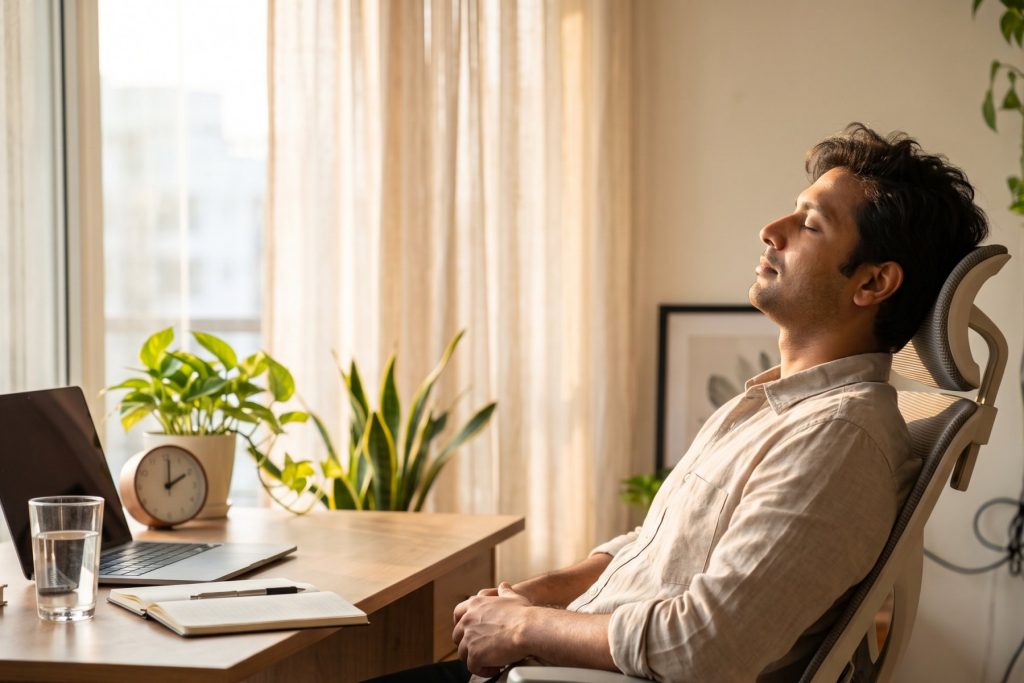
  3. Make it easy to switch off. A quiet, dark, comfortably cool spot helps. At work, an eye mask, earplugs or noise-cancelling headphones can turn a reclined chair into a nap spot.
  4. Don’t worry if you don’t fall asleep. Simply lying still with your eyes closed for 10–15 minutes can still feel restful.
  5. Wake up properly before anything demanding. Give yourself a few minutes to get moving: stand up, splash water on your face, step into daylight or take a short walk. Avoid driving or any task needing quick reactions until you feel fully alert.
  6. Watch the caffeine clock. If you have tea or coffee with your nap, keep it to the early afternoon. The NHS advises avoiding tea and coffee for at least six hours before bed.
  7. Mind your lunch. A balanced, not-too-heavy lunch can make the afternoon slump easier to manage. Our meal-prep guide has lunch ideas that keep you going through the afternoon.

If you work shifts

Shift work disrupts your body clock, and planned naps can help. A nap before a night shift, or a short nap during a break if your workplace allows it, can improve alertness. If you’re very sleepy after a night shift, consider a short nap or other transport before driving home.

If you don’t nap at all

That’s fine. Napping isn’t essential if you sleep well at night and feel alert during the day, and the studies above give no reason for non-nappers to start. Some people simply can’t sleep during the day, and that’s normal too.

The bottom line

For most people, the best power nap is short and early: 10–20 minutes, sometime between lunch and 3 pm. That’s enough to sharpen your focus and lift your mood without leaving you groggy or stealing your night-time sleep. Long naps are a different matter. If you regularly need an hour or more in the day, treat it as a signal to look at your night-time sleep, and to talk to a doctor if the tiredness doesn’t add up.

Pro Tip: Use the GOQii App to track your sleep and see how naps, caffeine and bedtimes affect your nights. Your GOQii Personalised Health Coach can help you build a sleep routine that keeps you alert through the day, with or without a nap.

Frequently asked questions

How long should a power nap be?

For most adults, 10–20 minutes of sleep is ideal. In one study, a 10-minute nap gave immediate improvements in alertness that lasted up to about two and a half hours. Longer naps are more likely to leave you feeling groggy.

Is a 1-hour nap too long?

Occasionally, it’s fine if you’re very short of sleep, but expect to feel groggy for a while afterwards. Regular naps of an hour or more have been linked in studies with higher risks of heart disease and metabolic problems, so if you need long naps often, check your night-time sleep and speak to a doctor.

What is the best time to take a nap?

Early afternoon, roughly between 1 pm and 3 pm, when alertness naturally dips. Napping after 3 pm can make it harder to fall asleep at night.

Why do I feel worse after a nap?

You probably woke from deep sleep, which causes “sleep inertia”: grogginess that usually passes within about 35 minutes. Keeping naps under 20 minutes helps you wake from lighter sleep.

Do naps make up for lost sleep at night?

Only partly. A short nap can improve alertness for a few hours, but it doesn’t replace a full night’s sleep. Most adults need 7 or more hours of sleep a night.

Does a coffee nap work?

It can. In a driving-simulator study, sleepy drivers who had caffeine followed by a 15-minute nap had far fewer sleep-related incidents than with caffeine alone. Keep it to the early afternoon so the caffeine doesn’t affect your night-time sleep.

Is it bad to need a nap every day?

Not necessarily. Many people enjoy a short daily nap. But if you feel very sleepy every day despite sleeping 7–9 hours, snore loudly or fall asleep at unexpected times, speak to a doctor, as this can be a sign of a sleep disorder such as sleep apnoea.

#BeTheForce

Disclaimer: The information provided in this blog is for general awareness and educational purposes only. It is not intended to replace professional medical advice, diagnosis, or treatment. Always consult a qualified healthcare provider for personalised medical guidance or concerns related to your health.
October 17, 2026 By GOQii Leave a Comment

Meal Prepping for Work: Healthy Lunch Ideas That Keep You Energised

A packed lunch built around vegetables, protein and whole grains is one of the easiest ways to eat well on a workday. With an hour or so of prep at the weekend, you can have healthy lunches ready for most of the week.

For many people, workday lunch is whatever is quickest: a canteen thali heavy on rice and fried sides, a delivery order, or biscuits and chai at the desk. Then comes the 3 pm slump. Some of that afternoon dip is down to your body clock, but what and how much you eat at lunch can make it better or worse.

This guide covers what a balanced lunchbox looks like, how to prep a week of lunches without spending your whole Sunday in the kitchen, practical Indian lunch ideas, and how to keep packed food safe.

Meal prep at a glance

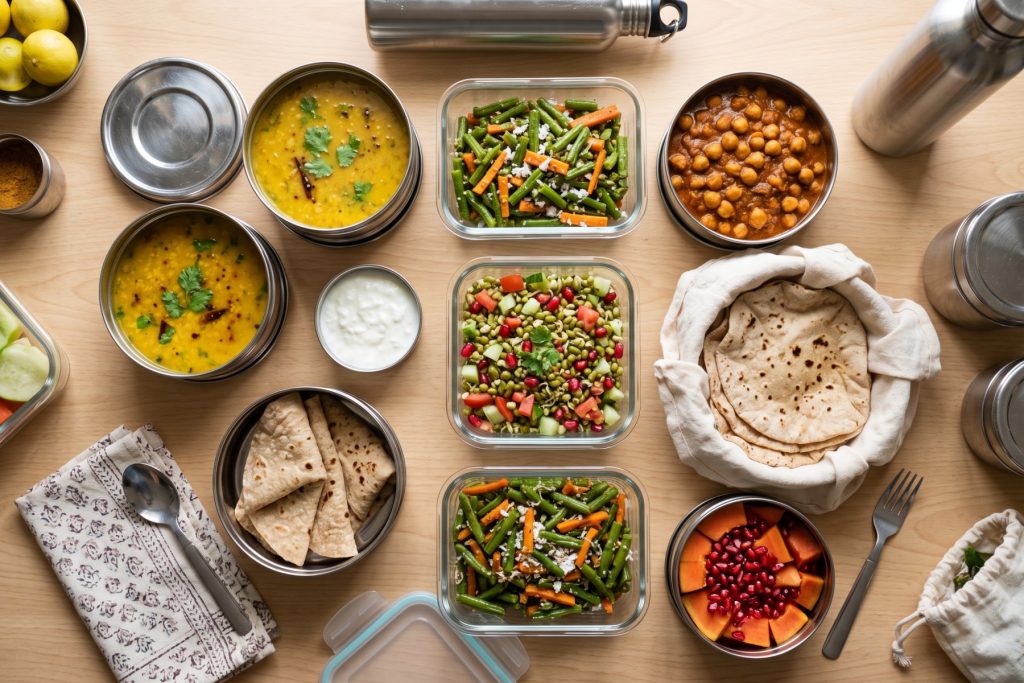
  • Fill half your box with vegetables. Then add a quarter protein (dal, paneer, eggs, chicken) and a quarter whole grains or millets.
  • A heavy, carb-led lunch can deepen the afternoon slump. Balance and portion size matter more than any single “superfood”.
  • Prep components, not complete meals. Cook a grain, a dal or protein, and chop vegetables once; mix and match through the week.
  • Keep it safe. Cool food quickly, refrigerate it, and eat cooked rice within a day and most other dishes within 2–3 days.
  • Lunch is only part of it. Drinking water and taking a short walk after eating also help you stay alert.

Why lunch affects your afternoon energy

The afternoon slump is real, but food is only part of the story. Research on the “post-lunch dip” shows it happens even when people skip lunch. It is partly built into the body clock and is worse when you have slept badly. The same review notes that a high-carbohydrate lunch can make it worse.

That gives you a few things you can actually control:

  • A meal that is mostly white rice, roti or bread, with little vegetable or protein, is digested quickly. Adding vegetables, dal, curd or another protein slows things down and keeps you fuller for longer.
  • Portion size. A very large lunch is more likely to leave you sluggish than a moderate one. Packing your own box makes portions easier to judge than a buffet or a large delivery order.
  • Vegetables, pulses and whole grains or millets add fibre, which helps you stay satisfied until evening, so you’re less likely to reach for biscuits or namkeen at 4 pm.
  • Sleep and water. A packed lunch can’t make up for a short night, and poor sleep affects appetite and food choices Being slightly dehydrated can also leave you feeling tired.

The balanced lunchbox formula

The ICMR–National Institute of Nutrition’s “My Plate for the Day” recommends that vegetables and fruits make up about half of what you eat, with cereals or millets, pulses or other protein, and some curd or milk, nuts and oil making up the rest. It also suggests eating from a range of food groups each day. Translated into a lunchbox, that looks like this:

Part of your box How much Indian examples
Vegetables About half Sabzi, salad, kosambari, stir-fried greens, vegetable raita
Protein About a quarter Dal, chana, rajma, sprouts, paneer, tofu, eggs, chicken, fish
Whole grains or millets About a quarter 1–2 whole wheat, jowar or bajra rotis; brown, red or hand-pounded rice; millet pulao
Extras A little Curd or buttermilk, a few nuts or seeds, a piece of fruit

Easy upgrades

  • Swap some of the grain for vegetables. If you usually pack three rotis, try two rotis and an extra serving of sabzi.
  • Add protein you can see. Many vegetarian lunches are low in protein. A bowl of dal, a handful of chana or a cube of paneer makes a real difference.
  • Pack curd or buttermilk. Both add protein and are easy to carry in a small steel box.
  • Go easy on oil and salt. Pickles, papad and fried sides add up quickly. The NIN suggests limiting added sugar to about 25–30 g a day.

How to meal prep in 60–90 minutes a week

Meal prep doesn’t mean eating the same dull box five days running. The trick is to prepare components you can combine in different ways, and to leave anything that spoils quickly for a short top-up mid-week.

1. Plan (10 minutes)

Pick two or three lunches for the week. Choose dishes that share ingredients, so one batch of chopped onions, tomatoes and greens covers several meals.

2. Batch-cook the base (45–60 minutes)

  • One protein: a pot of dal, chole or rajma, or grilled chicken or paneer.
  • Two vegetables: one dry sabzi (beans, cabbage or bhindi) and one gravy or roasted tray of mixed vegetables.
  • Raw prep: wash and chop salad vegetables, soak and sprout moong, boil eggs.
  • Grains: make roti or millet dough to keep in the fridge, and cook rice fresh on the day or the night before rather than for the whole week (see food safety below).

3. Store smart (10 minutes)

  • Portion straight away into individual boxes, so mornings are grab-and-go.
  • Keep wet and dry apart. Store dressings, chutney and raita separately so salads and rotis don’t go soggy.
  • Freeze what you won’t eat by Wednesday. Dal, chole, rajma and most cooked sabzis freeze well. Move a box to the fridge the night before.

4. Mid-week top-up (15–20 minutes)

On Wednesday evening, cook a fresh vegetable or protein and make fresh rice if you need it. This keeps Thursday and Friday lunches safe and tasting fresh.

Kit that helps

Steel or glass containers with tight lids, a compartment tiffin, a small leak-proof pot for curd or dressing, and an insulated lunch bag with an ice pack if you have no fridge at work.

10 healthy lunch ideas for work

Each of these follows the balanced lunchbox formula. Swap the protein to suit how you eat.

Lunch What’s in it Prep ahead Good for
Rajma or chole bowl Rajma or chole, a small portion of brown rice or 1–2 rotis, onion–cucumber salad Cook the rajma or chole at the weekend; it freezes well Vegetarian, high fibre
Dal, sabzi and millet roti Any dal, a dry sabzi, 2 jowar or bajra rotis, curd Dal and sabzi on Sunday; make rotis fresh or the night before Vegetarian, classic tiffin
Sprouts chaat box Moong sprouts, tomato, onion, cucumber, roasted peanuts, lemon, chaat masala Sprout moong over 2 days; pack the lemon separately Vegetarian, no reheating
Paneer or tofu tikka wrap Grilled paneer or tofu, peppers and onions, mint chutney in a whole wheat roti Marinate and grill in a batch; assemble in the morning Vegetarian, eat cold or warm
Vegetable millet pulao Foxtail or little millet cooked with mixed vegetables and peas, with raita Cook the night before; keep the raita separate Vegetarian, one-box meal
Besan chilla rolls Besan chillas filled with grated vegetables or paneer, green chutney Make the batter the night before; cook in the morning Vegetarian, high protein
Egg bhurji and veg roti Egg bhurji with onion, tomato and spinach, 2 whole wheat rotis, salad Boil or scramble eggs fresh; chop vegetables ahead Eggetarian
Chicken and vegetable stir-fry Chicken strips with beans, carrot, capsicum and cabbage, with a small portion of rice Cook the chicken in a batch; stir-fry vegetables fresh Non-vegetarian
Fish curry box Light fish curry, rice, a dry vegetable such as beans thoran Cook the curry once; eat within 2 days Non-vegetarian, omega-3
Curd rice with a twist Curd rice with grated carrot, cucumber and pomegranate, with a side of kosambari or chana Cook rice fresh the night before; mix with curd in the morning Vegetarian, cooling for hot days

Tips for variety

  • Change the cuisine, keep the formula. A rajma bowl, a paneer wrap and a millet pulao feel very different but share the same balance.
  • Rotate your grains. Alternate wheat roti with jowar, bajra, ragi, brown rice or millets across the week.
  • Keep a no-cook backup. Sprouts, boiled eggs, roasted chana and fruit cover you on days when the plan falls apart.

Keeping your lunch safe

Cooked food left warm for hours is a common cause of food poisoning, and India’s heat makes it a bigger risk. A few rules keep meal prep safe.

What Guidance
Cooling Cool cooked food and get it into the fridge within 2 hours. Spread large batches into smaller boxes so they cool faster.
Most cooked dishes Eat within about 3 days from the fridge, or freeze for up to 3 months.
Cooked rice Cool it quickly, ideally within 1 hour, refrigerate, and eat within 24 hours.
Reheating Reheat until steaming hot all the way through, and reheat rice only once.
Out of the fridge Food kept between 5°C and 60°C for more than 4 hours in total should be thrown away.

Why rice needs extra care

Raw rice can carry spores of a bacterium called Bacillus cereus that survive cooking. If cooked rice sits at room temperature, the bacteria can produce a toxin that makes it unsafe to eat. This is why rice is the one thing not to cook for the whole week. Make it fresh, or the night before, and cool it quickly.

No fridge at work?

  • Pack your lunch straight from the fridge into an insulated bag with an ice pack.
  • Choose foods that travel well, such as rotis with dry sabzi, chillas or roasted chana, over creamy gravies, rice or curd on very hot days.
  • If you have no way of keeping it cool, eat your lunch within about 4 hours of taking it out of the fridge.
  • If you use a hot-food flask, fill it with food that is already piping hot, and keep it closed until lunch.

Sprouts and salads

Rinse sprouts well and keep them chilled. Raw sprouts carry a small risk of food poisoning, so if you are pregnant, older or have a weakened immune system, steam or lightly cook them first. Add cut fruit and salad dressings on the day.

Beyond the lunchbox: other habits that help your afternoon

  • Step away from your desk. Eating while working makes it easy to overeat without noticing. Even 15 minutes away from the screen helps you notice when you’re full.
  • Take a short walk after eating. A 10-minute walk after lunch is an easy way to break up a long sitting day. Pair it with a few simple office workouts through the afternoon.
  • Keep water at your desk. Refill a bottle a couple of times through the day, especially in hot weather or air-conditioned offices, which can make you forget you’re thirsty.
  • Plan a 4 pm snack. A small, planned snack such as fruit, roasted chana, a handful of nuts, or buttermilk is better than whatever is in the office pantry.
  • Watch the extra chai. Two or three cups of sweetened tea in the afternoon add up in sugar, and caffeine late in the day can affect your sleep that night.

The bottom line

A healthy work lunch doesn’t need special ingredients or hours in the kitchen. Fill half your box with vegetables, add a good portion of protein and a moderate serving of whole grains or millets, and keep the portion sensible. An hour of batch-cooking at the weekend and a short top-up mid-week will cover most of your lunches. Store food safely, take a short walk after eating, and keep water close by.

Pro Tip: Use the GOQii App to log your lunches and see how your meals, water, steps and sleep line up with how you feel in the afternoon. Your GOQii Personalised Health Coach can help you build a weekly meal-prep plan around your food preferences, budget and work schedule.

Frequently Asked Questions (FAQs)

  1. How long does meal-prepped food last in the fridge?

Most cooked dishes, such as dal, sabzi and curries, are best eaten within about 3 days. Cooked rice should be eaten within 24 hours. Freeze anything you won’t eat in time.

  1. Is it safe to cook rice for the whole week?

No. Cooked rice can carry bacteria that produce a toxin if the rice cools slowly or is kept too long. Cook rice fresh or the night before, cool it quickly, refrigerate it, and eat it within a day.

  1. Why do I feel sleepy after lunch?

A dip in alertness in the early afternoon is partly natural and linked to your body clock. A heavy lunch that is mostly rice or bread can make it worse, and so can poor sleep. A balanced, moderate lunch and a short walk afterwards can help.

  1. How do I get enough protein in a vegetarian lunch?

Include a proper serving of dal, chana, rajma, sprouts, paneer or tofu, and add curd or buttermilk. If you eat eggs, a couple of boiled eggs or a bhurji add good-quality protein easily.

  1. What can I pack if there’s no fridge at work?

Pack your lunch straight from the fridge into an insulated bag with an ice pack. Choose foods that travel well, such as rotis with dry sabzi, chillas, sprouts kept chilled, or roasted chana, and eat within about 4 hours.

  1. Can I freeze Indian food for meal prep?

Yes. Dal, rajma, chole and most cooked sabzis freeze well for up to 3 months. Thaw them in the fridge overnight and reheat until steaming hot.

  1. How much time does meal prep take?

Around 60–90 minutes at the weekend for the main batch, plus a 15–20 minute top-up mid-week. Even prepping just one dal and chopping vegetables saves time every morning.

#BeTheForce

Disclaimer: The information provided in this blog is for general awareness and educational purposes only. It is not intended to replace professional medical advice, diagnosis, or treatment. Always consult a qualified healthcare provider for personalised medical guidance or concerns related to your health.

March 31, 2019 By GOQii 2 Comments

GOQii to Introduce Reiki Booster Pills!

Reiki PillsThe Reiki Revolution has taken the world by a storm and everyone is turning to this form of alternative medicine. Although some people disagree and term it as pseudoscience, there is enough evidence to conclude that universal energy is real and can be harnessed to heal a person from emotional and physical ailments.


What is Reiki?

Developed by Mikao Usui in 1922, Reiki is etymologically derived from the Japanese words rei which means soul or spirit, and ki which means vital energy. Reiki practitioners use a technique called palm healing or hands-on healing through which the universal energy is transferred through the palms of a master to the patient in order to encourage physical, emotional or mental healing.

How Do Reiki Pills Work?

With no master or practitioner to guide or heal you without touch, how exactly do these pills help you harness energy from the universe? After thorough research on the effects of certain elements on the brain and a lot of trials and tribulations later, we found that when certain natural compounds are introduced in the human body, they create a reaction that enables your body to directly harness energy from the universe.

Since ancient times, well-known Rishis and Gurus from India have meditated in nature and have attained profound wisdom and nirvana. Why so? Why is it that in today’s times, with all our technology, we find it so difficult to find the peace or wisdom they did? We believe that the environment they were in had a crucial role to play in their enlightenment. The answer was in nature itself!

After much research, we were able to detect the elements and their effects on different brainwaves, namely, Delta, Theta, Alpha, Beta and Gamma. We found that certain elements can trigger a reaction and influence these brainwaves to form a higher connection with universal energy for a certain period of time. This led to improved motor skills, reflexes and a burst of energy that lasted throughout the day. Other changes included an increase in focus, attention to detail, and the ability to learn new skills quickly.

Apart from the aforementioned positive outcomes, there were no notable side-effects on brain function or the body. With all the universal energy pouring directly into you, the possibilities are endless! You could heal from all your physical ailments. By connecting with a higher conscience, you need not worry about mental or emotional illnesses. You might even be able to live longer!

Thanks to the positive results of our testing, we will be launching the one-of-a-kind, never-seen-before ‘Reiki Booster’ on the GOQii Health Store soon. You can purchase the same for a huge discount with GOQii Cash. Stay tuned to the app, use this miracle product and make yourself healthier with the power of Reiki!

#BeTheForce

PS: Remember that there are no shortcuts to good health and fitness. You’ve got to work and walk for it! Happy April Fools Day!

Search

Recent Posts

  • PCOS: diet, exercise and the myths to stop believing
  • Cholesterol numbers explained: LDL, HDL and triglycerides
  • International Men’s Day 2026: why men’s health is everyone’s business
  • World COPD Day 2026: Short of Breath? Think COPD – Why Early Diagnosis Matters
  • National Epilepsy Day 2026: Seizure First Aid – What to Do (and Not Do) When Someone Has a Seizure

Stay Updated

Archives

  • November 2026 (20)
  • October 2026 (23)
  • September 2026 (5)
  • August 2026 (8)
  • July 2026 (24)
  • June 2026 (22)
  • May 2026 (20)
  • April 2026 (24)
  • March 2026 (18)
  • February 2026 (14)
  • January 2026 (14)
  • December 2025 (19)
  • November 2025 (14)
  • October 2025 (17)
  • September 2025 (6)
  • August 2025 (5)
  • July 2025 (9)
  • June 2025 (18)
  • May 2025 (16)
  • April 2025 (22)
  • March 2025 (25)
  • February 2025 (21)
  • January 2025 (25)
  • December 2024 (21)
  • November 2024 (21)
  • October 2024 (15)
  • September 2024 (22)
  • August 2024 (27)
  • July 2024 (14)
  • June 2024 (23)
  • May 2024 (26)
  • April 2024 (27)
  • March 2024 (27)
  • February 2024 (23)
  • January 2024 (21)
  • December 2023 (14)
  • November 2023 (10)
  • October 2023 (18)
  • September 2023 (20)
  • August 2023 (16)
  • July 2023 (16)
  • June 2023 (21)
  • May 2023 (20)
  • April 2023 (19)
  • March 2023 (23)
  • February 2023 (19)
  • January 2023 (15)
  • December 2022 (11)
  • November 2022 (15)
  • October 2022 (15)
  • September 2022 (12)
  • August 2022 (9)
  • July 2022 (17)
  • June 2022 (11)
  • May 2022 (10)
  • April 2022 (6)
  • March 2022 (6)
  • February 2022 (13)
  • January 2022 (11)
  • December 2021 (7)
  • November 2021 (3)
  • October 2021 (6)
  • September 2021 (3)
  • August 2021 (8)
  • July 2021 (7)
  • June 2021 (15)
  • May 2021 (16)
  • April 2021 (10)
  • March 2021 (7)
  • February 2021 (4)
  • January 2021 (4)
  • December 2020 (3)
  • November 2020 (4)
  • October 2020 (10)
  • September 2020 (3)
  • August 2020 (3)
  • July 2020 (2)
  • June 2020 (4)
  • May 2020 (10)
  • April 2020 (12)
  • March 2020 (10)
  • February 2020 (4)
  • January 2020 (4)
  • December 2019 (3)
  • November 2019 (7)
  • October 2019 (5)
  • September 2019 (4)
  • August 2019 (9)
  • July 2019 (9)
  • June 2019 (11)
  • May 2019 (4)
  • April 2019 (8)
  • March 2019 (8)
  • February 2019 (9)
  • January 2019 (8)
  • December 2018 (9)
  • November 2018 (3)
  • October 2018 (3)
  • September 2018 (5)
  • August 2018 (10)
  • July 2018 (6)
  • June 2018 (13)
  • May 2018 (8)
  • April 2018 (17)
  • March 2018 (9)
  • February 2018 (8)
  • January 2018 (15)
  • December 2017 (12)
  • November 2017 (19)
  • October 2017 (13)
  • September 2017 (15)
  • August 2017 (4)
  • July 2017 (8)
  • June 2017 (7)
  • May 2017 (6)
  • April 2017 (8)
  • March 2017 (6)
  • February 2017 (7)
  • January 2017 (9)
  • December 2016 (10)
  • November 2016 (7)
  • October 2016 (7)
  • September 2016 (7)
  • August 2016 (11)
  • July 2016 (9)
  • June 2016 (9)
  • May 2016 (12)
  • April 2016 (17)
  • March 2016 (17)
  • February 2016 (8)
  • January 2016 (6)
  • December 2015 (2)
  • November 2015 (9)
  • October 2015 (7)
  • September 2015 (9)
  • August 2015 (11)
  • July 2015 (9)
  • June 2015 (11)
  • May 2015 (9)
  • April 2015 (13)
  • March 2015 (8)
  • February 2015 (5)
  • January 2015 (12)
  • December 2014 (14)
  • November 2014 (11)
  • October 2014 (6)
  • September 2014 (13)
  • August 2014 (12)
  • July 2014 (6)
  • June 2014 (2)
  • May 2014 (7)
  • April 2014 (4)

From Burnout to Balance: How Dr. Ranjit Reclaimed His Health

Dr Ranjit Bhatt has spent years tending to others. A practising doctor in Odisha, his days were packed with patients, surgeries, and emergencies. From the outside, it looked like a life lived in service. But on the inside, something wasn’t right. “I had no … [Read More...]

From Shimla’s Slopes to Chandigarh’s Sidewalks: Surinder Kaur Bhalla’s Journey from Chaos to Control

Some journeys start with a plan. Others begin with a stumble literally. Surinder Bhalla, a government professional, born and raised in the scenic hill town of Shimla, had always lived a life of movement. “In Shimla, you walked everywhere,” she reflects. “Walking was never an exercise. It was just life.” But after shifting to Chandigarh, […]

“I’ve Challenged Myself to Live 100 Years” – The Story of Chandubhai Savani’s Second Chance at Life

At 67, most people start slowing down. Not Chandubhai Savani. A resident of Surat, Chandubhai, thought life was on track. “My life was going well till I had my bypass surgery,” he says. That surgery, back in 2021, was a wake-up call.  Medication was routine, but exercise wasn’t. His diet? What he calls ‘normal.’ “I […]

Ananda Mukherjee Health Story

From Terminal Illness To Complete Wellness! Ananda Mukherjee Health Story

As we observe World Cancer Day under the powerful theme ‘United by Unique’ (2025-2027)**, we are reminded that every individual’s journey with cancer is distinct, yet united by shared resilience, hope, and the collective fight against this disease. This theme places people at the centre of care and their stories at the heart of the […]

  • HOME
  • HEALTHY LIVING
  • FITNESS
  • HEALTHY RECIPES
  • USER STORIES
  • KARMA
  • BUY GOQii

Copyright ©2016 GOQii

