GOQii

Blog

  • HOME
  • HEALTHY LIVING
  • FITNESS
  • HEALTHY RECIPES
  • USER STORIES
  • KARMA
  • BUY GOQii

Search Results for: hunger

May 26, 2024 By Geetika Patni 8 Comments

Mindful Eating: The best habit ever!

Mindful-eating

Most humans eat more than their bodies require. Especially with the massive choice of culinary delights available, the eye appealing desserts, the way food is plated etc…it works on our minds to a level that we crave it. And that’s OK. Everyone loves good food too, who doesn’t.

The problem is, we eat too much of it and there reaches a point when the body does not know what to do with the crazy amounts of food we eat, so when you see your belly/tummy, mid riff, waist starting to expand, that’s your body telling you, ‘you are eating too much’. 

What next? Fad Diets? Time and again it has been proved that fad diets don’t work. With a fad diet plan, you will lose weight – and gain it back eventually, and in between you may end up even damaging your metabolism, digestion and your wonderful relationship with food.

But then isn’t it true? that ‘Abs are made in the Kitchen’ and that ‘Weight Management is 70% nutrition’. Indeed it is! The hidden answer to this dilemma lies in – Mindful Eating.
mindful-eating

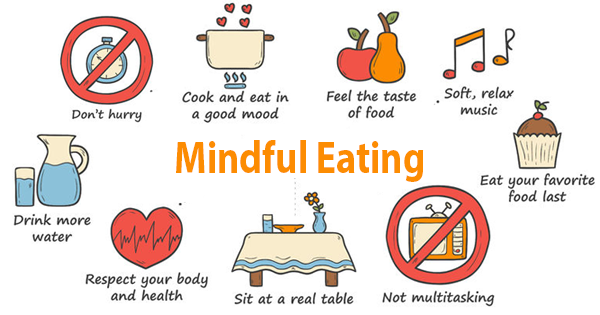
Technical definition says, “Mindful eating is allowing yourself to become aware of the positive and nurturing opportunities that are available through food selection and preparation by respecting your own inner wisdom”. 

In easier terms – It is an art of staying aware of, not only-what you are eating, but also how you are eating. In this article, I’ll help you understand the broad prospects of nurturing yourself with the art of mindful eating. And to do so, let’s first understand the contradiction – Mindless eating.

You are eating mindless when you are –

1) Overeating (Unable to practice portion control) –

Over eating is the most common act of mindless eating and in my experience, 90% of the players who want to lose weight – overeat during one or the other meal.

Portion control is very important but why is practicing portion control so difficult? That’s because we miss recognizing the internal cues our body provides (and yes it does send those signals!) to make us stop eating when it’s time. And why does this happen? That’s because we fail to pay attention to the task we are doing, in this context it is – eating. Implementing simple habits like keeping away gadgets while eating, using smaller plates, and taking a deep breath before you start your meal, can help you to practice portion control effectively.

2) Eating Fast

This one doesn’t need an example. If you are a fast eater you know it. Eating at your best speed to win a 1 minute food challenge is entirely different than doing it every day for every meal. Eating fast can also lead to weight gain and metabolic disorders like insulin resistance and arthritis. Small discomforts such as teeth bites and ulcers in the mouth, dental cavities, and acne outbursts can also be traced back to the habit of eating fast. And you may be blaming your gassy gut to your food choices, but do ponder upon if it’s related to your speed of eating too. Ideally you must aim to finish every meal in 20 minutes. This is the time range for our fullness hormones – Leptin, Ghrelin and some neuropeptides – to reach our brain and signal the satiety centre to feel full and stop eating.

Tricks like taking an intermission break after every few bites, using your non dominant hand to eat, chewing every bite thoroughly (32 times is dramatic, I know, 20 will do), using chopsticks for a change and/or using baby forks/spoons to finish your meal, can help you learn the art of eating slow and mindfully.

3) Emotional Eating

Emotional eating is as simple as the term sounds – eating to fulfil an emotion and not the stomach. It is also termed as ‘Head hunger’. If your hunger feels sudden and urgent and you have a craving for only fries or sugary treats, you can’t stop yourself to eat and then feel guilty afterwards, it is Head hunger – caused by emotions like boredom, anger, frustration, anxiety etc.

On the other hand if you are ‘Stomach Hungry’ you will know it easily for it will come gradually and you can still postpone it. There will be a stomach growl and it will get satisfied with any food (yes even salads!) You won’t feel guilty even after eating it heartily. And best part is you’ll know when to stop when you are feeding your body (but cannot- when fuelling your emotions).

Staying mindful of your hunger triggers and enjoying the meals to nourish your system, rather than feelings, is important, as this can make or break your relationship with food. Emotional eating whereas can cultivate poor self-esteem, unwanted weight gain and the plethora of troubles related to Obesity. Overcoming emotional eating requires a good amount of practice, patience and discipline and some tricks like distraction through work to pass off the emotional storm.

4) Disconnecting 

Eating each and every food that you can lay your hands on, without making a choice is what I call as ‘Disconnecting’. That’s odd! This doesn’t correlate.

Let me explain – If you belong to a club excelling in eating each and every ‘thing’ without knowing what it can do to you, where it came from and without acknowledging the feelings it produces in you (whether good or bad) you are disconnected from your foods, your meals and your nourishment – the very thing which helps you run your day and which prevents you from sufferings and sicknesses.

Disconnecting is a very subtle mindless eating practice but has profound effect on your weight and most importantly on your vital organs and their metabolic functioning. (Like a seemingly harmless can of diet-coke can wreak havoc on your pancreas and production of Insulin!)

Moreover, as we age, the mindless habit of Disconnecting does rapid harm to our system, to the extent of jeopardizing our longevity!

Hence, it is extremely important to make the ‘connect’ with your food choices. Attempt to learn or acknowledge the ingredients of the dish you are eating, which food group it belongs to, combining it in ways you can enhance (or deplete) it’s nutritional quotient, and most importantly how you truly feel having it.

In this 5 part series on ‘Mindful Eating’, I will take you through all the aspects of Mindful eating. In the second part tomorrow I will talk about slowing down while eating, how helpful can it be and some tips to help you eat slowly.

In essence, food is meant to be enjoyed and to nourish you. Adding the seasoning of Mindful eating to it, will pique up your health and wellness quotient.

To be Continued…………………

#BeTheForce 

April 30, 2024 By Hetal Chheda Leave a Comment

Why and how much should your child sleep?

toddler-sleep-routine

More often than not people do not consider sleep as an o important activity for good health. But, in reality sleep is a powerful tool that keeps your mind alert and calm. This is true for both elders as well as kids. Sleep should be considered as important as food.

Did you know that if you sleep well you can increase/build your brainpower just as you build muscles when you are weightlifting.

In this blog however, I am talking of how important is sleep for kids and how much they should sleep to be healthy.

Good sleep habits in kids help in;

  • Good health
  • Growth
  • Mental function.

BENEFITS OF SLEEP FOR KIDS

  • Increases concentration: Well slept kids are more receptive and interactive. These kids have good attention span and learn the most. Overall they become calmer, attentive, observant and also socially active.
  • Reduces behaviour problems: Sleep lets your entire body rest. Lack of rest makes kids hyperactive, fatigued, physically impulsive and agitated.
  • Reduces childhood obesity risk: Kids who don’t sleep enough are at higher risk for childhood obesity. Some researches prove that kids who slept only for an hour (Yes, Just an hour) they had increased their risk of obesity by 80 percent. This happens because the hormones that control hunger are directly related to sleep quality; with too little rest the appetite turns itself on and remains on.
  • Releases growth hormone: Quality sleep releases growth hormones. This hormone helps in normal growth and other bodily and brain development.
  • Increases Immunity: Kids who sleep well do not fall sick very often

HOW MUCH SLEEP IS NORMAL?

  • Toddlers – 12 hours till the age of three
  • Four to six – 10½ to 11½ hours
  • Six to Twelve – 10 hours
  • Teenagers – 8 to 9 hours

FOODS THAT WILL HELP YOUR CHILD SLEEP BETTER

  • Dairy products: Dairy products produce the hormone serotonin that makes you feel sleepy. So foods like milk, cottage cheese, yogurt and cheese helps kids sleep better.
  • Bananas: Bananas are another easy bedtime snack option. Researchers conclude that bananas contain melatonin, as well as serotonin, which helps to calm you and regulate your sleep cycles. They also contain magnesium and potassium, both of which are muscle relaxers.
  • Oatmeal: Oats have an extremely high concentration of melatonin. A warm serving of oatmeal may help your toddler feel full and enjoy a longer duration of sleep.

SLEEP TIPS FOR CHILDREN

  • Introduce good sleep habits right from the start
  • Create an environment that helps the child to sleep. Keep the lights minimum, room cool and quit.
  • Make sure that there is no TV or computer switched on which will distract sleep
  • Avoid caffeine
  • Put your child to bed at the same time on all days

Encourage importance of sleep in your children at an early age. This will help your child be happy, social and intelligent. The best part is you yourself might get some good deep sleep.

If you found this information helpful, we’d love to hear your thoughts in the comments below. To explore more insights on children’s health, check out Healthy Reads or for further information or guidance, reach out to our certified experts by subscribing to GOQii’s Personalised Health Coaching here.

#BeTheForce

April 26, 2024 By Vandana Juneja Leave a Comment

Millets: The Super Grain of Summer – Your Ally in Health and Coolness

With summer’s warmth intensifying, it’s time to rethink our dietary choices to ensure we stay vibrant and well-hydrated. Amongst a myriad of nutritional options, millets emerge as a veritable treasure trove of health benefits, rightfully earning their status as the season’s super grain. So let’s embark on an exploratory journey into the realm of millets, our potential partners in beating the heat.

Understanding Millets: The Ancient Grain for Modern Times

Belonging to a family of small-seeded grasses, millets are more than just a culinary choice—they’re a heritage, cultivated as a staple across Asia and Africa for centuries. With a spectrum ranging from pearl and foxtail to finger millet and sorghum, each variety offers a unique burst of flavor and a wealth of nutrition.

The Summer Advantage of Millets: Beyond Just Beating the Heat

Natural Coolants: These humble grains possess natural cooling properties, making them the ideal choice for sultry days. Rich in composition that balances body heat, millets are not just about sustenance; they’re about keeping you naturally cool and preventing the discomfort of heat waves.

Dietary Powerhouses: Don’t let their size fool you; millets are nutritional giants. Packed with protein, fiber, vitamins, and minerals, they ensure your body receives a holistic blend of nutrients, fortifying your health and vitality.

Guardians of Digestion: With a fiber content that champions digestion, millets can keep the common summer woes of constipation and indigestion at bay. They’re the friends your gut needs when the heat threatens to disrupt your digestive harmony.

Allies in Weight Management: Those on the journey of weight maintenance or reduction will find a loyal ally in millets. Their satiating fiber keeps hunger pangs in check, helping you manage your appetite and caloric intake effortlessly.

A Haven for the Gluten-Sensitive: As gluten intolerance becomes more prevalent, millets rise to the occasion as a stellar gluten-free substitute. They pave the way for culinary diversity, ensuring that dietary restrictions don’t limit the joy of eating.

Revamping Summer Diets with Millets: A Guide to Your Seasonal Well-being

Sorghum Millet (Jowar): A robust grain, jowar is a staple in the culinary world, commonly transformed into hearty rotis and bread. Loaded with nutrients like policosanols, sorghum is a protein and fiber-rich grain that aids in cholesterol management and weight loss. It’s a viable wheat alternative for those with gluten intolerance, offering rich sources of vitamin B1 and essential macro nutrients to boost metabolism.

Sorghum Upma: Soak and grind sorghum, then cook it with onions, tomatoes, green chilies, ginger, and veggies. This gluten-free upma is not only delicious but also nutritionally rich and perfect for a summer meal.

Kodo Millet (Koda or Arke Millet): Renowned for its nutrient density, kodo millet is an excellent alternative to traditional grains like rice and wheat. It’s rich in proteins, fiber, complex carbs, calcium, and polyphenols. Known for its cooling properties, kodo millet is ideal for summer consumption, contributing to lower sugar levels, weight management, and blood pressure control.

Kodo Millet Pulao: Soak the millet, then prepare it with onions, garlic, chili, tomatoes, carrots, peas, and spices. A simple pressure cook delivers a fluffy and aromatic dish ready in under an hour.

Foxtail Millet (Kangni): Foxtail millet is a powerhouse, teeming with complex carbs, proteins, fibers, and a spectrum of vital minerals and vitamins. With its low-fat content and gluten-free attribute, it’s perfect for those with dietary restrictions. Its health benefits are numerous, acting as a brain booster, bone strengthened, energy provider, and beauty enhancer.

Foxtail Millet Dosa Recipe: Begin your journey with a simple and nutritious Foxtail Millet Dosa. Soak foxtail millet, urad dal (black gram), and poha (flattened rice) for 4-6 hours. Grind these into a smooth batter, season with salt, and let it ferment overnight. When ready, heat a skillet, pour the batter thinly and cook until golden brown on each side. Serve this crispy dosa hot with your favorite chutney for a delightful meal.

Finger Millet (Ragi): A staple among health enthusiasts, Finger Millet, or Ragi, is celebrated for its high protein and amino acid content. This gluten-free grain is an excellent substitute for rice or wheat, packed with calcium, iron, and fibre, promoting bone health, aiding digestion, and helping regulate blood sugar levels. Incorporate ragi into your diet through porridge, rotis, and dosas for sustained energy and improved well-being.

Ragi Buttermilk Malt Recipe: For a refreshing drink, try the Ragi Buttermilk Malt. Mix ragi flour with water and cook with mustard seeds, asafoetida (hing), chili, and curry leaves until the mixture thickens. Separately, season buttermilk with salt, combine it with the cooked ragi mixture, bring to a boil, and serve hot. This nutritious malt drink is both comforting and healthy.

Barnyard Millet (Sanwa Rice): Known as Sanwa rice, Barnyard Millet is rich in protein, calcium, iron, and B vitamins. Its low carbohydrate content and gluten-free properties make it an ideal choice for those managing gluten sensitivities, diabetes, or cardiovascular conditions. Barnyard millet is often used as a nutritious rice substitute and is best prepared as porridge to maximize its health benefits.

Barnyard Millet Khichdi Recipe: For a wholesome meal, try Barnyard Millet Khichdi. Rinse and soak barnyard millet and mung dal for 30 minutes. In a cooker, sauté onions, ginger, garlic, and chili. Add tomatoes, turmeric, and salt. Stir in the soaked millet and dal, add water, and pressure cook for 3-4 whistles. Garnish with fresh coriander and serve hot for a nutritious and comforting dish.

These millet recipes not only offer a variety of health benefits but also introduce new flavors and textures to your diet, making your culinary experience both enjoyable and healthy.

Adding millets to your summer diet brings numerous health advantages and provides tasty, nutritious meals. Whether you aim to stay cool, boost digestion, manage your weight, or just try new recipes, millets are a flexible and healthy option for the warmer months. Dive into the benefits of millets this summer to enrich your nutrition and rejuvenate your body.

We hope this article helps you. For further information or guidance, reach out to our certified experts by subscribing to GOQii’s Personalised Health Coaching here.

#BeTheForce 

March 22, 2024 By GOQii 44 Comments

Water Fasting: The Healthiest Way to Detox!

Water FastingA couple of months ago, my aunt practiced a month-long water fast. In essence, she only drank water throughout the day. No food, no tea, no coffee, no milk and not even coconut or lime water. In short, it was nothing but just water! When I got to know of this, I was initially taken aback. I rushed to my aunt and asked if she was alright and what was the need to punish her body in this manner. To which my aunt replied, “I am doing this for religious purposes”.



Does Water Fasting Actually Help?

I am aware that fasting is an ancient, spiritual practice in many religions across the world. Also, fasting gives inner strength and confidence. But, like most of the traditional remedies, beliefs and practices have scientific reasoning and benefits attached. I was pretty sure water fasting would have some too. I researched on the benefits of ‘water only fast’ and was astonished to see multiple articles on the same that stated the various benefits of ‘Water Fasting’. Broadly, the benefits lie on the basic belief that the human body has self-healing abilities.

Water fasting gives improved energy and vigour. It removes mental blocks and gives clarity of mind. It also eliminates toxins from the body and can go a long way in preventing future illnesses. Water Fasting can improve immunity and has anti-aging benefits. The digestive system gets a break. All the energy that is used by our digestive system to break down foods, beverages, toxins, fats, and sugars, gets channeled to actual cleansing, detoxification, and repair of our vital organs, cells, and tissues. Many report a certain euphoria after a day or two of water fasting. You’ll likely feel a certain increase in energy as well, as you lose that slack, logy feeling.

After all the research and understanding about ‘Water Fasting’, I was naturally prompted to attempt water fasting for a day. I figured it wouldn’t hurt to give it a try just for a day and then post some tips from my personal experience which can be guidelines for others who wish to take this up for a day or two.

It was not easy for me or let me put it this way, if you have never attempted to do any kind of fast, this is going to be a little tough. Hence, I would like to share some tips and my personal experience which might inspire or support you to take up this challenge once in a week or probably a month.

Tips for Water Fasting

  • The right day to take up this fast would be to choose a day when you have lesser activities planned. If there are excessive activities, then they consume a lot of calories and that will make you hungry
  • Fasting should ideally start in the morning by drinking about two glasses of water which will clear your bowel movement
  • Simple pure water is the best. Boiled or cool water will also do. Drinking 1 ½ liters to 3 liters of plain water in one full day depending on individual capacity is good. You can drink more if you are up for it. I honestly did not count mine
  • Few bodily reactions which may seem scary but are considered normal and you all will experience as well if you are water fasting for the first time. Some of the signs are weakness, dizziness and nausea and these are common due to the sudden lack of food. I personally experienced a slight drop in blood pressure and headaches during the latter part of the day. The key to this is just lie down and relax whenever these symptoms become intense. The more difficult you find it, the more it means that your body has a lot of toxins to clean out
  • Towards mid-day, you will feel a sudden bout of hunger. Just have one or two glasses of water to dilute the gastric secretions. Then lie down and take rest. The hunger should go away in a short time
  • After having fasted, learning how to break a fast is important. As there is hardly any digestive activity during fasting, one should be very careful while breaking the fast. The best way to break a fast is with lime juice or orange juice which will make the stomach alkaline. It’s wiser to have few spices and no oily food during this time. Second meal of the day can be normal

All in all, I enjoyed my water-only fast of 24 hours. I look forward to doing this once every month. I recommend this to everyone to self-realize the benefits attached to this. If you can’t do 24 hours, start off with 12hrs and then build it up as you get better and used to it. As we always say, take gradual and small steps to reach your big goals sooner. So Good luck! Use nature and natural ways as your best medicine to prevent as well as treat your body.

For more tips on healthy living, check out Healthy Reads or speak to a GOQii Coach to get the right guidance and motivation by subscribing for Personalised Health Coaching here.

#BeTheForce

  • « Previous Page
  • 1
  • …
  • 16
  • 17
  • 18
  • 19
  • 20
  • …
  • 35
  • Next Page »

Search

Recent Posts

  • Foods to Manage Blood Sugar Naturally: A Complete Guide to Better Blood Sugar Control
  • The Lazy Person’s Guide to Staying Healthy: 5 Micro-Habits That Take Less Than 2 Minutes
  • Healthy Eating: Comforting Chilli Bean Soup Recipe for the Monsoon
  • The Truth About the ‘Beer Belly’: What Alcohol Really Does to Your Metabolism
  • Benefits of Meditation: How One Daily Habit Can Transform Your Mental Wellbeing

Stay Updated

Archives

  • August 2026 (7)
  • July 2026 (25)
  • June 2026 (22)
  • May 2026 (20)
  • April 2026 (24)
  • March 2026 (18)
  • February 2026 (14)
  • January 2026 (14)
  • December 2025 (19)
  • November 2025 (15)
  • October 2025 (20)
  • September 2025 (6)
  • August 2025 (6)
  • July 2025 (9)
  • June 2025 (18)
  • May 2025 (16)
  • April 2025 (22)
  • March 2025 (26)
  • February 2025 (21)
  • January 2025 (25)
  • December 2024 (22)
  • November 2024 (22)
  • October 2024 (20)
  • September 2024 (22)
  • August 2024 (28)
  • July 2024 (15)
  • June 2024 (23)
  • May 2024 (26)
  • April 2024 (27)
  • March 2024 (27)
  • February 2024 (23)
  • January 2024 (21)
  • December 2023 (14)
  • November 2023 (10)
  • October 2023 (19)
  • September 2023 (21)
  • August 2023 (16)
  • July 2023 (16)
  • June 2023 (21)
  • May 2023 (20)
  • April 2023 (19)
  • March 2023 (23)
  • February 2023 (19)
  • January 2023 (15)
  • December 2022 (11)
  • November 2022 (15)
  • October 2022 (15)
  • September 2022 (12)
  • August 2022 (9)
  • July 2022 (17)
  • June 2022 (11)
  • May 2022 (10)
  • April 2022 (6)
  • March 2022 (6)
  • February 2022 (13)
  • January 2022 (11)
  • December 2021 (7)
  • November 2021 (3)
  • October 2021 (6)
  • September 2021 (3)
  • August 2021 (8)
  • July 2021 (7)
  • June 2021 (15)
  • May 2021 (16)
  • April 2021 (10)
  • March 2021 (7)
  • February 2021 (4)
  • January 2021 (4)
  • December 2020 (3)
  • November 2020 (4)
  • October 2020 (10)
  • September 2020 (3)
  • August 2020 (3)
  • July 2020 (2)
  • June 2020 (4)
  • May 2020 (10)
  • April 2020 (12)
  • March 2020 (10)
  • February 2020 (4)
  • January 2020 (4)
  • December 2019 (3)
  • November 2019 (7)
  • October 2019 (5)
  • September 2019 (4)
  • August 2019 (9)
  • July 2019 (9)
  • June 2019 (11)
  • May 2019 (4)
  • April 2019 (8)
  • March 2019 (8)
  • February 2019 (9)
  • January 2019 (8)
  • December 2018 (9)
  • November 2018 (3)
  • October 2018 (3)
  • September 2018 (5)
  • August 2018 (10)
  • July 2018 (6)
  • June 2018 (13)
  • May 2018 (8)
  • April 2018 (18)
  • March 2018 (9)
  • February 2018 (8)
  • January 2018 (15)
  • December 2017 (12)
  • November 2017 (19)
  • October 2017 (13)
  • September 2017 (15)
  • August 2017 (4)
  • July 2017 (8)
  • June 2017 (7)
  • May 2017 (6)
  • April 2017 (8)
  • March 2017 (6)
  • February 2017 (7)
  • January 2017 (9)
  • December 2016 (10)
  • November 2016 (7)
  • October 2016 (7)
  • September 2016 (7)
  • August 2016 (11)
  • July 2016 (9)
  • June 2016 (9)
  • May 2016 (12)
  • April 2016 (17)
  • March 2016 (17)
  • February 2016 (8)
  • January 2016 (6)
  • December 2015 (2)
  • November 2015 (9)
  • October 2015 (7)
  • September 2015 (9)
  • August 2015 (11)
  • July 2015 (9)
  • June 2015 (11)
  • May 2015 (9)
  • April 2015 (13)
  • March 2015 (8)
  • February 2015 (5)
  • January 2015 (12)
  • December 2014 (14)
  • November 2014 (11)
  • October 2014 (6)
  • September 2014 (13)
  • August 2014 (12)
  • July 2014 (6)
  • June 2014 (2)
  • May 2014 (7)
  • April 2014 (4)

From Burnout to Balance: How Dr. Ranjit Reclaimed His Health

Dr Ranjit Bhatt has spent years tending to others. A practising doctor in Odisha, his days were packed with patients, surgeries, and emergencies. From the outside, it looked like a life lived in service. But on the inside, something wasn’t right. “I had no … [Read More...]

From Shimla’s Slopes to Chandigarh’s Sidewalks: Surinder Kaur Bhalla’s Journey from Chaos to Control

Some journeys start with a plan. Others begin with a stumble literally. Surinder Bhalla, a government professional, born and raised in the scenic hill town of Shimla, had always lived a life of movement. “In Shimla, you walked everywhere,” she reflects. “Walking was never an exercise. It was just life.” But after shifting to Chandigarh, […]

“I’ve Challenged Myself to Live 100 Years” – The Story of Chandubhai Savani’s Second Chance at Life

At 67, most people start slowing down. Not Chandubhai Savani. A resident of Surat, Chandubhai, thought life was on track. “My life was going well till I had my bypass surgery,” he says. That surgery, back in 2021, was a wake-up call.  Medication was routine, but exercise wasn’t. His diet? What he calls ‘normal.’ “I […]

Ananda Mukherjee Health Story

From Terminal Illness To Complete Wellness! Ananda Mukherjee Health Story

As we observe World Cancer Day under the powerful theme ‘United by Unique’ (2025-2027)**, we are reminded that every individual’s journey with cancer is distinct, yet united by shared resilience, hope, and the collective fight against this disease. This theme places people at the centre of care and their stories at the heart of the […]

  • HOME
  • HEALTHY LIVING
  • FITNESS
  • HEALTHY RECIPES
  • USER STORIES
  • KARMA
  • BUY GOQii

Copyright ©2016 GOQii