GOQii

Blog

  • HOME
  • HEALTHY LIVING
  • FITNESS
  • HEALTHY RECIPES
  • USER STORIES
  • KARMA
  • BUY GOQii

Search Results for: hormone

January 9, 2017 By Dr Ashwin Nanda 1 Comment

You are as ‘Old’ as your Prostate

Untitled-1Mr Rebello, sitting in front of me recalled his plight of waking up 2-3 times every night to void urine instead of only once as before. Initially, he assumed it was due to winter but, when the problem persisted in summer as well, he blamed it on his poorly controlled diabetes. He was 65 yrs of age when he began to experience this. He didn’t bother visiting his physician since he had made peace with his high blood sugars as he had no control over his eating habits.

How he wished he hadn’t assumed and instead consulted his physician. After 2 yrs he moved to another city and didn’t feel up to the task of finding a new physician to follow up with. Five years down the line, after his 70th birthday, he began experiencing lower back pain which he again concluded was due to ageing. Only when the pain became persistent and unbearable, he met an Orthopedic who after examination and X-rays diagnosed him with a collapsed vertebral fracture. He was crestfallen when the cause of his vertebral fracture was pinned down to ‘PROSTATE CANCER’.

Going back to the time when Mr Rebello was 65 yrs old, he overlooked the fact that the frequency of urination was normal during the day. Had high sugar been the cause, the issue would have bothered him during the day as well. Actually, this was the first symptom that his prostate gland was enlarged. Undiagnosed and untreated over 5 yrs the non-cancerous enlargement of the prostate had turned cancerous and spread to his backbone.

Let’s try to make sense about what the prostate gland is, its enlargement and when does it translate into cancer.

The Prostate Gland: Location in the body and function.

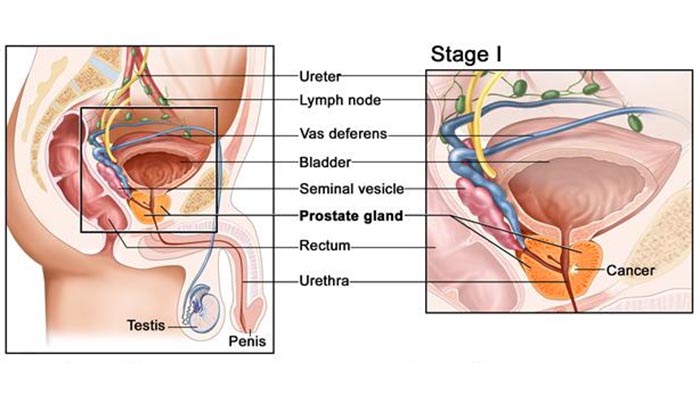
The image below shows the location of the prostate gland in the body which is present only in males. It is located below the urinary bladder. The prostate secretes the fluid that nourishes and protects sperms. During ejaculation, the prostate squeezes this fluid into the urethra, and it’s expelled with sperms as semen. In the prostatic cells, the male sex hormone testosterone gets converted to dihydrotestosterone (DHT) which causes the cells to grow resulting in an increase in its size.

Normally, the prostate gland is approximately the size of a walnut. As the size increases with age (which can start as early as 40 yrs) it starts to obstruct the urine outflow as shown in the image.
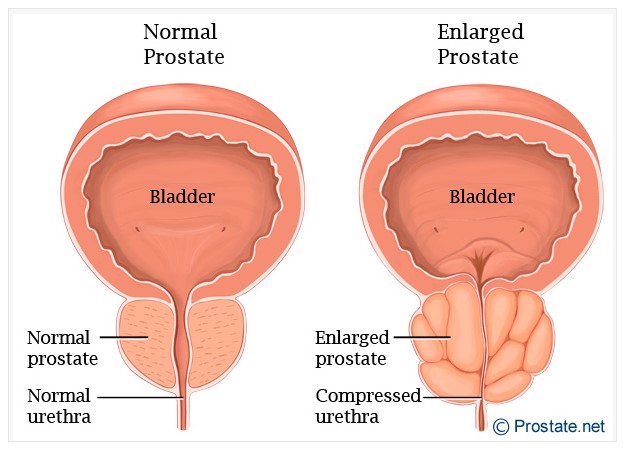
prostrate cancer-image 1


Symptoms of Prostatic enlargement:

  • A weak or slow urinary stream.
  • A feeling of incomplete bladder emptying.
  • Difficulty starting urination.
  • Frequent urination.
  • The urgency to urinate.
  • Getting up frequently at night to urinate.
  • A urinary stream that starts and stops.
  • Straining to urinate.

Medically enlarged prostate which is not cancerous is called Benign Prostatic Hyperplasia (BPH).

As the gland keeps getting enlarged, there are mutations in the DNA of its cells causing it to grow uncontrolled and abnormally resulting in cancer.

The saving grace in this entire process is that prostatic enlargement can be diagnosed early and controlled thereby preventing cancer.

DIAGNOSTIC MODALITIES:

  1. Sonography of the prostate gland is advised once a man turns 50 yrs to establish if enlargement has started. If there is a family history of prostate cancer then it should be done as early as 40 yrs.
  2. A blood test called Prostate Specific Antigen(PSA) should be done. Very high values are suggestive of cancer whereas in the enlargement phase the values remain < 4 units.

If you are facing any of the above symptoms, you must visit a Urologist who will diagnose and prescribe medication for the same. Incase medicines are not effective, one might have to opt for surgery.

In Mr Rebello’s case, since cancer had already developed, radiotherapy was first given to shrink the size of the prostate, post which surgery was performed to remove the cancerous gland. Cancer which had spread to his backbone was controlled by a combination of chemo and hormonal therapy.

Risk Factors for prostatic enlargement and cancer:

Age – prevalence increases markedly with age. The gland grows at a rate of 2 – 2.5 % annually in older men.

Genetics – 50% men undergoing surgery for BPH < 60 yrs of age have inheritable form of the disease.

PREVENTION:

Apart from timely diagnosis and treatment, being physically active, controlling Diabetes and weight are known to reduce enlargement of the gland. Diet rich in antioxidants and vitamins is also beneficial in prevention along with avoiding red meat.

Image credit – prostate.net
December 22, 2016 By Trupti Vyas (Pandya) 1 Comment

Be a happy and healthy eater

DE8AB426-13ED-4809-968D-650F639D3F41-9315-00001128AD2CB366_tmpWeekend is getaway time with our family, friends or colleagues. Some people think after doing strenuous workouts and crash dieting it’s time to relax over the weekend and relaxing means literally binging on outside food. More often than not, the thought process is –‘its only today so let me indulge…..I will make up for this binging over the week by sipping a meal or two’.
When Monday arrives, they are guilty of having indulged over the weekend. One needs to stop and notice these chain of events. There has to be a change in the behavior. Individuals’ need to realize that indulging in binge eating for two days and then feeling guilty and trying to rectify the situation does not work.

Hence it is said that ‘Mindful Eating’ is a must and the best solution. Mindful eating teaches us to simply observe thoughts, feelings and cravings for food. It enable us to change our behavior while we maintain our sanity and happiness

Here are Some Mindful eating tips-–

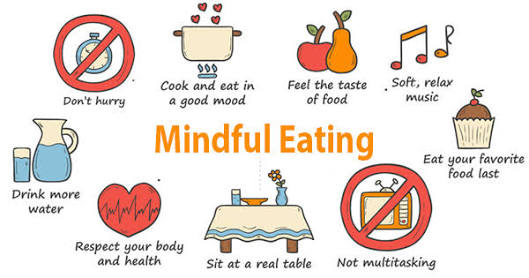
  • Multi-tasking while eating or watching television while eating always causes distraction or causes hurried eating. So switch off your phone, TV and Computer before eating.
  • Preferably adopt the cross legged posture Or sit At your usual dining place.
  • Try to eat sitting cross legged. You can do this even while sitting on a chair. Sitting cross legged on the floor and eating meals is an age old technique from our grandma’s days. (This helps to blood flow to the stomach area)
  • Calm your mind and body then start eating your meal. When your mind is calm and composed, you release the right amount of digestive juices which gives you better digestion.
  • If you are stressed or guilty while eating -stress hormone called cortisol is released which lowers our metabolic rate, prevent fat burning and help convert food to fat.
  • Take deep breath, calm yourself and get settled before eating.

While Eating-

  • Don’t be in a rush while eating and try to get up fast.
  • Start eating (preferably with your hands) and eat slowly.
  • Chew your food slowly
  • Use your entire mouth and do not just chew from 1 side of your Jaw.
  • While you still have food in your mouth don’t pick up another morsel from your plate.
  • Keeping food ready in your hands or in a spoon means you are eating fast and will ultimately this could lead to overeating.
  • Eat with your senses and think about how the food is nourishing you from within.
  • Savor every bit of what you eat, slowly and mindfully and you will naturally find your threshold. So be silence and attentive while you eat.
  • Prepare Food in smaller quantity. If number of People are less it helps to prepare lesser quantity and better by retaining nutrient value.
  • Always eat food that is freshly prepared. One should consume food within 3 hours of Cooking.
  • Don’t deep freeze cooked food.
  • Try eating with your non-dominant hand. If you’re a righty, hold your fork in your left hand when lifting food to your mouth whenever you eat outside in restaurant or party
  • Whenever you get the craving for a sweet – before opening the fridge or cabinet for the same, take a deep breath and ask yourself, “Am I really hungry?” Do something else, like reading or going on a short walk as that will help you to avoid any emotional extra eating under stress.

Let’s start to enjoy eating food rather than think of it as a task to complete. Remind the body of its own intelligence and its ability to self-regulate for you! Cultivate a sustainable, balanced and healthy approach to the way we eat, the way we look, and the way we live.

November 14, 2016 By Dr Ashwin Nanda 2 Comments

DECODING DIABETES

Diabetes-Day

Last month, I had 2 patients on the same day diagnosed with Diabetes- one an overweight 34 year old IT professional and the other a 6-year-old girl. The reason, why this incident comes to my mind today is because they were both diabetics but, had different diabetes and even their course of treatments was different.

But, the first question I was asked in both the cases was whether they will need to be put on insulin injections immediately. Well, this is a common question asked by patients. To understand this condition better, let me try and explain a bit about the different types of diabetes on the basis of which the required treatment is normally recommended.

Diabetes is a group of metabolic disorders in which the person has high blood glucose (blood sugar), either because insulin production is inadequate, or because the body’s cells do not respond properly to insulin or both. Common symptoms of either diabetes are unexplained weight loss, excess hunger, and excess thirst and delayed wound healing.

Today, I would like to take you through specifically 3 major types of diabetes namely, Type 1, Type 2 and gestational Diabetes.

Let’s talk about

Type 1 Diabetes: is caused by a loss or malfunction of the insulin-producing cells in the pancreas, called beta cells. Damage to beta cells results in absence or insufficient production of insulin. Most cases of Type 1 Diabetes have an autoimmune basis in which immune system mistakenly attacks and destroys its own beta cells. These cases are detected either in childhood or teenage years. There are many theories about what causes type 1 diabetes like autoimmune disease, viral infection, genetic predisposition and environmental factors may also play a role.

Whatever be the cause, this missing insulin has to be replaced as insulin is necessary to sustain life. It is responsible for entry of glucose into the body cells from where the glucose is further utilized for energy and other activities. This glucose which is not entering the cells is circulating in the blood which gets detected as high blood sugar. The replacement insulin is administered by injection using a syringe or an insulin pump. Thanks to the invention of Insulin clubbed with a healthy lifestyle, a Type 1 diabetic is able to lead a happy good quality life.

Coming to Type 2 diabetes most often than not your tissues will be resistant to insulin, so the insulin is being produced but unfortunately not being utilized properly. It is the most common form of diabetes worldwide and accounts for 90-95% of the cases.

Insulin resistance in type 2 diabetes means the signal insulin gives to a cell is weakened. This results in less glucose uptake by muscle and fat cells and a reduction in insulin mediated activities inside cells.

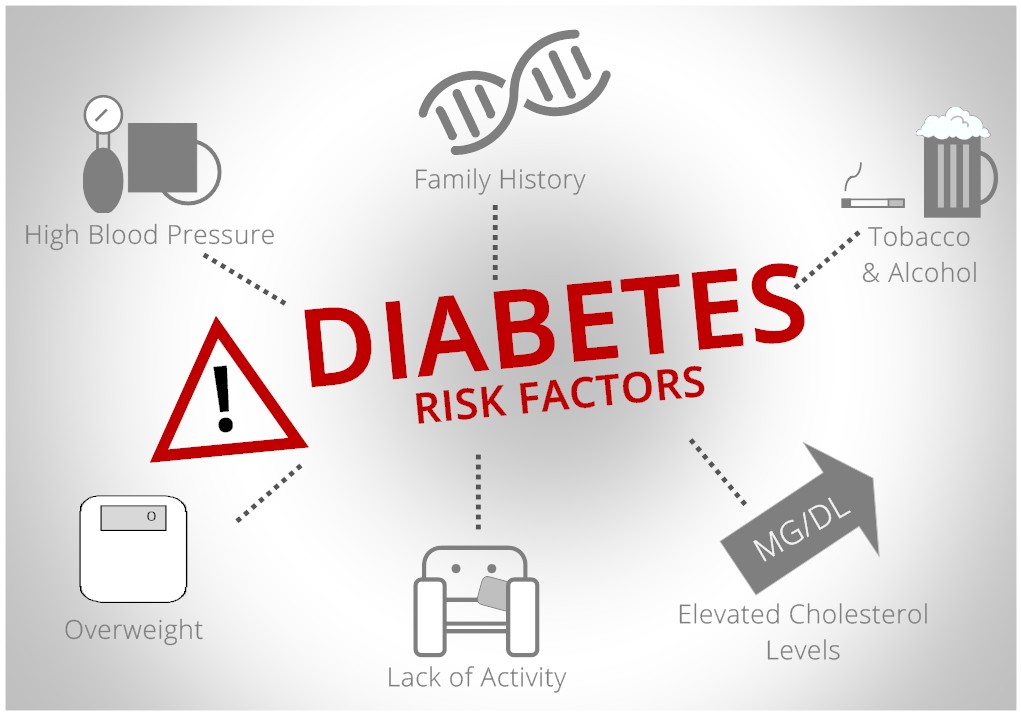
Risk factors for Type 2 Diabetes include an Unhealthy Lifestyle (being physically inactive or less active, erratic food and sleep habits, stress), being overweight or obese and importantly family history of diabetes in close relatives.

Diabetes-Risk

We have ample medicine combinations for type 2 diabetes like tablets which keep the blood sugar under control. But if sufficient sugar control is not achieved in spite of oral medications and a healthy lifestyle, then insulin might be required for further management.

Another type of Diabetes I would like to talk about is Gestational diabetes which basically refers to diabetes diagnosed during pregnancy.

Pregnancy hormones can interfere with the way insulin works in the mother’s body which can lead to elevated blood glucose levels during pregnancy. Women are typically screened for gestational diabetes at 24-28 weeks of pregnancy, however, women who have risk factors may be screened earlier.

Risk factors for developing gestational diabetes include having a family history of diabetes, being overweight, or over 28 years old. Blood glucose control during pregnancy is critical as elevated maternal glucose levels can lead to pregnancy complications and pose risks to the health of the baby. Gestational diabetes is likely to recur during subsequent pregnancies.

Gestational diabetes requires specialized treatment for the rest of the pregnancy. After the pregnancy is over, most women will have normal blood sugars again; however, up to 20-50 % can develop type 2 diabetes within 10 years. Regular screening is recommended.

A study conducted on people at risk of type 2 diabetes, it was seen that those who lost just 7% of their weight and exercised about 30 minutes a day cut their risk of diabetes by nearly 60%. In a nutshell, irrespective of the type of diabetes the best prevention or diabetes management strategy is to eat healthy, stay active and keep a check on your weight.

Reference: University of California, San Francisco – Diabetes online Education website.

October 20, 2016 By Dr Anand Kulkarni 3 Comments

OSTEOPOROSIS

osteoporosis

How often have you come across your parents, grandparents or an elderly relative who has had a minor fall in the bathroom, slipped on the floor or had a terrible jerk while travelling on a bumpy road and sustained fractures of bones with a lot of pain, suffering and disability.

It has been noticed that the culprit for such incidents is OSTEOPOROSIS.

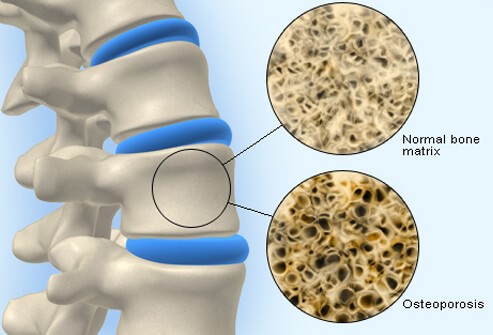
Osteoporosis is one of the most common disabilities encountered in the elderly. It literally means POROUS BONE. The condition results in reduced density and increased fragility of bones resulting in higher risk of fracture with minor falls, cough, sneeze, or minor bumps.

osteo1

The condition is observed worldwide. There are more than 10 million cases per year in India. In the USA about 55% of its population aged 50 years and older have Osteoporosis. One third have disabilities and one third regain their pre-fracture status. The health costs from fractures are tremendous amounting to billions of dollars annually.

It is very important to learn about osteoporosis because it is a ‘SILENT DISEASE’ except occasional bone pains. You may not know that you have osteoporosis until your thin weakened bones fracture in a bump or fall. The more common sites are Hip, Spinal Vertebrae and Wrist.

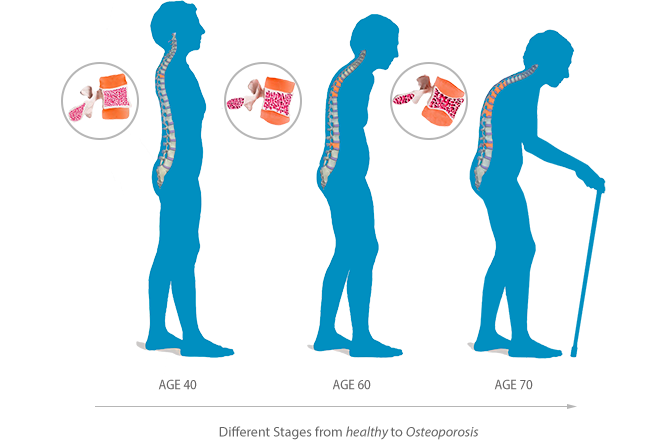
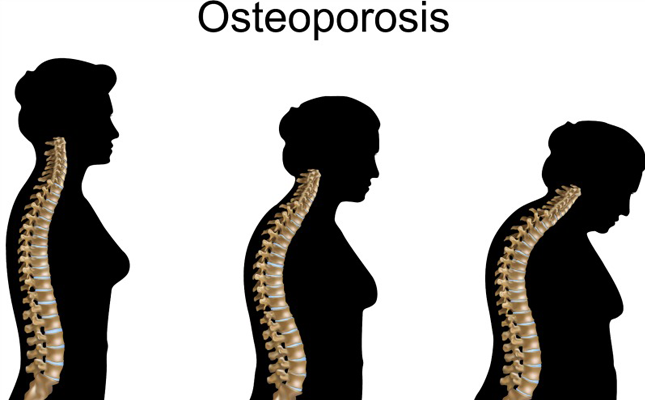
Clinical studies suggest that approximately 1 in 2 women and 1 in 4 men aged 50 years and older will break a bone due to osteoporosis. Such people in this age group usually present with chronic vague backache, loss of height, or stooping (Kyphosis) and should consult doctor immediately.

osteo2

THE RISK FACTORS ARE,

  • Advanced age
  • Family history of osteoporosis
  • Early menopause
  • Short Stature
  • Lack of Exercise
  • Poor nutrition with lack of Calcium
  • Lack of Vitamin D
  • Chronic Cigarette Smoking and Excessive Alcohol Consumption
  • Medical Illnesses- like hyperthyroidism, surgical removal of ovaries, long term steroid therapy and rare inherited bone disorders like Osteogenesis Imperfecta.

SCREENING is advised for all elderly above 65 years of age and Men and Women less than 65 years of age who have increased risk of fracture or already suffered from fracture.

DIAGNOSIS – is by bone scan which measures-Bone Mineral Density (BMD). The test called DEXA (Dual Energy X ray Absorptimetry) gives indication of likelihood of fracture due to osteoporosis.

It is also used to monitor response to treatment.

Result.— T score a)   ( -1) and above ——- normal

  1. b)   (-1) to ( -2.5) ——- mild bone loss or osteopenia
  2. c)     ( -2.5) and below —- osteoporosis

Our aim should be to prevent bone less or slow down the occurrence of Osteoporosis and encourage healthy bone mineralization.

Following measures are recommended:

  1. Healthy Nutritional Diet – To be incorporated during childhood and adolescent period itself with adequate calcium and magnesium intake. Calcium intake should be 1000 to 1200 mg per day. Common calcium rich foods are dairy products, cheese, ragi, broccoli, spinach, cabbage, green beans, soy beans, okra, dates, egg, salt water fish and fruits like orange, figs.
  2. Vitamin D intake of 800 IU per day is a must. We encourage exposure to SunLight and supplementation as Vitamin D requirement cannot be fulfilled through nutrition alone.
  3. EXERCISE plays a major role. Weight bearing exercises like walking, playing golf, Dancing, Hiking, Racket sports like Tennis, Squash promote mineralization of bones and make them healthy. Muscle strengthening exercises like weight lifting benefit by increasing muscle strength and Non- Impact activities like YOGA help in balancing, posture, agility of joints and benefit people with osteoporosis by decreasing the risk of falls and fractures.

Studies have also reported an increase in BMD in the spine of those who do YOGA regularly. Exercise should be tailored to the individual person based on BMD report and medical condition in consultation with health care professional.

osteo3

osteo    

  1. Other Lifestyle Changes – Have a Positive Attitude towards Life, avoid the use of tobacco and Cigarette Smoking, moderate alcohol intake if any, and measures to avoid falls like having railings, avoid slippery floors, having a mat or carpet on the floor helps etc.

Medications—You may also require osteoporosis medications to either build or maintain bone density. People have been treated with medications like Bisphosphonates, Hormone Therapy in Women, Calcitonin, Parathyroid Hormone. Stem Cell Therapy is also being tried out in severe cases.

But, any of these modalities of treatment should be undertaken in consultation with your Doctor. The doctor is the only one who will be able to decide the right treatment for you weighing the benefits and risks of the therapy.

Cultivate healthy living and enjoy life!

  • « Previous Page
  • 1
  • …
  • 63
  • 64
  • 65
  • 66
  • 67
  • …
  • 72
  • Next Page »

Search

Recent Posts

  • Foods to Manage Blood Sugar Naturally: A Complete Guide to Better Blood Sugar Control
  • The Lazy Person’s Guide to Staying Healthy: 5 Micro-Habits That Take Less Than 2 Minutes
  • Healthy Eating: Comforting Chilli Bean Soup Recipe for the Monsoon
  • The Truth About the ‘Beer Belly’: What Alcohol Really Does to Your Metabolism
  • Benefits of Meditation: How One Daily Habit Can Transform Your Mental Wellbeing

Stay Updated

Archives

  • August 2026 (7)
  • July 2026 (25)
  • June 2026 (22)
  • May 2026 (20)
  • April 2026 (24)
  • March 2026 (18)
  • February 2026 (14)
  • January 2026 (14)
  • December 2025 (19)
  • November 2025 (15)
  • October 2025 (20)
  • September 2025 (6)
  • August 2025 (6)
  • July 2025 (9)
  • June 2025 (18)
  • May 2025 (16)
  • April 2025 (22)
  • March 2025 (26)
  • February 2025 (21)
  • January 2025 (25)
  • December 2024 (22)
  • November 2024 (22)
  • October 2024 (20)
  • September 2024 (22)
  • August 2024 (28)
  • July 2024 (15)
  • June 2024 (23)
  • May 2024 (26)
  • April 2024 (27)
  • March 2024 (27)
  • February 2024 (23)
  • January 2024 (21)
  • December 2023 (14)
  • November 2023 (10)
  • October 2023 (19)
  • September 2023 (21)
  • August 2023 (16)
  • July 2023 (16)
  • June 2023 (21)
  • May 2023 (20)
  • April 2023 (19)
  • March 2023 (23)
  • February 2023 (19)
  • January 2023 (15)
  • December 2022 (11)
  • November 2022 (15)
  • October 2022 (15)
  • September 2022 (12)
  • August 2022 (9)
  • July 2022 (17)
  • June 2022 (11)
  • May 2022 (10)
  • April 2022 (6)
  • March 2022 (6)
  • February 2022 (13)
  • January 2022 (11)
  • December 2021 (7)
  • November 2021 (3)
  • October 2021 (6)
  • September 2021 (3)
  • August 2021 (8)
  • July 2021 (7)
  • June 2021 (15)
  • May 2021 (16)
  • April 2021 (10)
  • March 2021 (7)
  • February 2021 (4)
  • January 2021 (4)
  • December 2020 (3)
  • November 2020 (4)
  • October 2020 (10)
  • September 2020 (3)
  • August 2020 (3)
  • July 2020 (2)
  • June 2020 (4)
  • May 2020 (10)
  • April 2020 (12)
  • March 2020 (10)
  • February 2020 (4)
  • January 2020 (4)
  • December 2019 (3)
  • November 2019 (7)
  • October 2019 (5)
  • September 2019 (4)
  • August 2019 (9)
  • July 2019 (9)
  • June 2019 (11)
  • May 2019 (4)
  • April 2019 (8)
  • March 2019 (8)
  • February 2019 (9)
  • January 2019 (8)
  • December 2018 (9)
  • November 2018 (3)
  • October 2018 (3)
  • September 2018 (5)
  • August 2018 (10)
  • July 2018 (6)
  • June 2018 (13)
  • May 2018 (8)
  • April 2018 (18)
  • March 2018 (9)
  • February 2018 (8)
  • January 2018 (15)
  • December 2017 (12)
  • November 2017 (19)
  • October 2017 (13)
  • September 2017 (15)
  • August 2017 (4)
  • July 2017 (8)
  • June 2017 (7)
  • May 2017 (6)
  • April 2017 (8)
  • March 2017 (6)
  • February 2017 (7)
  • January 2017 (9)
  • December 2016 (10)
  • November 2016 (7)
  • October 2016 (7)
  • September 2016 (7)
  • August 2016 (11)
  • July 2016 (9)
  • June 2016 (9)
  • May 2016 (12)
  • April 2016 (17)
  • March 2016 (17)
  • February 2016 (8)
  • January 2016 (6)
  • December 2015 (2)
  • November 2015 (9)
  • October 2015 (7)
  • September 2015 (9)
  • August 2015 (11)
  • July 2015 (9)
  • June 2015 (11)
  • May 2015 (9)
  • April 2015 (13)
  • March 2015 (8)
  • February 2015 (5)
  • January 2015 (12)
  • December 2014 (14)
  • November 2014 (11)
  • October 2014 (6)
  • September 2014 (13)
  • August 2014 (12)
  • July 2014 (6)
  • June 2014 (2)
  • May 2014 (7)
  • April 2014 (4)

From Burnout to Balance: How Dr. Ranjit Reclaimed His Health

Dr Ranjit Bhatt has spent years tending to others. A practising doctor in Odisha, his days were packed with patients, surgeries, and emergencies. From the outside, it looked like a life lived in service. But on the inside, something wasn’t right. “I had no … [Read More...]

From Shimla’s Slopes to Chandigarh’s Sidewalks: Surinder Kaur Bhalla’s Journey from Chaos to Control

Some journeys start with a plan. Others begin with a stumble literally. Surinder Bhalla, a government professional, born and raised in the scenic hill town of Shimla, had always lived a life of movement. “In Shimla, you walked everywhere,” she reflects. “Walking was never an exercise. It was just life.” But after shifting to Chandigarh, […]

“I’ve Challenged Myself to Live 100 Years” – The Story of Chandubhai Savani’s Second Chance at Life

At 67, most people start slowing down. Not Chandubhai Savani. A resident of Surat, Chandubhai, thought life was on track. “My life was going well till I had my bypass surgery,” he says. That surgery, back in 2021, was a wake-up call.  Medication was routine, but exercise wasn’t. His diet? What he calls ‘normal.’ “I […]

Ananda Mukherjee Health Story

From Terminal Illness To Complete Wellness! Ananda Mukherjee Health Story

As we observe World Cancer Day under the powerful theme ‘United by Unique’ (2025-2027)**, we are reminded that every individual’s journey with cancer is distinct, yet united by shared resilience, hope, and the collective fight against this disease. This theme places people at the centre of care and their stories at the heart of the […]

  • HOME
  • HEALTHY LIVING
  • FITNESS
  • HEALTHY RECIPES
  • USER STORIES
  • KARMA
  • BUY GOQii

Copyright ©2016 GOQii