 Hypertension, or high blood pressure, rarely announces itself, which is why about 600 million adults worldwide have it without knowing. This guide explains what the numbers mean, what pushes them up, and what reliably brings them down.
Hypertension at a glance
- What it is: blood pressure that stays at 140/90 mmHg or higher on repeated readings, by the WHO definition.
- Why it is silent: most people have no symptoms, and about 44% of adults with hypertension do not know they have it.
- How common it is: an estimated 1.4 billion adults worldwide and 315 million in India.
- How to find out: measure it. From age 30, check at least once a year.
- What helps: less salt, a DASH-style diet, regular activity, a healthy weight, limited alcohol, no tobacco, and medicine when a doctor prescribes it.
What is hypertension?
Hypertension is the medical term for blood pressure that stays too high over time. WHO defines it as 140/90 mmHg or higher on two different days. Blood pressure is the force of blood pushing against your artery walls as the heart pumps.
Every reading has two numbers, measured in millimetres of mercury (mmHg):
- Systolic (the top number): the pressure when your heart beats.
- Diastolic (the bottom number): the pressure when your heart rests between beats.
Blood pressure rises and falls through the day with exercise, stress, caffeine and even conversation. One high reading is not a diagnosis. Hypertension means the pressure stays raised across repeated measurements.
What do your blood pressure numbers mean?
Below 120/80 mmHg is normal everywhere, and 140/90 mmHg or above, confirmed on separate days, is hypertension everywhere. The range in between is where guidelines differ.
| Reading (mmHg) | WHO, and most practice in India | AHA/ACC guideline (United States, 2025) |
| Below 120 and below 80 | Normal | Normal |
| 120–129 and below 80 | Below the diagnostic threshold | Elevated |
| 130–139 or 80–89 | Below the diagnostic threshold | Stage 1 hypertension |
| 140 or higher, or 90 or higher | Hypertension | Stage 2 hypertension |
Sources: WHO hypertension fact sheet, 2025 AHA/ACC guideline announcement.
If you sit between 120/80 and 139/89, a range often called prehypertension, you are not ill, but you are not in the clear either. This is the range where changes to food, movement, sleep and weight do the most good.
Your doctor will read the number alongside your age, family history, and conditions such as diabetes or kidney disease. The same reading can call for different action in different people.
Why is hypertension called the silent killer?
Hypertension is called the silent killer because it usually causes no symptoms while it gradually damages the heart, brain and kidneys. Most people with high blood pressure feel completely well. The World Health Organization estimates that 1.4 billion adults aged 30–79 had hypertension in 2024. About 600 million of them, or 44%, did not know it, and only around 23% had it under control.
India reflects the same pattern. The ICMR-INDIAB study estimated that 315 million Indians, or 35.5% of adults, had hypertension in 2021. In India’s National NCD Monitoring Survey, fewer than three in ten adults with hypertension knew they had it, and about one in eight had it under control.
There is progress. In nine districts covered by the India Hypertension Control Initiative, 58.5% of people with hypertension were aware of it in 2023–24 and 21.2% had it controlled.
Headaches, nosebleeds, dizziness or “feeling tense” are not reliable signs. Those symptoms usually appear only when pressure is very high, and many people never have them at all. The only way to know your blood pressure is to measure it.
That is less worrying than it sounds. A condition you can detect with a two-minute check, and manage with well-understood tools, is one you can stay ahead of.
What causes high blood pressure?
For most adults there is no single cause. Blood pressure creeps up over years through a mix of genes, age and daily habits. Doctors call this primary hypertension.
Some risks you cannot change: getting older, a family history of hypertension, and co-existing conditions such as diabetes or kidney disease.
Others you can influence:
- Too much salt. WHO advises less than 5 g of salt a day, just under a teaspoon. Estimates of average Indian intake range from about 8 g to 11 g.
- Too few vegetables and fruits, and too much saturated and trans fat.
- Excess weight, particularly around the waist.
- Too little movement and long hours of sitting.
- Alcohol and tobacco.
- Air pollution, which WHO names as the most significant environmental risk.
- Long-term stress and poor sleep.
Much of the salt in Indian diets is hidden. ICMR’s National Institute of Epidemiology points to pickles, papad, namkeen, bread, biscuits, instant noodles and other packaged foods as common sources.
In a smaller group, high blood pressure has a specific cause. Kidney disease, thyroid or adrenal conditions, obstructive sleep apnoea, and medicines such as some painkillers, steroids and decongestants can all raise it. This is worth asking about if your readings are high at a young age or hard to control.
What does untreated high blood pressure do to the body?
Years of raised pressure stiffen and narrow the arteries and make the heart work harder. The damage builds slowly and affects several organs:
- Heart: angina, heart attack, heart failure and irregular heart rhythm.
- Brain: The 2025 AHA/ACC guideline also links high blood pressure to memory problems, cognitive decline and dementia.
- Kidneys: gradual damage that can progress to kidney failure.
- Eyes: damage to the small blood vessels of the retina.
The relationship runs both ways. Bringing blood pressure down lowers the risk of heart attack, stroke and kidney damage, which is why early detection matters.
How is hypertension diagnosed?
Diagnosis rests on repeated readings, never on one. WHO defines hypertension as 140/90 mmHg or higher on two different days.
Many doctors also ask for home readings. Some people run higher in a clinic than at home, known as the white-coat effect, and others show the reverse. The 2025 AHA/ACC guideline recommends home monitoring to help confirm a diagnosis and to track treatment.
Who should get checked, and how often?
India’s national NCD programme screens adults aged 30 and above for hypertension, and an annual check from that age is a sensible minimum. Start earlier and check more often if you have a family history, diabetes, kidney disease or excess weight, or if you had high blood pressure during a pregnancy.
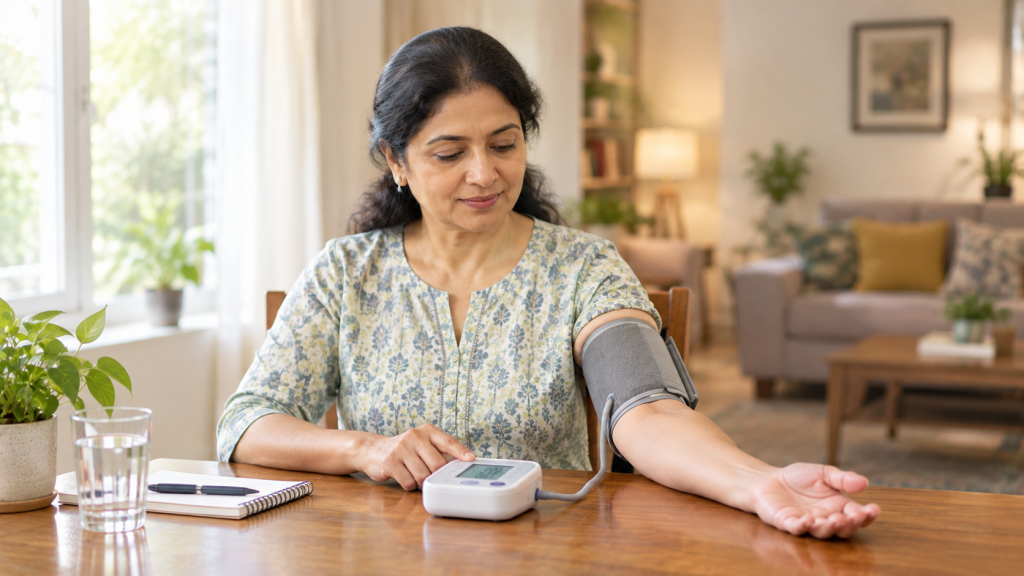
How to measure blood pressure at home
These steps follow the American Heart Association’s home-monitoring guidance:
- Use an automatic, validated monitor with an upper-arm cuff in the right size for your arm.
- Avoid caffeine, smoking and exercise for 30 minutes beforehand, and empty your bladder.
- Sit quietly for at least five minutes. Do not talk or use your phone.
- Rest your bare arm on a flat surface so the cuff sits at heart level.
- Take two readings, one minute apart, at the same time each day.
- Write down every reading, or use your monitor’s memory, and take the record to your doctor.
The AHA does not recommend wrist or finger monitors because their readings are less reliable. Wearables can be useful for noticing trends, but decisions about diagnosis or treatment should rest on a validated upper-arm cuff.
How can you lower blood pressure?
You can lower blood pressure by cutting salt, eating a DASH-style diet, moving more, losing excess weight, limiting alcohol and tobacco, and looking after sleep and stress. These changes are the first line of care at every stage, with or without medication. Six habits appear consistently in WHO and AHA/ACC guidance, and GOQii Healthy Reads covers several in more depth in its guide to natural ways to lower your blood pressure.
- Cut salt, especially the hidden kind. Aim for less than 5 g a day. Taste before you add salt, go easy on pickles, papad, chutneys and namkeen, and check packaged foods for sodium. As a guide, 1 g of salt contains 400 mg of sodium.
Potassium-enriched, low-sodium salt can help. ICMR-NIE cites an average drop of 7/4 mmHg from switching. It is not suitable for people with kidney disease or on certain medicines, so ask your doctor first.
- Eat in a DASH-style pattern. DASH stands for Dietary Approaches to Stop Hypertension. It favours vegetables, fruits, whole grains, pulses, nuts, seeds and low-fat dairy. An Indian plate adapts easily: dal, sabzi, curd, whole-grain roti or millets, fruit, and a handful of unsalted nuts.
- Move most days. WHO recommends at least 150 minutes of moderate activity a week, or 75 minutes of vigorous activity, plus strength work on two or more days. Brisk walking counts.
- Lose a little weight if you carry extra. The AHA/ACC guideline suggests a goal of at least 5% of body weight for adults with overweight or obesity. Read more on how excess weight raises blood pressure.
- Limit alcohol and stop tobacco. The AHA/ACC guideline says no alcohol is ideal. For those who drink, it advises no more than one drink a day for women and two for men.
- Protect sleep and manage stress. Keep regular sleep hours. If you snore loudly and wake unrefreshed, ask your doctor about sleep apnoea. Yoga, breathing exercises and meditation are among the stress-reduction techniques the guideline names.
None of these is a cure, and results vary from person to person. Their effects add up, and they continue to help if you also need medicine. For a starting point, see these lifestyle changes to manage hypertension.
When is medication needed?
Medicine is needed when lifestyle changes alone do not bring blood pressure down to your target, or when your readings are high enough that your doctor advises starting straight away. Needing tablets is not a failure of willpower. WHO notes that many people who improve their habits will still need medicine to reach a safe level.
Doctors decide based on your readings and your overall risk. WHO’s general goal is below 140/90 mmHg. It is below 130/80 mmHg for people with heart disease, a previous stroke, diabetes, chronic kidney disease or high cardiovascular risk.
The main medicine groups are ACE inhibitors, angiotensin receptor blockers (ARBs), calcium channel blockers and diuretics. Many people need more than one.
Three habits matter once you start:
- Take medicine as prescribed, including on days you feel fine.
- Do not stop or change the dose because your readings look good. They look good because the medicine is working.
- Tell your doctor about side effects. There are usually alternatives.
When should you seek urgent help?
A reading above 180/120 mmHg with symptoms is a medical emergency. Go to the nearest emergency department if a reading that high comes with any of these:
- Chest pain or shortness of breath
- Severe headache or confusion
- Sudden change in vision
- Numbness, weakness or difficulty speaking
If the reading is that high and you feel well, the AHA advises waiting at least a minute and measuring again. If it is still very high, contact your doctor straight away.
During pregnancy and in the weeks after birth, report any high reading promptly. GOQii’s guide to high blood pressure in pregnancy explains the warning signs.
Frequently asked questions
What is a normal blood pressure reading?
A normal adult reading is below 120/80 mmHg. Readings of 140/90 mmHg or higher on two different days meet the WHO definition of hypertension.
Can hypertension be cured?
Usually it is managed, not cured. Some people lower their readings enough through lifestyle change to reduce or stop medicine, but only under a doctor’s supervision. When another condition is the cause, treating that condition can sometimes bring blood pressure back to normal.
Does high blood pressure cause headaches?
Usually not. Most people with hypertension feel nothing at all. Headaches tend to appear only when pressure is very high, so the absence of a headache tells you nothing about your blood pressure.
Can young adults get high blood pressure?
Yes. A nationally representative survey of Indians aged 15 to 49 found that 18.1% had hypertension. Fewer than half of them knew it.
Is 130/80 mmHg high?
It depends on the guideline. The United States classifies it as stage 1 hypertension, while WHO sets the threshold at 140/90 mmHg. Either way, it is a reason to recheck, review your habits and speak to your doctor.
Are home blood pressure monitors accurate?
A validated upper-arm monitor, used correctly, gives readings your doctor can rely on. Take it to an appointment once a year so it can be checked against clinic equipment.
The bottom line
Hypertension is common, quiet and manageable. Know your numbers, recheck them at least once a year, and treat small changes to salt, movement, sleep and weight as worth making.
If your readings are raised, a doctor can help you decide what comes next. The earlier that conversation happens, the more options you have.
Pro Tip: Blood pressure responds to small habits repeated every day, not to one big change. Keep a log of your readings and daily habits in the GOQii App, so you and your doctor can see how they move over time. A GOQii Personalised Health Coach can help you build the food, movement and sleep habits in this guide and keep them going, alongside the treatment your doctor recommends.
#BeTheForce
Disclaimer: This article is for general awareness and education only. It does not replace professional medical advice, diagnosis or treatment. Do not start, stop or change any medicine without consulting your doctor.

Leave a Reply