GOQii

Blog

  • HOME
  • HEALTHY LIVING
  • FITNESS
  • HEALTHY RECIPES
  • USER STORIES
  • KARMA
  • BUY GOQii

October 21, 2026 By GOQii Leave a Comment

How Exercise Impacts Mental Health

Regular exercise is one of the most reliable ways to protect your mental health. It can lift your mood, ease stress and anxiety, help you sleep, and lower your risk of depression, and you don’t need a gym to get the benefits.

Most of us know the feeling: a brisk walk after a tense day, and the mind feels a little clearer. That isn’t just a pleasant side effect. Large reviews of hundreds of studies now show that physical activity has a real, measurable effect on depression, anxiety and stress.

This guide explains what the research shows, why movement helps the mind, how much and what kind of exercise to aim for, and how to start when you’re feeling low. It also covers what exercise can’t do, and when to get support.

Exercise and mental health at a glance

  • Even a little helps. People doing half the recommended activity had an 18% lower risk of depression than those doing none.
  • It eases existing symptoms. Walking, jogging, yoga and strength training all reduced depression symptoms in trials.
  • Any type counts. Choose something you enjoy enough to keep doing.
  • Short, regular sessions work. Aim for about 150 minutes a week, but start smaller if you need to.
  • It works alongside treatment, not instead of it. If you have depression or anxiety, keep talking to your doctor or therapist.

What the evidence shows

The World Health Organization states that physical activity reduces symptoms of depression and anxiety, enhances brain health, and can improve overall well-being, and lists better sleep and thinking among its benefits. Three large reviews show how strong that evidence is.

Study What it looked at What it found
Pearce et al., JAMA Psychiatry, 2022 15 studies, 191,000 adults followed over time Half the recommended activity was linked to an 18% lower risk of depression, and the full recommendation to 25% lower.
Noetel et al., BMJ, 2024 218 trials, 14,170 people with depression Walking or jogging, yoga and strength training gave moderate reductions in depression symptoms, with more benefit at higher intensity.
Singh et al., British Journal of Sports Medicine, 2023 97 reviews, over 1,000 trials and 128,000 people Exercise improved depression, anxiety and psychological distress across many groups. Resistance training helped depression most; yoga and mind–body exercise helped anxiety most.

The research has limits. Many trials are small, and people know whether they are exercising, which can affect results. But the overall direction is clear and consistent: moving more is good for the mind.

What it can help with

  • Low mood and depression: both lowering the risk and easing symptoms, especially mild to moderate depression.
  • Anxiety and stress: many people feel calmer after exercise, and regular activity can reduce anxiety over time.
  • Sleep: being active during the day can help you fall asleep and sleep better.
  • Focus and memory: regular activity supports brain health and thinking skills.
  • Self-esteem: reaching small goals and feeling stronger can build confidence.

Why exercise helps your mind

Scientists are still working out exactly how exercise helps mental health. It is probably a mix of effects on the brain, the body and daily life.

  • Feel-good chemicals. Harder exercise releases endorphins, behind the well-known “runner’s high”. But most of the lasting benefit comes from regular, moderate activity.
  • A healthier brain. Regular activity triggers growth factors that help nerve cells form new connections, including in the hippocampus, an area involved in mood that is often smaller in people with depression.
  • A calmer stress response. Regular exercise may help your body handle stress better, so that over time you feel less tense day to day.
  • Better sleep. Being active during the day tends to improve sleep, and good sleep is closely tied to mood.
  • A sense of achievement. Finishing a walk or lifting a little more than last week gives you small wins, which matter most when you’re feeling low.
  • Time with others and outdoors. A walking group, a game of badminton or a yoga class adds social contact and fresh air, both good for wellbeing.

The benefits build over time. Harvard Health notes that most people begin to feel better a few weeks after starting, so it’s worth sticking with it even if the first sessions feel hard.

How much exercise, and what kind?

The WHO recommends adults get at least 150 minutes of moderate activity a week, such as brisk walking, and adds that any amount is better than none. That target is also a good aim for mental health, but the research shows benefits start well below it.

Type Examples Good for
Walking or jogging Brisk walks, jogging, cycling, swimming Depression and mood; one of the most effective types in trials, and the easiest to start
Yoga and mind–body Yoga, tai chi, pilates Anxiety and stress; also rated among the most acceptable by participants
Strength training Bodyweight exercises, resistance bands, weights Depression; strength training showed some of the biggest benefits
Dance and sport Zumba, garba, badminton, football Mood and social connection; fun makes it easier to keep going

Tips for getting the most out of it

  • Pick what you’ll actually do. The best exercise for your mental health is the one you keep doing.
  • Push a little, when you can. Trials found that more vigorous exercise tended to give bigger benefits. Brisk enough that you can talk but not sing is a good level.
  • Go outside when possible. A walk in a park or green space adds fresh air and daylight.
  • Make it social. Walking with a friend or joining a group adds company and helps you show up.

Getting started when you’re feeling low

When your mood is low, even a short walk can feel like a lot. That’s normal, and it’s why starting small matters more than starting big.

  1. Start with 5–10 minutes. A short walk around the block or 10 minutes of stretching is a real start. The NHS notes that even a brisk 10-minute walk can clear your mind and help you relax.
  2. Tie it to something you already do. Walk after your morning chai, or stretch before bed.
  3. Lower the bar on hard days. On a bad day, putting on your shoes and stepping outside counts.
  4. Plan it, don’t wait for motivation. Mood often improves after you move, not before. Put it in your calendar like any other appointment.
  5. Bring someone along. A friend, family member or walking group makes it easier to show up and adds company.
  6. Notice how you feel afterwards. A quick note of your mood before and after can show you the difference over a few weeks.
  7. Build up slowly. Add a few minutes each week until you’re closer to 30 minutes on most days.

Pair it with other habits that protect your mind

Exercise works best alongside other everyday habits. Regular sleep, a few minutes of daily meditation, and noticing when stress drives your eating all support your mental health too.

What exercise can’t do, and when to get help

Exercise is a powerful tool, but it isn’t a cure-all. It works best alongside professional care, not instead of it. In the UK, for example, NICE recommends group exercise as one treatment option for less severe depression, usually guided by a trained practitioner. The authors of the large reviews above also see exercise as complementing therapy and medicines, not replacing them.

  • Don’t stop prescribed medicines without talking to your doctor, even if you start feeling better.
  • See a doctor or mental health professional if low mood, worry or loss of interest lasts more than two weeks, or affects your work, sleep, eating or relationships.
  • Talk to someone if exercise starts to feel compulsive, for example if you feel unable to miss a session, or it’s tied to strict rules about food or weight.

Free support in India

Tele-MANAS, the Government of India’s mental health helpline, is free, open 24 hours a day and available in around 20 languages. Call 14416 or 1800-891-4416.

If you or someone you know is thinking about suicide or self-harm, or is in immediate danger, call 112 or go to the nearest hospital emergency department straight away.

The bottom line

Exercise is one of the simplest, cheapest and best-supported ways to look after your mental health. It can lower your risk of depression, ease low mood, anxiety and stress, and help you sleep and think more clearly. You don’t need a gym or a long workout: a brisk walk, a yoga session or a few bodyweight exercises all count. Start small, choose something you enjoy, and keep going. And if you’re struggling, reach out for support alongside it.

Pro Tip: Use the GOQii App to track your steps, workouts and sleep, and note how you feel each day to see how movement affects your mood over time. Your GOQii Personalised Health Coach can help you build an activity routine that fits your life and keeps you motivated on harder days.

Frequently Asked Questions (FAQs)

  1. Can exercise help with depression?

Yes. Large reviews of trials show that exercise such as walking, jogging, yoga and strength training reduces depression symptoms. It works best alongside professional care, not as a replacement for it.

  1. How much exercise do I need for my mental health?

The WHO recommends at least 150 minutes of moderate activity a week, but benefits start well below that. People doing half that amount had an 18% lower risk of depression than those doing none.

  1. What type of exercise is best for anxiety?

Any regular activity can help. In one large review, yoga and other mind–body exercise showed the biggest benefits for anxiety. Walking is also an easy, effective place to start.

  1. How soon will I feel the benefits?

Many people feel calmer or more positive straight after a session. Longer-lasting improvements in mood usually take a few weeks of regular activity.

  1. Can exercise replace antidepressants or therapy?

No. Exercise is a valuable part of treatment, but you shouldn’t stop prescribed medicines or therapy without talking to your doctor. Many people use exercise alongside them.

  1. I have no energy when I’m low. How do I start?

Start very small, such as a 5–10 minute walk, and plan it rather than waiting until you feel motivated. Mood often improves after you move. Bringing a friend along can help you show up.

  1. Where can I get help for my mental health in India?

Tele-MANAS, the government’s free mental health helpline, is open 24 hours a day on 14416 or 1800-891-4416. In an emergency, or if you are thinking about harming yourself, call 112 or go to the nearest hospital.

#BeTheForce

Disclaimer: The information provided in this blog is for general awareness and educational purposes only. It is not intended to replace professional medical advice, diagnosis, or treatment. Always consult a qualified healthcare provider for personalised medical guidance or concerns related to your health.
October 16, 2026 By GOQii Leave a Comment

5 Daily Stretches to Prevent & Relieve Lower Back Pain

A few gentle stretches a day can ease lower back stiffness and help keep pain from coming back. They work best as part of staying active, not as a replacement for it.

Lower back pain is the leading cause of disability worldwide, affecting around 619 million people. Long hours at a desk, long commutes and too little movement all play a part. In about 90% of cases there is no specific disease or injury behind it. Doctors call this non-specific low back pain, and it usually improves with time and movement.

The five stretches below are simple, need no equipment, and take about 10 minutes. They suit everyday stiffness and mild, non-specific back pain. If your pain is severe, follows an injury or comes with other symptoms, read the safety section first.

Lower back pain at a glance

  • Most back pain is not serious. It usually improves within a few weeks and isn’t caused by damage.
  • Movement helps, bed rest doesn’t. Staying active is the main advice from the NHS and WHO.
  • Exercise reduces pain. A large Cochrane review of 249 trials found it eases chronic low back pain more than no treatment.
  • Gentle is enough. Stretches may feel a little uncomfortable, but they shouldn’t make your pain clearly worse.
  • Little and often works best. About 10 minutes, once or twice a day.
  • Know the warning signs. Numbness, leg weakness or bladder changes need urgent care, not stretching.

Before you start

These stretches are safe for most people with everyday back stiffness. A few simple rules keep them that way:

  • Move slowly. No bouncing or jerking. Ease into each stretch until you feel a gentle pull.
  • Mild discomfort is fine; sharp pain is not. NHS physiotherapy advice is that exercises may feel uncomfortable but shouldn’t significantly increase your symptoms. If one does, skip it and try the others.
  • Breathe normally. Don’t hold your breath during a stretch.
  • Use a mat or carpet. Most of these are done lying down.
  • Check first if you need to. If you are pregnant, have had back surgery, or have a diagnosed spine condition such as osteoporosis or a slipped disc, ask your doctor or physiotherapist which stretches suit you.

Don’t stretch, get help

Stop and get urgent medical help if your back pain comes with any of these warning signs:

  • Numbness, tingling or weakness in both legs
  • Numbness around your genitals or bottom
  • New difficulty passing urine, or losing control of your bladder or bowels
  • Chest pain, fever or feeling generally unwell
  • Pain that started after a fall or accident

These can be signs of a serious problem that needs prompt treatment.

The 5 stretches

The first four are stretches and the fifth gently strengthens the muscles that support your back. The knee-to-chest stretch, knee rolls and bridge all appear in NHS physiotherapy advice for low back pain. Cat–cow and child’s pose are gentle mobility stretches widely used in physiotherapy and yoga.

The evidence supports regular exercise in general rather than any single move. The largest review, covering 249 trials, found that exercise reduced chronic low back pain more than no treatment, but it didn’t single out one type as best. So pick the stretches that feel good for you and do them regularly.

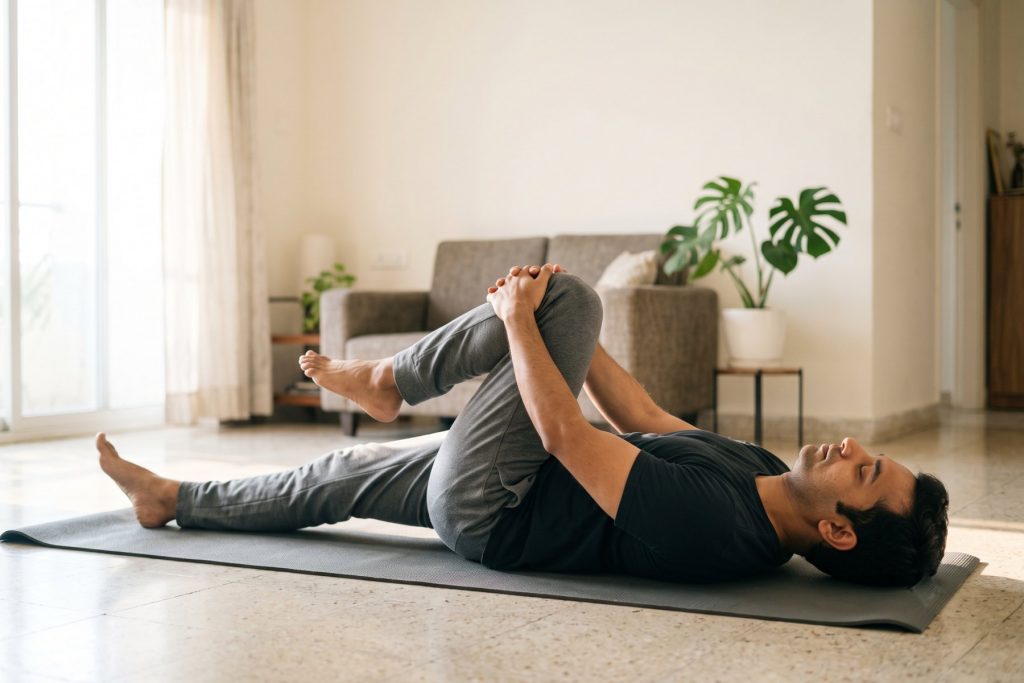
1. Knee-to-chest stretch

Good for: easing tightness across the lower back.

  1. Lie on your back with your knees bent and feet flat on the floor.
  2. Hold your knees, or behind your thighs if that is more comfortable for your knees, and gently draw both knees towards your chest.
  3. Stop when you feel a comfortable stretch in your lower back. Keep your head and shoulders relaxed on the floor.
  4. Hold for 20–30 seconds, breathing slowly, then lower your feet one at a time.

Repeat: 3 times. Easier version: bring one knee up at a time.

Avoid: yanking your knees in hard, or lifting your head. The stretch should come from a gentle hug, not force.

2. Knee rolls

Good for: gently loosening the lower back and hips with a twisting movement.

  1. Lie on your back with your knees bent, feet flat, and arms out to the sides.
  2. Keeping your knees together and both shoulders on the floor, slowly roll your knees to one side.
  3. Go only as far as is comfortable, pause for a breath, then roll back to the middle.
  4. Repeat on the other side.

Repeat: 8–10 times each side.

Avoid: letting your shoulders lift off the floor, or dropping your knees quickly.

3. Cat–cow

Good for: moving the whole spine gently, especially after sitting.

  1. Start on your hands and knees, with hands under your shoulders and knees under your hips.
  2. Breathe in and let your belly drop gently while you lift your chest and tailbone (cow).
  3. Breathe out and round your back up towards the ceiling, tucking your chin and tailbone (cat).
  4. Move slowly between the two, in time with your breath.

Repeat: 8–10 times. If your wrists hurt: rest on your fists or forearms.

Avoid: forcing either end of the movement. Work within a range that feels easy.

4. Child’s pose

Good for: a gentle stretch along the back and hips, and a calm way to finish.

  1. From hands and knees, sit your hips back towards your heels.
  2. Walk your hands forward and rest your forehead on the floor or a cushion.
  3. Let your back and shoulders relax, and breathe into your lower back.
  4. Hold for 20–30 seconds, or longer if comfortable.

Repeat: 2–3 times. Easier version: widen your knees, or put a pillow between your hips and heels.

Avoid: this one if it hurts your knees. Do an extra knee-to-chest stretch instead.

5. Glute bridge

Good for: strengthening the buttock and core muscles that support your lower back.

  1. Lie on your back with your knees bent, feet flat and hip-width apart, and arms by your sides.
  2. Tighten your stomach muscles gently and squeeze your buttocks.
  3. Lift your hips until your shoulders, hips and knees form a straight line.
  4. Hold for 3–5 seconds, then lower slowly.

Repeat: 8–10 times.

Avoid: arching your back or lifting too high. The work should come from your buttocks, not your lower back.

Your 10-minute daily routine

Order Stretch How much Time
1 Cat–cow 8–10 slow rounds 1 min
2 Knee rolls 8–10 each side 2 min
3 Knee-to-chest 3 × 20–30 seconds 2 min
4 Glute bridge 8–10 lifts, 2 sets 2–3 min
5 Child’s pose 2–3 × 20–30 seconds 2 min

Do it once or twice a day. The NHS leaflet suggests little and often, morning and afternoon.

Making it a habit

  • Tie it to something you already do. Straight after waking, after your evening walk, or before bed.
  • Start small. Even three of the five stretches is better than none on a busy day.
  • Use desk breaks. A seated cat–cow (slowly arching and rounding your back in your chair) and a standing side bend are easy to do at work after long sitting.
  • Expect gradual change. Stiffness often eases within days; it can take a few weeks of regular practice to notice less pain.

Beyond stretching: what else keeps your back healthy

Walk more

Walking is one of the simplest ways to keep back pain away. In a 2024 trial in The Lancet, 701 adults who had just recovered from low back pain followed a gradual walking programme with some physiotherapist guidance. They went a median of 208 days before their pain came back, compared with 112 days for those who didn’t. A daily walk pairs well with your stretching routine.

Keep moving, even when it hurts a little

During a flare-up, it is tempting to rest in bed. The NHS advises the opposite: stay active and keep up your normal activities as far as you can. Long bed rest tends to make stiffness worse.

Break up long sitting

No single posture is perfect, and there is little evidence that sitting a certain way causes back pain on its own. What helps most is changing position often. Stand up or walk for a minute or two every 30–45 minutes, and try a few simple office stretches between meetings. A comfortable desk setup, with your screen at eye level and your feet supported, makes long workdays easier.

Build strength

Stronger buttock, hip and core muscles help support your back. The bridge is a good start. Over time, add squats, step-ups or pilates-style exercises. WHO guidance recommends exercise programmes for chronic low back pain, and does not recommend back belts or braces for most people.

Look after sleep, stress and weight

Poor sleep and stress can make back pain feel worse and last longer, and WHO lists good sleep, activity and a healthy diet among the lifestyle changes that help. Keeping to a healthy weight also eases the load on your back.

When to see a doctor or physiotherapist

Most back pain gets better within a few weeks. See a doctor if your back pain:

  • doesn’t improve after a few weeks of home care, or stops you doing everyday activities
  • is worse at night or doesn’t ease with rest
  • comes with unexplained weight loss, fever or feeling unwell
  • gets worse when you cough, sneeze or go to the toilet
  • spreads down one leg, with numbness or tingling
  • worries you, or you’re finding it hard to cope

A physiotherapist can check what is going on and give you an exercise plan tailored to you. This is especially useful if your pain keeps coming back.

Go to A&E or call emergency services straight away for the warning signs listed in Before you start, such as numbness around your genitals or bottom, weakness in both legs, or changes in bladder or bowel control.

The bottom line

For most people, lower back pain is common, not serious, and gets better with movement. Ten minutes of gentle stretching a day, plus regular walking and fewer long stretches of sitting, is one of the simplest ways to ease stiffness and keep pain from returning. Go gently, stop anything that makes your pain clearly worse, and get help quickly if you notice any warning signs.

Pro Tip: A routine only helps if you keep it up. Use the GOQii App to track your steps, activity and sleep, and set a daily reminder for your stretches. Your GOQii Personalised Health Coach can help you build a movement plan around your work day, so back-friendly habits become part of your routine.

Frequently Asked Questions (FAQs)

  1. How often should I do these stretches?

Once or twice a day is a good aim. Little and often works better than a long session once a week. The full routine takes about 10 minutes.

  1. Should I stretch if my back already hurts?

Gentle movement usually helps, even during a flare-up. Stretches may feel a little uncomfortable, but they shouldn’t make your pain clearly worse. If one does, skip it. Don’t stretch through sharp pain, and see a doctor if the pain is severe or followed an injury.

  1. How long should I hold each stretch?

Hold static stretches such as knee-to-chest and child’s pose for 20–30 seconds. Moving stretches such as cat–cow and knee rolls are done slowly, 8–10 times.

  1. Is it better to rest or stay active with back pain?

Stay active. The NHS advises keeping up normal activities as far as you can, because long bed rest tends to make back pain and stiffness worse.

  1. Can stretching prevent back pain from coming back?

Regular exercise lowers the chances of back pain returning, and walking has some of the best evidence. In one large trial, a walking programme nearly doubled the time before people’s back pain came back. Stretching works best as part of staying generally active.

  1. Can I do these stretches at work?

A seated cat–cow, slowly arching and rounding your back in your chair, and a standing side bend are easy to do during a break. The floor stretches are better at home, before or after work. Standing up and moving every 30–45 minutes also helps.

  1. When should I see a doctor about lower back pain?

See a doctor if your pain doesn’t improve after a few weeks, stops you doing everyday things, is worse at night, or comes with fever or weight loss. Get urgent help for numbness around your genitals or bottom, weakness in both legs, or changes in bladder or bowel control.

#BeTheForce

Disclaimer: The information provided in this blog is for general awareness and educational purposes only. It is not intended to replace professional medical advice, diagnosis, or treatment. Always consult a qualified healthcare provider for personalised medical guidance or concerns related to your health.

April 2, 2025 By GOQii 3 Comments

How Can Walking Help You Overcome Stress?

overcome stressStress is inevitable given the fast-paced life all of us lead. It is something that can take over us completely if we do not make an effort to overcome it at the right time. There are many ways you can minimize and cope with stress and walking is a great way to overcome stress!
Most believe that walking only helps one lose weight or get into shape. But, it’s way more than that. It also helps you overcome stress. Exercise in almost any form can act as a stress reliever. Being active can boost your feel-good endorphins and distract you from daily worries. Walking is one way to lower your stress levels.

Any kind of Aerobics exercise (more than 2 minutes of walking is Aerobic exercise) has the power to swing an individual’s mood. If it is done every day, it can enhance self-esteem as well.

How Can Walking Help You Overcome Stress? 

Pumps up your endorphins: Walking increases your overall health and your sense of well-being and preps you up to take more steps every day. Walking also has some direct stress-busting benefits. Whenever you do any kind of aerobic activity you release endorphins (feel-good hormones). The higher your level of endorphins, the greater your sense of calm and well-being. No wonder that walking can make you feel so good!

Meditation in motion: After a fast-paced game of racquetball or several laps in the pool, you will often find that you have forgotten the day’s irritations and concentrate only on your body’s movements. As you begin to regularly shed your daily tensions through movement and physical activity, you may find that this focus on a single task, and the resulting energy and optimism, can help you remain calm and clear in everything you do.

Improves your mood: Regular Walking can increase self-confidence, it can help you relax and it can lower the symptoms associated with mild depression, stress and anxiety. Walking can also improve your sleep, which is often disrupted by stress, depression and anxiety. All of these walking benefits can ease your stress levels and give you a sense of command over your body and your life.

So whenever you feel you are stressed, go for a walk and come back feeling good and stress-free!

We hope this article helps you! Do leave your thoughts in the comments below.

#BeTheForce

Disclaimer: The information provided in this blog is for general awareness and educational purposes only. It is not intended to replace professional medical advice, diagnosis, or treatment. Always consult a qualified healthcare provider for personalised medical guidance or concerns related to your health.

July 31, 2024 By Anusha Subramanian 3 Comments

How to choose proper footwear?

footwear

One of the most common questions asked by people before starting any type of workout regime is what shoes do we get? Imagine walking 100 km or running 42 km or hiking or trekking without proper shoes. It could just be disastrous. And history is a witness that most people back out from such challenges midway not because of lack of motivation or because they are tired. But give up largely due to foot injuries caused due to bad shoes.

Why it is important to choose the right footwear?… A very Important aspect of workout which is often neglected.

A good workout is achieved with good footwear. Bad shoes can derail all the efforts that you have put into your workouts and bring your fitness to a standstill due to injury. Strenuous outdoor workout or long distance running puts increased amount of pressure on your feet and therefore wearing the right shoes are important to prevent injury.

According to University of Illinois’ McKinley Health Centre’s note on foot type and proper footwear, foot problems are one of the most common health complaints. The high incidence of foot problems is understandable given the fact that there are 26 bones, 33 joints, 112 ligaments, and tendons, nerves, and blood vessels in the foot. It’s even more understandable when the weight of the body is considered. The force of the body weight borne by the foot increases roughly 1½ times during walking and up to 3-4 times during running. Add in 10,000 steps during a typical day while wearing ill-fitted shoes possibly, and it’s a wonder one’s feet are willing to get out of bed the next day.

A condition called Plantar Fasciitis i.e. damage and inflammation to Plantar Fascia (a connective tissue on the sole of foot forming the inner arch) is caused due to repetitive activity creating a strain on the plantar fascia.

Another common condition often faced by people is Achilles Tendonitis i.e. tissue damage and pain to Achilles Tendon caused during the contraction of the calf muscles. When the calf muscles contract some amount of tension is created on the Achilles Tendon and Wrong footwear further adds to that stress.

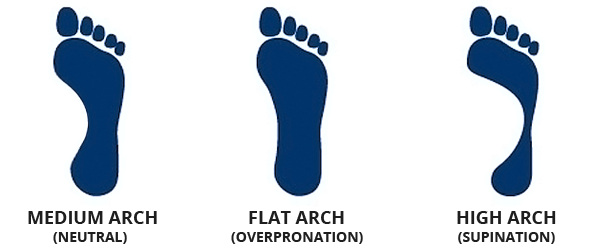
Let us now understand the three main categories of foot types :

1: Normal (Medium) Arch: If you see about half of your arch region filled in, you have the most common foot type. Usually, this means you have an arch that naturally supports your bodyweight and pronates normally under load. Some pronation or “rolling in” of the foot is desirable and acts as a natural shock absorber. Most runners with this pattern can wear just about any shoe.

2: Flat Floot (Absent curve): If the arch of your footprint is filled in, it’s likely that your foot collapses inward when you run. This acts as a shock absorber, but the additional rolling in of your foot may stress your feet and knees, adding to your injury risk. Usually, it is recommended that shoes with more stability, such as internal wedges that build up the arch side, dual-density midsoles, and supportive “posts,” or wider, more substantial midsoles be used.

3: More or High Arch: If your footprint shows little or no contact along the outside edge and you see just your heel and the ball of your foot, you have a “high” arch. Your foot may not roll in much when you run, but it doesn’t absorb much shock. We would usually recommend you use a well-cushioned shoe with little or no arch support or stability features.

three main categories of foot


Here are a few basics to keep in mind

  1. A good shoe must be very comfortable and must provide good cushion
  2. Good grip on the floor to avoid sliding or skidding
  3. It is important to understand your foot type. Visit a store that specializes in all kinds of sporting and athletic footwear. The associates there can help you find a shoe that’s appropriate for your foot type, the way you walk, and your sport.
  4. The right time to buy a shoe is in the evening when your feet are tired and there is more swelling in the feet.
  5. For Sportspersons variety of shoes are available depending on the type of sport.
  6. Running shoes have inbuilt shock absorbers, walking shoes are light weight and for Hiking one can choose low, mid or high cut shoes. High cut shoes or commonly known as Ankle shoes protects the ankles and provides more protection. And, finally, there are the cross training shoes which are suitable if you do more than one type of workouts.
  7.  One size larger than your usual shoe size is better in terms of trekking and trail running shoes.

A good shoe must support your foot, front and back and provide protection, stability, and good shock absorption.

We hope this article helps you choose the right footwear for your activities. Is there an interesting way you select your workout shoes? Let us know in the comments below. For more tips on fitness and health, check out Healthy Reads or speak to a certified expert by subscribing to GOQii’s Personalised Health Coaching here.

#BeTheForce

Disclaimer: The information provided in this blog is for general awareness and educational purposes only. It is not intended to replace professional medical advice, diagnosis, or treatment. Always consult a qualified healthcare provider for personalised medical guidance or concerns related to your health.

  • 1
  • 2
  • 3
  • Next Page »

Search

Recent Posts

  • World Stroke Day 2026: Know the Signs, Act FAST
  • Healthy Diwali Recipe: Dates Roll with Seeds
  • Overcome Worry: The Biggest Obstacle to Weight Loss
  • Essential Vitamins and Minerals for Women
  • Healthy Eating: Vegetable and Paneer Kathi Roll

Stay Updated

Archives

  • October 2026 (21)
  • September 2026 (5)
  • August 2026 (8)
  • July 2026 (25)
  • June 2026 (22)
  • May 2026 (20)
  • April 2026 (24)
  • March 2026 (18)
  • February 2026 (14)
  • January 2026 (14)
  • December 2025 (19)
  • November 2025 (15)
  • October 2025 (19)
  • September 2025 (6)
  • August 2025 (5)
  • July 2025 (9)
  • June 2025 (18)
  • May 2025 (16)
  • April 2025 (22)
  • March 2025 (25)
  • February 2025 (21)
  • January 2025 (25)
  • December 2024 (21)
  • November 2024 (21)
  • October 2024 (15)
  • September 2024 (22)
  • August 2024 (27)
  • July 2024 (14)
  • June 2024 (23)
  • May 2024 (26)
  • April 2024 (27)
  • March 2024 (27)
  • February 2024 (23)
  • January 2024 (21)
  • December 2023 (14)
  • November 2023 (10)
  • October 2023 (18)
  • September 2023 (20)
  • August 2023 (16)
  • July 2023 (16)
  • June 2023 (21)
  • May 2023 (20)
  • April 2023 (19)
  • March 2023 (23)
  • February 2023 (19)
  • January 2023 (15)
  • December 2022 (11)
  • November 2022 (15)
  • October 2022 (15)
  • September 2022 (12)
  • August 2022 (9)
  • July 2022 (17)
  • June 2022 (11)
  • May 2022 (10)
  • April 2022 (6)
  • March 2022 (6)
  • February 2022 (13)
  • January 2022 (11)
  • December 2021 (7)
  • November 2021 (3)
  • October 2021 (6)
  • September 2021 (3)
  • August 2021 (8)
  • July 2021 (7)
  • June 2021 (15)
  • May 2021 (16)
  • April 2021 (10)
  • March 2021 (7)
  • February 2021 (4)
  • January 2021 (4)
  • December 2020 (3)
  • November 2020 (4)
  • October 2020 (10)
  • September 2020 (3)
  • August 2020 (3)
  • July 2020 (2)
  • June 2020 (4)
  • May 2020 (10)
  • April 2020 (12)
  • March 2020 (10)
  • February 2020 (4)
  • January 2020 (4)
  • December 2019 (3)
  • November 2019 (7)
  • October 2019 (5)
  • September 2019 (4)
  • August 2019 (9)
  • July 2019 (9)
  • June 2019 (11)
  • May 2019 (4)
  • April 2019 (8)
  • March 2019 (8)
  • February 2019 (9)
  • January 2019 (8)
  • December 2018 (9)
  • November 2018 (3)
  • October 2018 (3)
  • September 2018 (5)
  • August 2018 (10)
  • July 2018 (6)
  • June 2018 (13)
  • May 2018 (8)
  • April 2018 (17)
  • March 2018 (9)
  • February 2018 (8)
  • January 2018 (15)
  • December 2017 (12)
  • November 2017 (19)
  • October 2017 (13)
  • September 2017 (15)
  • August 2017 (4)
  • July 2017 (8)
  • June 2017 (7)
  • May 2017 (6)
  • April 2017 (8)
  • March 2017 (6)
  • February 2017 (7)
  • January 2017 (9)
  • December 2016 (10)
  • November 2016 (7)
  • October 2016 (7)
  • September 2016 (7)
  • August 2016 (11)
  • July 2016 (9)
  • June 2016 (9)
  • May 2016 (12)
  • April 2016 (17)
  • March 2016 (17)
  • February 2016 (8)
  • January 2016 (6)
  • December 2015 (2)
  • November 2015 (9)
  • October 2015 (7)
  • September 2015 (9)
  • August 2015 (11)
  • July 2015 (9)
  • June 2015 (11)
  • May 2015 (9)
  • April 2015 (13)
  • March 2015 (8)
  • February 2015 (5)
  • January 2015 (12)
  • December 2014 (14)
  • November 2014 (11)
  • October 2014 (6)
  • September 2014 (13)
  • August 2014 (12)
  • July 2014 (6)
  • June 2014 (2)
  • May 2014 (7)
  • April 2014 (4)

From Burnout to Balance: How Dr. Ranjit Reclaimed His Health

Dr Ranjit Bhatt has spent years tending to others. A practising doctor in Odisha, his days were packed with patients, surgeries, and emergencies. From the outside, it looked like a life lived in service. But on the inside, something wasn’t right. “I had no … [Read More...]

From Shimla’s Slopes to Chandigarh’s Sidewalks: Surinder Kaur Bhalla’s Journey from Chaos to Control

Some journeys start with a plan. Others begin with a stumble literally. Surinder Bhalla, a government professional, born and raised in the scenic hill town of Shimla, had always lived a life of movement. “In Shimla, you walked everywhere,” she reflects. “Walking was never an exercise. It was just life.” But after shifting to Chandigarh, […]

“I’ve Challenged Myself to Live 100 Years” – The Story of Chandubhai Savani’s Second Chance at Life

At 67, most people start slowing down. Not Chandubhai Savani. A resident of Surat, Chandubhai, thought life was on track. “My life was going well till I had my bypass surgery,” he says. That surgery, back in 2021, was a wake-up call.  Medication was routine, but exercise wasn’t. His diet? What he calls ‘normal.’ “I […]

Ananda Mukherjee Health Story

From Terminal Illness To Complete Wellness! Ananda Mukherjee Health Story

As we observe World Cancer Day under the powerful theme ‘United by Unique’ (2025-2027)**, we are reminded that every individual’s journey with cancer is distinct, yet united by shared resilience, hope, and the collective fight against this disease. This theme places people at the centre of care and their stories at the heart of the […]

  • HOME
  • HEALTHY LIVING
  • FITNESS
  • HEALTHY RECIPES
  • USER STORIES
  • KARMA
  • BUY GOQii

Copyright ©2016 GOQii



