GOQii

Blog

  • HOME
  • HEALTHY LIVING
  • FITNESS
  • HEALTHY RECIPES
  • USER STORIES
  • KARMA
  • BUY GOQii

Search Results for: sexual wellness

December 31, 2019 By GOQii Leave a Comment

Level Up Your 2020 With GOQii!

Level Up 2020

The year has come to an end and around this time, we all begin formulating resolutions for the coming year. While most of us haven’t stuck to our resolutions or surprisingly achieved them, we need to understand that being healthy and active is an ongoing process. It never ends and the only thing to do is Level Up!

What happens once you achieve a health goal? Do you stop? Do you go back to being unhealthy? What happens if you don’t achieve your health goals? Do you give up? The answer is no! You move forward. You rise up to the challenge. You learn all there is to know to push ahead and #BeTheForce. That’s what we mean when we say Level Up.

So how do you Level Up? How do you take things up a notch? Let us help!

How You Can Level Up Your 2020

Below are a few things that GOQii helps you with so you can better equip yourself with the right guidance, right knowledge and the right products – all available within the GOQii App.

  1. GOQii Play: Tired of routine? Have doubts about nutrition? Want to try yoga and meditation? We’ve got all of these covered and much more on GOQii Play. You have access to tons of information from experts in their respective fields. Be it sexual wellness, mental health or medicine, we bring you the latest topics, exciting workouts, healthy recipes among others, all of which will help you better equip yourself to take it to the next level in 2020!
  2. Health Store: Want a trusted source for nutraceuticals? Want to eat healthy snacks? Do you need clothing for your gym? The GOQii Health Store has everything you need to get you started on the right path to good health. The brands and their products are curated by a team of experts to bring you nothing but the best. Let shopping healthy be one of your resolutions this year.
  3. Active Sunday: If motivation doesn’t find you, you need to go out there and find it yourself! Nothing works as better motivation than a group of like-minded individuals who meet up every Sunday for an hour and exercise. GOQii Active Sundays happen every week and are a great way to kickstart your week on a healthy note. Currently, we have around 50 GOQii Champions who conduct Active Sundays across different locations in India and at the pace at which we’re going, this number is likely to increase in the coming year. Want to be a part of this? Click here to register: https://goo.gl/KN82CU
  4. Challenges: In 2019, we initiated 3 challenges that were massive and had a huge impact on healthcare in India. Through the India Steps Challenge, we were able to increase the national step count to an average of 9391. The India Health Quiz helped users increase their knowledge about all things healthy and bust common health myths which were floating around the internet. The GOQii Trail Challenge this year saw an amazing turnout, inspiring stories which included a 60 year old participant completing the trail with a broken arm as well as a blind and sighted duo who completed the 50km arduous trail in 16 hours. In 2020, we’re going to issue more challenges and more opportunities for all of us to shine!
In one app, you have all the tools you need to make 2020 as healthy as possible but don’t forget one of the key ingredients which is YOU! It is your willpower, determination and motivation which will make all the difference. 2020 is about you and what you do to Level Up your lifestyle and make a difference.

So walk more, eat healthy, sleep right and have more fun! The world is your playground. Here’s to a healthy and happy New Year!

#BeTheForce 
October 10, 2023 By Divya Thampi 5 Comments

Let’s Talk About Mental Health

mental healthIn 2020, we released a study that revealed how 43% Indians are plagued with depression. But surprisingly, even in large metros like Mumbai, awareness of mental health is low, stigma is high and discrimination against people with mental health concerns is a harsh reality. The very recommendation that one should see a therapist or a mental health professional is received with distaste at best and anger at worst.

What is Mental Health?

The world over ‘Mental Health’ week is being observed but do we understand ‘Mental Health’?  It is important that we first understand what “Mental Health” means. It does not just refer to the absence of illness, rather it denotes a state of mind that allows people to believe in their abilities, work productively, cope effectively with day to day stressors, reach out for help when feeling overwhelmed, relate to others, and to work towards their highest potential.

While the mental health condition of a person is established by the individual’s ability to manage his/her thoughts, feelings, actions and interactions with others, mental illnesses and disorders are  often caused by a combination of factors including social discrimination, lack of protective policies, poor working conditions, poverty, lack of education, below average living standards, abuse (verbal, physical and sexual) and absence of familial or/and social support systems. It is true that certain genetics and specific personality attributes can make people more vulnerable to mental health issues, however contrary to popular belief, these are neither the only nor the most significant contributors to mental illnesses or disorders.

According to a survey conducted nationally, in 2018, on the attitudes towards people affected by mental health concerns, the top three attitudes prevalent in India were found to be the following:

  1. People with mental illness should not be given any responsibility
  2. One of the main causes of mental illness is a lack of self-discipline and will-power
  3. Mentally unhealthy people should have their own groups – healthy people need not be contaminated by them.

If one is diagnosed with cancer or with Malaria, would we ask them to get their act together and get better or expect them to use will-power to cure themselves? In terms of its prevalence and the number of people impacted by it, mental health issues are no different to physical health concerns and they need to be addressed with the same care and concern that is adapted to tackle a physical ailment, rather than with disdain and scorn.

With the existing attitudes, it comes as no surprise that the affected people, as well as the families, refrain from talking about their concerns or seeking the support they need due to the fear of being judged or labelled. But there are changes each of us can make that will help in creating an environment that promotes positive mental health.

Here are four steps you could take to do your bit in reducing social stigma attached to mental health concerns:

1. Educate Yourself About Mental Illnesses

General beliefs that people with mental illness are dangerous or are violent are myths which have unfortunately been propagated by movies. Often people with mental illnesses are victims of violence and abuse themselves. Question every stereotype and treat people with respect, irrespective of their diagnoses.

2. Stop Using Labels

Often people say things like ‘she is depressed’ or ‘he is schizophrenic’. The mental illness that someone deals with, is just one aspect of their lives and not their identity. Hence use language that separates the person from the health issue. For example, we could say “she deals with depression” or  “he’s been diagnosed with schizophrenia”. Use language that’s respectful and sensitive.

3. Support People

Remember that people who deal with mental health issues make important contributions to the world. Did you know that Mr. Kjell Magne Bondevik, the ex-Prime Minister of Norway had suffered from a depressive episode in August 1998 while he was still in power? He took some time out to recover and continued as PM till March 2000. Do not judge people to be incompetent or dismiss their capabilities based on a mental health condition they may be suffering from. Treat people with dignity, just like you would like to be treated yourself, had you been in their position. Encourage the actions that your own family members and friends take to overcome mental illness, support their efforts to get well and lead productive lives.

4. Encourage & Initiate Open Discussions

If you yourself have dealt with or are dealing with mental health issues, talk about it. Your courage will help in creating awareness and empower many others. If it is a family member or friend who is dealing with it, talk openly regarding the illness with their permission and in doing so, you will take away the shame attached to it.

The first Director-General of the World Health Organization (WHO), Dr. Brock Chisholm, in 1954, had quite aptly declared that “without mental health, there can be no true physical health.” On this very important day, let’s pledge to do our bit by becoming advocates to reducing the stigma surrounding mental health concerns and promote a world of inclusion and sensitivity.

For more on Mental Health, check out Healthy Reads or tune in to Emotional Wellness Expert Divya Thampi’s classes on GOQii Play.

#BeTheForce

April 19, 2019 By Dr. Viral Thakkar Leave a Comment

Epitome of Climax: The Big “O” Part II

The big O

I believe that a good night’s sleep, A good laugh and an exhilarating orgasm can solve humanity’s problems (not technically! But I hope you get my message!) None of us need to be convinced to make love and orgasm. We all accept and love that feeling! Having an orgasm could help improve your health as well!

In the Vedic texts, having a good and satisfying sex life is a prerequisite to reach higher spiritual realms. The Khajuraho temples depict that one can get the most from the energized temples if one is completely ‘over’ other needs and desires, including making love.

Apart from the said spiritual gains, a good and satisfying sex life has numerous other benefits too!

Having an orgasm is fun and that’s it! If a good one can bring in some happiness, which in turn impacts other aspects of a human’s life, then one must go for it!

Benefits of an Orgasm

  • Stress Relief: Having an orgasm releases Oxytocin, the relaxing hormone. It also stimulates feelings of warmth and relaxation. The part of the brain associated with fear and anxiety, shows little to no activity. And hence the “ahaah” feeling.
  • Building a Relationship: Pleasuring your partner by making love is critical among many other aspects as well. A number of psychosomatic disorders are linked to unsatisfied or unwanted sexual life.
  • Relieving Pain: Orgasms lead to Neurotransmissions which reduce the feeling of pain. This includes pain from arthritis and pain after surgery. According to research, women’s pain tolerance and pain detection increased by 74.6 percent and 106.7 percent respectively, when those women masturbated to orgasm.
  • Better Skin: Ever seen that glow on the face of people who are in love? The feeling of being in love and cherished is also felt by people who orgasm. You will feel happy, loved and cherished inside which will reflect on your skin tone too!

What can you do to Orgasm?

While the actual ‘act’ matters to reach the O, a number of other random factors impact it too.

A few things to do before THE ACT

  1. While I do not want to emphasize that you plan, but just be aware of what your partner wants. Does he/she likes it when you hug or kiss? Or does a simple “I love you” works? Does he/she like it romantic? Remember, pleasuring your partner many times will lead you to your own pleasure as well. And needless to say, it helps build your relationship.
  2. Communicate: Ask what your partner likes and tell what you like.
  3. Take a few mindful moments to decompress from your day. Focusing on being present with your partner will make you more likely to Orgasm.
  4. Enjoy. Yes, sex is for procreation, but it is to have fun too! Be in the mood & go for it.
  5. It is said that the chances of a healthy sex life largely depends on your equation with your partner. If you love them, the better your chances are of orgasming. So the one night stands might not always lead to the gratification you are looking for!
  6. It might seem like your orgasm is your partner’s responsibility (and let’s be honest, having the moves definitely contributes), but researchers have also found that your sense of self-esteem and satisfaction with your body is a huge contributing factor. So be happy with yourself, with the body you have and go for it!
  7. Eat foods which increase the heat in the body, like garlic, onions, potatoes, broccoli, nuts, etc.  are known to increase the libido.

Do you have any queries? Want to know more about orgasms? Let us know in the comments below!

#BeTheForce

Disclaimer: Reader discretion is advised. This content is for an older, mature audience who seek to improve their health and wellness. GOQii is not responsible for any misrepresentation of this information.

April 18, 2019 By Dr. Viral Thakkar 1 Comment

Epitome of Climax: The Big “O”

know your orgasmWhat is an Orgasm?

The climax of coitus, the mountaintop of making love and the ultimate, the almighty orgasm! Yes! This is what this article is about. You will agree that the pleasure of an orgasm is so heightened, it is difficult to know what is happening; but knowing what’s going on inside of us may heighten that.

Orgasm is the sudden discharge of accumulated sexual excitement resulting in rhythmic muscular contractions in the pelvic region of men and women. It is controlled by the involuntary or autonomic nervous system & associated with other  involuntary actions, including muscular spasms in multiple areas of the body, a general euphoric sensation and, frequently, body movements and vocalizations due to intense pleasure.

How Does it Happen?

I believe it is extremely essential to be attracted to your partner before indulging in any sexual activity. In fact, I would go ahead and say, indulge only if you love the person, else do not! More about this in another article.

If you are in this wonderful state, the continual stimulation of erogenous zones, such as the genitals, anus, nipples, or perineum by your partner might lead to an orgasm. Many believe that orgasms actually happen in the brain. Hence, one can reach an orgasm through masturbation as well. Physiologically, orgasms occur following two basic responses to continual stimulation:

  • Vasocongestion: The process whereby body tissues fill up with blood, swelling in size as a result
  • Myotonia: The process whereby muscles tense, including both voluntary flexing and involuntary contracting

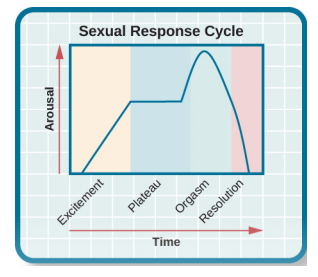
If you thought having an orgasm is just a minute’s game, then you are in for a surprise. The body undergoes a long process to reach that state through the sexual response cycle, which is the sequence of physical and emotional changes that occur as a person becomes sexually aroused and participates in sexually stimulating activities, including intercourse and masturbation.

the epitome of climaxPhase 1: Excitement

As the name suggests, this is the stage when you blush and breath heavily in the hope of your coitus. In this stage:

  • Skin may become flushed
  • Muscle tension will increase
  • Heart rate quickens and breathing is accelerated
  • Nipples become hardened or erect
  • Vaginal lubrication begins
  • Blood flow to the genitals increases, resulting in swelling of the woman’s clitoris and labia minora (inner lips), and erection of the man’s penis
  • The woman’s breasts become fuller and the vaginal walls begin to swell
  • The man’s testicles swell, his scrotum tightens, and he begins secreting a lubricating liquid

Phase 2: Plateau

This is the phase when you are about to get an orgasm, but haven’t yet! The part of the brain that controls sensations – the primary somatosensory cortex – sees an increase in activity and the parts of the brain that control alertness and anxiety – the amygdala and hippocampus – dropped off.

Several other areas of the prefrontal cortex all show a decrease in activity. In other words, having an orgasm shuts the parts of your brain that make you worry.  No wonder all of mankind is crazy about having orgasams! It’s a great stress buster! It’s in the way our bodies are built!

The general characteristics in this stage are:

  • The changes of phase 1 are intensified
  • The vagina continues to swell from increased blood flow, and the vaginal walls turn a dark purple
  • The woman’s clitoris becomes highly sensitive (may even be painful to touch) and retracts under the clitoral hood to avoid direct stimulation from the penis
  • The man’s testicles are withdrawn up into the scrotum
  • Breathing, heart rate, and blood pressure continue to increase
  • Muscle spasms may begin in the feet, face, and hands
  • Muscle tension increases

Phase 3: Orgasm

The climax – It is the shortest of the phases and generally lasts only a few seconds. Both sexes feel the contractions in a variety of places from the head (that explains funny faces) to the feet (that explains clenched toes). You cannot control these contractions as they are involuntary and cannot be contained… kind of like when you sneeze. The loss of control can be messy, but it is ultimately why we enjoy our orgasms so much.

General characteristics of this phase include the following:

  • Involuntary muscle contractions begin
  • Blood pressure, heart rate, and breathing are at their highest rates, with a rapid intake of oxygen
  • Muscles in the feet spasm
  • There is a sudden, forceful release of sexual tension
  • In women, the muscles of the vagina contract. The uterus also undergoes rhythmic contractions
  • In men, rhythmic contractions of the muscles at the base of the penis results in the ejaculation of semen

Phase 4: Resolution

This is the feeling of “Oh my! What was that?” In this stage, the man enters a temporary recovery phase where further orgasms are not possible. This is known as the refractory period, and its length varies from person to person. It can last from a few minutes to a few days, and this period generally grows longer as a man ages. During this phase, the man’s penis and testicles return to their original size. The rate of breathing will be heavy and fast, and the pulse will be fast.

Orgasms are an inbuilt mechanism of human body (mammals). Our brain, emotions, and physiology are wired so that a person can experience it. In the second part of my article, I will elaborate on the benefits of orgasms, and why it is important to have a few now and then!

Want to know more? Drop a comment below!

#BeTheForce

Disclaimer: Reader discretion is advised. This content is for an older, mature audience who seek to improve their health and wellness. GOQii is not responsible for any misrepresentation of this information.

  • « Previous Page
  • 1
  • 2
  • 3
  • 4

Search

Recent Posts

  • PCOS and Anxiety: Discover Relief with the 54321 Technique
  • Navigating the Maze of Nutrition: Finding Clarity Amidst Confusion
  • Get children active and keep them healthy
  • What Gestational Diabetes Can Do To You & Your Unborn Child
  • Breathing – A Forgotten Art

Stay Updated

Archives

  • December 2025 (4)
  • November 2025 (15)
  • October 2025 (20)
  • September 2025 (6)
  • August 2025 (6)
  • July 2025 (12)
  • June 2025 (18)
  • May 2025 (16)
  • April 2025 (23)
  • March 2025 (23)
  • February 2025 (22)
  • January 2025 (26)
  • December 2024 (26)
  • November 2024 (25)
  • October 2024 (22)
  • September 2024 (24)
  • August 2024 (31)
  • July 2024 (21)
  • June 2024 (26)
  • May 2024 (31)
  • April 2024 (27)
  • March 2024 (29)
  • February 2024 (26)
  • January 2024 (25)
  • December 2023 (15)
  • November 2023 (11)
  • October 2023 (22)
  • September 2023 (22)
  • August 2023 (20)
  • July 2023 (22)
  • June 2023 (24)
  • May 2023 (24)
  • April 2023 (24)
  • March 2023 (23)
  • February 2023 (20)
  • January 2023 (16)
  • December 2022 (12)
  • November 2022 (15)
  • October 2022 (15)
  • September 2022 (12)
  • August 2022 (10)
  • July 2022 (17)
  • June 2022 (11)
  • May 2022 (10)
  • April 2022 (6)
  • March 2022 (6)
  • February 2022 (13)
  • January 2022 (12)
  • December 2021 (7)
  • November 2021 (3)
  • October 2021 (6)
  • September 2021 (3)
  • August 2021 (8)
  • July 2021 (7)
  • June 2021 (15)
  • May 2021 (16)
  • April 2021 (10)
  • March 2021 (7)
  • February 2021 (4)
  • January 2021 (4)
  • December 2020 (3)
  • November 2020 (4)
  • October 2020 (10)
  • September 2020 (3)
  • August 2020 (3)
  • July 2020 (2)
  • June 2020 (4)
  • May 2020 (10)
  • April 2020 (12)
  • March 2020 (10)
  • February 2020 (4)
  • January 2020 (4)
  • December 2019 (3)
  • November 2019 (7)
  • October 2019 (5)
  • September 2019 (4)
  • August 2019 (9)
  • July 2019 (9)
  • June 2019 (11)
  • May 2019 (4)
  • April 2019 (9)
  • March 2019 (8)
  • February 2019 (9)
  • January 2019 (8)
  • December 2018 (9)
  • November 2018 (3)
  • October 2018 (3)
  • September 2018 (5)
  • August 2018 (10)
  • July 2018 (6)
  • June 2018 (13)
  • May 2018 (8)
  • April 2018 (18)
  • March 2018 (9)
  • February 2018 (8)
  • January 2018 (15)
  • December 2017 (12)
  • November 2017 (19)
  • October 2017 (13)
  • September 2017 (15)
  • August 2017 (4)
  • July 2017 (8)
  • June 2017 (7)
  • May 2017 (6)
  • April 2017 (8)
  • March 2017 (6)
  • February 2017 (7)
  • January 2017 (9)
  • December 2016 (10)
  • November 2016 (7)
  • October 2016 (7)
  • September 2016 (7)
  • August 2016 (11)
  • July 2016 (9)
  • June 2016 (9)
  • May 2016 (12)
  • April 2016 (17)
  • March 2016 (17)
  • February 2016 (8)
  • January 2016 (6)
  • December 2015 (2)
  • November 2015 (9)
  • October 2015 (7)
  • September 2015 (9)
  • August 2015 (11)
  • July 2015 (9)
  • June 2015 (12)
  • May 2015 (9)
  • April 2015 (13)
  • March 2015 (8)
  • February 2015 (5)
  • January 2015 (12)
  • December 2014 (14)
  • November 2014 (11)
  • October 2014 (6)
  • September 2014 (13)
  • August 2014 (12)
  • July 2014 (6)
  • June 2014 (2)
  • May 2014 (7)
  • April 2014 (5)

From “Laddu Nawin” to Fit and Fierce: How a 25-Year-Old Insurance Advisor Shed 20 Kilos and Gained His Life Back

When 25-year-old Nawin Yadav from Hyderabad walked into his office every morning, he carried more than just his files and policy papers. He had the weight of fatigue, sluggish energy, and an ever-growing belly that was becoming the butt of jokes. “People … [Read More...]

“I’ve Challenged Myself to Live 100 Years” – The Story of Chandubhai Savani’s Second Chance at Life

At 67, most people start slowing down. Not Chandubhai Savani. A resident of Surat, Chandubhai, thought life was on track. “My life was going well till I had my bypass surgery,” he says. That surgery, back in 2021, was a wake-up call.  Medication was routine, but exercise wasn’t. His diet? What he calls ‘normal.’ “I […]

From Shimla’s Slopes to Chandigarh’s Sidewalks: Surinder Kaur Bhalla’s Journey from Chaos to Control

Some journeys start with a plan. Others begin with a stumble literally. Surinder Bhalla, a government professional, born and raised in the scenic hill town of Shimla, had always lived a life of movement. “In Shimla, you walked everywhere,” she reflects. “Walking was never an exercise. It was just life.” But after shifting to Chandigarh, […]

Ananda Mukherjee Health Story

From Terminal Illness To Complete Wellness! Ananda Mukherjee Health Story

As we observe World Cancer Day under the powerful theme ‘United by Unique’ (2025-2027)**, we are reminded that every individual’s journey with cancer is distinct, yet united by shared resilience, hope, and the collective fight against this disease. This theme places people at the centre of care and their stories at the heart of the […]

  • HOME
  • HEALTHY LIVING
  • FITNESS
  • HEALTHY RECIPES
  • USER STORIES
  • KARMA
  • BUY GOQii

Copyright ©2016 GOQii