GOQii

Blog

  • HOME
  • HEALTHY LIVING
  • FITNESS
  • HEALTHY RECIPES
  • USER STORIES
  • KARMA
  • BUY GOQii

Search Results for: portion control

May 7, 2025 By GOQii Leave a Comment

A Guide to Managing Diabetes with Everyday Foods

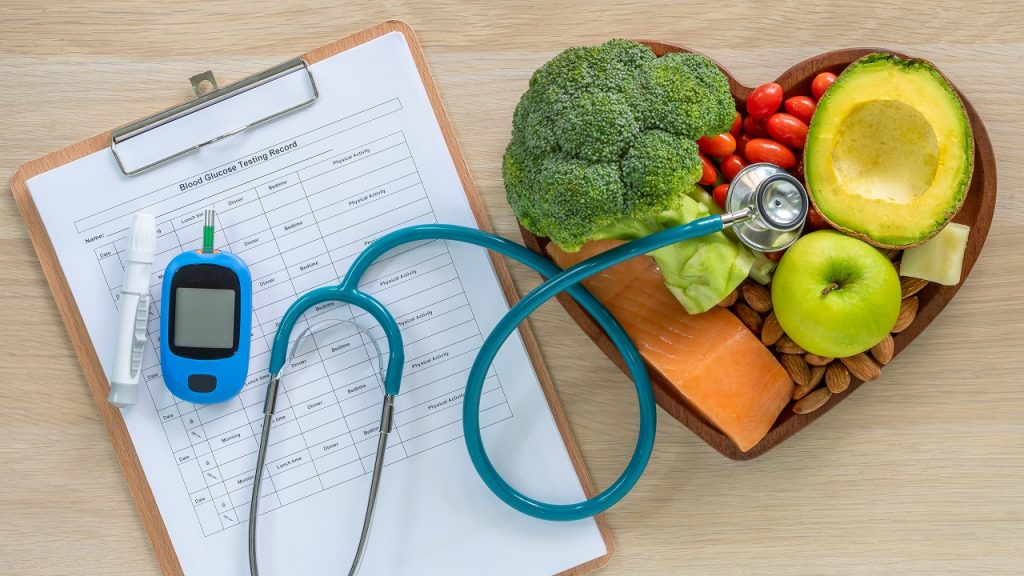
Diabetes is becoming an increasingly common health condition across Saudi Arabia. Many individuals and families are learning to manage this lifestyle challenge, which is marked by high blood sugar levels.



While medication and regular medical check-ups are essential, one of the most powerful tools for managing diabetes lies in your hands your food choices.

The Carbohydrate Challenge

For those living with diabetes, carbohydrates are a major concern. When we eat them, our body breaks them down into sugar. Simple carbs — like white bread, sugary drinks, juices, and sweets — are digested too quickly, leading to sharp spikes in blood sugar levels.

The Solution: Slow-Release, High-Fibre Foods

To manage blood sugar effectively, focus on foods that are digested slowly — often referred to as low glycaemic index (GI) foods.

These are typically high in fibre, which helps the body absorb sugar more gradually, offering major benefits:

✅ Improves insulin sensitivity, allowing your body to manage sugar better

✅ Lowers bad cholesterol (LDL), protecting your heart

✅ Reduces risk of cardiovascular disease

Everyday Foods That Support Diabetes Management

The good news? Many slow-release, diabetes-friendly foods are already part of Saudi kitchens and traditions. You don’t need expensive or foreign superfoods — just a few smart swaps and mindful portions.

Here’s what to add to your daily meals:

Food Why It’s Good Portion Tip
Foul Medames High in fibre and protein; keeps blood sugar stable and supports fullness for hours ~1 cup per serving
Hummus & Chickpeas Slow-digesting legume that’s great as a dip or in salads 2–4 tbsp hummus or ½ cup chickpeas
Lentil Soup Nourishing and gentle on blood sugar; packed with plant protein and iron 1 medium bowl
Jareesh & Harees Traditional wheat-based dishes rich in fibre and slow carbs — but watch preparation Avoid excess ghee/oil or fatty meat; keep portions moderate
Whole-Wheat Bread Higher fibre than white bread; helps prevent sugar spikes 1-2 small pieces (e.g. khubz or pita size)
Barley (Sha’ir) Known for stabilising blood sugar; try in soups or as Talbina Use unsweetened Talbina; ~½–1 cup

A Special Note on Dates (Tamr)

Dates are a cultural symbol of generosity and tradition in Saudi Arabia — and you don’t need to give them up.

However, they do contain natural sugars, so moderation is key:

  • Eat 1 to 3 dates at a time
  • Pair them with a handful of nuts (like almonds or walnuts) or a spoon of yoghurt — this slows down sugar absorption

Don’t Forget Fruits & Veggies

Non-starchy vegetables and low-GI fruits (like cucumbers, lettuce, spinach, apples, and berries) are your best friends. Include a variety in your meals to support overall health, digestion, and blood sugar control.

Your Health Starts at Home

With a few mindful swaps and a return to traditional whole foods, you can take charge of your health — right from your kitchen.

🟢 Choose wisely
🟢 Eat mindfully
🟢 Stay consistent

And always work closely with your doctor or registered dietitian for personalised care.

Disclaimer: This information is for educational purposes only. Always consult your doctor or a licensed dietitian before making changes to your diet.

April 22, 2025 By Hardika Vira 5 Comments

Common Reasons For Not Losing Belly Fat

Commons Reasons For Not Losing Belly FatBelly fat is not accumulated in a day or two. It takes several weeks and months of unhealthy eating and lifestyle to build it. When people finally decide to lose belly fat, the first thing they wonder is ‘Why am I not losing belly fat even after exercising so much and cutting down on junk food?’ There are several reasons for it.

Reasons Why You’re Not Losing Belly Fat

Here are a few common reasons why most individuals find it difficult to lose belly fat.

1. Eating Heavy Meals At One Time
Most people struggling with losing belly fat and weight loss are the ones who tend to have too much food at one time. The reason for this is largely either long gaps between the meals or skipping previous meal or if the person consumes food very fast. How is this related to belly fat?

When a person consumes food, it gets broken down to release/provide energy. Firstly, it will fill in the glycogen stores and then the excess calories that are not used up with good physical activity get converted into fats and the most common sites of fat storage is the belly, arms, thighs and buttocks.

When you are having food, only post 20-25 mins of eating, the satiety centers in the brain are activated and you feel full and satisfied. When you eat fast the satiety centers of the brain are not activated and you end up eating more. Small frequent meals and chewing your food thoroughly and eating mindfully is the key to control food portion.

2. Dinner Meals Are High In Carbs & High In Quantity
Due to a hectic schedule, the only meal that we have together with the family turns out to be ‘dinner’ and in turn, it ends up to be the largest meal with a variety of food that the entire family enjoys. Ideally, dinners should be light and should be high in proteins and less in carbs. This is actually vice versa of what is generally practiced.

The reason for the dinners to be light and high in proteins and less in carbs is that post dinner, we are not that active. Hence, there’s no real requirement of all the carbs for energy. The process of recovery of all the muscles that are used up throughout the day, the repairing of all the wear and tear happens during the night and that requires proteins, not carbs.

3. Physical & Mental Stress
This is only with regards to people who are excessively obsessed with exercise to lose belly fat. Excessive exercise leads to physical stress and thus, high cortisol levels. In case of mental stress, you might have noticed that the first thing you would choose is chocolates/ice creams or any comfort foods that are high in sugar or carbs for that matter. At this point of stress, the food gets broken down and is converted to fat and stored in your belly area. Exercise in moderation and keep yourself stress free by indulging in some yoga and meditation or your hobbies.

4. Consumption Of Processed Food
Do you have the habit of reading labels? Do pick one product that you eat the most and read the label today. Most of the processed or ready to eat food products are high in sugar, fat or refined carbs. They are extremely low in fiber as well. Even the fiber enriched product gives less than 2gm of fiber per serving. Read labels and choose wisely. The best solution here is to eat homemade food or you can try some variations to increase fiber intake by incorporating more veggies/fruits along with the main product.

5. Aerated Drinks
Products containing HFCS (High Fructose Corn syrup) or liquid glucose, that are present in all the aerated drinks like Cola, flavored sugar syrups, etc. do not get metabolized and are stored in the belly as fat, which is really tough to get rid off through just activities. Instead, opt for buttermilk, lemon water, coconut water, and fresh lime soda (salted) over the above drinks.

We hope this article helps you make better choices and avoid these common reasons for not losing belly fat.

#BeTheForce

Disclaimer: The information provided in this blog is for general awareness and educational purposes only. It is not intended to replace professional medical advice, diagnosis, or treatment. Always consult a qualified healthcare provider for personalised medical guidance or concerns related to your health.

April 5, 2025 By GOQii Leave a Comment

Reversing Type 2 Diabetes Through a Low-Carbohydrate Lifestyle

Type 2 diabetes is often seen as a lifelong condition, but research and real-world experience show that it can be managed—and even reversed—with the right dietary approach. One of the most effective strategies is adopting a low-carbohydrate lifestyle, which not only helps regulate blood sugar levels but also improves insulin sensitivity.

Unlike traditional high-carb diets that lead to frequent glucose spikes, a low-carb approach stabilises energy levels, reduces cravings, and supports long-term health. If you’re looking for a sustainable way to take control of your diabetes, reducing your carbohydrate intake might be the key.

Why Reduce Carbohydrates?

Carbohydrates break down into glucose in the bloodstream. For individuals with type 2 diabetes, the pancreas struggles to produce enough insulin to move glucose into cells for energy. This results in persistently high blood sugar levels, which can eventually lead to complications such as nerve damage, kidney issues, and cardiovascular disease.

By reducing carbohydrate intake to 60–130g per day, you prevent large spikes in blood glucose after meals, easing the pressure on your pancreas. Over time, this can allow your pancreatic beta cells to recover and improve insulin sensitivity, helping your body regulate blood sugar more effectively.

The Ideal Process:

  1. Carb-controlled meals → lower glucose load
  2. Less strain on pancreas → beta cells recover
  3. Improved insulin sensitivity → glucose absorbed into cells
  4. Stable, healthy blood sugar levels

Which Carbohydrates to Avoid?

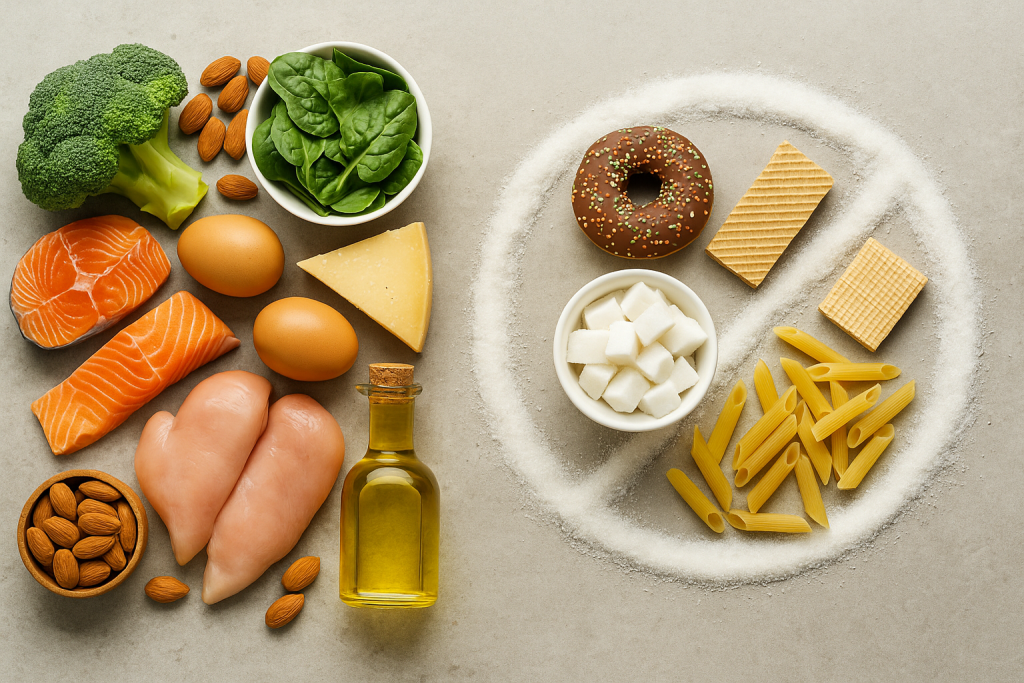
Starchy foods are typically high in carbohydrates and should be limited:

  • Bread (white, whole grain, multigrain)
  • Pasta
  • Rice (white, brown, basmati)
  • Potatoes (including sweet potatoes)
  • Grains (wheat, oats, barley, corn, quinoa)

The general rule: vegetables that grow underground (e.g., potatoes, carrots) contain more carbs than those that grow above ground.

Best Low-Carb Vegetables (per 100g)

Leafy Greens
Lettuce (2g), Spinach (1g), Arugula (1.6g), Kale (3g), Swiss Chard (1.8g)

Cruciferous Vegetables
Broccoli (4g), Cauliflower (3g), Brussels Sprouts (5.1g), Cabbage (3g)

Other Non-Starchy Vegetables
Asparagus (2g), Courgette (3g), Aubergine (3g), Tomatoes (3g),
Mushrooms (3.3g), Bell Peppers (4.6g), Onions (8g), Garlic (33.1g),
Radishes (3.4g), Cucumbers (3g), Celery (3g), Green Beans (4g), Artichokes (10.5g)

Focus on nutrient-dense, high-fibre, low-carb vegetables to meet your nutritional needs while keeping carbohydrate intake low.

What Are Net Carbs?

You may come across the term “net carbs,” which refers to the total carbs minus fibre and sugar alcohols—the carbs that actually raise blood sugar.

Net Carbs = Total Carbs – Fibre – Sugar Alcohols

While this can offer a more accurate reflection of how food impacts blood glucose, we recommend focusing on total carbohydrate intake for now, as calculating net carbs can be confusing in the early stages.

Protein: An Essential Nutrient

Protein supports muscle maintenance, satiety, and metabolism. On a low-carb diet, protein should be moderate, not excessive.

Target: 1.5–2.0g per kg of body weight per day

Portion Guide:

  • Women: ~85g cooked meat/tofu, 1 cup Greek yoghurt/cottage cheese, 2 whole eggs
  • Men: ~115g cooked meat/tofu, 1 cup Greek yoghurt/cottage cheese, 2 whole eggs

Low-Carb Dairy Options

Milk (per 240 ml / 1cup):

  • Whole or Semi-Skimmed: 12g carbs
  • Unsweetened Almond Milk: 1g carbs

Cheese (30g / 1oz):

  • Cheddar: 0.4g, Brie: 0.1g, Feta: 0.8g, Cream Cheese: 0.8g

Yoghurt (170g / 6oz):

  • Full-Fat Greek: 5g, Low-Fat Greek: 7g

Cream (30ml/ 1fl oz):

  • Double Cream: 0.6g, Single Cream: 0.7g

Butter (14g / 1 tbsp):

  • Salted/Unsalted: 0.1g

Avoid flavoured yoghurts and sweetened milk which can have hidden sugars.

Alcohol on a Low-Carb Diet

You can enjoy alcohol occasionally by choosing low-carb options:

Wines (per 5oz glass):

  • Dry White (e.g., Sauvignon Blanc, Pinot Grigio): 2–4g carbs
  • Dry Red (e.g., Merlot): 2–4g carbs

Beers (per 12oz):

  • Bud Light: 4.6g, Michelob Ultra: 2.6g, Beck’s Premier Light: 3.9g, Brewdog Pale Ale: 7 g

Spirits (per 1oz):

  • Gin, Vodka, Rum, Tequila, Whisky: 0g (when consumed neat)
  • Add low-carb mixers like soda water, diet tonic, diet ginger ale

Low-Carb Cocktails:

  • Vodka Soda with lime, Gin & Diet Tonic, Whisky Ginger with diet ginger ale, Rum & Diet Coke

❗ Note: Avoid beer and cider unless opting for very light versions. Also, steer clear of sugary mixers, juices, and syrups which can add a substantial carb load to your drink.

Don’t Forget to Keep a Food Diary

Tracking what you eat helps in:

  1. Increasing awareness and mindfulness
  2. Identifying hidden sugars and carbs
  3. Tracking progress over time
  4. Identifying behavioural patterns
  5. Ensuring accountability and better food choices

You can use your phone, an app, or even a journal to keep track. Share it with your nutritionist or coach to get tailored guidance.

A low-carbohydrate lifestyle, when well-planned, can help reverse type 2 diabetes by addressing the root causes—excessive glucose and insulin resistance.

By:
✔ Lowering carbs to 60–130g per day
✔ Prioritising non-starchy vegetables and whole foods
✔ Including moderate protein and healthy fats
✔ Avoiding sugary, starchy, and processed foods
✔ Tracking food intake and blood sugar

…you can achieve stable glucose levels, improved insulin sensitivity, and potentially reduce or eliminate medication.

It’s not about perfection—it’s about consistency and sustainability. And remember: you’re not alone on this journey.

💬 Have you tried a low-carb approach to manage your diabetes or weight? Share your experience in the comments below!

#BeTheForce

March 26, 2025 By GOQii Leave a Comment

Decode Your Food: How to Read Labels and Make Smarter Choices

Walking down the supermarket aisle, you’re bombarded with choices—”low fat,” “high protein,” “sugar-free,” “natural.” But what do these claims really mean? How do you know if a product is genuinely healthy or just smartly marketed? The answer lies in the fine print: the food label.

Reading food labels can feel like cracking a code, but once you know what to look for, it becomes second nature—and empowers you to make healthier, smarter decisions for yourself and your family.

Let’s break it down into simple, actionable steps with a few nutritionist-approved pro tips!

  1. Start With the Ingredients List 📝

This is where the truth of the product lies. Ingredients are listed in order of quantity, from most to least. If sugar, salt, or refined flour are among the first three, it’s a red flag.

  • Choose products with whole, recognisable ingredients.
  • Fewer ingredients usually mean less processing.

💡 Pro Tip: Ingredients like high fructose corn syrup, maltose, dextrose, or anything ending in “-ose” are forms of sugar. The same goes for hydrogenated oils, which signal unhealthy trans fats.

  1. Serving Size vs. Reality 🍿

The label might say 120 calories per serving—but what’s a serving? 5 crackers? Half a chocolate bar? Often, the serving size is much smaller than what we typically consume.

  • Always check the number of servings per package.
  • If you eat double the serving size, you’re getting double the calories, fat, and sugar.

💡 Pro Tip: For single-serve snacks, don’t assume the whole pack is one serving. Check to avoid underestimating your intake.

  1. Understanding Nutrition Per 100g vs. Per Serving 📊

Many labels show nutrition per 100g and per serving.

  • Use per 100g to compare products easily.
  • Use per serving to track your intake.

💡 Pro Tip: If you’re comparing two products, always use the per 100g column to avoid being misled by serving sizes that vary between brands.

  1. Know Your Daily Reference Intakes (RI) 📅

Labels often list percentages of nutrients based on a daily reference intake (also called Daily Value). These help you understand how much of a nutrient you’re getting per portion.

  • Aim for high %RI in fibre, protein, vitamins, and minerals.
  • Aim for low %RI in saturated fat, sugar, and salt.

💡 Pro Tip: A %RI of 5% or less is low; 20% or more is high. Use this to gauge whether a food is helping or hindering your goals.

  1. Nutrients to Prioritise ✅

  • Fibre: Go for 3g or more per serving. Fibre keeps you full, supports digestion, and stabilises blood sugar.
  • Protein: Helps with satiety and muscle maintenance—look for at least 5-10g per serving in snacks.
  • Vitamins & Minerals: Check for iron, calcium, vitamin D, and B vitamins. These often get overlooked!
  1. Nutrients to Watch Out For ⚠️

  • Added Sugars: Ideally less than 5g per serving. Sugar is often hidden in “healthy” foods like yoghurt and granola.
  • Saturated Fat: Keep this below 1.5g per 100g for a healthy heart.
  • Salt (Sodium): Aim for less than 0.3g per 100g. High salt intake can raise blood pressure.

💡 Pro Tip: Some products list sodium instead of salt. Multiply sodium by 2.5 to get the salt equivalent.

  1. Don’t Fall for Buzzwords ❌

“Natural,” “low fat,” “no added sugar”—these claims can be misleading.

  • “Low fat” might mean high sugar.
  • “No added sugar” doesn’t mean sugar-free—fruit concentrates count!
  • “Gluten-free” doesn’t mean healthy—many such products are high in fat or sugar.
  1. Example: Comparing Two Granola Bars 🍫 vs. 🥜

Nutrient

Bar A Bar B
Calories 200 160
Sugar 12g 5g
Fibre 2g 5g
Protein 3g 6g

✔ Bar B wins—lower sugar, higher fibre and protein, fewer calories. Always check beyond the front label!

Understanding food labels helps you cut through the noise, take control of your health, and make empowered choices. It’s not about perfection—it’s about making informed swaps that add up over time.

Next time you shop, take a closer look. Your future self will thank you for every smarter bite.

💬 Do you check labels regularly? What’s the biggest surprise you’ve found? Let us know in the comments!

#BeTheForce

Disclaimer: The information provided in this blog is for general awareness and educational purposes only. It is not intended to replace professional medical advice, diagnosis, or treatment. Always consult a qualified healthcare provider for personalised medical guidance or concerns related to your health.

  • « Previous Page
  • 1
  • …
  • 18
  • 19
  • 20
  • 21
  • 22
  • …
  • 32
  • Next Page »

Search

Recent Posts

  • India Leads in Longevity: GOQii Sanjeevini Named Top 40 in $101M XPRIZE
  • The Importance Of Knowing If You’re Thirsty Or Hungry
  • Best Foods To Alleviate Irritable Bowel Syndrome
  • ALL ABOUT VERTIGO!
  • PCOS and Anxiety: Discover Relief with the 54321 Technique

Stay Updated

Archives

  • December 2025 (8)
  • November 2025 (15)
  • October 2025 (20)
  • September 2025 (6)
  • August 2025 (6)
  • July 2025 (12)
  • June 2025 (18)
  • May 2025 (16)
  • April 2025 (23)
  • March 2025 (23)
  • February 2025 (22)
  • January 2025 (26)
  • December 2024 (26)
  • November 2024 (25)
  • October 2024 (22)
  • September 2024 (24)
  • August 2024 (31)
  • July 2024 (21)
  • June 2024 (26)
  • May 2024 (31)
  • April 2024 (27)
  • March 2024 (29)
  • February 2024 (26)
  • January 2024 (25)
  • December 2023 (15)
  • November 2023 (11)
  • October 2023 (20)
  • September 2023 (22)
  • August 2023 (20)
  • July 2023 (22)
  • June 2023 (24)
  • May 2023 (24)
  • April 2023 (24)
  • March 2023 (23)
  • February 2023 (20)
  • January 2023 (16)
  • December 2022 (12)
  • November 2022 (15)
  • October 2022 (15)
  • September 2022 (12)
  • August 2022 (10)
  • July 2022 (17)
  • June 2022 (11)
  • May 2022 (10)
  • April 2022 (6)
  • March 2022 (6)
  • February 2022 (13)
  • January 2022 (12)
  • December 2021 (7)
  • November 2021 (3)
  • October 2021 (6)
  • September 2021 (3)
  • August 2021 (8)
  • July 2021 (7)
  • June 2021 (15)
  • May 2021 (16)
  • April 2021 (10)
  • March 2021 (7)
  • February 2021 (4)
  • January 2021 (4)
  • December 2020 (3)
  • November 2020 (4)
  • October 2020 (10)
  • September 2020 (3)
  • August 2020 (3)
  • July 2020 (2)
  • June 2020 (4)
  • May 2020 (10)
  • April 2020 (12)
  • March 2020 (10)
  • February 2020 (4)
  • January 2020 (4)
  • December 2019 (3)
  • November 2019 (7)
  • October 2019 (5)
  • September 2019 (4)
  • August 2019 (9)
  • July 2019 (9)
  • June 2019 (11)
  • May 2019 (4)
  • April 2019 (9)
  • March 2019 (8)
  • February 2019 (9)
  • January 2019 (8)
  • December 2018 (9)
  • November 2018 (3)
  • October 2018 (3)
  • September 2018 (5)
  • August 2018 (10)
  • July 2018 (6)
  • June 2018 (13)
  • May 2018 (8)
  • April 2018 (18)
  • March 2018 (9)
  • February 2018 (8)
  • January 2018 (15)
  • December 2017 (12)
  • November 2017 (19)
  • October 2017 (13)
  • September 2017 (15)
  • August 2017 (4)
  • July 2017 (8)
  • June 2017 (7)
  • May 2017 (6)
  • April 2017 (8)
  • March 2017 (6)
  • February 2017 (7)
  • January 2017 (9)
  • December 2016 (10)
  • November 2016 (7)
  • October 2016 (7)
  • September 2016 (7)
  • August 2016 (11)
  • July 2016 (9)
  • June 2016 (9)
  • May 2016 (12)
  • April 2016 (17)
  • March 2016 (17)
  • February 2016 (8)
  • January 2016 (6)
  • December 2015 (2)
  • November 2015 (9)
  • October 2015 (7)
  • September 2015 (9)
  • August 2015 (11)
  • July 2015 (9)
  • June 2015 (12)
  • May 2015 (9)
  • April 2015 (13)
  • March 2015 (8)
  • February 2015 (5)
  • January 2015 (12)
  • December 2014 (14)
  • November 2014 (11)
  • October 2014 (6)
  • September 2014 (13)
  • August 2014 (12)
  • July 2014 (6)
  • June 2014 (2)
  • May 2014 (7)
  • April 2014 (5)

From “Laddu Nawin” to Fit and Fierce: How a 25-Year-Old Insurance Advisor Shed 20 Kilos and Gained His Life Back

When 25-year-old Nawin Yadav from Hyderabad walked into his office every morning, he carried more than just his files and policy papers. He had the weight of fatigue, sluggish energy, and an ever-growing belly that was becoming the butt of jokes. “People … [Read More...]

“I’ve Challenged Myself to Live 100 Years” – The Story of Chandubhai Savani’s Second Chance at Life

At 67, most people start slowing down. Not Chandubhai Savani. A resident of Surat, Chandubhai, thought life was on track. “My life was going well till I had my bypass surgery,” he says. That surgery, back in 2021, was a wake-up call.  Medication was routine, but exercise wasn’t. His diet? What he calls ‘normal.’ “I […]

From Shimla’s Slopes to Chandigarh’s Sidewalks: Surinder Kaur Bhalla’s Journey from Chaos to Control

Some journeys start with a plan. Others begin with a stumble literally. Surinder Bhalla, a government professional, born and raised in the scenic hill town of Shimla, had always lived a life of movement. “In Shimla, you walked everywhere,” she reflects. “Walking was never an exercise. It was just life.” But after shifting to Chandigarh, […]

Ananda Mukherjee Health Story

From Terminal Illness To Complete Wellness! Ananda Mukherjee Health Story

As we observe World Cancer Day under the powerful theme ‘United by Unique’ (2025-2027)**, we are reminded that every individual’s journey with cancer is distinct, yet united by shared resilience, hope, and the collective fight against this disease. This theme places people at the centre of care and their stories at the heart of the […]

  • HOME
  • HEALTHY LIVING
  • FITNESS
  • HEALTHY RECIPES
  • USER STORIES
  • KARMA
  • BUY GOQii

Copyright ©2016 GOQii