GOQii

Blog

  • HOME
  • HEALTHY LIVING
  • FITNESS
  • HEALTHY RECIPES
  • USER STORIES
  • KARMA
  • BUY GOQii

Search Results for: hormone

September 16, 2023 By Shehnaz Shaikh 3 Comments

Do Children Need Exercise and Nutritional Care?

exercise and nutrition for childrenExercise/Physical activity is important for everyone, but more so for children and adolescents as it plays a key role in the development of their personality. Hence, it has increasingly become important to encourage a healthy lifestyle among them. Having said this how much children need to exercise depends on age.

Why Is Exercise Important For Children & Adolescents?

Exercise for children is important for both their physical and mental well-being. By staying physically active, children and adolescents can reduce the risk of stress, depression and other mental health issues. Physical activity can also help teenagers maintain a positive body image because physical activity is beneficial to the human body.

How Does Exercise Benefit Children?

  • It improves immunity
  • Helps in building better focus
  • It helps in strengthening the lungs and the cardiovascular system
  • Keeps the children in a happy mood due to the release of feel-good hormones called endorphins
  • Helps in maintaining good brain health and also helps in enhancing memory
  • Decreases the risk of developing certain diseases, including obesity, type 2 diabetes, and high blood pressure in later years
  • Helps in maintaining a healthy weight
  • Exercise can help children of all ages and can prevent weak bones (osteoporosis) in later years by strengthening bones and joints
  • Helps in performing well in sports

How Long Should Children Exercise For?

Children and adolescents should do 60 minutes or more of physical activity each day. Children and adolescents are often active in short bursts of time rather than for sustained periods of time, and these short bursts can add up to meet physical activity needs. Physical activities for children and adolescents should be developmentally-appropriate, fun, and offer variety.

Having a balanced exercise routine is good. let’s take a look at 

The three parts of a balanced exercise routine are Aerobic exercise, strength training and flexibility training.

  1. Aerobic exercises

Aerobic exercises increase the heart rate and breathing rate. When you give your heart and lungs this kind of workout regularly, they get stronger. Aerobic exercises should be fun and easy exercises for children that they will love to engage in. Some of the aerobic exercises that your children will enjoy include Swimming, Skating, Cycling, Jogging, Dancing, Skipping, Football, etc. Some team sports that provide a great aerobic workout are basketball, hockey, rowing, cricket and badminton.

  1. Strength Training

Go for exercises that strengthen bones and muscles. Experts recommend that children and adolescents, ages 6 to 17, should get at least one hour of moderate to high-intensity aerobic exercise every day. Strength-training activities that build muscle should also be part of a 60-minute exercise routine on at least three days of the week.

Young people ages 13 to 17 should do a variety of moderate to vigorous physical activity for 60 minutes each day. Along with aerobic exercises like running, jogging, fast walking, circuit training, one should also include sit-ups, push-ups, lunges and squats.

Some of the Exercises Include: 

  1. Lunges: Children can improve their balance and strengthen their legs with some lunges
  2. Squats: are the best for building quads, hamstrings, and glutes, and they help to strengthen your child’s lower back as well
  3. Push-ups: can also be done on the knees or on the feet, according to the child’s ability. Don’t worry if they don’t have the form right initially

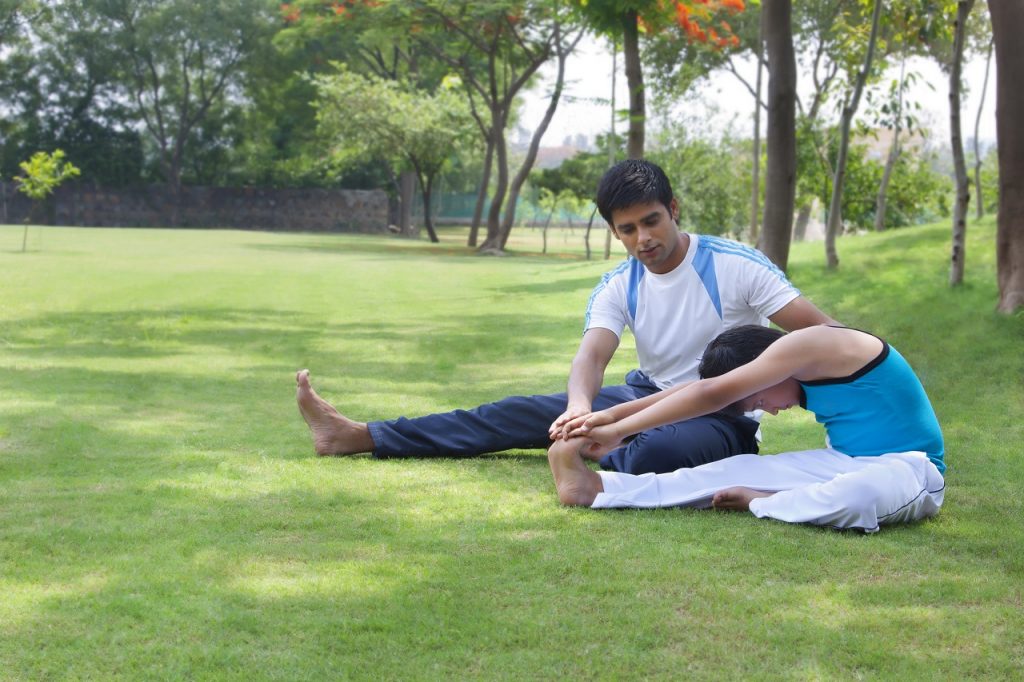
Encourage your child to Warm up before exercise and cool down after exercise to prevent muscle soreness and injury.

Warm up before exercise: Warming up before exercise prevents injury by softening the muscles and making them supple. Some warm-up exercises you can do are:

  • Slow jogging or walking
  • Stretching all the muscles they’re going to use (hold each and stretch for 8 to 10 seconds, but never until it hurts)

Cool down after exercise: Cooling down after high-intensity exercise is important for relaxing and softening the muscles. Cool down or ballistic stretch begins to lower the heart rate, improves flexibility and will speed up recovery from a workout.

Some Cool Down Examples Include: 

  1. Hamstring Stretch: The stretch helps Hamstring muscles that are on the back of the thigh 2
  2. Side Lunge: This stretch works the inner thighs
  3. Calf Stretch: This stretch feels good after running or walking.
  4. Butterfly Stretch: Children are usually quite adept to the butterfly stretch and it relaxes them well after a good physical activity.

Nutrition is Equally Important When You Exercise 

While exercise is very important, nutrition is equally important for children and adolescents to lead an active and healthy life.

Children who eat healthy, well-balanced meals and snacks will get the nutrients needed to perform well in sports. Kids and teens who play a sport that can involve 1½ to 2 hours or more of activity in a day, in particular, may need to consume more balanced nutrition to keep up with increased energy and fluid demands.

We trust that this article on exercise and nutrition for children assists you in making informed decisions about your child’s health. Do let us know your thoughts in the comments below. For more on Kid’s Health check out Healthy reads. To get expert advice, speak to a GOQii Coach by subscribing for Personalised Health Coaching here.

September 11, 2023 By GOQii 9 Comments

2 Breathing Techniques For Better Sleep

breathing techniques for better sleep

Do you have trouble getting sleep despite the fact that you are tired? Sleeping well is an art. It needs a perfect blend of healthy habits and control of mind. A clean body and mind, relaxed mood, physical exercises, and perfect dietary control are some of the basic sleep-inducing methods. However, one of the best ways to bring the body into its relaxed state is – BREATHING! How do breathing techniques for better sleep work? Let’s find out!

Breathing Techniques For Better Sleep

Breathing deeply has been proven to affect the heart, the brain, digestion, the immune system and even the expression of genes. Research has shown that breathing exercises like Pranayama can have immediate effects by altering the pH of the blood, or changing blood pressure. But, more importantly, they can be used as a method to train the body’s reaction to stressful situations and dampen the production of harmful stress hormones and help induce sleep.

Here are 2 important breathing methods to calm the mind and induce sleep naturally.

1.  The 4-7-8 Technique

How To Do It?
This process is recommended by Dr. Andrew Weil, a practitioner and teacher of integrative medicine for the last thirty years. To do this exercise, sit up in bed with your back straight or lie down on a straight back and press the tip of your tongue on the roof of your mouth right behind your front teeth. Maintaining that position, close your mouth and inhale through your nose for four counts, hold that breath for seven counts, and then exhale through your mouth around your tongue for eight counts. Repeat this pattern until you have completed four full breaths.

How It Works?
The 4-7-8 breathing technique is effective because it encourages the fast removal of carbon dioxide. Doing so equates into a better preservation of the bicarbonate pool; our reservoirs for helping maintain an appropriate pH balance. Also, it allows the lungs to become fully charged with air, allowing more oxygen into the body, which promotes a state of calm.

2. Left Nostril Breathing 

How To Do It?
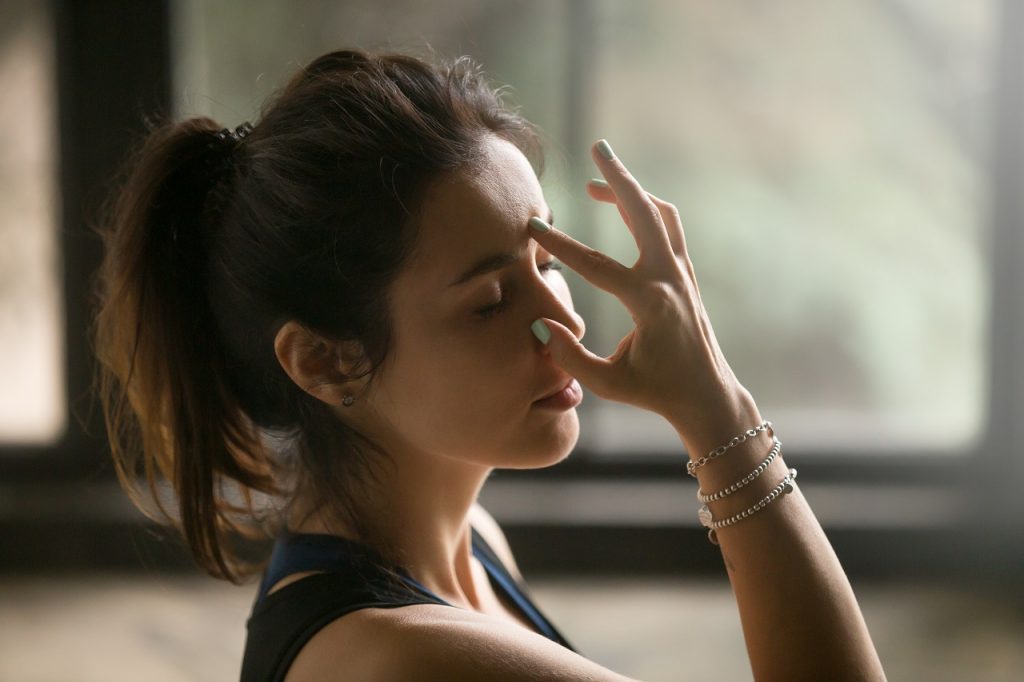
Simply take your right hand and with your fingers outstretched, block off your right nostril by putting gentle pressure on it with your right thumb.  Be sure to keep the rest of your fingers straight and pointing up. With a long, slow, deep breath, gently inhale through your left nostril.  Then, just as gently, exhale long, slowly and completely, again through the left nostril. Do this for at least 3 minutes; chances are you might doze of even before that!

How It Works?
When we’re under stress or feeling anxious, we tend to breathe mostly out of our right nostril, which is connected to our left brain. This activates our sympathetic nervous system, the channel responsible for the classic stress response – dilated pupils, increased core temperature, sweating, and increased heart rate and blood pressure. And when we start breathing through the left nostril the parasympathetic system gets activated which slows us down and helps our body automatically run its day to day jobs of digestion, elimination, sleep cycles and more.

Apart from these 2 breathing techniques for better sleep, you can also try meditation or mindfulness by just observing your breath as it goes in and as it comes out. Connecting with this rise and fall of the breath, and noticing where you feel that breath move within the body can help you begin the process of relaxing tense muscles and create a coherent heart pattern which brings an instant state of tranquil and helps you drift off to peaceful deep sleep.

We hope this article helps you sleep better! Do you meditate before you go to bed? What helps you sleep better? Leave your thoughts in the comments below! For more articles on sleep, check out Healthy Reads or you can get tips directly from a GOQii Coach by subscribing for Personalised Health Coaching here.

#BeTheForce

September 10, 2023 By Rashmi Deshpande Leave a Comment

Foods To Manage Blood Sugar Naturally

manage blood sugar

By now, we’re all aware that Diabetes is a condition in which the body is unable to control the glucose entering the bloodstream. Along with medicines, food is key to controlling it. As it is a slow progressive disorder, it makes our organs weak and affects their functioning like a slow poison. Hence, it is really important to keep our blood sugar levels under control. Let’s see how we can manage blood sugar naturally with food. 

Foods That Manage Blood Sugar Naturally 

High blood sugar occurs when your body can’t effectively transport sugar from blood into cells. If sugar levels go high, you need to add the following food to your diet. 

1. Eat More Green Leafy Veggies
Leafy green vegetables are extremely nutritious and low in calories. They’re also very low in digestible carbs, so they won’t significantly affect blood sugar levels. Spinach, kale, methi, bathua and other leafy greens are good sources of many vitamins and minerals, including vitamin C. People with diabetes have a greater requirement of vit C as it acts as a potent antioxidant and also has anti-inflammatory qualities. Increasing dietary intake of vitamin C-rich foods can help people with diabetes increase their serum vitamin C levels while reducing inflammation and cellular damage. In addition, leafy greens are good sources of the antioxidants – lutein, zeaxanthin. These antioxidants protect your eyes from macular degeneration and cataracts, which are common diabetes complications. Leafy green vegetables are rich in nutrients like Vitamin C, as well as antioxidants that protect your heart and eye health. You can add these veggies in all meals in different forms like sabji, soup, salads, in roti , paratha, chutneys etc.

2. Addition of Micronutrients
Chromium is involved in carb and fat metabolism. It also helps control blood sugar levels. Lack of chromium may predispose you to carb intolerance. Chromium rich foods include egg yolks, whole-grain products like millets, coffee, nuts, green beans, broccoli and meat (in moderation).

Magnesium-rich foods include dark leafy greens, whole grains, fish, dark chocolate, bananas, avocados and beans (not matured).

3. Reduce Carb Intake
Reduction in carb intake not more than 100grams per day, avoiding simple carbs like maida products and packet atta as well. Try to get coarse atta which has wheat husk, add isabgol in roti to reduce the spike in sugar levels after meals. Add whole grains like millets, jawar, chana, chia seeds and quinoa to your daily meals.

4. Add a Good Amount of Nuts
All types of nuts contain fiber and are low in net carbs, high in essential oils and protein to regulate sugar levels and provide nutrients.

  • Almonds: 2.6 grams
  • Brazil nuts: 1.4 grams
  • Cashews: 7.7 grams
  • Hazelnuts: 2 grams
  • Macadamia: 1.5 grams
  • Pecans: 1.2 grams
  • Pistachios: 5 grams
  • Walnuts: 2 grams

5. Add Seeds To Your Diet
These are rich in good fats, protein, dietary fibers and have the ability to reduce hunger pangs and craving for sugar. They also provide constant energy supply to diabetics.

  • Flax seeds – 1 to 2tbps per day 
  • Sunflower seeds – 2tbs per day
  • Pumpkin seeds – 2tbps per day
  • Sesame seeds – 1tbps per day
  • Methi seeds – 1 to 2tsp soaked.

Nuts and seeds can be easily added as evening snacks, in salads and to your morning breakfast too.

People with diabetes often experience low blood sugar levels. Certain medications, excessive alcohol consumption, some critical illnesses and hormone deficiencies can also cause hypoglycemia without diabetes. To fix this, you can have:

  • A small apple, banana, or orange
  • 15 grapes
  • A few prunes
  • 2 tablespoons of raisins or dates
  • 1/2 cup of juice or regular (not diet) soda
  • 1 tablespoon of honey or sugar
  • Hard candy, jellybeans, or gummy candy check on ingredients before consuming.
  • Glucose tablets or Lemon sharbat with sugar but without salt. 

These are a few foods we need to add to our diet to manage blood sugar naturally – this along with exercise for approx 30 mins a day. For more on managing blood sugar, check out Healthy Reads or consult a GOQii Coach by subscribing for Personalised Health Coaching here.

#BeTheForce 

September 6, 2023 By Mubasheera Chaiwala 2 Comments

Benefits of Practicing Morning Yoga at Home!

morning yogaPicture this: you’re starting your day with a sense of inner calm, strength, and clarity, all thanks to the practice of morning yoga at home. Before we unravel the numerous benefits that come with this enriching practice, let’s first take a moment to delve into the heart of yoga and what it signifies.



What Do You Understand About Yoga?

What is it? Is it a form of exercise? Is it meditation? For me, yoga is a way of life. I believe the whole idea behind it is total discipline. It is physical, mental, intellectual and spiritual development. It helps you balance health from a physical, mental and emotional standpoint.

Benefits of Morning Yoga

You can practice yoga in the morning and night as well, although, morning yoga is the best as it cleanses your mind and body. It energizes all day and keeps you disciplined. Let’s explore the benefits of morning yoga!

  • Yoga improves flexibility and posture but it’s much more effective in the morning. The fresh air helps us relax our body and make it more flexible.  
  • We have more energy in the morning and morning yoga enhances it to last all day. Which means more intensity and focus! 
  • Setting up a morning practice is beneficial as it creates a ritual – it sets the tone for the day. By practicing morning yoga, there are no distractions or tasks that will get in the way – so no excuses for cancelling your session in the morning. 
  • That fresh morning air helps you deliver more oxygen to the body, breathe better and cleanses your system naturally. 
  • It also helps your digestive system as metabolism rate is higher in the morning. It increases digestion and keeps all indigestion problems at bay. 
  • Morning yoga boosts your brainpower and makes your brain more active to study or work. 
  • It enhances happiness and positivity as it boosts mental clarity and relaxes you. The release of endorphins that early in the morning make your body a more physically comfortable place to live in. 
  • Disease-fighting white blood cells in the body are able to do their best when our blood flow and lymphatic system have efficient circulation. By moving in a way that feels good first thing in the morning, we essentially ‘wake up’ all the body’s systems, which enhances the flow of circulation and gives the immune system an immediate boost. Gentle inversions like Viparita Karani, Cow Pose and Child Pose are especially effective for stimulating the immune system.
  • As a parent, taking time out for your own well being is difficult. Getting up early and practicing morning yoga puts your health first. Only if you are healthy, can you take care of others. A morning yoga practice is a way to know you’ve done something for yourself that day  
  • Apart from all of the above, morning yoga regulates your sleep rhythm, balances your hormones and helps you build a healthy and consistent routine. 

Asanas You Can Practice 

Try these yoga poses daily in the morning to increase blood circulation, enhance and stimulate the immune system, improve body function and strengthen your cells, tissues, glands and organs! Also, these poses will help you beat stress, anxiety and depression.  

  1. Suryanamaskar – for over all body workout
  2. Jivah Bandh – manages and relieves stress
  3. Simha Mudra – decreases stress and prepares you to face the day by increasing your willpower.
  4. Sheetali Pranayama – is a process which can cool the body down and give a feeling of calmness.
  5. Bhramari Pranayama – is one of the great breathing exercises to release the mind of disturbance, anxiety or frustration and get rid of anger.
  6. Om Recitation – excellent breathing exercises for meditation. Brings stability of mind and improves memory power
  7. Shavasana – removes nervousness, adds a sense of presence. Very important to start our day peacefully.
  8. Tratak Drishti – to increase concentration.
  9. Anulom Vilom Pranayama – is the best way of balancing the Tri Dosas in our body. Our body gets ill when Tri Dosas are not in balance. Vaat, Pitta and Kaffa are known as the Tri Dosas (Tri means “three” and the meaning of dosas is impurities). All three are the cause of all diseases. So, it is important to balance them. The way to do that is to practice Anulom Vilom Pranayama regularly. It is the simplest and best way for this.
  10. Kapalbhati Pranayama – generates heat in the system to help dissolve toxins and waste matter. It adds luster and beauty to your face and helps your skin glow!  

If yoga is practiced regularly in the morning, it will help you face the day with balance and a practical approach. Ensure that you do not eat at least 2-3 hours before you begin your practice. So try morning yoga and do share your feedback and changes with us in the comments below! 

To learn more about Pranayama, read this article: https://goqii.com/blog/pranayama/. 

To begin practicing yoga subscribe for LIVE interactive sessions with our Yoga experts on GOQii Pro within the GOQii App.

#BeTheForce 

  • « Previous Page
  • 1
  • …
  • 32
  • 33
  • 34
  • 35
  • 36
  • …
  • 64
  • Next Page »

Search

Recent Posts

  • Water Intake Pre, During and Post Workout
  • India Leads in Longevity: GOQii Sanjeevini Named Top 40 in $101M XPRIZE
  • The Importance Of Knowing If You’re Thirsty Or Hungry
  • Best Foods To Alleviate Irritable Bowel Syndrome
  • ALL ABOUT VERTIGO!

Stay Updated

Archives

  • December 2025 (9)
  • November 2025 (15)
  • October 2025 (20)
  • September 2025 (6)
  • August 2025 (6)
  • July 2025 (12)
  • June 2025 (18)
  • May 2025 (16)
  • April 2025 (23)
  • March 2025 (23)
  • February 2025 (22)
  • January 2025 (26)
  • December 2024 (26)
  • November 2024 (25)
  • October 2024 (22)
  • September 2024 (24)
  • August 2024 (31)
  • July 2024 (21)
  • June 2024 (26)
  • May 2024 (31)
  • April 2024 (27)
  • March 2024 (29)
  • February 2024 (26)
  • January 2024 (25)
  • December 2023 (15)
  • November 2023 (11)
  • October 2023 (20)
  • September 2023 (22)
  • August 2023 (20)
  • July 2023 (22)
  • June 2023 (24)
  • May 2023 (24)
  • April 2023 (24)
  • March 2023 (23)
  • February 2023 (20)
  • January 2023 (16)
  • December 2022 (12)
  • November 2022 (15)
  • October 2022 (15)
  • September 2022 (12)
  • August 2022 (10)
  • July 2022 (17)
  • June 2022 (11)
  • May 2022 (10)
  • April 2022 (6)
  • March 2022 (6)
  • February 2022 (13)
  • January 2022 (12)
  • December 2021 (7)
  • November 2021 (3)
  • October 2021 (6)
  • September 2021 (3)
  • August 2021 (8)
  • July 2021 (7)
  • June 2021 (15)
  • May 2021 (16)
  • April 2021 (10)
  • March 2021 (7)
  • February 2021 (4)
  • January 2021 (4)
  • December 2020 (3)
  • November 2020 (4)
  • October 2020 (10)
  • September 2020 (3)
  • August 2020 (3)
  • July 2020 (2)
  • June 2020 (4)
  • May 2020 (10)
  • April 2020 (12)
  • March 2020 (10)
  • February 2020 (4)
  • January 2020 (4)
  • December 2019 (3)
  • November 2019 (7)
  • October 2019 (5)
  • September 2019 (4)
  • August 2019 (9)
  • July 2019 (9)
  • June 2019 (11)
  • May 2019 (4)
  • April 2019 (9)
  • March 2019 (8)
  • February 2019 (9)
  • January 2019 (8)
  • December 2018 (9)
  • November 2018 (3)
  • October 2018 (3)
  • September 2018 (5)
  • August 2018 (10)
  • July 2018 (6)
  • June 2018 (13)
  • May 2018 (8)
  • April 2018 (18)
  • March 2018 (9)
  • February 2018 (8)
  • January 2018 (15)
  • December 2017 (12)
  • November 2017 (19)
  • October 2017 (13)
  • September 2017 (15)
  • August 2017 (4)
  • July 2017 (8)
  • June 2017 (7)
  • May 2017 (6)
  • April 2017 (8)
  • March 2017 (6)
  • February 2017 (7)
  • January 2017 (9)
  • December 2016 (10)
  • November 2016 (7)
  • October 2016 (7)
  • September 2016 (7)
  • August 2016 (11)
  • July 2016 (9)
  • June 2016 (9)
  • May 2016 (12)
  • April 2016 (17)
  • March 2016 (17)
  • February 2016 (8)
  • January 2016 (6)
  • December 2015 (2)
  • November 2015 (9)
  • October 2015 (7)
  • September 2015 (9)
  • August 2015 (11)
  • July 2015 (9)
  • June 2015 (12)
  • May 2015 (9)
  • April 2015 (13)
  • March 2015 (8)
  • February 2015 (5)
  • January 2015 (12)
  • December 2014 (14)
  • November 2014 (11)
  • October 2014 (6)
  • September 2014 (13)
  • August 2014 (12)
  • July 2014 (6)
  • June 2014 (2)
  • May 2014 (7)
  • April 2014 (5)

From “Laddu Nawin” to Fit and Fierce: How a 25-Year-Old Insurance Advisor Shed 20 Kilos and Gained His Life Back

When 25-year-old Nawin Yadav from Hyderabad walked into his office every morning, he carried more than just his files and policy papers. He had the weight of fatigue, sluggish energy, and an ever-growing belly that was becoming the butt of jokes. “People … [Read More...]

“I’ve Challenged Myself to Live 100 Years” – The Story of Chandubhai Savani’s Second Chance at Life

At 67, most people start slowing down. Not Chandubhai Savani. A resident of Surat, Chandubhai, thought life was on track. “My life was going well till I had my bypass surgery,” he says. That surgery, back in 2021, was a wake-up call.  Medication was routine, but exercise wasn’t. His diet? What he calls ‘normal.’ “I […]

From Shimla’s Slopes to Chandigarh’s Sidewalks: Surinder Kaur Bhalla’s Journey from Chaos to Control

Some journeys start with a plan. Others begin with a stumble literally. Surinder Bhalla, a government professional, born and raised in the scenic hill town of Shimla, had always lived a life of movement. “In Shimla, you walked everywhere,” she reflects. “Walking was never an exercise. It was just life.” But after shifting to Chandigarh, […]

Ananda Mukherjee Health Story

From Terminal Illness To Complete Wellness! Ananda Mukherjee Health Story

As we observe World Cancer Day under the powerful theme ‘United by Unique’ (2025-2027)**, we are reminded that every individual’s journey with cancer is distinct, yet united by shared resilience, hope, and the collective fight against this disease. This theme places people at the centre of care and their stories at the heart of the […]

  • HOME
  • HEALTHY LIVING
  • FITNESS
  • HEALTHY RECIPES
  • USER STORIES
  • KARMA
  • BUY GOQii

Copyright ©2016 GOQii
