GOQii

Blog

  • HOME
  • HEALTHY LIVING
  • FITNESS
  • HEALTHY RECIPES
  • USER STORIES
  • KARMA
  • BUY GOQii

Search Results for: sex

February 17, 2017 By Dr Darshana Salve 2 Comments

Blood should circulate – Donate Blood!

blood-donation

We only understand the importance of blood donation when someone close to us is in need of it. A few days back my cousin contacted me to know the availability of blood for her friend’s father who met with an accident. Unfortunately, we lost him due to excess blood loss. We know of this incident because it’s a dear friend’s father but, on a daily basis there are so many such cases where there is loss of death due to non-availability of blood.

Statistics show that roughly every year in India there are 234 million major operations, 63 million trauma-induced surgeries, 31 million cancer-related procedures and 10 million pregnancy related complications which require blood transfusions.

Apart from these there are also disorders like sickle cell anemia, thalassemia and hemophilia that require repeated blood transfusions.

One of the main reasons for lack of blood is, many people are skeptical about blood donation. They have fears of contracting infections during blood donation, fear of the needle or feeling weak after blood donation. Human body approximately has 4.7-5.5 L of blood, out of it only 350/ 450 ml of blood is withdrawn during blood donation drives and it takes only a day or two to replenish the fluid volume in the body and three months for the regeneration of red cells to donate more blood.

There is no substitute for human blood. Blood cannot be manufactured – it can only come from
volunteer donors like you and me. One blood donation can save 3 lives. But, unfortunately only 1 % of volunteer donors come forward to donate blood and majority of the blood donation comes from replacement donors.
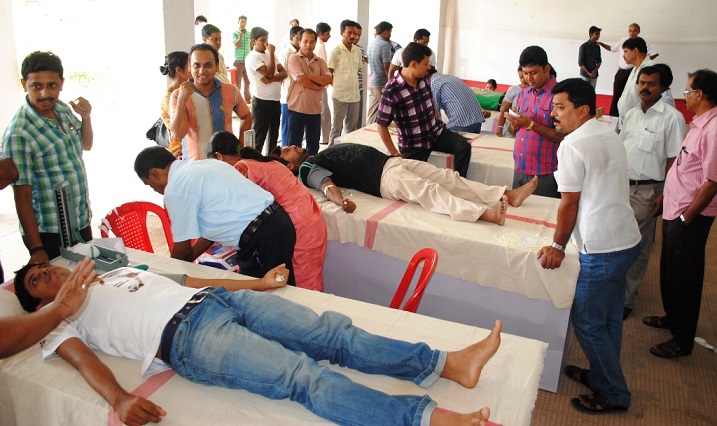
Blood Donation Camp

Replacement donors are friends and relatives of a patient who donate blood as replacement for the blood given to the patient.

At times, these replacement donors (friends and relatives) are more likely to harm the recipients by hiding or overlooking the many don’ts of donation.

Though voluntary self-referral to donate without citing reasons is widely accepted, replacement donors rarely adhere to it either to hide their high-risk behavior or due to pressure to meet the immediate demand for certain units of blood. As a result, the prevalence of HIV, hepatitis B, and hepatitis C is much higher among family donors when compared to voluntary donors, according to a 2012 study published in the Asian Journal of Transfusion Science.

Donation of safe blood can be achieved only when replacement donors are replaced by healthy volunteer donors to meet ‘over 95 per cent of blood requirement’. This can be done through increased awareness, providing appropriate facilities for people to donate blood, and improved donor retention.

While donating blood always be truthful about your health status!

Do not donate blood if you have any of these conditions

  • Cold / fever in the past 1 week.
  • Under treatment with antibiotics or any other medication.
  • Cardiac problems, hypertension, epilepsy, diabetes (on insulin therapy), history of cancer, chronic kidney or liver disease, bleeding tendencies, venereal disease etc.
  • Major surgery in the last 6 months.
  • Vaccination in the last 24 hours.
  • Miscarriage in the last 6 months or have been pregnant / lactating in the last one year.
  • Had fainting attacks during last donation.
  • Have regularly received treatment with blood products.
  • Shared a needle to inject drugs/ have history of drug addiction.
  • Had sexual relations with different partners or with a high risk individual.
  • Tested positive for antibodies to HIV.
  • If you are Underweight ( below 50 KGs)

Pregnancy and Menstrual Cycle

  • Females should not donate blood during pregnancy and lactation.
  • Females should not donate blood if they are having heavy menstrual flow or menstrual cramps.

Do donate blood if…

  • You are between age group of 18-60 years.
  • Weight is 50 kgs or more.
  • Hemoglobin is 12.5 gm% minimum.
  • Last blood donation was 3 months earlier.
  • You are healthy and have not suffered from malaria, typhoid or other transmissible disease in the recent past.

It’s time that we take up the responsibility to do voluntary blood donation. Donate Blood without waiting for a call.
January 9, 2017 By Dr Ashwin Nanda 1 Comment

You are as ‘Old’ as your Prostate

Untitled-1Mr Rebello, sitting in front of me recalled his plight of waking up 2-3 times every night to void urine instead of only once as before. Initially, he assumed it was due to winter but, when the problem persisted in summer as well, he blamed it on his poorly controlled diabetes. He was 65 yrs of age when he began to experience this. He didn’t bother visiting his physician since he had made peace with his high blood sugars as he had no control over his eating habits.
How he wished he hadn’t assumed and instead consulted his physician. After 2 yrs he moved to another city and didn’t feel up to the task of finding a new physician to follow up with. Five years down the line, after his 70th birthday, he began experiencing lower back pain which he again concluded was due to ageing. Only when the pain became persistent and unbearable, he met an Orthopedic who after examination and X-rays diagnosed him with a collapsed vertebral fracture. He was crestfallen when the cause of his vertebral fracture was pinned down to ‘PROSTATE CANCER’.

Going back to the time when Mr Rebello was 65 yrs old, he overlooked the fact that the frequency of urination was normal during the day. Had high sugar been the cause, the issue would have bothered him during the day as well. Actually, this was the first symptom that his prostate gland was enlarged. Undiagnosed and untreated over 5 yrs the non-cancerous enlargement of the prostate had turned cancerous and spread to his backbone.

Let’s try to make sense about what the prostate gland is, its enlargement and when does it translate into cancer.

The Prostate Gland: Location in the body and function.

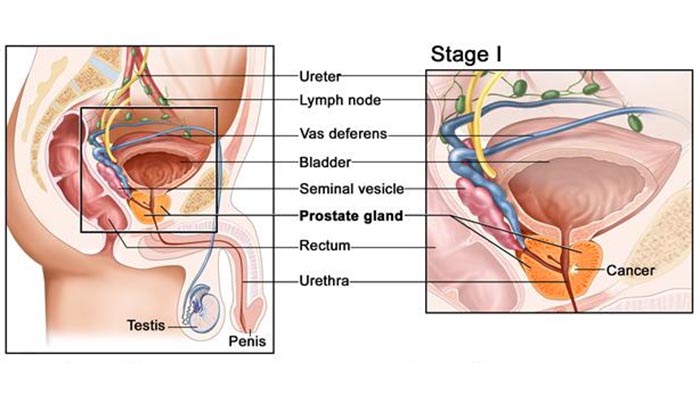
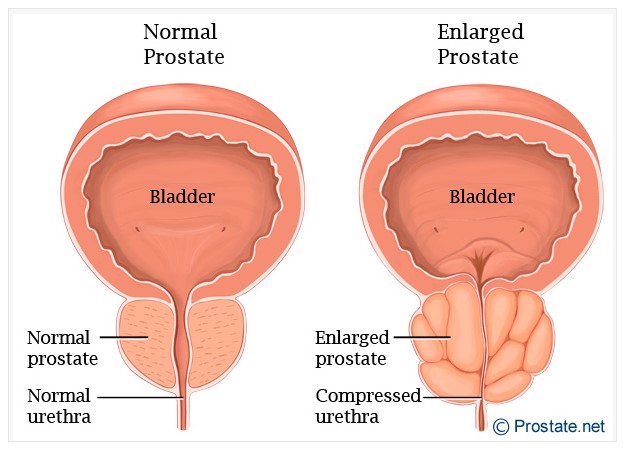
The image below shows the location of the prostate gland in the body which is present only in males. It is located below the urinary bladder. The prostate secretes the fluid that nourishes and protects sperms. During ejaculation, the prostate squeezes this fluid into the urethra, and it’s expelled with sperms as semen. In the prostatic cells, the male sex hormone testosterone gets converted to dihydrotestosterone (DHT) which causes the cells to grow resulting in an increase in its size.

Normally, the prostate gland is approximately the size of a walnut. As the size increases with age (which can start as early as 40 yrs) it starts to obstruct the urine outflow as shown in the image.

prostrate cancer-image 1


Symptoms of Prostatic enlargement:

  • A weak or slow urinary stream.
  • A feeling of incomplete bladder emptying.
  • Difficulty starting urination.
  • Frequent urination.
  • The urgency to urinate.
  • Getting up frequently at night to urinate.
  • A urinary stream that starts and stops.
  • Straining to urinate.

Medically enlarged prostate which is not cancerous is called Benign Prostatic Hyperplasia (BPH).

As the gland keeps getting enlarged, there are mutations in the DNA of its cells causing it to grow uncontrolled and abnormally resulting in cancer.

The saving grace in this entire process is that prostatic enlargement can be diagnosed early and controlled thereby preventing cancer.

DIAGNOSTIC MODALITIES:

  1. Sonography of the prostate gland is advised once a man turns 50 yrs to establish if enlargement has started. If there is a family history of prostate cancer then it should be done as early as 40 yrs.
  2. A blood test called Prostate Specific Antigen(PSA) should be done. Very high values are suggestive of cancer whereas in the enlargement phase the values remain < 4 units.

If you are facing any of the above symptoms, you must visit a Urologist who will diagnose and prescribe medication for the same. Incase medicines are not effective, one might have to opt for surgery.

In Mr Rebello’s case, since cancer had already developed, radiotherapy was first given to shrink the size of the prostate, post which surgery was performed to remove the cancerous gland. Cancer which had spread to his backbone was controlled by a combination of chemo and hormonal therapy.

Risk Factors for prostatic enlargement and cancer:

Age – prevalence increases markedly with age. The gland grows at a rate of 2 – 2.5 % annually in older men.

Genetics – 50% men undergoing surgery for BPH < 60 yrs of age have inheritable form of the disease.

PREVENTION:

Apart from timely diagnosis and treatment, being physically active, controlling Diabetes and weight are known to reduce enlargement of the gland. Diet rich in antioxidants and vitamins is also beneficial in prevention along with avoiding red meat.

Image credit – prostate.net

January 3, 2017 By Ruta Satam 1 Comment

2016 Report Card: Karma activities at GOQii


Oxfam Trailwalk

GOQii has been working with Non-profit organizations as its Karma partners in promoting and spreading awareness for different causes. Karma activities are also based on the premise that doing Karma keeps you healthy. Just to reiterate inspired by Mahatma Gandhi’s journey of 390 KM, for every 390 steps tracked through your GOQii activity tracker band, you earn one Karma point. These points are then converted into monetary donations that is donated to charity sponsored by our Karma partner.

It’s been two successful years now and we have charities listed on the GOQii app that are successfully funded by the Donor partners.

Here are two recent causes that we have contributed to.

Millions of children in India go to bed hungry because their parents/guardians are not able to purchase food for them. Most of them drop out from schools so that they can help their parents and supplement the family income.

Ratna Nidhi Charitable Trust’s-Food for Education Program distributes free food prepared at our kitchens on a daily basis, to poor children if they attend any formal or non-formal educational class. It thus combines food with education-we now have a child who is educated and well fed also. The programme has been very effective in arresting the drop-out rate in schools.

Ratna Nidhi’s food has been treated by the beneficiaries as “Homely Balanced and Tasty”. Not for profit, the food has a flavour of compassion, and tender loving care.

As of today, the organisation feeds more than 4500 Children daily through its approximately 50 centres all over Mumbai including the suburbs. The Mid Day Meal is cooked at the Food Center by the special team of cooks under Ratna Nidhi’s representatives’ direct supervision.

The food partners are identified carefully and after the detailed need evaluation. These are generally Non-aided vernacular schools who do not qualify for the Govt. Mid-Day-Meal, Pre-schools in Urban Areas, Night schools who do not receive any of the welfare benefits and Street Children NGO’s who provide shelter.

The meals are packed for various partner schools and Balwadis. A special delivery system ensures that the food reaches the children by lunch time on a daily basis.

A simple meal for children each day that improves nourishment, increase weight, boosted attentiveness in class and ensures a healthy educated future.

Empowering Women against Violence:-

Moving from children let us now talk of women empowerment. After children, it’s the women who get abused the most and hence empowering women against violence is paramount.

How often have you come across a story in the newspapers or television about violence against women? Every day is the answer. Violence against women and girls is a bitter reality in India. As many as one-third of women and girls in the age group 15-49 have experienced physical violence, about one in 10 have experienced some form of sexual violence [Source: National Family Health Survey Round III (2005-2006)].

Yet, violence against women and girls, particularly domestic violence, is unavoidable. Many of us think and justify that violence by intimate partners is normal, and therefore acceptable. We need to change this very thinking that normalises violence against women and girls. We all have a role in preventing such violence.

The story of a 9 year old girl Mynah, who was married to a 20-year-old man, is an example to stand up against violence. Her husband repeatedly subjected her to intimate partner violence. After hearing of her experience, counsellors of Oxfam India advised Mynah to file a case under the Protection of Women from Domestic Violence Act, 2005. Mynah took the brave decision to take control of her life. She continued with her studies, with the court’s intervention, she has got compensation. She has also remarried according to her own wish.

Oxfam India programmes are currently active in the six focus states of Assam, Bihar, Chhattisgarh, Jharkhand, Odisha and Uttar Pradesh.

Oxfam India has been working to reduce the acceptance of violence against women and girls. They have reached out to more than 42,000 women to end violence in their lives and established 23 support centres within formal and informal locations to provide psycho-social counselling and legal aid to women facing this issue in their lives.

Together, we need to make sure that perceptions, attitudes and behaviours towards women and girls change so that gender-based discrimination comes to an end. With your help, this is what Oxfam India hopes to achieve in the future through supporting women like Mynah.

What has GOQii been doing in the Karma space in the last two years?

Here are some of the activities that we have conducted for players as well as our employees in the last two years…..

One of the biggest on ground Karma event that we are a part of is the 100 KM Oxfam Trailwalk where GOQii players and employees participate and walk 100 km to raise awareness and support a cause.

Part from this we have had regular activities in GOQii office. This year we had a session with Greensole, a social venture that collects discarded shoes, refurbishes them and makes comfortable footwear for the underprivileged.

We also did something interesting this Christmas. While last year we went to a home that housed children with Cancer and spent few hours with the kids by playing and dancing with them, this year we celebrated Christmas in the most unique way. GOQii employees played secret santa to orphaned children of an orphanage in Chembur and also employees pledged for various basic commodities like Rice, dal, wheat, Oil etc and donated to the orphanage.

December 1, 2016 By Dr Manali Rao Leave a Comment

Living Healthy with HIV – Reality or Myth


343101-hiv

Have you seen the latest#CondomEmoji campaign by Durex, the Global Sexual-well-being brand depicting an “Umbrella with Raindrops”? This was the unofficial safe sex emoji launched ahead of World AIDS Day today. It was an interesting campaign to communicate ‘Safe Sex’ among the young adults. The campaign called for putting a safe sex emoji on every smartphone in order to help young people communicate about safe sex. The campaign has trended both on Twitter and Facebook with supporters from over 160 countries backing the movement.

The survey findings noted while more than 60 per cent of young people surveyed admitted to being uncomfortable discussing safe sex, 72 per cent of respondents admitted that they found it easier to express emotions using emojis and more than three quarters admitted that they use emojis to discuss sex and relationships.

Why is this discomfort about talking of sex or sex related diseases such as HIV/Aids even in the 21st Century?
One of my earliest memories of AIDS would be the movie PHILADELPHIA where Tom Hanks sues his Company for being fired from his workspace for being HIV positive.

Whenever we hear the word AIDS or HIV the word itself it creates a lot of fear and makes one judgmental. This is not the case only among the lay man but also is the case equal judgment, not only among general public but also within the medical fraternity. Unfortunately more than a the disease, AIDS is considered to be a social stigma and a taboo.
It’s become imperative to understand why this stigma is attached to HIV/AIDS?

AIDS (Acquired Immunodeficiency Syndrome) as we all know is a syndrome caused by the Human Immunodeficiency Virus (HIV) which directly attacks the immune system of the patient leaving the body vulnerable to a host of infections. Aids is the last stage of HIV infection where the disease progresses and the body can no longer defend itself leading to more severe infections, malignancies and eventually death (if left untreated).
Let me try to look into the ways one can get infected with this Virus which are considered some of the main reasons for fear and stigma.

1. Unprotected sex- with an individual who is infected with HIV is the biggest cause of new HIV cases be it vaginal or anal sex. Oral sex also predisposes one to HIV if there are any cuts, ulcers or sores in the mouth. Wearing a condom is the easiest way to protect yourself and your partner against the disease. Unprotected Sex is more prevalent among young adults.
2. Blood transfusion with infected blood. This is one of the most unfortunate ways to contract the disease as the recipient is unaware of the blood being infected. It is always a good idea to make sure that the blood has been screened for HIV infection.
3. HIV infected mother can pass on the virus to her baby during pregnancy lactation or even delivery. These mothers can now take treatment to protect their babies.
4. Sharing razors or needles with infected people also puts you at risk of contracting the virus like in the case of drug abuse or needle prick in hospital.
In short the virus can be transmitted through infected blood, semen and vaginal fluids. In fact, when the disease first came to light in India, it was the sex workers and their clients who had the maximum prevalence followed by truck drivers.

The latest ‘DIPPER’ at night campaign where the Condom is disguised as the dipper is a great way to create awareness among truck drivers in India to frequent sex workers often.
But, honestly it’s not so bad as it’s been made out to be over the years. Currently, experiments are being conducted to find a cure for this disease. The good news in India is that we are seeing an overall reduction in HIV infections among the adult population.

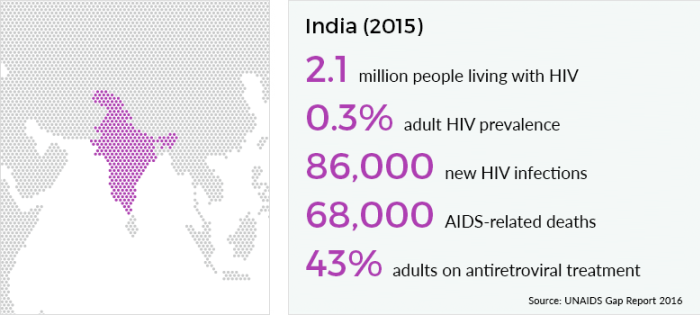
According to more recent National AIDS Control Organisation data, India has demonstrated an overall reduction of 57 percent in estimated annual new HIV infections (among adult population) from 0.274 million in 2000 to 0.116 million in 2011.

HIV-data pic

India has the third largest number of people living with HIV in the world, according WHO.

LIVING WITH HIV / AIDS:

It’s not as bad. One can live with HIV.

The diagnosis is confirmed by a blood test and depending on the extent of severity of the immune deficiency, anti-viral medication is started which improves the number of immune cells which help fight infections and restore near normal life.

The medicines though expensive are distributed free of cost to patients at Government and NGO run clinics.Psychological help for not getting overwhelmed after the diagnosis, is also readily available. Confiding in a trusted person who won’t be judgmental. Judgmental helps in calming your nerves.

One must realize and believe that they can live to their potential  inspite of being HIV positive. Having social and emotional support is very essential, hence patients must not isolate themselves from their near and dear ones and f.amily and friends should also not ostracize the patient.

The Constitution of India prevents any discrimination against anyone having HIV and AIDS and neither is it a legal ground for dismissal from occupational services.

Patients living with HIV must maintain a healthy lifestyle just like diabetics or any other chronic disorders. Having a healthy diet and exercising regularly are a must to boost your immunity along with the medication. Till date HIV and AIDS has no cure but anti-retroviral therapy (ART medicines) are helping people live a healthy and happy life for almost 2 to 3 decades.

Currently, Art drugs have become ‘very good’ at controlling infection but patients need use the medication for life. If they stop the treatment, the virus rapidly replicates, eventually leading to the fatal AIDS disease.

Pregnant mothers have successfully delivered children without HIV with the help of anti-viral medication.
Lot of research by brilliant minds is being done around the globe to find more effective medicines and a cure.
HIV facts to know

• According to the WHO, more than 70 million people have been infected with HIV so far and about 35 million people have died of from the virus.

• In 2015, an estimated 36.7 million people were living with HIV and so far the infection remains incurable.

  • « Previous Page
  • 1
  • …
  • 14
  • 15
  • 16
  • 17
  • 18
  • Next Page »

Search

Recent Posts

  • Social Health and Longevity: Why Relationships Matter as Much as Diet
  • Top 10 Foods For Diabetics: What to Eat to Manage Blood Sugar
  • Why Good Nutrition Before Conception Is Crucial For Your Baby’s Health
  • 6 Tricks To Help You Make Exercise A Habit
  • World Parkinson’s Day 2026: Bridging the Care Gap & Supporting Caregivers

Stay Updated

Archives

  • April 2026 (12)
  • March 2026 (18)
  • February 2026 (14)
  • January 2026 (14)
  • December 2025 (19)
  • November 2025 (15)
  • October 2025 (20)
  • September 2025 (6)
  • August 2025 (6)
  • July 2025 (12)
  • June 2025 (18)
  • May 2025 (16)
  • April 2025 (22)
  • March 2025 (28)
  • February 2025 (22)
  • January 2025 (25)
  • December 2024 (22)
  • November 2024 (23)
  • October 2024 (21)
  • September 2024 (23)
  • August 2024 (30)
  • July 2024 (21)
  • June 2024 (25)
  • May 2024 (30)
  • April 2024 (27)
  • March 2024 (27)
  • February 2024 (24)
  • January 2024 (21)
  • December 2023 (14)
  • November 2023 (11)
  • October 2023 (19)
  • September 2023 (22)
  • August 2023 (18)
  • July 2023 (22)
  • June 2023 (23)
  • May 2023 (24)
  • April 2023 (22)
  • March 2023 (23)
  • February 2023 (19)
  • January 2023 (15)
  • December 2022 (11)
  • November 2022 (15)
  • October 2022 (15)
  • September 2022 (12)
  • August 2022 (10)
  • July 2022 (17)
  • June 2022 (11)
  • May 2022 (10)
  • April 2022 (6)
  • March 2022 (6)
  • February 2022 (13)
  • January 2022 (11)
  • December 2021 (7)
  • November 2021 (3)
  • October 2021 (6)
  • September 2021 (3)
  • August 2021 (8)
  • July 2021 (7)
  • June 2021 (15)
  • May 2021 (16)
  • April 2021 (10)
  • March 2021 (7)
  • February 2021 (4)
  • January 2021 (4)
  • December 2020 (3)
  • November 2020 (4)
  • October 2020 (10)
  • September 2020 (3)
  • August 2020 (3)
  • July 2020 (2)
  • June 2020 (4)
  • May 2020 (10)
  • April 2020 (12)
  • March 2020 (10)
  • February 2020 (4)
  • January 2020 (4)
  • December 2019 (3)
  • November 2019 (7)
  • October 2019 (5)
  • September 2019 (4)
  • August 2019 (9)
  • July 2019 (9)
  • June 2019 (11)
  • May 2019 (4)
  • April 2019 (8)
  • March 2019 (8)
  • February 2019 (9)
  • January 2019 (8)
  • December 2018 (9)
  • November 2018 (3)
  • October 2018 (3)
  • September 2018 (5)
  • August 2018 (10)
  • July 2018 (6)
  • June 2018 (13)
  • May 2018 (8)
  • April 2018 (18)
  • March 2018 (9)
  • February 2018 (8)
  • January 2018 (15)
  • December 2017 (12)
  • November 2017 (19)
  • October 2017 (13)
  • September 2017 (15)
  • August 2017 (4)
  • July 2017 (8)
  • June 2017 (7)
  • May 2017 (6)
  • April 2017 (8)
  • March 2017 (6)
  • February 2017 (7)
  • January 2017 (9)
  • December 2016 (10)
  • November 2016 (7)
  • October 2016 (7)
  • September 2016 (7)
  • August 2016 (11)
  • July 2016 (9)
  • June 2016 (9)
  • May 2016 (12)
  • April 2016 (17)
  • March 2016 (17)
  • February 2016 (8)
  • January 2016 (6)
  • December 2015 (2)
  • November 2015 (9)
  • October 2015 (7)
  • September 2015 (9)
  • August 2015 (11)
  • July 2015 (9)
  • June 2015 (11)
  • May 2015 (9)
  • April 2015 (13)
  • March 2015 (8)
  • February 2015 (5)
  • January 2015 (12)
  • December 2014 (14)
  • November 2014 (11)
  • October 2014 (6)
  • September 2014 (13)
  • August 2014 (12)
  • July 2014 (6)
  • June 2014 (2)
  • May 2014 (7)
  • April 2014 (4)

From “Laddu Nawin” to Fit and Fierce: How a 25-Year-Old Insurance Advisor Shed 20 Kilos and Gained His Life Back

When 25-year-old Nawin Yadav from Hyderabad walked into his office every morning, he carried more than just his files and policy papers. He had the weight of fatigue, sluggish energy, and an ever-growing belly that was becoming the butt of jokes. “People … [Read More...]

“I’ve Challenged Myself to Live 100 Years” – The Story of Chandubhai Savani’s Second Chance at Life

At 67, most people start slowing down. Not Chandubhai Savani. A resident of Surat, Chandubhai, thought life was on track. “My life was going well till I had my bypass surgery,” he says. That surgery, back in 2021, was a wake-up call.  Medication was routine, but exercise wasn’t. His diet? What he calls ‘normal.’ “I […]

From Shimla’s Slopes to Chandigarh’s Sidewalks: Surinder Kaur Bhalla’s Journey from Chaos to Control

Some journeys start with a plan. Others begin with a stumble literally. Surinder Bhalla, a government professional, born and raised in the scenic hill town of Shimla, had always lived a life of movement. “In Shimla, you walked everywhere,” she reflects. “Walking was never an exercise. It was just life.” But after shifting to Chandigarh, […]

Ananda Mukherjee Health Story

From Terminal Illness To Complete Wellness! Ananda Mukherjee Health Story

As we observe World Cancer Day under the powerful theme ‘United by Unique’ (2025-2027)**, we are reminded that every individual’s journey with cancer is distinct, yet united by shared resilience, hope, and the collective fight against this disease. This theme places people at the centre of care and their stories at the heart of the […]

  • HOME
  • HEALTHY LIVING
  • FITNESS
  • HEALTHY RECIPES
  • USER STORIES
  • KARMA
  • BUY GOQii

Copyright ©2016 GOQii