GOQii

Blog

  • HOME
  • HEALTHY LIVING
  • FITNESS
  • HEALTHY RECIPES
  • USER STORIES
  • KARMA
  • BUY GOQii

Search Results for: carb

July 23, 2024 By Disti Shah 7 Comments

Why You Should Exercise To Manage Diabetes

exercise to manage diabetesThe facts and myths about diabetes are plenty, especially on the kind of foods one should have or not have, whether one should exercise to manage diabetes, etc. But, it’s when I saw my dad exercising one day, a thought struck me – is it not important to test a diabetic before exercise? Is diet all that one needs to focus on?

What if he exercises vigorously and his sugar levels drop down? At what sugar levels should we allow or not allow a person to exercise? What should be the intensity and frequency of the exercise? What type of exercise should a diabetic do?

These questions obviously led me to explore and research more about diabetes and exercise. I would like to share some information about what Diabetes is, what are its types and how regular exercise can control your Diabetes.

What is Diabetes?

Diabetes is a chronic disease where there’s a high level of sugar in the blood, either due to less insulin sensitivity or because of low insulin secretion or no insulin levels in the body.

There are three major types of diabetes. The causes and risk factors are different for each type:

  • Type 1 diabetes: can occur at any age, but it is most often diagnosed in children, teens, or young adults. In this type, the body makes little or no insulin. Daily injections of insulin are needed. The exact cause is unknown.
  • Type 2 diabetes: makes up for most of the diabetes cases. It often occurs in adulthood, but teens and young adults are now being diagnosed because of high obesity rates. In such cases, either the body becomes less sensitive to insulin or insulin secretion decreases.
  • Gestational diabetes: is high blood sugar that develops at any time during pregnancy in a woman who does not have diabetes, and disappears once the pregnancy is over.

Can You Exercise To Manage Diabetes? 

We all know that exercise provides multiple benefits but does it help diabetics as well? In fact, it does! Here are some of the changes you can experience if you exercise to manage diabetes:

  • Exercise helps lower blood sugar levels
  • It helps you feel better
  • Helps maintain proper body weight
  • Keeps the heart rate and blood pressure lower
  • Keeps blood fat levels normal
  • Improves insulin sensitivity
  • Helps in maintaining normal blood circulation in the feet

Now that we know a few of many reasons why exercise is important for a person with diabetes, let’s see which exercises can benefit diabetics.

Which kinds Of Exercise Are Best For Diabetics?

To help manage diabetes, you can try:

  1. 30 minutes of “moderate intensity” aerobic activity – 5 days a week.
  2. “Vigorous intense” aerobic activity for 20 minutes or more a day – 3-5 days a week.

In addition, you should add flexibility and strength training to your routine.

  1. Flexibility activities 5-7 days a week.
  2. Strength training 8-10 exercises, 10-15 repetitions of each exercise, 2-3 days a week.

Calories Per hour and the types of moderate and vigorous exercises

Moderate physical activity for one hour Calorie burnt per hour
Hiking 370
Light gardening / Yard work 330
Dancing 330
Golf (walking and carrying clubs) 330
Bicycling (<10mph) 290
Walking  (3.5mph) 280
Weight lifting (light workout) 220
Stretching 180
Vigorous physical activity for one hour 
Running / Jogging (5mph) 590
Bicycling (>10mph) 590
Swimming (Slow freestyle laps) 510
Aerobics 480
Walking (4-5 mph) 460
Heavy Yard work (chopping wood) 440
Weight lifting (vigorous effort) 440
Basket ball (vigorous) 440

Source – Dietary Guidelines for Americans – 2005 *(These values are derived from American journals and may not be specific to other populations).

When Should One Exercise?

The best time to exercise will vary with the schedule. Preferably, one should pick the same time for exercise each day so that if one is on insulin, the adjustment of insulin dosage is manageable.

  1. Morning exercise may cause your blood glucose to drop less than if you exercised later.
  2. If you are on insulin or taking pills that work by making more insulin, evening exercise may result in low blood glucose while you sleep.

Remember – Your Diabetes Management can be adjusted to suit your lifestyle. Your lifestyle does not have to be adjusted to fit your diabetes.

After knowing what kind of exercise and at what time we should do them, let’s see what precautions should be taken while doing them.

Safety Tips for Active Diabetics

1. Get your doctor’s okay before you start exercising.
This is especially important if you are older than age 35, have had diabetes for more than 10 years, have any complications of diabetes, have not exercised in a long time, or have heart disease. Exercise has the same effect on blood glucose as insulin. It lowers blood glucose, making you more sensitive to insulin. This is a benefit of exercise that can also pose a problem if it lowers your blood glucose too much.

2. Avoid low blood sugar levels
Low blood sugar levels are when the glucose levels dip below <70mg/dl. Common symptoms include shakiness, weakness, abnormal sweating, and anxiety, tingling of mouth and hunger, headache, visual disturbance, confusion, seizures, coma. Monitor your blood glucose before and after working out, especially when beginning or modifying the exercise program. Always keep a 15g of fast-acting carbohydrate (powdered sugar/Glucose tablets 3-4) with you to treat Hypoglycemia.

3. Check your blood glucose levels pre and post workout
If you blood glucose is below 70 –

  1. Take 5g of carbohydrate right away
  2. Wait for 15 minutes
  3. Check again – if still below 70, then have another 15 grams.

It should work now.

If the blood glucose is high – Fasting is>250 and ketosis is present.

Or >300 with or without ketosis. Avoid exercise with such high blood sugar levels.

4. Eat before heavy exercise
If you’re going to exercise around mealtime, you should eat the meal first. When possible, allow half an hour for digestion. Solid foods, such as whole grains, vegetables, etc. are digested slowly than liquids. They provide protection for at least 2-3 hours. When it is possible to choose the exercise time, try to begin the exercise 30-60 minutes after a meal or snack.

Remember – Nothing works better than experience and frequent blood glucose testing. 

5. Diabetic complications 

  • Retinopathy: Patients with retinopathy are at risk for retinal detachment and vitreous hemorrhage associated with vigorous-intensity exercise. For those with retinopathy, vigorous aerobic and resistance, weight-bearing exercises should be avoided.
  • Nephropathy: Should not indulge in vigorous-intensity exercise as protein excretion increases post-exercise.
  • Peripheral Neuropathy: Should take proper care of feet to prevent foot ulcers. Feet should be kept dry. Avoid the wrong type of socks and shoes. Avoid tight elastic bands and ill-fitted shoes (they reduce circulation). Avoid wearing thick or bulky socks (they can fit poorly and irritate the skin). Rather wear light colored cotton socks that dissipate heat faster. Moisturize your feet – but not between your toes- that could encourage a fungal infection. Use a moisturizer daily to keep dry skin from itching or cracking. Consider non-weight bearing activities as they may be better tolerated and aid healing.

6. Stay hydrated
Proper hydration is essential during exercise. Exercising during hot weather requires special attention. Drinking extra fluids should begin an hour or two before you begin exercise to manage diabetes. A general rule is to drink 8 ounces of fluid for every 30 minutes of vigorous activity. 

7. Check your pulse rate
It’s important to check the pulse periodically to see if you are exercising within your target zone. Right after you exercise, take your pulse – count your pulse for 10 secs and multiply the no by 6.

Compare the numbers on the right grouping in the table below.

Age Target Heart range zone
20 years 100-150 beats/min
25 years 98-146 beats/min
30 years 95-142 beats / min
35 years 93-138 beats/ min
40 years 90-135 beats/min
45 years 88-131 beats/min
50 years 85-127 beats/ min
55 years 83-123 beats/min
60 years 80-120 beats/min
65 years 78-116 beats/ min
70 years 75-113 beats / min

Source: Exercise and Your Heart, National Heart, Lung, and Blood Institute/American Heart Association, NIH Publication No. 93-1677.

The good news is that if someone regularly exercises, these benefits can be permanent, and for someone with diabetes, it can mean reducing medication. If younger members of families with a predisposition to diabetes exercise regularly, they could avoid diabetes altogether.

A single bout of exercise can benefit the body’s sensitivity to insulin for 16-18 hours and have positive effects on blood glucose control (glucose absorption) for 24-48hours.

But these effects wear off between 60-72 hours. Hence, staying active most of the time is imperative.

I just want to convey that Diabetes cannot take your hope, faith, attitude, courage and happiness away from you. We are the authors of our own health. Let’s overcome it, no matter what type or what level of disease it is.

Now that you know why you should exercise to manage diabetes, get out there and begin your journey! To read more on Diabetes, check out Healthy Reads.

For further guidance and motivation by certified experts, join the GOQii Diabetes Care program. It’s India’s only diabetes program that is driven by Smart Science and Personal Coaching to improve Fasting Blood Sugar (FBS), Postprandial Blood Sugar (PP), reduce HbA1c levels and let you win gold! You can subscribe here: https://store.goqii.com/diabetescare.

#BeTheForce
July 3, 2024 By Geetika Patni 3 Comments

Mindful Eating: Connect Back with your food – Part 5

mindful-eating-1

I hope by now, you are all well aware of the do’s and don’ts of Mindful Eating through the series of four blogs. I have talked about the concept of Mindful Eating and how Mindless Eating can be harmful. I discussed why  should you eat slowly to enjoy your meal (https://goqii.com/blog/mindful-eating-slow-down-and-enjoy-your-meal-2/) and shared some tips on how can you eat slowly. Then I took you through portion control and how to be wise (https://goqii.com/blog/mindful-eating-control-portions-and-be-wise-part-3/). In the fourth blog we talked of emotional eating and how it can be avoided (https://goqii.com/blog/mindful-eating-mind-your-mood-part-4/). In the last of the blog in this 5-Part series on Mindful Eating, I will talk about connecting back with food and how one can do that.

Mindful Eating is eating with attention and right intention. It is eating with the intention to care for yourself. It is also eating with the attention necessary for noticing and enjoying your food and its effects on your body.

If you choose to eat each and everything you can lay your hands on, you indeed are disconnected from your food-the very ingredient of life that keeps you alive and going. And, when you are disconnected from your nutrition, you make yourself vulnerable to a host of illnesses, life-threatening disorders, and loss of longevity.

I was wondering-what makes us disconnected from our nutrition as we grow? For I am certain we were connected with our food when we were children (as that is how we learned that seeds sitting in an apple core can grow into an entirely new apple tree! And, that the water we drink doesn’t come from tap but, from a faraway river channel).

So, I have come to conclude that with time, our body just repeats what it has done previously as trained by the mind. These are nothing but habits. And unless our mind makes a choice, the body will not break the pattern even if it is a potentially harmful one. In terms of eating, since it’s the most repeated skill of all human behaviours, our mind has pretty much trained us to ignore eating and be on an autopilot mode while grabbing a bite. Thus, we don’t ask ourselves anymore-where do these strawberries come from? Or what goes into making a Pizza?

If we can turn around our ways and connect back with our meals, learning about the foods that will help us and those that will not, and make a conscious choice to pick the right dish at the right time by breaking the habit of eating everything at any time, a lot of our future troubles will get resolved. Turning into a mindful eater and making an informed choice-an intention to care for yourself-is what it will take.

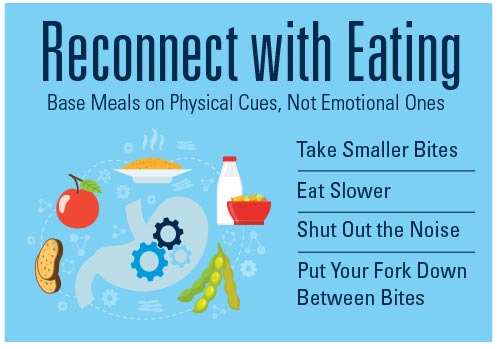
To help you get connected, I am sharing some simple tips here with you today

mindful eating-connect

 1) Connect right from grocery shopping: Most of us go grocery shopping on weekends. And there is usually a long queue at the billing counter. In a hurry to finish our job, we just throw into our cart whatever is more attractive or convenient-which is mostly processed foods. To connect with your food, shop smart at the store itself.

 i) Fill up your cart from produce section first. Once you have half filled up your cart with fruits and veggies, you’ll be less tempted to shop for processed and ready-to-eat meals.

ii) Read ingredient list and nutritional labels. Choose food products with short ingredient list, ingredients that you can pronounce, with 0 trans fats, no sugar or if at all, appearing last on the list, mentions whole grain composition, small per serving calories (and not per 100gm) and has fiber serving size >2 units. If a food product matches these criteria, it is worthy to be nourishing you.

2) Be a food critic: You don’t need to write a review or become a fussy eater. But learn the art of analyzing your food dishes. What are you eating? What are the ingredients that go into this dish? How is it prepared? How’s the aroma, texture, color of the meal? How does it make you feel? Knowing the answers to all of these questions will help you know why you eat what you eat and thus will help you turn into a mindful eater.

i) One player once mentioned to me he can’t stop eating ‘vada-pao’ the fried snack tucked between white flour bread. On my insistence, he made the attempt to analyze how he feels while having the snack. To his own surprise, he found out that it was only the act of tearing the bread apart and tucking in the fried snack, which appealed to him. He didn’t really enjoy the taste of the snack as much as he liked the procedure of eating it!

So to know yourself and your eating habits better, be a food critic.

3) Make an attempt to learn about your nutrition

# Know major food groups like carbs, proteins and fats and the minor but essential ones like vitamins and minerals. Know which food dishes you commonly eat fall in these categories and influence you.

# Know alkaline and acidic foods- because our blood pH is slightly alkaline (7.3-7.4) and to keep our system running efficiently, we need to maintain this alkaline pH. Your food choices will play an important role in this physiological action.

# Know various benefits of different herbs-cinnamon, turmeric, coriander, cloves, ginger, garlic, fennel, cardamom, coriander, saffron, fenugreek, garam masala, varieties of pepper, and so on. You have them in each and every single dish. They deserve your attention.

# Know how to eat your fruits right, what time of the day and how much and in what combination is good enough.

# Know combination of foods that can enhance each other’s nutritional values-like Vitamin C with Iron rich foods, Vitamin D and calcium rich foods and know what food combinations can interfere with each other’s absorption in the body like Iron and Calcium heavy foods don’t go well together.

# Know what meals are best options for pre and post workout nutrition

# Learn why you should not eat white sugar, white flour or white salt. Or have an aerated drink ever

# Know replacements for sugar and white salt and what you can do to beat down your sugar cravings.

# Understand why dark chocolates or nuts are good for you despite being calorific or why eating a healthy ‘mukhwas’ (mouth freshner) after a meal can be a good habit.

And, there are many more such small and simple things to know about your everyday nutrition. Keep asking your coach or make an attempt to read and learn yourself.

Mindful eating is much more than learning about your food or food choices alone or practicing slow eating, in the moment eating itself. It encompasses having a relationship with your food wherein you respect your meals and feel gratitude towards them.

To sum up, mindful eating is a way of nurturing your physical self, harmonizing your mental state, and satisfying your soul.

If you have been missing out on mindful eating, get on the mindful eating wagon now! If you found this information valuable, share your thoughts in the comments below and for more insights, check out Healthy Reads or  for further guidance speak to a certified expert by subscribing to GOQii’s Personalised Health Coaching here.

#BeTheForce

July 1, 2024 By Aesha Mehta 1 Comment

7 Foods To Avoid If You Have Asthma

Asthma

Asthma is an ancient Greek word which means “short drawn breath”. It can be quite troublesome as it causes chest tightness, shortness of breath, and coughing. Patients suffering from asthma have more trouble exhaling carbon dioxide than inhaling oxygen because the air passages of the small bronchi become clogged, making it difficult to breathe. Most asthma patients face more difficulty breathing during the night time. 

Modern medicine has not been able to find a cure for this troublesome respiratory disease. Drugs and vaccines help in reducing symptoms and provide temporary relief. Allergy is a major cause of asthma, but it can be managed with a  proper diet and lifestyle, such as eating foods which are easy to digest and adapting lifestyle methods such as yogic kriya – which helps in proper assimilation of food, strengthening of lungs, digestive and circulatory system. 

Which Foods Should You Avoid If You Have Asthma? 

While there are foods which can help you alleviate the symptoms of asthma, here are some which you must avoid at any cost. 

  1. Sugar: Sweet carbonated drinks, candies, cakes, biscuits, and all the foods which are rich in sugar increase coughing and wheezing in children. Sugar attacks the immune system of the airway, causing narrowing of airways and mucous production. Instead of sweets, include jaggery and coconut sugar.
  2. Junk Foods: Foods like burgers, pizza, red meats, fries, etc., which are loved by a large part of the population, worsens asthma symptoms. These foods make one overweight, and the lungs have to work harder, making it difficult to breathe. Include simple, homemade foods instead of junk foods
  3. Alcohol: Sulphites, one of the allergens present in many alcoholic beverages, worsen asthma symptoms. It increases wheezing and breathing difficulty. Include more natural beverages like lemon water and coconut water instead of beer and wine.
  4. Beans: Beans cause gas in our body, putting pressure on the diaphragm and increasing acid reflux. It is better to avoid beans and other foods like cabbage, onion and garlic which are gas forming.
  5. Tea and Coffee: Another allergen, Salicylates, is found in tea and coffee. Though it is rare, some asthmatic patients are allergic to salicylates and find difficulty in breathing. As an alternative, you can include herbal teas like chamomile tea and passionflower tea instead of regular tea and coffee.
  6. Shrimp: Shrimp contains sulphites, which is an allergen. Yes, SULPHITES again! It can worsen asthma symptoms.
  7. Salt: Salt is one of the worst foods for asthma. It can tighten the airways, cause inflammation, and fluid retention, making it a very serious lung complication. Include natural flavouring ingredients like cumin, turmeric and chilli flakes instead of salt. 

We hope this article helps you understand which foods to avoid if you have asthma. By making mindful dietary choices, you can better manage your asthma symptoms and improve your overall well-being. Do leave your thoughts in the comments below.

#BeTheForce 

Disclaimer: The information provided in this blog is for general awareness and educational purposes only. It is not intended to replace professional medical advice, diagnosis, or treatment. Always consult a qualified healthcare provider for personalised medical guidance or concerns related to your health.

June 27, 2024 By Luke Coutinho Leave a Comment

Your Gut Health: Why It Matters More Than You Think

You would have heard of the saying, ‘Almost all diseases begin in the gut’. Well, it’s true. Maintaining the right ‘microflora’ (balance of good bacteria) in the gut is crucial for great health, immunity and even preventing, healing and recovering from serious diseases like cancer.

Your intestines (gut) contain pounds of good bacteria that help with the absorption of nutrients from the food you eat. These ‘good bacteria’ determine the strength of your immunity, regulate weight loss, aid recovery, support colon health, manage body toxicity, and handle several other functions.

The gut also contains yeast (fungals), which, if exceeds in number compared to the good bacteria, cause serious digestive issues, affect nutrient assimilation, and can cause leaky gut, vaginal rashes, IBS and other bowel and GI tract disorders. It is crucial to maintain the proportion of good bacteria, especially in children.

A shortage of good bacteria can lead to allergies, skin problems, headaches, migraines, inability to lose weight, and even contribute to fat accumulation. Energy levels can fall when there is an imbalance.

Everything we eat and drink passes through the gut along the gastrointestinal (GI) tract. This tube-like GI tract, lined with a thin, sticky mucous, is embedded with millions of bacteria that live, grow, and metabolize (digesting and absorbing) in a complex ecosystem comprised of both beneficial and harmful bacteria.

Maintaining gut health is one of the most important and least addressed aspects of overall health. Many lifestyles choices deplete the gut of the ‘good’ bacteria’, leading to health problems ranging from acne to deadly diseases like cancer.

If you have more bad bacteria (fungus) than good bacteria in your gut, even the healthy food you eat will not be assimilated the right way. Even if you eat clean, organic, or expensive foods, it does not matter if your gut microflora is out of balance. This is where probiotics come in.

Probiotic bacteria do several things that contribute to good health and immunity.

Their most basic function is to fight harmful foreign substances that enter the body by detoxifying them and easing their elimination. Probiotics can prevent the growth of harmful bacteria, which thrive and grow within a neutral pH environment, by producing organic acids such as acetic and lactic acids that, in turn, lower the pH of the large intestine.

This lower pH also prevents the metabolism of cholesterol and bile acids in the colon. Since cholesterol and bile metabolites act as cancer-causing agents, they can play an important role in the prevention of cancers of the GI tract and other organs as well. These helpful bacteria can even lower serum cholesterol levels along with cardiovascular disease risk by preventing the activity of an enzyme involved in the synthesis of cholesterol.

Inside the gut are about 100 trillion live microorganisms that promote normal GI (gastro intestinal tracts) function, protect the body from infection, and regulate metabolism and the mucosal immune system. They comprise more than 75% of the immune system.

Also important is their role in maintaining and protecting the GI barrier. An intact GI barrier maintains gut health, while a problem with its microbiota composition will affect the body’s defense systems and can create a condition known as leaky gut syndrome, which can compromise gut health and lead to diseases such as inflammatory breast cancer, obesity, chronic fatigue syndrome, and depression.

Your diet is the most important element for building gut health. Include curds or probiotic supplement if you are vegan or cannot have yogurt. Some top natural probiotic-rich foods include:

  • Yogurt (plain kind)
  • Miso
  • Sauekraut
  • Kimchi
  • Kefir
  • Kombucha tea
  • Pickled gherkins
  • Spirulina
  • Chlorella

Ensure your diet is rich in complex carbs, fiber, fruits, vegetables, and omega – 3, with a healthy water intake and low intake of sugar, processed foods and red meat.

Avoid sodas, processed foods, and sugar as they quickly depletes the gut of good bacteria, dropping immunity almost instantly, making it the worst thing your child or you can consume. I constantly tell parents that giving your child aerated drinks is worse than drugs.

Your gut health plays a pivotal role in your overall well-being. By maintaining a balanced gut microflora through a healthy diet and probiotics, you can prevent diseases, boost immunity, and ensure optimal nutrient absorption. Prioritize your gut health to experience better health and vitality.

We hope this article helps you. For further information or guidance, reach out to our certified experts by subscribing to GOQii’s Personalised Health Coaching here.

#BeTheForce

Disclaimer: The information provided in this blog is for general awareness and educational purposes only. It is not intended to replace professional medical advice, diagnosis, or treatment. Always consult a qualified healthcare provider for personalised medical guidance or concerns related to your health.

  • « Previous Page
  • 1
  • …
  • 27
  • 28
  • 29
  • 30
  • 31
  • …
  • 95
  • Next Page »

Search

Recent Posts

  • 4 Reasons Why Affirmations Are Not Working For You
  • The Social Side of GLP-1: Navigating “Food Culture” and Peer Pressure
  • Leaky Gut: Symptoms and Causes
  • Muscle Is Your Insurance Policy: Why Strength Predicts Lifespan More Than Cardio
  • The Fiber Gap: Managing Digestion on GLP-1 Therapy

Stay Updated

Archives

  • March 2026 (1)
  • February 2026 (14)
  • January 2026 (14)
  • December 2025 (19)
  • November 2025 (15)
  • October 2025 (20)
  • September 2025 (6)
  • August 2025 (6)
  • July 2025 (12)
  • June 2025 (18)
  • May 2025 (16)
  • April 2025 (22)
  • March 2025 (23)
  • February 2025 (22)
  • January 2025 (25)
  • December 2024 (22)
  • November 2024 (23)
  • October 2024 (21)
  • September 2024 (24)
  • August 2024 (30)
  • July 2024 (21)
  • June 2024 (26)
  • May 2024 (31)
  • April 2024 (27)
  • March 2024 (29)
  • February 2024 (25)
  • January 2024 (21)
  • December 2023 (15)
  • November 2023 (11)
  • October 2023 (19)
  • September 2023 (22)
  • August 2023 (18)
  • July 2023 (22)
  • June 2023 (24)
  • May 2023 (24)
  • April 2023 (23)
  • March 2023 (23)
  • February 2023 (19)
  • January 2023 (15)
  • December 2022 (11)
  • November 2022 (15)
  • October 2022 (15)
  • September 2022 (12)
  • August 2022 (10)
  • July 2022 (17)
  • June 2022 (11)
  • May 2022 (10)
  • April 2022 (6)
  • March 2022 (6)
  • February 2022 (13)
  • January 2022 (11)
  • December 2021 (7)
  • November 2021 (3)
  • October 2021 (6)
  • September 2021 (3)
  • August 2021 (8)
  • July 2021 (7)
  • June 2021 (15)
  • May 2021 (16)
  • April 2021 (10)
  • March 2021 (7)
  • February 2021 (4)
  • January 2021 (4)
  • December 2020 (3)
  • November 2020 (4)
  • October 2020 (10)
  • September 2020 (3)
  • August 2020 (3)
  • July 2020 (2)
  • June 2020 (4)
  • May 2020 (10)
  • April 2020 (12)
  • March 2020 (10)
  • February 2020 (4)
  • January 2020 (4)
  • December 2019 (3)
  • November 2019 (7)
  • October 2019 (5)
  • September 2019 (4)
  • August 2019 (9)
  • July 2019 (9)
  • June 2019 (11)
  • May 2019 (4)
  • April 2019 (8)
  • March 2019 (8)
  • February 2019 (9)
  • January 2019 (8)
  • December 2018 (9)
  • November 2018 (3)
  • October 2018 (3)
  • September 2018 (5)
  • August 2018 (10)
  • July 2018 (6)
  • June 2018 (13)
  • May 2018 (8)
  • April 2018 (18)
  • March 2018 (9)
  • February 2018 (8)
  • January 2018 (15)
  • December 2017 (12)
  • November 2017 (19)
  • October 2017 (13)
  • September 2017 (15)
  • August 2017 (4)
  • July 2017 (8)
  • June 2017 (7)
  • May 2017 (6)
  • April 2017 (8)
  • March 2017 (6)
  • February 2017 (7)
  • January 2017 (9)
  • December 2016 (10)
  • November 2016 (7)
  • October 2016 (7)
  • September 2016 (7)
  • August 2016 (11)
  • July 2016 (9)
  • June 2016 (9)
  • May 2016 (12)
  • April 2016 (17)
  • March 2016 (17)
  • February 2016 (8)
  • January 2016 (6)
  • December 2015 (2)
  • November 2015 (9)
  • October 2015 (7)
  • September 2015 (9)
  • August 2015 (11)
  • July 2015 (9)
  • June 2015 (12)
  • May 2015 (9)
  • April 2015 (13)
  • March 2015 (8)
  • February 2015 (5)
  • January 2015 (12)
  • December 2014 (14)
  • November 2014 (11)
  • October 2014 (6)
  • September 2014 (13)
  • August 2014 (12)
  • July 2014 (6)
  • June 2014 (2)
  • May 2014 (7)
  • April 2014 (5)

From “Laddu Nawin” to Fit and Fierce: How a 25-Year-Old Insurance Advisor Shed 20 Kilos and Gained His Life Back

When 25-year-old Nawin Yadav from Hyderabad walked into his office every morning, he carried more than just his files and policy papers. He had the weight of fatigue, sluggish energy, and an ever-growing belly that was becoming the butt of jokes. “People … [Read More...]

“I’ve Challenged Myself to Live 100 Years” – The Story of Chandubhai Savani’s Second Chance at Life

At 67, most people start slowing down. Not Chandubhai Savani. A resident of Surat, Chandubhai, thought life was on track. “My life was going well till I had my bypass surgery,” he says. That surgery, back in 2021, was a wake-up call.  Medication was routine, but exercise wasn’t. His diet? What he calls ‘normal.’ “I […]

From Shimla’s Slopes to Chandigarh’s Sidewalks: Surinder Kaur Bhalla’s Journey from Chaos to Control

Some journeys start with a plan. Others begin with a stumble literally. Surinder Bhalla, a government professional, born and raised in the scenic hill town of Shimla, had always lived a life of movement. “In Shimla, you walked everywhere,” she reflects. “Walking was never an exercise. It was just life.” But after shifting to Chandigarh, […]

Ananda Mukherjee Health Story

From Terminal Illness To Complete Wellness! Ananda Mukherjee Health Story

As we observe World Cancer Day under the powerful theme ‘United by Unique’ (2025-2027)**, we are reminded that every individual’s journey with cancer is distinct, yet united by shared resilience, hope, and the collective fight against this disease. This theme places people at the centre of care and their stories at the heart of the […]

  • HOME
  • HEALTHY LIVING
  • FITNESS
  • HEALTHY RECIPES
  • USER STORIES
  • KARMA
  • BUY GOQii

Copyright ©2016 GOQii