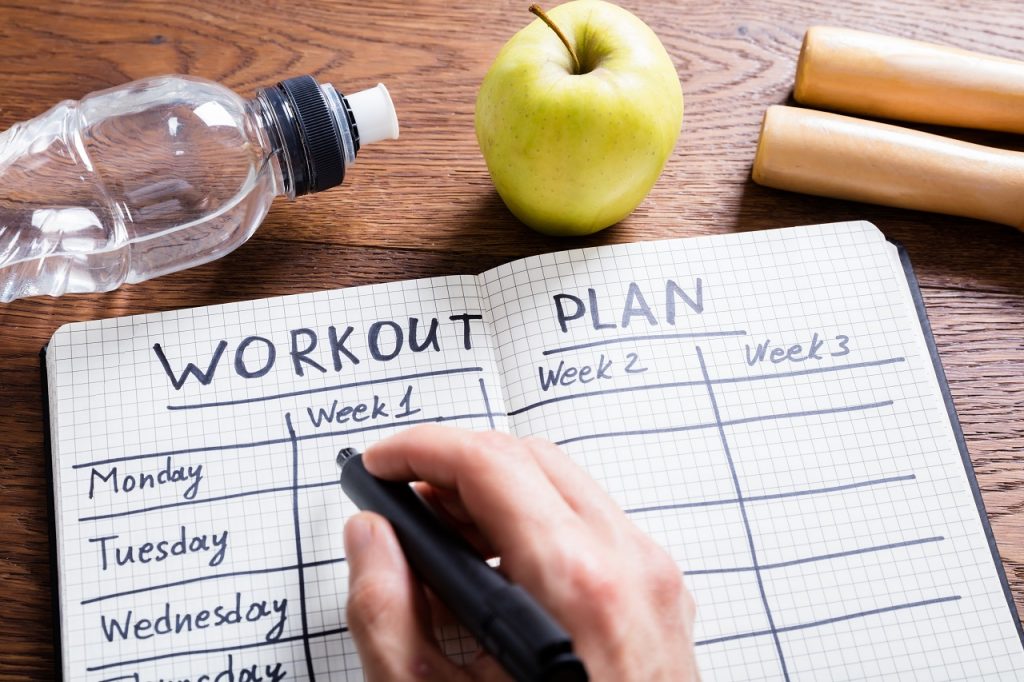
As health is among the top priorities in our life, being healthy, immune to all types of infections, diseases and getting fit are the avenues for the same now. If you’re thinking about getting fit, and as we have stepped into the new year, don’t just take up a gym membership but work on consistency and have a plan.
As per the American College of Sports Medicine recommendation, a healthy person needs at least 30 mins of exercise every day to maintain physical health, mental health, immunity, and prevent chronic diseases for all age groups. So, here’s an ideal weekly workout routine for beginners you can follow and stick to!
Get Motivated For Your Weekly Workout Routine
Every day of the week may not go as we plan. But if we are determined to be fit, we can set aside some time for exercise every day. If you are a beginner, creating a workout schedule for every week would be a better choice than just having a vague idea about staying active every day. Find out a strong reason for yourself as to why you need to workout every day. This should be a reminder to maintain consistency in order to achieve your goal.
Getting Started On Your Weekly Workout Routine
Beginning a workout can be confusing and intimidating as to where and how to start. Once you find out the ideal time, duration, and location for you to exercise, think about the obstacles that can come your way. Slot a backup time to avoid missing the workout.
For example, if you set a goal to walk for 30 mins, completing about 5-6k steps, and that doesn’t happen due to some unplanned situations, walk more at work, take the steps instead of the elevator, walk while you talk over the phone just to complete the intended number of steps for the day.
Here are some points to remember before you begin:
- Start with short duration but be consistent: It can be 15-20 mins workout rather than an hour of workout at a stretch in a day. Make sure to plan your workout for at least 5 days in a week with a short term specific, measurable goal.
- Keep a track of how your energy levels are getting better: Notice what other benefits you are getting out of exercise like improved quality of sleep, reduced stress, and increased appetite instead of just keeping a track of numbers on your weighing scale or inch loss.
- Plan your workout: Schedule it according to your entire week’s schedule taking into consideration your work, personal life and family time, etc.
- Choose different types of workouts: Pick activities that you are interested in and you are comfortable doing. Make a list of physical activities that you enjoy. It can be dance, running, walking, sports like football, badminton, tennis, volleyball, basketball, cricket, weight training, or yoga.
Week 1
 Day 1: Cardio exercises
- Start with 5 minutes warm-up exercises at a slow to moderate pace to slowly increase the heart rate
- Switch to 20 mins of cardio exercise. It can include aerobic exercises, brisk walk, interval running outside, cycling, stationary bike, swimming, Zumba or any type of dance, or any type of sport. Pay attention to your energy level and breath. You should ideally be able to talk without going out of breath while exercising to know your comfortability. People who want to do running can begin with 1 min of running and 3 mins of walking initially.
- Stretch for 5 mins to cool down to gradually bring down the heart rate back to normal
Day 2: Strength training
- Warm-up exercises for 5 Minutes
- Easy Strength training exercises for 25 mins: As a beginner, it’s better, to begin with, bodyweight training initially. Some of the exercises that come under this can be jumping jacks, push-ups, squats, lunges, burpees, mountain climbers, shoulder bridge, crunches, planks and reverse lunges with just one set each and about 10 repetitions each. There can be 10 seconds of rest in between each set.
- Cooldown workout for 5 mins
Day 3: Yoga/Dance
- Warm-up with 5 Surya namaskars/ jumping jacks
- Easy Standing and sitting Yoga postures or Dance of your choice for 25 mins. It’s always better to learn yoga postures through a trainer to learn about breathing patterns and the correct postures.
- Cooldown workout for 5 mins
Day 4: Strength training
- Warm-up exercises for 5 Minutes
- Easy Strength training exercises for 25 mins. This can be repeated the same as day 2.
- Cooldown workout for 5 mins
Day 5: Cardio exercises
- Warm-up exercises for 5 Minutes
- Easy Cardio exercise for 25 mins. This can be repeated the same as day 1.
- Cooldown workout for 5 mins
Day 6: Strength training
- Warm-up exercises for 5 Minutes
- Easy Strength training exercises for 25 mins. This can be repeated the same as day 2
- Cooldown workout for 5 mins
Day 7: Rest day
Active rest, which means low-intensity exercise like stretching and casual walking, are suggested on this day to stay active, increase the blood flow to the muscles for good healing, and reduce soreness.
Week 2
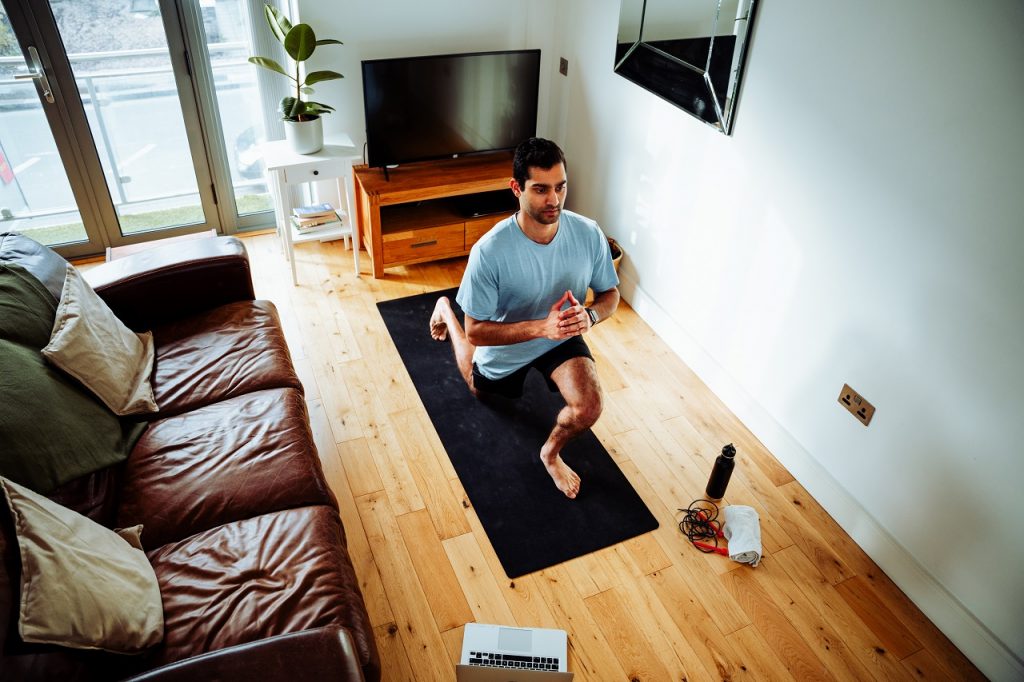 The routine of week 1 can be repeated on week 2 as well. People who are training for running can increase the duration of running to 3 mins of running and 1 min of walk.
- Day 1: Cardio exercise for 25 mins with warm-up and cool down
- Day 2: Strength training exercise for 25 mins (15 reps of 1 set each) with warm-up and cool down
- Day 3: Yoga, Pilates, dance, or stretching for 25 mins with warm-up and cool down
- Day 4: Strength training exercises for 25 mins (15 reps of 1 set each) with warm-up and cool down
- Day 5: Cardio exercise for 25 mins with warm-up and cool down
- Day 6: Strength training exercise for 25 mins (15 reps of 1 set each) with warm-up and cool down
- Day 7: Rest day
Week 3 and Week 4
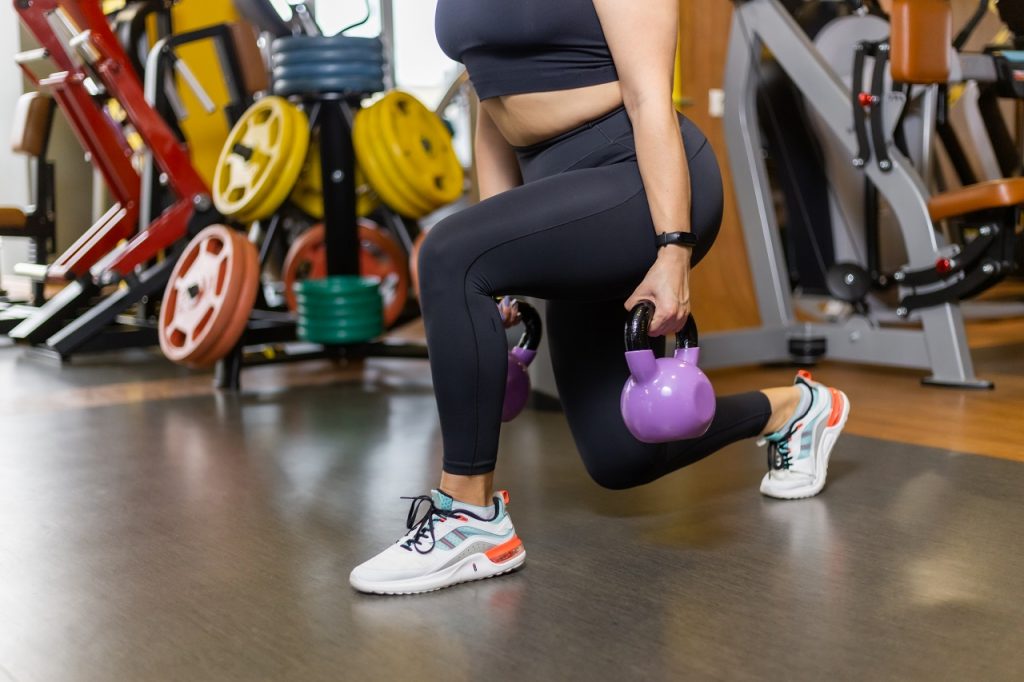 Repeat the same routine for week 3 while increasing the duration, speed, and intensity of the workout this week. Small changes can be made with your workout to keep it interesting. For strength training, 2 sets can be done with 12 repetitions. If you feel this routine is easy one can also try other workouts like HIIT, kettlebell, resistance band workout, and weight training depending on their energy level and comfortability. This can include exercises that involve different muscle groups of the body like shoulder, arms, chest, abdomen, back, hips, glutes, thigh, and legs.
These workouts have to be done again with the combination of cardio workouts on alternate days with one day as a Rest day. People who are running can switch to 4 mins running and 1 min walking, if they are comfortable. The idea here is to gradually increase the intensity of the workout so that the body is getting adjusted to the workouts easily without any injuries and exhaustion.
- Day 1: Cardio exercise for 25 mins with warm-up and cool down
- Day 2: Strength training exercise for 25 mins (15 reps of 2 set each) with warm-up and cool down
- Day 3: Yoga, Pilates, dance, or stretching for 25 mins with warm-up and cool down
- Day 4: Strength training exercise/HIIT for 25 mins (15 reps of 2 sets each) with warm-up and cool down
- Day 5: Cardio exercise for 25 mins with warm-up and cool down
- Day 6: Strength training exercise for 25 mins (15 reps of 2 sets each) with warm-up and cool down
- Day 7: Rest day
Proper warm-up and cool-down exercises are critical here to prevent injuries and for better healing. Muscle soreness can be common during the first week of exercise. But don’t give up. You will slowly get over it as you continue the workouts.
One needs to pay attention to their diet with good protein, complex carbs, and fibers. Not to forget good hydration and quality sleep. If you have any health conditions like heart problems, diabetes, back pain, neck pain, knee pain, vertigo, arthritis, post-COVID or balance-related issues, get the clearance from your doctor. Certain types of exercises can be contraindicated in some of the conditions. It’s always ideal to have a personal coach or fitness trainer to learn how to go about a proper exercise routine, balanced diet, and healthy lifestyle tailored for your health condition and body type.
For any additional help on getting started from the comfort of your home, you can sign up for our live, interactive GOQii Pro Classes where our fitness experts will guide and motivate you. You can book a class now from the GOQii App.
Hope this weekly workout routine for beginners helps you. Do let us know your thoughts in the comments below!
#BeTheForce
Disclaimer: The information provided in this blog is for general awareness and educational purposes only. It is not intended to replace professional medical advice, diagnosis, or treatment. Always consult a qualified healthcare provider for personalised medical guidance or concerns related to your health. Images shown are for representation purposes only and may not depict the exact recommendations or outcomes.
 As the countdown to marathon day enters its final two weeks, the anticipation and excitement build for seasoned runners. This critical phase is not just about physical preparation but also mental readiness and strategic planning. It’s a time to reflect on the rigorous training, fine-tune the final details, and set the stage for a successful race day. For the experienced marathoner, these last two weeks are about balancing rest with readiness, nourishment with energy, and anticipation with focus. This guide provides essential tips to help experienced runners make the most of this crucial period, ensuring they arrive at the starting line in peak condition, both physically and mentally. Here are few things to keep in mind
 Once upon a time, our ancestors roamed the land, hunting for food and escaping predators. They were constantly on the move, adapting to their environment and surviving against the odds.
 Being physically fit has many benefits. This is not true of adults alone but also true for children. I remember as a child I would love to play in the outdoors. Every day my friends and I would spend at least an hour playing all kinds of games from football to cricket to various other physically taxing games. But, today its sad that we hardly see kids playing in the outdoors.


