
GOQii

Blog

  • HOME
  • HEALTHY LIVING
  • FITNESS
  • HEALTHY RECIPES
  • USER STORIES
  • KARMA
  • BUY GOQii

Search Results for: heart health

November 24, 2025 By Vandana Juneja Leave a Comment

5 Breathing Exercises To Relieve Anxiety In An Instant

breathing exercises to relieve anxiety Many individuals experience anxiety, which can have a significant impact on their lives. When feeling anxious, symptoms such as increased heart rate, shallow and rapid breathing, and heightened tension often arise. However, there are effective methods to alleviate anxiety, such as engaging in breathing exercises.

Breathing exercises are straightforward yet potent techniques that enable individuals to regulate their breathing and achieve a state of mental calmness. By directing attention to the breath, it becomes possible to slow down the heart rate, reduce blood pressure, and alleviate muscle tension. Here are a few breathing exercises that can help relieve anxiety.

1. Diaphragmatic Breathing

Also referred to as belly breathing or deep breathing, diaphragmatic breathing involves inhaling deeply into the abdomen. This technique aids in slowing down the breathing process and activating the relaxation response.

To practice diaphragmatic breathing, find a comfortable position by lying down on your back or sitting on a chair with your feet flat on the ground. Then, place one hand on your chest and place the other on your belly. Inhale slowly and deeply through your nostrils, noticing the expansion of your belly as you breathe in. Now, exhale through your mouth slowly while feeling your belly contract. Repeat this exercise for a few minutes, concentrating on your breath and the sensations in your body.

2. Box Breathing

Box breathing, also known as square breathing, involves following a pattern of inhaling for four counts, holding the breath for four counts, exhaling for four counts, and holding the breath again for four counts. This technique aids in regulating breathing and calming the mind.

To practice box breathing, assume a comfortable position with a straight back and your feet flat on the ground. Take a gradual breath in through your nostrils, ensuring a slow count to four. Hold your breath for four counts. Next, exhale through the mouth slowly for four counts. Before you inhale again, pause and hold your breath for a count of four. Repeat this exercise for a few minutes. Be sure to focus on your breath and the sensations in your body.

3. Coherent Breathing

The goal of coherent breathing is to slow down the breathing rate to five breaths per minute. This pattern of breathing helps lower heart rate and blood pressure, resulting in a calmer nervous system.

Sit comfortably and inhale through your nose, expanding your belly for a count of five. Without pausing at the top of the inhale, immediately begin exhaling to a count of six. Repeat this sequence at least five times to complete a full-minute cycle. If inhaling or exhaling for this length of time is challenging, start with a three-count and gradually increase.

4. Alternate Nostril Breathing

Also known as Nadi Shodhana in Sanskrit, alternate nostril breathing involves inhaling and exhaling through one nostril at a time to balance the flow of energy. This technique helps quiet the mind and emotions.

To practice Nadi Shodhana, sit upright in a comfortable position with a straight spine. Bring your right hand in front of your face, placing your index and middle fingers between your eyebrows for stability. During the exercise, you will block either the left or right nostril using your thumb and ring finger. Close your eyes and block the right nostril with your thumb. Inhale slowly through the left nostril for a count of four, take a brief pause, and exhale through the right nostril for a count of four. Perform this cycle for a minimum of five repetitions.

5. Victory Breath

Victory breath, also known as Ujjayi Breath, derives its name from the Sanskrit term and is often associated with the soothing sound resembling waves crashing against the shore, hence referred to as ocean breath.

To practice this technique, find a comfortable upright position with a straight spine and hands resting in your lap. Keep your mouth closed and begin by inhaling through your nose for a count of 4, gently constricting the airflow to the back of your throat during the inhale. After reaching the top of the inhale, pause for a second before exhaling. Constrict your throat slightly and exhale slowly to a count of 6. Repeat this exercise for 5-10 repetitions.

In conclusion, breathing exercises provide a simple yet effective means to manage anxiety. Through regular practice, you can develop the ability to regulate your breathing and cultivate a calm mind, ultimately promoting a sense of relaxation and ease. So, take a few moments each day to focus on your breath and embrace the numerous benefits of these powerful techniques.

If this article helped you, let us know in the comments below! Find more articles on breathwork and yoga here. You can also get these techniques and more from a GOQii Coach by subscribing for Personalised Health Coaching here.

#BeTheForce 

Disclaimer: The information provided in this blog is for general awareness and educational purposes only. It is not intended to replace professional medical advice, diagnosis, or treatment. Always consult a qualified healthcare provider for personalised medical guidance or concerns related to your health. Images shown are for representation purposes only and may not depict the exact recommendations or outcomes.

November 12, 2025 By Neha Sharma Leave a Comment

Can You Die From Pneumonia? 6 Serious Complications You Should Know

pneumoniaPneumonia is an infection of the lungs which can be caused by bacteria, fungi or a virus. It can range from mild to life threatening – when you require medical intervention at the earliest. When the air sac of one or both lungs are filled with some fluid or pus, it leads to inflammation which causes chest pain while breathing, cough with phlegm or pus, fever, chills and difficulty in breathing. Newborns up to 2 years of age and older people above 65 yrs of age are more prone to pneumonia as their immunity is not strong enough to fight the infection.

Types Of Pneumonia 

There are four types of Pneumonia.

  • CAP (Community Acquired Pneumonia): It is a type of pneumonia that occurs outside the hospital or other healthcare facilities and is caused by bacteria, bacteria like organisms, fungi or a virus like COVID-19 as well.
  • HAP (Hospital Acquired Pneumonia): This type of pneumonia occurs during a hospital stay and can be serious as the person is already sick.
  • Health Care Acquired Pneumonia: This type of acquired pneumonia occurs when patients stay for a long term in hospitals or go to outpatient clinics for dialysis or chemotherapy.
  • Aspiration Pneumonia: This type of pneumonia occurs when you inhale food, liquid, saliva or vomit in your lungs and that causes an infection and it also occurs when there’s a brain injury.

What Are The Complications That Occur? 

Even with treatment, some people with Pneumonia, who have other health ailments, suffer complications. Here are some of them: 

  1. Bacteremia: When infection is caused by bacteria, it travels down to the bloodstream and can lead to septic shock that lowers the blood pressure and the heart cannot pump blood into the organs and organs may stop working altogether. So, if you are having symptoms like fever with chills, low blood pressure, stomach upset, fast breathing with a fast heart rate, you need to consult a doctor immediately.
  2. Lung Abscesses: Sometimes, due to pneumonia, pus pockets are formed in the lungs and give rise to fever, fatigue, weight loss, loss of appetite and coughing. This basically happens when a person is having bacteremia, gum disease, weakened immune system and regular intake of alcohol.
  3. Pleural Effusions, Empyema and Pleurisy: There are two types of layers surrounding your lungs called pleura. One from the outer side and one lines the part of your chest where the lungs sit. They help the lungs to move smoothly when one breathes. Sometimes, pain occurs while breathing and this is because the pleura swells and sometimes a fluid forms in between the layers and that is known as PLEURA EFFUSION. And if the fluid gets infected it leads to EMPYEMA.
  4. Respiratory Failure: With pneumonia, your lungs get infected and they will not be able to transfer oxygen to organs and won’t be able to get rid of carbon dioxide from the body which leads to this condition. Symptoms are fast breathing, irregular heart rate, anxiety, fatigue, losing consciousness or bluish tint on your skin, fingertips or nails.
  5. Kidney Failure: It’s not a common complication of pneumonia but when you are having bacteremia or septic shock, your heart may not be able to pump enough blood to your kidneys and they might stop functioning. Chances of kidney failure are high if it is coupled with other metabolic disorders.
  6. Heart Failure: Chances of heart diseases are higher if you have pneumonia as the heart may not be able to pump enough blood and oxygen as the heart itself doesn’t have enough supply. 

All the complications of pneumonia are not to be taken casually. If you experience any of the above symptoms or complications, seek medical help immediately. You can also track symptoms such as low blood oxygen, low blood pressure, increased heart rate and high body temperature with Smart Devices from GOQii. Tracking these symptoms early can help you avoid any unnecessary complications and get medical assistance on time.

We hope this article helps you. For more on Pneumonia and other medical conditions, check out Healthy Reads or ask your GOQii Coach directly by subscribing for Personalised Health Coaching here.

#BeTheForce 

Disclaimer: The information provided in this blog is for general awareness and educational purposes only. It is not intended to replace professional medical advice, diagnosis, or treatment. Always consult a qualified healthcare provider for personalised medical guidance or concerns related to your health. Images shown are for representation purposes only and may not depict the exact recommendations or outcomes.

October 30, 2025 By Priyanka Mangla 3 Comments

The Early Signs & Symptoms of Diabetes

symptoms of diabetesDiabetes has become one of the most common lifestyle disorders affecting both, urban and rural areas alike. You can attribute this to overeating, obesity, stressful, busy and sedentary lifestyles which lead to the early symptoms of diabetes. This also includes lack of proper nutrition which leads to disturbed glucose metabolism. Heredity is also a major factor in the development of the disease. It is usually misunderstood that eating only refined sugar in excess will lead to diabetes but that’s not the case. Excess intake of proteins and fats also leads to development of diabetes because ultimately they are also metabolized and converted to glucose.
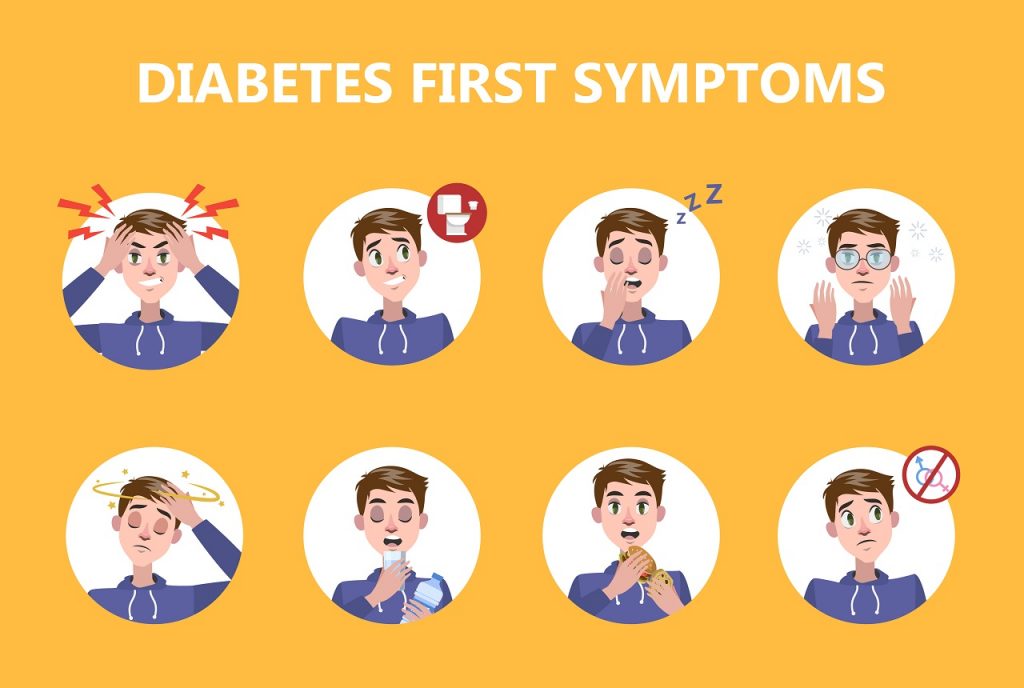
Diabetes is characterized by the elevated levels of glucose in the blood and urine. It is of 2 types:

  • Type 1: is present since birth due to complete absence of insulin 
  • Type 2: Develops later in life due to the deficiency of insulin

There are other variants too like gestational diabetes which occur during  pregnancy. Read more about it here: https://goqii.com/blog/what-gestational-diabetes-can-do-to-you-your-unborn-child/ 

Since untreated or uncontrolled diabetes gradually starts affecting the functioning of major organs of the body, like the heart, kidneys, brain, nervous system, eyes, etc. it is important to diagnose and manage diabetes as early as possible.  

How Can You Diagnose It? 

It is diagnosed by a blood test, in which the blood glucose in the fasting state (normal values range between 80-120 mg/100 ml of blood) and 2 hours after having the meal (normal values, 140 mg/100 ml of blood) are measured. Now, even before getting your blood glucose tested, there are certain signs and symptoms which our body shows which indicate the development of diabetes. 

Early Signs and Symptoms of Diabetes

  1. 3P’s: Polyphagia (increased hunger), polydipsia (increased thirst), polyuria (increased urination). Remember these 3 P’s and look out if you are experiencing these. 
  2. Loss of weight: In spite of increased hunger, there will be a very sharp loss of weight, which again is a warning symptom. This is happening because the glucose is getting lost in the urine, also due to insufficient insulin, the available glucose is not getting utilized to provide energy and to function, the body has started utilizing the glucose which is stored in the muscles and organs. 
  3. Getting tired: Loss of weight due to this condition leads to early tiredness. The person gets tired easily both mentally and physically. 
  4. Dry mouth: Despite drinking more water, there will be dryness in the mouth. 
  5. Paleness: appears because of anemia.
  6. Frequent infections and delayed healing of wounds: happens due to excess of glucose in the blood. 
  7. Loss of libido. 

In its early stages, we can easily prevent it from progressing further to a full blown Diabetes Mellitus with: 

  • Regular exercise: for a minimum of 30 minutes to maintain optimum weight. Engage yourself in light games. 
  • Proper diet: Which includes salads with meals (this slows down digestion and prevents an immediate spike in blood sugar levels) and excluding refined sugar, alcohol, smoking and high fat foods. 
  • Yoga & meditation: take care of the stress levels and curb the disease from getting any worse. Pranayama (Breath Control) and certain yoga asanas like Cobra Pose (Bhujangasana), Shoulder Stand (Sarvangasana) and various others help in stimulating the pancreas to produce insulin . 

There are certain home remedies which can be used as a supportive measure. I want to discuss here the two most important ones. 

  1. Bitter gourd (Karela): is highly beneficial in the treatment of diabetes. It contains an insulin-like principle, known as plant-insulin which has been found effective in lowering the blood and urine sugar levels.
  2. Java Plum (Jamun): The seeds contain a glycoside ‘jamboline’ which has the power to check the pathological conversion of starch into sugar in cases of increased production of glucose. In the Homoeopathic system of medicine, we have a very effective medicine prepared from this fruit to treat diabetes. 

We hope this article helps you manage Diabetes and helps you spot the early signs and symptoms. Do leave your thoughts in the comments below! For more articles on managing Diabetes, check out Healthy Reads. 

For further guidance and motivation by certified experts, join the GOQii Diabetes Care program. It’s India’s only diabetes program that is driven by Smart Science and Personal Coaching to improve Fasting Blood Sugar (FBS), Postprandial Blood Sugar (PP), and reduce HbA1c levels. You can subscribe here: https://store.goqii.com/diabetescare.

#BeTheForce Against Diabetes! 

Disclaimer: The information provided in this blog is for general awareness and educational purposes only. It is not intended to replace professional medical advice, diagnosis, or treatment. Always consult a qualified healthcare provider for personalised medical guidance or concerns related to your health. Images shown are for representation purposes only and may not depict the exact recommendations or outcomes.

October 28, 2025 By GOQii 9 Comments

How Important Is Cardio For Weight Loss?

cardio and weight lossYou are well aware of the fact that you lose weight when you burn more calories irrespective of how much you eat. The best way to lose weight is to follow a combination of cardio, strength training and a healthy diet.



Cardio is one of the key components because:

  • You burn more calories at one time.
  • Getting your heart rate into your target heart rate zone means your blood is pumping, you’re breathing hard, and you’re sweating and burning calories.
  • You can easily add intensity to increase your calorie burn. With cardio, it’s easy to increase your calorie burn with small changes, for instance running or walking faster, jumping higher, climbing hills or trying new activities that your body isn’t used to.
  • It adds to your overall calorie deficit. Burning calories with exercise means you don’t have to cut as many calories from your diet.
  • You can do cardio most days of the week. With strength training, your muscles require rest to recover and grow stronger. Cardio can be done most days of the week without worrying about injury or over-training.

The Best Cardio Exercises

While you know that cardio is important for weight loss, which exercises are best and how much do you really need for weight loss?

The truth is, there really isn’t any best cardio exercise. The best activity is the one you’ll do on a regular basis. So, finding something you like is critical to reaching your weight loss goals. That said, some exercises offer more intensity than others.

  • Impact activities: Exercises that involve some impact, like walking, will usually boost your heart rate quicker than no-impact activities like swimming or cycling.
  • High impact activities: High impact, or exercises that involve running or jumping, will often burn more calories than lower impact things like walking.
  • Whole body activities: When you involve both the upper and lower body, such as an aerobic activity which is also is known as cross training, it’s often easier to get the heart rate up and burn more calories.

That doesn’t mean you shouldn’t bother with low impact exercise. Both types of activities offer opportunities to burn calories and doing both gives you a well-rounded cardiovascular endurance development.

To get an idea of just how much cardio can do for you, check out the following list of common exercises. Below is the number of calories burned for a 150-pound person in 30 minutes:

  1. Step aerobics: 340 calories
  2. Stationary bike: 238 calories
  3. Swimming: 270 calories
  4. Walking 4 mph: 170 calories
  5. Running 5 mph: 270 calories
  6. kickboxing: 400 calories

Everything from walking to kickboxing can burn a significant number of calories!

How Much Do You Need?

It’s tough to know exactly how much cardio we need for weight loss. The American College of Sports Medicine and the American Heart Association recommend about 60 minutes of moderate to vigorous intensity activity on most days of the week. But, the truth is how much cardio you need varies from person to person and depends on factors such as:

  • How many calories you eat
  • How hard you exercise
  • Metabolism, age and gender
  • Fitness levels
  • Body fat percentage and weight
  • Exercise schedule

That said, here are some tips for setting up an effective cardio program:

  1. If you’re a beginner, start with 3 days of the cardio exercise of your choice, working at a level you can handle.
  2. Add time each week to work your way up to 30 to 45 minutes of continuous exercise.
  3. As you get stronger, try interval training once a week to help boost endurance and burn more calories.
  4. Work your way up to 5 to 6 days of cardio and try to vary what you do and how hard you work.

It will help you lose weight but it is most effective when combined with strength training and a healthy, low-calorie diet and adequate rest.

How Much Do You Need To Build Muscle?

You may think you shouldn’t do cardio exercise if you’re trying to gain muscle. But, cardio isn’t just for weight loss. It also helps condition the heart and lungs and promotes health and well-being. If your goal is to gain muscle, you won’t need tons of cardio. But, doing at least three 20-minute sessions a week won’t hurt your goals and will help you reap the benefits of cardio without burning too many calories. These are some simple necessities for cardio in weight loss. After reading this, I am sure all your misconceptions about weight training and weight loss are cleared!

If you want to begin working out or want to take your workouts to the next level, book a GOQii PRO class through the GOQii App and join our certified experts for a live, interactive session.

For more on weight loss, click here. Do let us know your thoughts in the comments below.

#BeTheForce 

Disclaimer: The information provided in this blog is for general awareness and educational purposes only. It is not intended to replace professional medical advice, diagnosis, or treatment. Always consult a qualified healthcare provider for personalised medical guidance or concerns related to your health. Images shown are for representation purposes only and may not depict the exact recommendations or outcomes.

  • « Previous Page
  • 1
  • …
  • 54
  • 55
  • 56
  • 57
  • 58
  • …
  • 136
  • Next Page »

Search

Recent Posts

  • Beyond the Screen: How Your Digital Habits Are Impacting Your Longevity
  • Healthy Eating: Vegetable Stuffed Ragi Paratha
  • Sustaining the “GLP-1 Glow”: Nutrition for Skin and Tissue Elasticity
  • Nutritional Deficiencies That Can Cause Hair Loss (And How to Fix Them)
  • The Recovery Gap: Sleep Debt, Overwork and Silent Burnout Are Ageing You Faster

Stay Updated

Archives

  • March 2026 (11)
  • February 2026 (14)
  • January 2026 (14)
  • December 2025 (19)
  • November 2025 (15)
  • October 2025 (20)
  • September 2025 (6)
  • August 2025 (6)
  • July 2025 (12)
  • June 2025 (18)
  • May 2025 (16)
  • April 2025 (22)
  • March 2025 (23)
  • February 2025 (22)
  • January 2025 (25)
  • December 2024 (22)
  • November 2024 (23)
  • October 2024 (21)
  • September 2024 (24)
  • August 2024 (30)
  • July 2024 (21)
  • June 2024 (26)
  • May 2024 (31)
  • April 2024 (27)
  • March 2024 (27)
  • February 2024 (25)
  • January 2024 (21)
  • December 2023 (15)
  • November 2023 (11)
  • October 2023 (19)
  • September 2023 (22)
  • August 2023 (18)
  • July 2023 (22)
  • June 2023 (24)
  • May 2023 (24)
  • April 2023 (23)
  • March 2023 (23)
  • February 2023 (19)
  • January 2023 (15)
  • December 2022 (11)
  • November 2022 (15)
  • October 2022 (15)
  • September 2022 (12)
  • August 2022 (10)
  • July 2022 (17)
  • June 2022 (11)
  • May 2022 (10)
  • April 2022 (6)
  • March 2022 (6)
  • February 2022 (13)
  • January 2022 (11)
  • December 2021 (7)
  • November 2021 (3)
  • October 2021 (6)
  • September 2021 (3)
  • August 2021 (8)
  • July 2021 (7)
  • June 2021 (15)
  • May 2021 (16)
  • April 2021 (10)
  • March 2021 (7)
  • February 2021 (4)
  • January 2021 (4)
  • December 2020 (3)
  • November 2020 (4)
  • October 2020 (10)
  • September 2020 (3)
  • August 2020 (3)
  • July 2020 (2)
  • June 2020 (4)
  • May 2020 (10)
  • April 2020 (12)
  • March 2020 (10)
  • February 2020 (4)
  • January 2020 (4)
  • December 2019 (3)
  • November 2019 (7)
  • October 2019 (5)
  • September 2019 (4)
  • August 2019 (9)
  • July 2019 (9)
  • June 2019 (11)
  • May 2019 (4)
  • April 2019 (8)
  • March 2019 (8)
  • February 2019 (9)
  • January 2019 (8)
  • December 2018 (9)
  • November 2018 (3)
  • October 2018 (3)
  • September 2018 (5)
  • August 2018 (10)
  • July 2018 (6)
  • June 2018 (13)
  • May 2018 (8)
  • April 2018 (18)
  • March 2018 (9)
  • February 2018 (8)
  • January 2018 (15)
  • December 2017 (12)
  • November 2017 (19)
  • October 2017 (13)
  • September 2017 (15)
  • August 2017 (4)
  • July 2017 (8)
  • June 2017 (7)
  • May 2017 (6)
  • April 2017 (8)
  • March 2017 (6)
  • February 2017 (7)
  • January 2017 (9)
  • December 2016 (10)
  • November 2016 (7)
  • October 2016 (7)
  • September 2016 (7)
  • August 2016 (11)
  • July 2016 (9)
  • June 2016 (9)
  • May 2016 (12)
  • April 2016 (17)
  • March 2016 (17)
  • February 2016 (8)
  • January 2016 (6)
  • December 2015 (2)
  • November 2015 (9)
  • October 2015 (7)
  • September 2015 (9)
  • August 2015 (11)
  • July 2015 (9)
  • June 2015 (12)
  • May 2015 (9)
  • April 2015 (13)
  • March 2015 (8)
  • February 2015 (5)
  • January 2015 (12)
  • December 2014 (14)
  • November 2014 (11)
  • October 2014 (6)
  • September 2014 (13)
  • August 2014 (12)
  • July 2014 (6)
  • June 2014 (2)
  • May 2014 (7)
  • April 2014 (4)

From “Laddu Nawin” to Fit and Fierce: How a 25-Year-Old Insurance Advisor Shed 20 Kilos and Gained His Life Back

When 25-year-old Nawin Yadav from Hyderabad walked into his office every morning, he carried more than just his files and policy papers. He had the weight of fatigue, sluggish energy, and an ever-growing belly that was becoming the butt of jokes. “People … [Read More...]

“I’ve Challenged Myself to Live 100 Years” – The Story of Chandubhai Savani’s Second Chance at Life

At 67, most people start slowing down. Not Chandubhai Savani. A resident of Surat, Chandubhai, thought life was on track. “My life was going well till I had my bypass surgery,” he says. That surgery, back in 2021, was a wake-up call.  Medication was routine, but exercise wasn’t. His diet? What he calls ‘normal.’ “I […]

From Shimla’s Slopes to Chandigarh’s Sidewalks: Surinder Kaur Bhalla’s Journey from Chaos to Control

Some journeys start with a plan. Others begin with a stumble literally. Surinder Bhalla, a government professional, born and raised in the scenic hill town of Shimla, had always lived a life of movement. “In Shimla, you walked everywhere,” she reflects. “Walking was never an exercise. It was just life.” But after shifting to Chandigarh, […]

Ananda Mukherjee Health Story

From Terminal Illness To Complete Wellness! Ananda Mukherjee Health Story

As we observe World Cancer Day under the powerful theme ‘United by Unique’ (2025-2027)**, we are reminded that every individual’s journey with cancer is distinct, yet united by shared resilience, hope, and the collective fight against this disease. This theme places people at the centre of care and their stories at the heart of the […]

  • HOME
  • HEALTHY LIVING
  • FITNESS
  • HEALTHY RECIPES
  • USER STORIES
  • KARMA
  • BUY GOQii

Copyright ©2016 GOQii
