
GOQii

Blog

  • HOME
  • HEALTHY LIVING
  • FITNESS
  • HEALTHY RECIPES
  • USER STORIES
  • KARMA
  • BUY GOQii

Search Results for: breathing

April 18, 2019 By Dr. Viral Thakkar 1 Comment

Epitome of Climax: The Big “O”

know your orgasmWhat is an Orgasm?

The climax of coitus, the mountaintop of making love and the ultimate, the almighty orgasm! Yes! This is what this article is about. You will agree that the pleasure of an orgasm is so heightened, it is difficult to know what is happening; but knowing what’s going on inside of us may heighten that.

Orgasm is the sudden discharge of accumulated sexual excitement resulting in rhythmic muscular contractions in the pelvic region of men and women. It is controlled by the involuntary or autonomic nervous system & associated with other  involuntary actions, including muscular spasms in multiple areas of the body, a general euphoric sensation and, frequently, body movements and vocalizations due to intense pleasure.

How Does it Happen?

I believe it is extremely essential to be attracted to your partner before indulging in any sexual activity. In fact, I would go ahead and say, indulge only if you love the person, else do not! More about this in another article.

If you are in this wonderful state, the continual stimulation of erogenous zones, such as the genitals, anus, nipples, or perineum by your partner might lead to an orgasm. Many believe that orgasms actually happen in the brain. Hence, one can reach an orgasm through masturbation as well. Physiologically, orgasms occur following two basic responses to continual stimulation:

  • Vasocongestion: The process whereby body tissues fill up with blood, swelling in size as a result
  • Myotonia: The process whereby muscles tense, including both voluntary flexing and involuntary contracting

If you thought having an orgasm is just a minute’s game, then you are in for a surprise. The body undergoes a long process to reach that state through the sexual response cycle, which is the sequence of physical and emotional changes that occur as a person becomes sexually aroused and participates in sexually stimulating activities, including intercourse and masturbation.
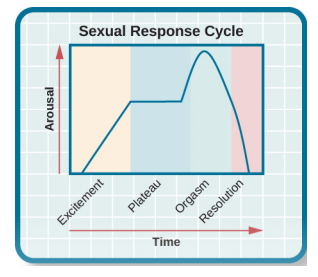
the epitome of climaxPhase 1: Excitement

As the name suggests, this is the stage when you blush and breath heavily in the hope of your coitus. In this stage:

  • Skin may become flushed
  • Muscle tension will increase
  • Heart rate quickens and breathing is accelerated
  • Nipples become hardened or erect
  • Vaginal lubrication begins
  • Blood flow to the genitals increases, resulting in swelling of the woman’s clitoris and labia minora (inner lips), and erection of the man’s penis
  • The woman’s breasts become fuller and the vaginal walls begin to swell
  • The man’s testicles swell, his scrotum tightens, and he begins secreting a lubricating liquid

Phase 2: Plateau

This is the phase when you are about to get an orgasm, but haven’t yet! The part of the brain that controls sensations – the primary somatosensory cortex – sees an increase in activity and the parts of the brain that control alertness and anxiety – the amygdala and hippocampus – dropped off.

Several other areas of the prefrontal cortex all show a decrease in activity. In other words, having an orgasm shuts the parts of your brain that make you worry.  No wonder all of mankind is crazy about having orgasams! It’s a great stress buster! It’s in the way our bodies are built!

The general characteristics in this stage are:

  • The changes of phase 1 are intensified
  • The vagina continues to swell from increased blood flow, and the vaginal walls turn a dark purple
  • The woman’s clitoris becomes highly sensitive (may even be painful to touch) and retracts under the clitoral hood to avoid direct stimulation from the penis
  • The man’s testicles are withdrawn up into the scrotum
  • Breathing, heart rate, and blood pressure continue to increase
  • Muscle spasms may begin in the feet, face, and hands
  • Muscle tension increases

Phase 3: Orgasm

The climax – It is the shortest of the phases and generally lasts only a few seconds. Both sexes feel the contractions in a variety of places from the head (that explains funny faces) to the feet (that explains clenched toes). You cannot control these contractions as they are involuntary and cannot be contained… kind of like when you sneeze. The loss of control can be messy, but it is ultimately why we enjoy our orgasms so much.

General characteristics of this phase include the following:

  • Involuntary muscle contractions begin
  • Blood pressure, heart rate, and breathing are at their highest rates, with a rapid intake of oxygen
  • Muscles in the feet spasm
  • There is a sudden, forceful release of sexual tension
  • In women, the muscles of the vagina contract. The uterus also undergoes rhythmic contractions
  • In men, rhythmic contractions of the muscles at the base of the penis results in the ejaculation of semen

Phase 4: Resolution

This is the feeling of “Oh my! What was that?” In this stage, the man enters a temporary recovery phase where further orgasms are not possible. This is known as the refractory period, and its length varies from person to person. It can last from a few minutes to a few days, and this period generally grows longer as a man ages. During this phase, the man’s penis and testicles return to their original size. The rate of breathing will be heavy and fast, and the pulse will be fast.

Orgasms are an inbuilt mechanism of human body (mammals). Our brain, emotions, and physiology are wired so that a person can experience it. In the second part of my article, I will elaborate on the benefits of orgasms, and why it is important to have a few now and then!

Want to know more? Drop a comment below!

#BeTheForce

Disclaimer: Reader discretion is advised. This content is for an older, mature audience who seek to improve their health and wellness. GOQii is not responsible for any misrepresentation of this information.
February 16, 2019 By GOQii Leave a Comment

From Scalp Issues to No Issue – Incredible Change with GOQii

From Scalp Issues to No Issue - Incredible Change with GOQiiSince GOQii’s inception, our core motive has always been to help people help themselves. With a majority of healthcare services focusing on sickcare instead of getting you healthy, GOQii chose to be different. GOQii chose to be an enabler.

We understand how frustrating it must be for someone with a health issue to keep looking for a solution in traditional healthcare and not find it. Like most people out there, Manisanthosh Bondugula suffered from a condition that Allopathy could not solve. After a lot of searching, Manisanthosh found GOQii.

For well over 3 years, Manisanthosh Bondugula, a 26 year old, working professional from Hyderabad, suffered from a condition known as Scalp Psoriasis – which is a skin disorder that makes raised, reddish and often single or several scaly patches that affect the entire scalp. When Allopathy couldn’t help, Mani began reading books for a solution and one of the books he read was ‘The Great Indian Diet’ by Luke Coutinho and Shilpa Shetty. Impressed and intrigued by the content, he reached out to GOQii’s Master Coach Luke Coutinho, who then introduced him to GOQii and Mani’s life began changing for the better.

In 2017, Mani became a GOQii Player. After much conversation, Mani’s coach diagnosed that his scalp psoriasis was caused by multiple issues which involved stress and sleep. His coach explained why he had these issues and how he can overcome them. The long-term goals assigned to him were to Manage Stress and Good Gut Health to Manage Psoriasis.

Mani’s coach asked him to consume chamomile tea to improve his sleep and asked him to add nuts and salads to his diet. He was asked to consume veg proteins for breakfast and dinner to improve his stamina. He was to avoid tamarind, curd, fish and non-veg entirely. To compensate, he began eating a lot of veggies and fruits. Additionally, his coach also advised him to participate in activities that gave him pleasure.

Currently, Mani is regular with meditation and walks 5km every day. When he finds the time, he performs yoga as well. He drinks 1 glass of lemon/honey water to detox his system and boost metabolism. He drinks milk with a pinch of turmeric before he sleeps to boost his immunity and healing. Initially he consumed Quinoa but replaced it with Millets as suggested by his coach. He also adds salads and sprouts to his meals.

After 2-3 months, Mani began noticing changes. His sleep improved and he lost 4-5kg. As of 2019, his Scalp Psoriasis has been cured by 90%. He is closely working with his coach to resolve the rest of it. Since 2017, Mani has had 4 GOQii coaches and has had a good experience with all of them.

With all that he has learned, Mani can now manage his lifestyle on his own. He told us, “For over 3 years no Allopathy doctor could help me. They kept telling me that the issue cannot be solved but when I got GOQii, it felt as though someone gave me a helping hand and pulled me out. It changed everything and it is awesome!”

Since being a part of our ever-growing family, Mani has recommended GOQii to 20 of his friends and acquaintances. He has subscribed to GOQii Play and follows dance workouts, yoga and breathing exercises. He had also attended the first GOQii Active Sunday in Hyderabad.

In closing, Mani had to say, “GOQii is an enabler. It doesn’t provide you with half knowledge. There’s only so much you can learn from a book and a book can’t tell you everything. Having a coach by your side does wonders as you can interact and get precise solutions for your problems, what you should and should not do and even your diet.”

We hope Mani completely recovers from his issue and is able to lead a happy and healthier lifestyle!

November 12, 2018 By Trupti Hingad 2 Comments

The Happy Hormone Journal

 Divya-Image 2-Part 1

Stress is a very common component of our everyday life. Staying happy amidst our busy schedules has become almost impossible. Everybody wants to be happy and we often find ourselves pursuing this emotion in various ways. Did you know that these emotions are the result of chemical reactions in the brain? The human body has 4 natural built-in mood-enhancing chemicals, which help combat stress and relieve pain keeping you happy and positive.

What are happy hormones? Why do they make us happy? How do we get more of these in our system?

The four happy hormones are Dopamine, Oxytocin, Serotonin and Endorphin (DOSE).

DOPAMINE: This is one of the chemical signals that pass information from one neuron to the next. Dopamine is released during pleasurable moments or situations and helps to regulate how pleasure is perceived and experienced. Dopamine is also responsible for our motivation, concentration, pleasure, bliss and euphoria.

How can you boost your Dopamine level:-

  1. Limit your sugar intake: Although sugar is linked with raising dopamine levels, the “high” achieved is only temporary and is linked to a wide array or illnesses.
  2. Limit caffeine intake: Yes, caffeine can also raise dopamine levels but studies show that increased caffeine intake can actually cause an increase in tolerance and can lead to lowered or even diminished dopamine release in the long run.
  3. Connect with others: Human contact such as hugs from your kids, kisses from your spouse, or even simply shaking hands with a friend or colleague is enough to boost dopamine levels.
  4. Meditate: Meditation and mindfulness helps the body relax through deep breathing and calming of the nervous system. This in turn helps with the release of dopamine.
  5. Listen to music: Listening to the music you enjoy helps trigger our pleasure centre thereby releasing dopamine.

OXYTOCIN:

This hormone and neurotransmitter is best known for its role in breastfeeding and childbirth. It’s produced in the hypothalamus and females have been shown to have higher levels than males. Oxytocin has been linked to higher self- esteem, trust, optimism and can help lower stress and blood pressure.

How to boost Oxytocin:-

  1. Cry: Suppressing ones emotions can lead to lower oxytocin levels which can cause stress as well as various physical issues within the body. We often hear that a good cry can help us heal both emotionally and physically. It’s true!
  2. Give: This can be in the form of volunteering or simply making a generous donation. The act of giving and/or bonding with others can help increase oxytocin levels and make us feel good overall.
  3. Physical Touch: Oxytocin helps to trigger the reward system in our brain when we are in healthy and loving relationships. It is also released during orgasms in both men and women.
  4. Encouragement: Whether we are getting it, or giving it, words of encouragement go a long way in the release of oxytocin. Compliment and encourage one another at every chance you get!

SEROTONIN:

Do you feel imbalanced? Do you have depression, anxiety, hot flashes, night sweats, bipolar disorder, migraines, insomnia, PMS, or chronic pain? The cause of all these symptoms is a neurotransmitter imbalance.

Like dopamine, serotonin is also a neurotransmitter. While dopamine is responsible for our excitement and motivation, serotonin is responsible for calming us, suppressing pain, and regulating our mood and sleep cycles. This hormone is found mainly in the gastrointestinal tract, platelets,                    and the nervous system. Serotonin also controls appetite and reduces your sensitivity to pain.

How to boost Serotonin:-

  1. 1. Aroma massage: Regular body massages can help lower the stress hormone cortisol, and help increase both dopamine and serotonin levels in the brain/body.
  2. Positive affirmations: Regularly reciting positive affirmations can help almost re-wire your thinking. Numerous studies show the effects of positive thinking can help with serotonin synthesis while lowering cortisol levels.
  3. Good vitamin B Intake: Vitamin B6 and B12 are directly linked to lowered levels of depression and when taken regularly, can help boost overall feelings of well-being. The richest sources of vitamin B6 include fish, beef liver and other organ meats, potatoes and other starchy vegetables, and fruit (excluding citrus). Vitamin B12 is naturally found in animal products, including fish, meat, poultry, eggs, milk, and milk products.
  4. Gardening: This one may seem strange but studies show that microbes contained in the soil can lead to a rise in serotonin simply through inhalation.

ENDORPHINS:

These are chemical compounds which are produced in the human body and interact with receptors in the brain. They help to reduce pain, increase focus, and improve your overall mood. It also helps boost energy, confidence, and makes all of the daily stressors of life much easier to cope with. Today, we produce endorphins when exercising our anaerobic zones. Anaerobic exercise helps us to cope with chronic pains by activating our body’s natural painkillers. Hence exercise is one of the many ways of boosting Endorphins.

How to boost Endorphin:-

  1. Laughter: Not only does laughter boost serotonin levels but also helps to increase pain tolerance levels.
  2. Healthy eating habits: Increase your consumption of protein, healthy fats, and plant based food while limiting alcohol and caffeine. If you supply the necessary amino acids the body will restore balance and you will have improved health and moods.
  3. 3. Sunshine exposure: Regularly spending time outdoors in the sun can regulate the release of endorphins. The best time is to expose the body to the Sun is from 10am to 1pm.
  4. Aromatherapy: Soothing scents such as those found in essential oils can help with the release of endorphins in the body.

So keep smiling, stay positive and keep these hormones levels at the peak!

August 9, 2018 By Parwage Alam 196 Comments

Yoga for the beginners: Some myths and benefits

Triangle-PoseCouple of months ago I had written a blog on meditation.(http://goqii.com/blog/author/parwage/). I now follow this written piece with a blog on Yoga which is also one of the ways to get stress free in your life and relax. I have been practicing Yoga for the last 8 years and have full faith in this form of exercise. Yoga can bring about positive changes in your life if practiced well. I personally feel the ‘Power of Yoga’.

Yoga is a precious gift given to us by our elders and can be practiced to better our lives. Originated in India, almost 26,000 years ago, Yoga is believed to have evolved during the period of the ‘Sat Yuga’, also called the Golden age. The term yoga can be derived from either yujir yoga (to yoke) or yujsamadhau (to concentrate).

While Yoga originated in India today, many people across the world practice yoga. Yoga in a way is helping many to achieve their physical fitness goal. Through this blog post, I would like to talk about the myths that are attached with Yoga and the benefits of Yoga for one and all.

A strong and flexible body, glowing beautiful skin, peaceful mind, good health – whatever you may be looking for, yoga has it on offer. Yoga helps you to achieve your overall fitness level. If you do follow Yoga regularly you are not just physically fit but, also mentally and emotionally balanced.

Ten minutes of yoga during the day can be a great way to get rid of stress that accumulates daily – in body and in the mind. This will also help you to achieve your inner peace. Some of yoga asanas are effective techniques to release stress.

Some myths regarding yoga :

  1. There is only one type of yoga:Vinyasa is the most popular type of yoga right now and involves using your breath with movement. Hatha yoga is slower with more static postures. Power yoga is more strengthening and cardiovascular. These are just a sampling of the many available styles today.
  2. Yoga requires time-commitment:If you give 10 min in a day daily to yoga, you can change your life.
  3. Yoga is only for women: This is not true. It has been proven by many schools of yoga that one and all can practice Yoga
  4. You have to be extremely agile: Yes, it’s true that there are some difficult yoga positions but, that doesn’t necessarily mean that you need to be super agile to practice yoga. Most postures can be modified to fit all skill levels or you can choose a position that isn’t so hard on the body.

Benefits of Yoga:

Yoga has both physical and mental benefits to the body and mind.

Health Benefits:

Physical benefits: Yoga improves flexibility and muscle joint mobility (Moving and stretching in new ways will help you become more flexible,).

Tones, strengthens and builds muscles; corrects posture; strengthens the spine (Many yoga poses require you to support the weight of your own body in new ways, including balancing on one leg (such as in Tree Pose) or supporting yourself with your arms (such as in Downward Facing Dog). Holding poses over the course of several breaths also builds strength.

Eases back pain; improves muscular-skeletal conditions such as bad knees, tight shoulders and neck, swayback and scoliosis; increases stamina; boosts immune response; stimulates the glands of the endocrine system; creates balance and grace; improves digestion and elimination; increases circulation; improves heart conditions; improves breathing disorders; decreases cholesterol and blood sugar levels.

Mental benefits:

Mental Calmness, Stress Reduction, Body Awareness

Asanas are good for developing coordination and helps to improve your concentration levels and memory. Regular practice can enable young people to keep their natural flexibility for many years. There is no age bar for Yoga.Yoga allows each and everyone who is practicing it to retain mobility and relieve problems such as arthritis and poor circulation. During pregnancy, yoga promotes good health in both mother and the unborn child. Yoga asanas lessen the effects of problems such as overweight, backache, and depression.

Here are some Yoga Asanas for the Beginners:

Mountain Pose (Tadasana) :Stand tall with feet together, shoulders relaxed, weight evenly distributed between your soles, arms on the sides.Take a deep breath and raise your hands overhead, palms facing each other with arms straight. Reach up toward the sky with your fingertips.

Downward Facing Dog (Adhomukhasvanasana): Get on all fours with your hands and knees and shoulder-and-hips-width apart. Walk with your hands a few inches forward and spread the fingers wide, pressing the palms into mat. Curl toes under and slowly press hips toward ceiling, bringing your body into an inverted V, pressing shoulders away from ears. Feet should be hip-width apart, knees slightly bent. Hold for 3-4 full breaths.

Warrior Pose (Virabhadrasana): Stand with legs 3 to 4 feet apart, turning right foot out 90 degrees and left foot in slightly. Bring your hands to your hips and relax your shoulders, then extend arms out to the sides, palms down. Bend right knee 90 degrees, keeping the knee over the ankle; gaze out over right hand. Stay for 1 minute. Switch sides and repeat.

Tree Pose (Vriksasana): Take mountain pose. Then shift your weight onto your left leg. With your hips facing forward, place the sole of your right foot inside your left thigh and find your balance. When you’re there, take a prayer position with your hands. To kick it up a notch, reach your arms up as you would in a mountain pose. Be sure to repeat with the other side.

Bridge Pose (Setubhanda): Lie on the floor with your knees bent and directly over the heels. Place the arms on your sides, palms down. Exhale, then press feet onto the floor as you lift your hips. Clasp hands under lower back and press arms down, lifting hips until thighs are parallel to the floor, bringing chest toward chin. Hold for 1 minute.
Make it easier: Place a stack of pillows underneath your tailbone.

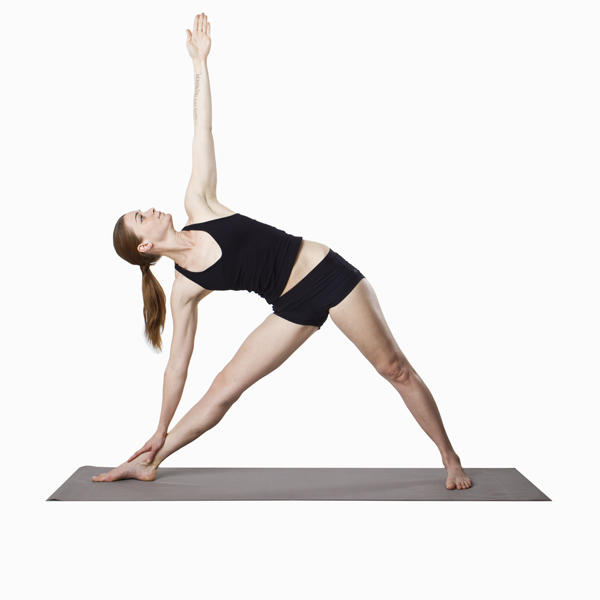
Triangle Pose (Trikonasana): Take warrior pose on your right side without lunging into your knee. Then touch the inside of your right foot with the outside of your right hand. Reach up to the ceiling with your left hand. Turn your gaze toward and pass your left hand to stretch your back. Don’t forget to repeat it on the other side.

Upward Facing Dog (Urdhvamukhasvanasana): Lie face down on the floor with your thumbs under shoulders, legs extended with the top of your feet on the floor. Tuck your hips downward as you squeeze your glutes. Keeping your shoulders down, push up and lift your chest off the ground. Relax and repeat.

Pigeon Pose (Ekapadarajakapotasana): Start in a push-up position, your palms under your shoulders. Place your left knee on the floor near your shoulders with your left heel by your right hip. Press your hands to the floor and sit back with your chest lifted. You can also lower your chest closer to the floor for a stretch. Try it on the other side.

Child’s Pose (Balasana): Sit up comfortably on your heels. Roll your torso forward, bringing your forehead to rest on the bed in front of you. Lower your chest as close to your knees as you comfortably can, extending your arms in front of you. Hold the pose and breathe.

What are you waiting for, get up, plan your day and bring Yoga into your lifestyle and stay stress-free lifelong.

  • « Previous Page
  • 1
  • …
  • 42
  • 43
  • 44
  • 45
  • 46
  • …
  • 55
  • Next Page »

Search

Recent Posts

  • India Leads in Longevity: GOQii Sanjeevini Named Top 40 in $101M XPRIZE
  • The Importance Of Knowing If You’re Thirsty Or Hungry
  • Best Foods To Alleviate Irritable Bowel Syndrome
  • ALL ABOUT VERTIGO!
  • PCOS and Anxiety: Discover Relief with the 54321 Technique

Stay Updated

Archives

  • December 2025 (8)
  • November 2025 (15)
  • October 2025 (20)
  • September 2025 (6)
  • August 2025 (6)
  • July 2025 (12)
  • June 2025 (18)
  • May 2025 (16)
  • April 2025 (23)
  • March 2025 (23)
  • February 2025 (22)
  • January 2025 (26)
  • December 2024 (26)
  • November 2024 (25)
  • October 2024 (22)
  • September 2024 (24)
  • August 2024 (31)
  • July 2024 (21)
  • June 2024 (26)
  • May 2024 (31)
  • April 2024 (27)
  • March 2024 (29)
  • February 2024 (26)
  • January 2024 (25)
  • December 2023 (15)
  • November 2023 (11)
  • October 2023 (20)
  • September 2023 (22)
  • August 2023 (20)
  • July 2023 (22)
  • June 2023 (24)
  • May 2023 (24)
  • April 2023 (24)
  • March 2023 (23)
  • February 2023 (20)
  • January 2023 (16)
  • December 2022 (12)
  • November 2022 (15)
  • October 2022 (15)
  • September 2022 (12)
  • August 2022 (10)
  • July 2022 (17)
  • June 2022 (11)
  • May 2022 (10)
  • April 2022 (6)
  • March 2022 (6)
  • February 2022 (13)
  • January 2022 (12)
  • December 2021 (7)
  • November 2021 (3)
  • October 2021 (6)
  • September 2021 (3)
  • August 2021 (8)
  • July 2021 (7)
  • June 2021 (15)
  • May 2021 (16)
  • April 2021 (10)
  • March 2021 (7)
  • February 2021 (4)
  • January 2021 (4)
  • December 2020 (3)
  • November 2020 (4)
  • October 2020 (10)
  • September 2020 (3)
  • August 2020 (3)
  • July 2020 (2)
  • June 2020 (4)
  • May 2020 (10)
  • April 2020 (12)
  • March 2020 (10)
  • February 2020 (4)
  • January 2020 (4)
  • December 2019 (3)
  • November 2019 (7)
  • October 2019 (5)
  • September 2019 (4)
  • August 2019 (9)
  • July 2019 (9)
  • June 2019 (11)
  • May 2019 (4)
  • April 2019 (9)
  • March 2019 (8)
  • February 2019 (9)
  • January 2019 (8)
  • December 2018 (9)
  • November 2018 (3)
  • October 2018 (3)
  • September 2018 (5)
  • August 2018 (10)
  • July 2018 (6)
  • June 2018 (13)
  • May 2018 (8)
  • April 2018 (18)
  • March 2018 (9)
  • February 2018 (8)
  • January 2018 (15)
  • December 2017 (12)
  • November 2017 (19)
  • October 2017 (13)
  • September 2017 (15)
  • August 2017 (4)
  • July 2017 (8)
  • June 2017 (7)
  • May 2017 (6)
  • April 2017 (8)
  • March 2017 (6)
  • February 2017 (7)
  • January 2017 (9)
  • December 2016 (10)
  • November 2016 (7)
  • October 2016 (7)
  • September 2016 (7)
  • August 2016 (11)
  • July 2016 (9)
  • June 2016 (9)
  • May 2016 (12)
  • April 2016 (17)
  • March 2016 (17)
  • February 2016 (8)
  • January 2016 (6)
  • December 2015 (2)
  • November 2015 (9)
  • October 2015 (7)
  • September 2015 (9)
  • August 2015 (11)
  • July 2015 (9)
  • June 2015 (12)
  • May 2015 (9)
  • April 2015 (13)
  • March 2015 (8)
  • February 2015 (5)
  • January 2015 (12)
  • December 2014 (14)
  • November 2014 (11)
  • October 2014 (6)
  • September 2014 (13)
  • August 2014 (12)
  • July 2014 (6)
  • June 2014 (2)
  • May 2014 (7)
  • April 2014 (5)

From “Laddu Nawin” to Fit and Fierce: How a 25-Year-Old Insurance Advisor Shed 20 Kilos and Gained His Life Back

When 25-year-old Nawin Yadav from Hyderabad walked into his office every morning, he carried more than just his files and policy papers. He had the weight of fatigue, sluggish energy, and an ever-growing belly that was becoming the butt of jokes. “People … [Read More...]

“I’ve Challenged Myself to Live 100 Years” – The Story of Chandubhai Savani’s Second Chance at Life

At 67, most people start slowing down. Not Chandubhai Savani. A resident of Surat, Chandubhai, thought life was on track. “My life was going well till I had my bypass surgery,” he says. That surgery, back in 2021, was a wake-up call.  Medication was routine, but exercise wasn’t. His diet? What he calls ‘normal.’ “I […]

From Shimla’s Slopes to Chandigarh’s Sidewalks: Surinder Kaur Bhalla’s Journey from Chaos to Control

Some journeys start with a plan. Others begin with a stumble literally. Surinder Bhalla, a government professional, born and raised in the scenic hill town of Shimla, had always lived a life of movement. “In Shimla, you walked everywhere,” she reflects. “Walking was never an exercise. It was just life.” But after shifting to Chandigarh, […]

Ananda Mukherjee Health Story

From Terminal Illness To Complete Wellness! Ananda Mukherjee Health Story

As we observe World Cancer Day under the powerful theme ‘United by Unique’ (2025-2027)**, we are reminded that every individual’s journey with cancer is distinct, yet united by shared resilience, hope, and the collective fight against this disease. This theme places people at the centre of care and their stories at the heart of the […]

  • HOME
  • HEALTHY LIVING
  • FITNESS
  • HEALTHY RECIPES
  • USER STORIES
  • KARMA
  • BUY GOQii

Copyright ©2016 GOQii


