GOQii

Blog

  • HOME
  • HEALTHY LIVING
  • FITNESS
  • HEALTHY RECIPES
  • USER STORIES
  • KARMA
  • BUY GOQii

July 3, 2018 By Urvashi Malhotra - GOQii Coach 1 Comment

Role of social media / internet on our kid’s lifestyle and habits

social-media

Recently a girl came to me for consultation, asking specifically for a weight reduction diet. You will be surprised to know that the girl is just about 15 years old and yet to appear for her 10th-grade examination and can easily pass off as being on the heavier side (obese). While I was talking to her, she casually happened to mention that she has a habit of “munching snacks late at night while surfing the internet”. My observation says that this has become a common trend in today’s times.

Social media is now used for a host of different reasons and gone beyond just social interaction. It’s extended to information and even to seek entertainment. A life without internet seems next to impossible and unimaginable, but an excess of anything is bad and that is quite visible in the society in the recent times.

Social networking sites like Facebook, Instagram, Twitter are increasingly becoming popular among adolescents. Numerous studies have shown that Internet addiction has an adverse effect on several lifestyle-related factors in adolescents. Some important ill effects of the same are:-

  • Irregular dietary habits
  • Physical inactivity
  • Increased use of alcohol and tobacco
  • Adverse impact on the growth and development
  • Indirect negative effects through sleep deprivation
  • Obesity

Studies have shown that people are more likely to have meals while sitting at the computer than at the dining table. Majority of people are multitasking by working on different things at the same time such as eating food while surfing on internet, chatting with friends (Facebook) and writing emails etc. This multitasking is making us less efficient and productive.

Children are socializing through media channels and direct communication has now become limited. I know of a boy who is a champion in some of the online games while he simply hates to play anything in its physical form. He can almost be termed as a “couch potato” at the age of 8, which is very harmful for his overall development. Today, there is an increase in Child, Teenage and adult obesity than ever before. Excess weight issues or Obesity increases the risk of many other chronic diseases such as diabetes and cardiovascular diseases.

Research indicates that the light from the screens of TV/computer affects melatonin production, a key hormone in the body’s clock, or circadian system. This causes sleep deprivation as it interrupts deep, restorative sleep eventually causing an increase in stress and depressive symptoms. Thus, teaching adolescents to develop healthy eating habits is of critical importance.

Parents should act as a role model for their children by adopting a healthy lifestyle themselves. Providing nutritious meals and snacks, daily physical activity, and nutrition education can prevent many a life style disorders. Also meal time should be the family time as it provides children great opportunity to learn about healthy foods, balanced meals, and table manners and offers good time to spend with family. Parents should be vigilant on the use of internet by their children. To avoid the conflicts clear guidelines should be set regarding the time of the day your child is allowed to be online and for how long.

June 29, 2018 By Trupti Hingad 3 Comments

Four pillars to lead a healthy and happy life

yoga-for-healthy-happy-living Recently, I had published a blog on how certain yoga asana, if followed with some attitude, can tune your behaviour and imbibe good qualities in you. If you have not read that blog here is the link to the same https://goqii.com/blog/best-yoga-poses-with-attitudes/

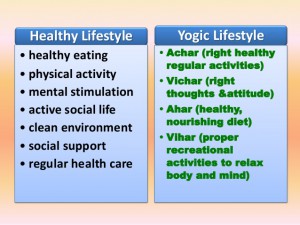
Having said that yoga is not about asana alone and pranayama, yoga is a way of life. Good health depends on the long-term commitment and the foundation for that needs to be built on four important pillars. According to the World Health Organization (WHO), health is state of physical, mental and social well being.

The Four Pillars of a healthy lifestyle is AHAR (Food), VIHAR (Recreation), ACHAR (Routines), VICHAR (Thoughts)

  1. The first Pillar is AHAAR

AHAR means food. “Annam Brahma—means the food is Brahman (Lord of creation). There is an old adage which says, “As the food so the mind, As the mind so the Man”. This saying depends on what you eat, how you eat and when you eat. Every bite you put in your mouth counts for your well being and lifespan, but this does not mean you start binge eating. Eating in moderation is key to maintain a healthy life.

According to Ayurveda, our food is categorized into three segments: Sattvik, Rajasic, Tamasic,

Satvik food is very simple food and gives loads of energy and keeps the mind stable. This food type includes Milk and milk products fresh fruits, dry fruits, seasonal veggies, unrefined cereals, pulses, spices like ginger, pepper, turmeric, cumin, honey, jaggery, Ghee, and oil

Rajasic food creates a restless state of mind. These foods are difficult to digest like non-veg, non-sprouted beans and pulses, garlic, onion, unseasonal veggies and salt.

Tamasic food creates a lethargic state of mind. This includes food which is stale or cooked over a long period. All refined, processed, artificial flavoured foods, deep-frozen foods, pickles, jams, beverages, deep-fried foods, liquor, tobacco, drugs.

The ancient literature says, “One should break one’s night long fast at the time of sunrise and end ones last meal at the time of sunset”. Going by what our ancient literature says, we all know BREAKFAST should be our first meal and that should be king sized. Whatever, we eat in the morning is absorbed and assimilated to the maximum. Food taken during the lunch should be easily digestible and dinner should be the lightest meal of the day.

When you eat food. Your state of mind will decide how food is going to be utilised by the body. Eat your meals with full concentration. Chew your food well and enjoy the subtle taste of each food items. Most important avoid using mobile or watch TV while eating food.

  1. The second pillar is VIHAR

Vihar means recreation. The literal meaning is moving or walking. Stress is a common factor these days. Everybody is stressed on a day to day basis and the reasons for stress can vary and spend time with oneself is a big task. Recreation, relaxation and enjoying family time rejuvenates the body and mind. It’s a kind of anti-depressant for us.

Spending some time in activities which you enjoy clears off mind, relieves depression and anxiety, elevates your mood and gives a feeling of well being.

Active creative hobbies like gardening, painting, playing musical instruments engage all sensory organs and releases pent-up emotions and recharges the mind. Playing sports is another way of relaxing body and mind.

Relaxation is the cornerstone of well-balanced personality. Maintain the relaxed attitude throughout the day. Relaxation is an art which needs to be cultivated. It is important for our body, emotions and our nervous system. Regular exercise or relaxation keeps you fit and keeps disorders at bay.

  • The Third pillar is ACHAR—(Routine)

How often is it that your day goes unplanned and you get hassled with too much work in the day? Our mental health and being are dependent on better routines (achaar). Regularity and sincerity are two major components of a good routine. The best example of following a routine is the SUN-It rises and sets daily without any excuse.

Plan your day in advance. Incorporate all necessary task for self, work, food, recreation and sleep. The solutions to many of our difficulties in life lie in setting out right habits and right routines. Dr Abdul Kalam had said, “You cannot change your future but you can change your habits and your habits will surely change your future”

  1. The fourth pillar is VICHAAR (Thoughts)

Our intellectual health is rightly dependent on how we think. Our thoughts are food for our mind. Buddha says, “Based on your thinking you become the person you are”. If you think you are weak, you will be weak. If you think you are strong, you will be strong. Manage your thought process correctly. Always develop a good attitude and enlarge your vision.

Good thoughts process can be added in daily life by reading good books, scriptures, attending Satsang (religious discourses), reciting holy mantras, observing rituals, recollecting good experiences and thinking positive in all situations.

So let me share a quick small recipe for happiness with you.  If you add this in your life this might add spark to your life.

Recipe for Happiness:

Ingredients:

2 heaped cup of patience

1 heart full of love

2 hands full of generosity

1 hand full of understanding

Method:

Mix all the ingredients, sprinkle generosity and kindness

Add faith and mix well.

Add a dash of laughter. Spread over a period of time

Serve smilingly to everyone you meet to spread happiness.

Have a healthy, Happy life ahead!


June 28, 2018 By Samar Hafeez 7 Comments

Reduce Anxiety, Sleep Sound

anxiety1

Anxiety and Fear are a part of life. You may feel anxious before you take a test or walk a dark street. This kind of anxiety is useful as it can make you more alert, careful and productive, however, it usually ends soon after you are out of the situation that caused it. But, for millions of people, the anxiety does not go away and gets worse over time. This can make one, more restless, clumsy and unproductive thereby causing dysfunction in daily activities, and ultimately begins to take over lives.

Anxiety has plagued millions around the world from time immemorial. Anxiety is defined as a feeling of excessive worry, nervousness or unease about something. In this people are always preoccupied with ‘what- if’ thinking, what if something bad, dangerous or threatening could happen, what if anything bad happens to someone I love etc.

Symptoms of Anxiety:

Physical symptoms include:

  • Muscle tension, Muscle Twitching
  • Chronic indigestion, constipation, Diarrhoea
  • Increased or heavy breathing
  • Hyperventilation/Palpitations
  • Nausea
  • Cold chills, Hot flash, Frequent urination, sudden weight loss, headaches

Emotional symptoms include:

  • Feeling of dread, feeling tense and jumpy
  • Irritability
  • Restlessness
  • Sleep problems
  • Panicky most of the time

Cognitive symptoms:

  • Poor concentration Negative thoughts and Apprehension
  • Confusion
  • Poor communication, attention and memory skills

Now let’s move on to discuss how Anxiety may cause sleep problems

Many of us toss and turn and watch the clock when we can’t sleep for a night or two. But for some, a restless night is routine.

The growing cases of sleep disorders due to anxiety are not to be ignored. Indian women outnumber men when it comes to disturbed sleep due to anxiety.

Anxiety and sleep have a bidirectional relationship, meaning high amounts of anxiety tends to disrupt sleep and disruptions in sleep tend to increase anxiety.

In case of Anxiety, it begins in anticipation of an event. When you reflect on a stressful event at night, the emotional centres of brain namely Amygdala and Insular cortex get activated. This stimulates a chain of events that raise both your adrenaline and blood sugar levels. This sudden source of energy then keeps you alert, tense and restless. Ultimately disrupting your sleep.

Sleep on other hand is an integral part of emotional regulation. A lack of it leaves your emotions unstable and in disarray. You are more prone to falling sick often, show irritability and lack of patience and discontent often.

What your Anxiety at night may look like

An individual usually experiences either racing or stagnant/fixed anxious thoughts. These thoughts build on each other or spiral around making it harder and harder to fall asleep.

Some people describe this feeling as being stuck in their head.

Due to the consistent rise in adrenaline and cortisol (stress hormone) levels more and more physical symptoms may result.

Reduce Anxiety

  1. Melt Anxiety with mindfulness meditation: Focusing on your breath and physical sensations can help you stay in the present moment. This can help you recognize what your thoughts may be, allowing them to pass without reaction or judgement.
  2. Rationalize and not Awfulize: Accept the what if thinking as a projection that connects horrifying thoughts and images to anxiety. Think that a what if disaster does not validate or guarantee a disaster, Awfulizing things real or imagined situations as horrible, Awful or terrible will only make symptoms worse
  3. The shift from passive to active perspective: Talk to yourself in a realistic self- assuring way
  4. Relax your body Relax your mind: Practice Diaphragmatic breathing these exercises are simple to learn and can have relatively quick effects. This technique involves breathing in a way that your belly expands as you breathe in and contracts as you breathe out. Psychologist Jon Carlson describes belly breathing as a technique that can send calming signals to the brain and promote a feeling of relaxation and improved attention and awareness.
  5. Imagination and Relaxation: Rolodex of anxiety thoughts can be controlled by using Guided imagery, Guided imagery serves to redirect people’s attention away from what is stressing them and towards an alternative focus, this includes only visualizing pleasant and relaxing image like on a beach or on a serene hill or whatever may soothe a person. This practice is extremely portable, as it relies on nothing but one’s imagination and concentration abilities.
  6. Exercise: Regular exercise provides an outlet for frustrations and releases mood-enhancing endorphins/hormones
  7. Play music: Soft calming music can lower blood pressure and muscle agitation, usually found symptoms in people who get anxious often
  8. Direct anxiety elsewhere: Lend a hand to relative or neighbour or volunteer in your community services. Helping others will take your mind off your own anxieties and will help you count your blessings.

Sleep More Soundly

  1. Make good sleep a priority: Block out 7 hours for a full uninterrupted sleep
  2. Maintain regularity: Try to sleep and wake up on same time daily even on weekends, this helps circadian rhythm your ‘biological clock’ to tick properly.
  3. Avoid stimulants: Say no-no to alcohol, coffee, chocolate or nicotine post sunset
  4. Keep it cool: sleep in a dark room which is slightly cold, this helps the temperature in the brain to fall and help fall asleep quicker, the cool room takes your brain and body in the right temperature direction to get good sleep.
  5. Dark- deprived society: We need darkness in the evening to allow the release of a hormone called Melatonin(sleep hormone) It helps the healthy time of our sleep. In this modern era, we are severely deprived of darkness. So try to dim lights down in your home an hour before bed. Stay away from LED screens as they emit blue light that actually puts break on melatonin and fools brain into thinking it’s still daytime, even though night time.
  6. Do not stay in bed awake: If you haven’t fallen asleep within 30 mins of getting into bed or have woken up and finding difficult to fall back asleep, the advise is to get up go to another room and in dim light just read a book, no screens, no email checking, NO FOOD. And only when you feel sleepy should you return to bed and that way your brain can actually re-learn the association between bed being a place of sleep, rather than a place to stay awake.
  7. Avoid big meals before bedtime and avoid working out 2 hours before bedtime.
  8. Try magnesium-rich foods/supplements like fish or fish oil, almonds, bananas, pumpkin seeds, warm milk, cherries, mushrooms and dark green leafy veggies in dinner. Magnesium relaxes muscles and easesanxiety1 anxiety which contributes to insomnia
  9. Chamomile magic: Try having a cup of chamomile tea 30 mints before bed chamomile is regarded as a mild tranquillizer and sleep inducer, It relaxes nerves and muscles and help fall sleep quicker.

The power of sleep has always been known to be significant but now there’s more and more evidence demonstrating just how important it is for those who experience anxiety. By using above mentioned techniques you can hope for relief from anxiety and eventually will sleep your anxiety away!


June 27, 2018 By Vinod Kumar 25 Comments

Top 5 Health Benefits of Himalayan Single Clove Garlic

himalayan Clove

At Naturally Yours over the years I have met and spoken to hundreds of farmers, collectors and farm product distributors.

If I had to point out one thing that has always amazed me, it is the diverse agricultural heritage that we have across our country. Each region has a “gem” hidden away.

And yet they exist due to the strong knowledge and commitment that our farming community has towards preserving these little-known herbs and plants.

One such product that I came across a couple of years ago was the Himalayan Single Clove Garlic or the Snow Garlic or the Kashmiri Garlic (as this is found commonly in the Kashmir region of India) as it is popularly referred to as.

When I first saw this single clove garlic I was astonished at this small pointy somewhat lotus-like structure with a hard surface and pungent smell.

I clearly remember asking the farmer where the rest of the garlic is! The farmer calmly explained, Sir, this is all of it!

Himalayan Single Clove Garlic is one of the most potent herbs in the world and is known to be 7 times more potent than the normal Garlic.

7 Times! That blew my mind!

So I did my research to dig out all the facts & health benefits of this amazing herb.

  1. Reduces High Cholesterol Levels

Himalayan Single Clove Garlic is known to effectively reduce high cholesterol levels in the body. Research shows that garlic can lower about 20 mg/dl Cholesterol and Triglyceride levels in human body.

A popular recipe is to peel 3 or 4 cloves of garlic and have it on an empty stomach.

  1. Cures Cold & Cough

Scientist say Himalayan single clove garlic helps reduce the risk of getting cold and cough by over 50% when regularly consumed. In addition, it also reduces the chances of getting infected by other diseases. The presence of chemical compounds called Alliinase and Alliin helps create a powerful compound called Allicin when the bulbs are crushed or ground.

These powerful compounds help to alleviate cold and cough.  A syrup which is made of 2 bulbs crushed together and put in glass water and consumed is known to cure a cold and cough.

  1. Helps Fight Cancer 

Garlic inherently contains an organosulphur compound named diallyl trisulfide which helps fight cancer by helping the body to kill the cancerous cells. Researchers at the University of North Carolina have found that patients who consume garlic have a 66.67% per cent lesser probability to get cancer.

The National Cancer Institute says that consumption of garlic regularly reduces the risk of various cancers by 50% (average). This they attribute to the sulphur compound which helps to fight the cancerous cells in the body.

  1. Fights Diabetes

Researchers have found that consumption of 2-3 bulbs Himalayan Single Clove Garlic regularly helps decrease and control blood sugar levels. The presence of Allicin when combines with Vitamin B and Thiamine triggers the pancreas to generate insulin in the body. This, in turn, helps the body to fight diabetes effectively.

  1. Cures Heart Disease & High Blood Pressure

Himalayan Single Clove Garlic helps fight Heart Disease in two ways. One it reduces the LDL Cholesterol and the triglycerides in the body. Studies have shown that patients consuming garlic have up to 20% less LDL Cholesterol and triglycerides.

Second, it prevents the formation of plaque and clots by reducing the density of the blood. Scientists are of the view that patients consuming garlic regularly are 83% less prone to harmful blood clots.

In case of High Blood Pressure consumption of Himalayan Single Clove Garlic helps muscles relax and thereby help in reducing blood pressure levels.

A chemical compound called Hydrogen Sulfide present in garlic helps create this magic, which reduces the systolic and diastolic blood pressure in the body.

If you know of any more health benefits than the ones mentioned above please do share in the comments section below.

Ps Note: Himalayan Clove Garlic is available in GOQii Store

  • « Previous Page
  • 1
  • …
  • 36
  • 37
  • 38
  • 39
  • 40
  • …
  • 78
  • Next Page »

Search

Recent Posts

  • Navigating the Maze of Nutrition: Finding Clarity Amidst Confusion
  • Get children active and keep them healthy
  • What Gestational Diabetes Can Do To You & Your Unborn Child
  • Breathing – A Forgotten Art
  • The Incredible Benefits Of Milk You Might Not Know

Stay Updated

Archives

  • December 2025 (3)
  • November 2025 (15)
  • October 2025 (20)
  • September 2025 (6)
  • August 2025 (6)
  • July 2025 (12)
  • June 2025 (18)
  • May 2025 (16)
  • April 2025 (23)
  • March 2025 (23)
  • February 2025 (22)
  • January 2025 (26)
  • December 2024 (26)
  • November 2024 (25)
  • October 2024 (22)
  • September 2024 (24)
  • August 2024 (31)
  • July 2024 (21)
  • June 2024 (26)
  • May 2024 (31)
  • April 2024 (27)
  • March 2024 (29)
  • February 2024 (26)
  • January 2024 (25)
  • December 2023 (15)
  • November 2023 (11)
  • October 2023 (22)
  • September 2023 (22)
  • August 2023 (20)
  • July 2023 (22)
  • June 2023 (24)
  • May 2023 (24)
  • April 2023 (24)
  • March 2023 (23)
  • February 2023 (20)
  • January 2023 (16)
  • December 2022 (12)
  • November 2022 (15)
  • October 2022 (15)
  • September 2022 (12)
  • August 2022 (10)
  • July 2022 (17)
  • June 2022 (11)
  • May 2022 (10)
  • April 2022 (6)
  • March 2022 (6)
  • February 2022 (13)
  • January 2022 (12)
  • December 2021 (7)
  • November 2021 (3)
  • October 2021 (6)
  • September 2021 (3)
  • August 2021 (8)
  • July 2021 (7)
  • June 2021 (15)
  • May 2021 (16)
  • April 2021 (10)
  • March 2021 (7)
  • February 2021 (4)
  • January 2021 (4)
  • December 2020 (3)
  • November 2020 (4)
  • October 2020 (10)
  • September 2020 (3)
  • August 2020 (3)
  • July 2020 (2)
  • June 2020 (4)
  • May 2020 (10)
  • April 2020 (12)
  • March 2020 (10)
  • February 2020 (4)
  • January 2020 (4)
  • December 2019 (3)
  • November 2019 (7)
  • October 2019 (5)
  • September 2019 (4)
  • August 2019 (9)
  • July 2019 (9)
  • June 2019 (11)
  • May 2019 (4)
  • April 2019 (9)
  • March 2019 (8)
  • February 2019 (9)
  • January 2019 (8)
  • December 2018 (9)
  • November 2018 (3)
  • October 2018 (3)
  • September 2018 (5)
  • August 2018 (10)
  • July 2018 (6)
  • June 2018 (13)
  • May 2018 (8)
  • April 2018 (18)
  • March 2018 (9)
  • February 2018 (8)
  • January 2018 (15)
  • December 2017 (12)
  • November 2017 (19)
  • October 2017 (13)
  • September 2017 (15)
  • August 2017 (4)
  • July 2017 (8)
  • June 2017 (7)
  • May 2017 (6)
  • April 2017 (8)
  • March 2017 (6)
  • February 2017 (7)
  • January 2017 (9)
  • December 2016 (10)
  • November 2016 (7)
  • October 2016 (7)
  • September 2016 (7)
  • August 2016 (11)
  • July 2016 (9)
  • June 2016 (9)
  • May 2016 (12)
  • April 2016 (17)
  • March 2016 (17)
  • February 2016 (8)
  • January 2016 (6)
  • December 2015 (2)
  • November 2015 (9)
  • October 2015 (7)
  • September 2015 (9)
  • August 2015 (11)
  • July 2015 (9)
  • June 2015 (12)
  • May 2015 (9)
  • April 2015 (13)
  • March 2015 (8)
  • February 2015 (5)
  • January 2015 (12)
  • December 2014 (14)
  • November 2014 (11)
  • October 2014 (6)
  • September 2014 (13)
  • August 2014 (12)
  • July 2014 (6)
  • June 2014 (2)
  • May 2014 (7)
  • April 2014 (5)

From “Laddu Nawin” to Fit and Fierce: How a 25-Year-Old Insurance Advisor Shed 20 Kilos and Gained His Life Back

When 25-year-old Nawin Yadav from Hyderabad walked into his office every morning, he carried more than just his files and policy papers. He had the weight of fatigue, sluggish energy, and an ever-growing belly that was becoming the butt of jokes. “People … [Read More...]

“I’ve Challenged Myself to Live 100 Years” – The Story of Chandubhai Savani’s Second Chance at Life

At 67, most people start slowing down. Not Chandubhai Savani. A resident of Surat, Chandubhai, thought life was on track. “My life was going well till I had my bypass surgery,” he says. That surgery, back in 2021, was a wake-up call.  Medication was routine, but exercise wasn’t. His diet? What he calls ‘normal.’ “I […]

From Shimla’s Slopes to Chandigarh’s Sidewalks: Surinder Kaur Bhalla’s Journey from Chaos to Control

Some journeys start with a plan. Others begin with a stumble literally. Surinder Bhalla, a government professional, born and raised in the scenic hill town of Shimla, had always lived a life of movement. “In Shimla, you walked everywhere,” she reflects. “Walking was never an exercise. It was just life.” But after shifting to Chandigarh, […]

Ananda Mukherjee Health Story

From Terminal Illness To Complete Wellness! Ananda Mukherjee Health Story

As we observe World Cancer Day under the powerful theme ‘United by Unique’ (2025-2027)**, we are reminded that every individual’s journey with cancer is distinct, yet united by shared resilience, hope, and the collective fight against this disease. This theme places people at the centre of care and their stories at the heart of the […]

  • HOME
  • HEALTHY LIVING
  • FITNESS
  • HEALTHY RECIPES
  • USER STORIES
  • KARMA
  • BUY GOQii

Copyright ©2016 GOQii