 A step-by-step guide to help you use your USEMA pen correctly and confidently.
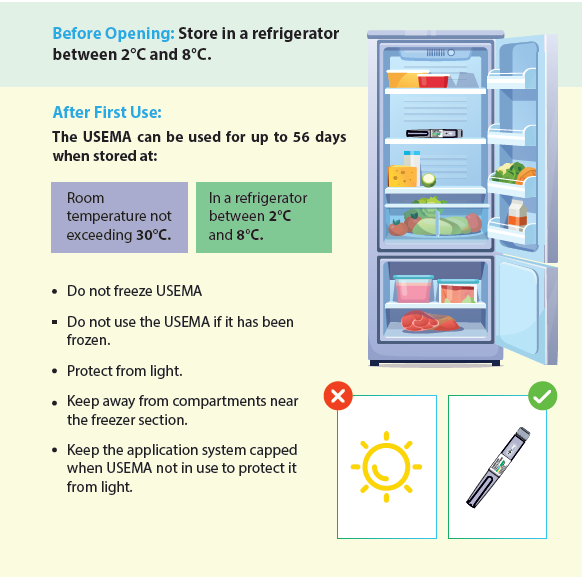
Storage recommendations
Follow these simple steps to keep your medication safe and effective.
INSTRUCTIONS FOR USE
- Read these instructions carefully before using your Semaglutide Injection pen.
- Do not share your Semaglutide Injection pen with other people, even if the needle has been changed. You may give other people a serious infection, or get a serious infection from them.
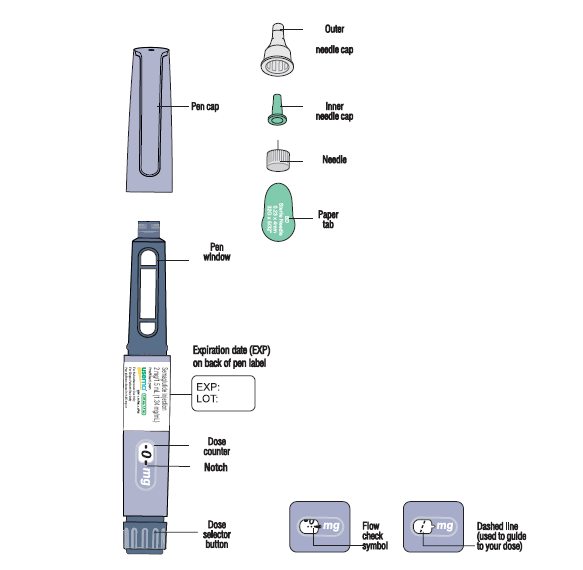
- Start by checking your pen to make sure that it contains semaglutide, then look at the pictures below to know the different parts of your pen and needle.
- Your pen is a prefilled, single-patient-use, dial-a-dose pen.
2 mg USEMA Pen:
- It contains 2 mg of semaglutide, and you can select doses of 0.25 mg or 0.5 mg.
- Each prefilled pen contains 4 doses of 0.25 mg and 2 doses of 0.5 mg or contains 4 doses of 0.5 mg.
4 mg USEMA Pen:
- It contains 4 mg of semaglutide, and you can only select doses of 1 mg.
- Each prefilled pen contains 4 doses of 1 mg.
- Your pen is made to be used with BD Ultra-Fine™.
- BD Ultra-Fine™ 32G 4mm disposable needles are included with your Semaglutide Injection pen.
- Always use a new needle for each injection.
Supplies you will need to give your Semaglutide injection:
- Semaglutide Injection pen
- A new BD Ultra-Fine™ needle
- 1 alcohol swab
- 1 gauze pad or cotton ball
- 1 sharps disposal container for throwing away used Semaglutide Injection pen and needles.
USEMA 2 mg pen and BD Ultra-Fine™ needle
Step 1: Prepare your pen with a new needle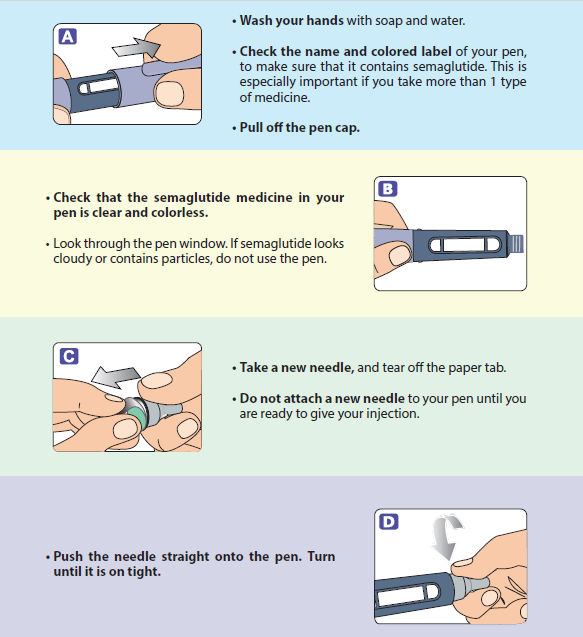
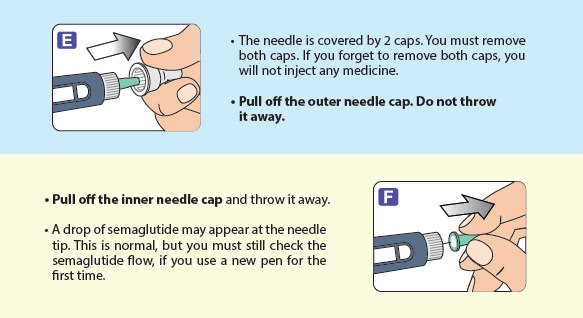
Important points to remember:
- Always use a new needle for each injection. This will reduce the risk of contamination, infection, leakage of semaglutide, and blocked needles leading to the wrong dose.
- Do not reuse or share your needles with other people. You may give other people a serious infection, or get a serious infection from them.
- Never use a bent or damaged needle.
Step 2: Check the semaglutide flow with each new pen
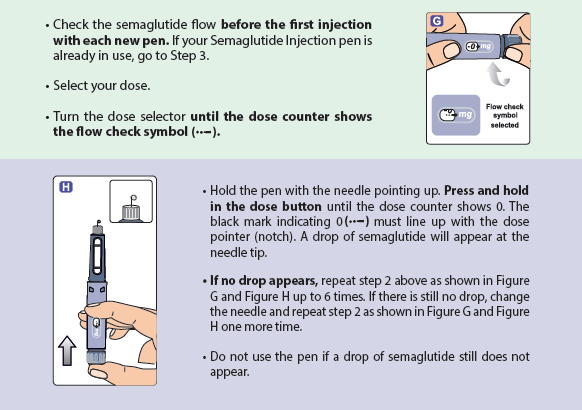
Important points to remember:
- Always make sure that a drop appears at the needle tip before you use a new pen for the first time. This makes sure that semaglutide flows.
- If no drop appears, you will not inject any semaglutide, even though the dose counter may move. This may mean that there is a blocked or damaged needle.
- A small drop may remain at the needle tip, but it will not be injected.
- Only check the semaglutide flow before your first injection with each new pen.
Step 3: Select your dose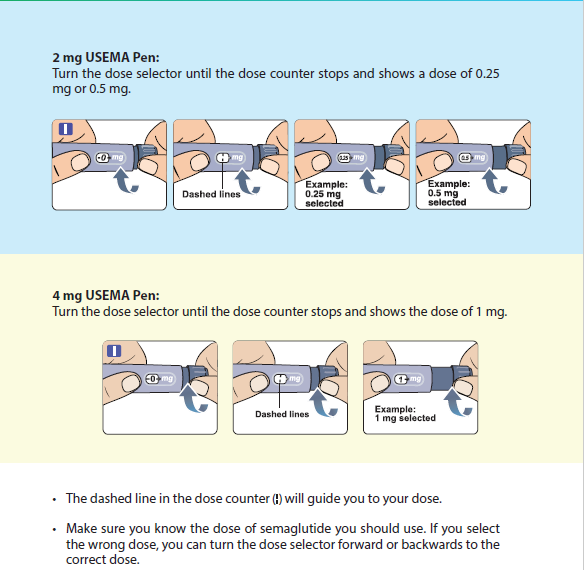
Important points to remember:
- Always use the dose counter and the notch to see how many mg you select.
- You will hear a “click” every time you turn the dose selector. Do not set the dose by counting the number of clicks you hear.
2 mg USEMA Pen
-
- Only doses of 0.25 mg or 0.5 mg can be selected with the dose selector.
- The black mark (••—) indicating the selected doses must appear in the notch to make sure that you get correct dose.
- When your pen contains less than 0.25 mg or 0.5 mg, the dose counter stops before 0.25 mg or 0.5 mg is shown.
4 mg USEMA Pen
-
- Only doses of 1 mg can be selected with the dose selector.
- The black mark indicating the 1 mg must line up exactly with the dose pointer (notch) to make sure that you get the correct dose.
- When your pen contains less than 1 mg, the dose counter stops before 1 mg is shown.
- The dose selector may click differently when turned forward or backward.
- The black mark (••—) indicating the selected dose must appear in the notch to make sure that you get a correct dose.
- Do not count the pen clicks.
How much USEMA is left?
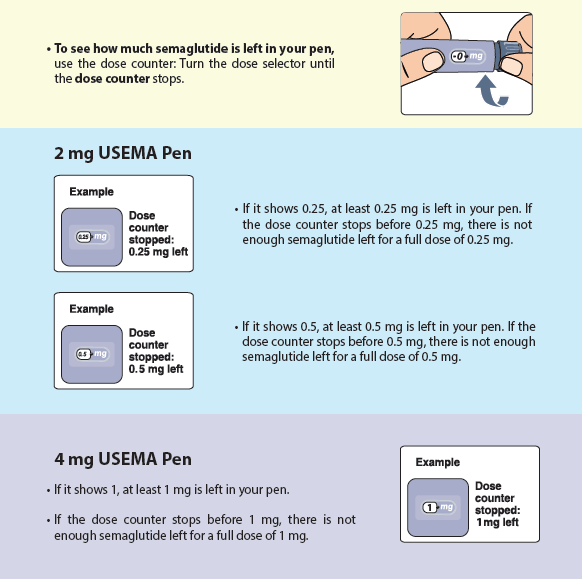
If there is not enough semaglutide left in your pen for a full dose, do not use it. Use a new Semaglutide Injection pen.
Step 4: Inject your dose
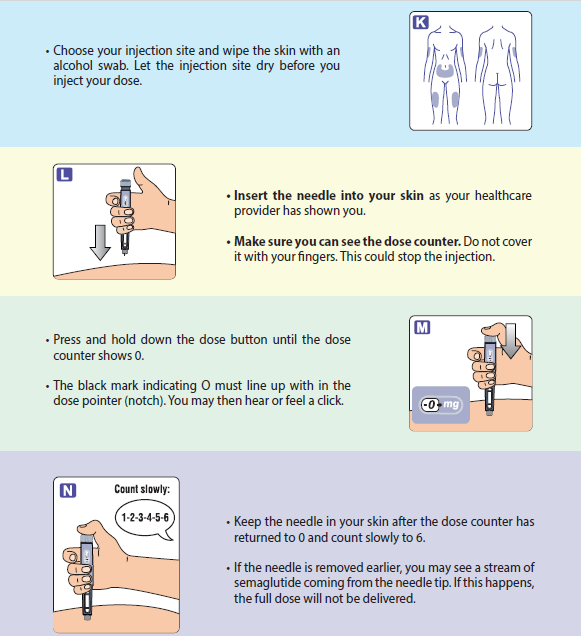
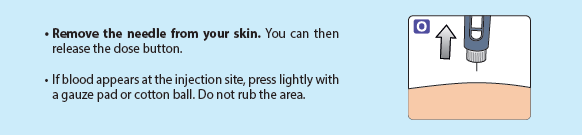
Important points to remember:
- Always watch the dose counter to make sure you have injected your complete dose. Hold the dose button down until the dose counter shows 0.
How to identify a blocked or damaged needle?
- If 0 does not appear in the dose counter after continuously pressing the dose button, you may have used a blocked or damaged needle.
- If this happens you have not received any semaglutide even though the dose counter has moved from the original dose that you have set.
How to handle a blocked needle?
- Change the needle as described in Step 5, and repeat all steps starting with Step 1: “Prepare your pen with a new needle”.
- Never touch the dose counter when you inject. This can stop the injection.
- You may see a drop of semaglutide at the needle tip after injecting. This is normal and does not affect your dose.
Step 5: After your injection
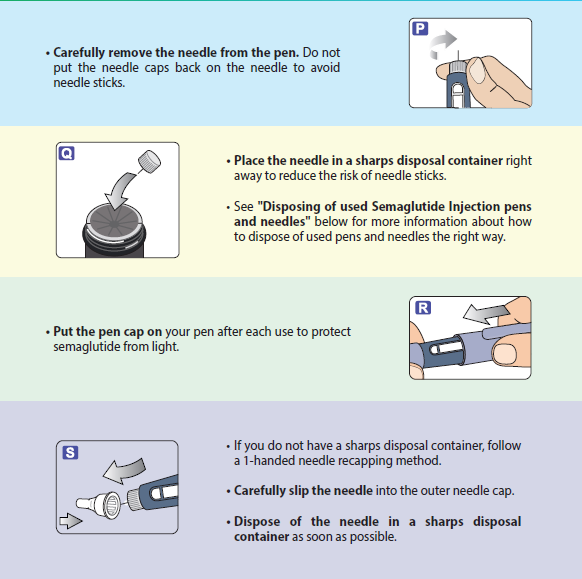
Important points to remember:
- Never try to put the inner needle cap back on the needle. You may stick yourself with the needle.
- Always remove the needle from your pen. This will reduce the risk of contamination, infection, leakage of semaglutide, and blocked needles leading to the wrong dose. If the needle is blocked, you will not inject any semaglutide.
- Always dispose of the needle after each injection.
Disposing of used Semaglutide Injection pens and needles:
- Put your used Semaglutide Injection pen and needle in a sharps disposal container right away after use. If you do not have sharps disposal container, you may use a house hold container that is:
-
- made of a heavy-duty plastic
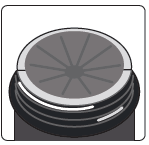
- can be closed with a tight- fitting, puncture resistant lid, without sharps being able to come out
- upright and stable during use
- leak-resistant
- properly labeled to warn of hazardous waste inside the container
- made of a heavy-duty plastic
- When your sharps disposal container is almost full, you will need to follow your community guidelines for the right way to dispose of your sharps disposal container. There may be state or local laws about how you should throw away used needles and syringes.
- Do not dispose of your used sharps disposal container in your household trash unless your community guideline permit this. Do not recycle your used sharps disposal container.
Important points to remember:
- Care givers must be very careful when handling used needles to prevent accidental needle stick injuries and prevent passing (transmission) of infection.
- Never use a syringe to withdraw semaglutide from your pen.
- Always carry an extra pen and new needles with you, in case of loss or damage.
- Always keep your pen and needles out of reach of others, especially children.
- Always keep your pen with you. Do not leave it in a car or other place where it can get too hot or too cold.
Caring for your pen
Do not drop your pen or knock it against hard surfaces. If you drop it or suspect a problem, attach a new needle and check the semaglutide flow before you inject.
- Do not try to repair your pen or pull it apart.
- Do not expose your pen to dust, dirt or liquid.
- Do not wash, soak, or lubricate your pen. If necessary, clean it with mild detergent on a moistened cloth.
#BeTheForce




Leave a Reply