
GOQii

Blog

  • HOME
  • HEALTHY LIVING
  • FITNESS
  • HEALTHY RECIPES
  • USER STORIES
  • KARMA
  • BUY GOQii

Search Results for: nutrition

March 8, 2026 By GOQii Leave a Comment

Accelerate Action for Your Health: Why Self-Care Matters This International Women’s Day

Every year, International Women’s Day is an opportunity to celebrate progress and reflect on the work that still needs to be done to achieve gender equality.

The 2026 theme, championed by UN Women, calls on individuals, institutions and communities around the world to Accelerate Action toward gender equality.

While policy change, education and economic opportunity remain critical drivers of equality, one powerful yet often overlooked area where women can accelerate progress is their own health and well-being.

Prioritising self-care for women’s health is not a luxury. It is a foundation for empowerment. When women invest in preventive health, they gain the strength, clarity and resilience needed to lead families, workplaces and communities.

At GOQii, we believe that women’s health empowerment begins with preventive care, mindful living and consistent lifestyle habits.

What Is the International Women’s Day 2026 Theme?

The theme for International Women’s Day 2026 is “Accelerate Action.”

The campaign highlights the urgency of making faster progress toward gender equality by encouraging individuals, organisations and governments to take meaningful steps that support and empower women.

One of the most powerful ways women can accelerate progress in their own lives is by taking proactive steps to protect and strengthen their health.

After all, sustainable empowerment requires energy, resilience and well-being.

Why Self-Care Matters for Women’s Health

Across cultures and generations, women have often been conditioned to place the needs of others before their own. Between professional responsibilities, caregiving roles and family commitments, personal health frequently moves to the bottom of the priority list.

However, this pattern carries long-term consequences.

Health research consistently shows that many women delay regular health check-ups, ignore early warning signs of stress or burnout, and postpone lifestyle changes because they feel they “don’t have time.”

The reality is simple:

You cannot pour from an empty cup.

Self-care is not selfish. It is strategic. When women invest in their own health, they build the physical and mental capacity needed to support others and pursue their ambitions with confidence.

Accelerating action toward equality must also mean accelerating action toward better health.

3 Ways Women Can Accelerate Action for Their Health

Empowerment does not require drastic transformation. It often begins with small, consistent actions that build long-term resilience.

Here are three practical ways women can prioritise preventive health and strengthen their well-being.

  1. Give to Your Nutrition, Gain Vitality

When life becomes busy or stressful, nutrition is often the first thing to suffer. Quick snacks, processed foods and skipped meals may seem convenient, but they gradually reduce energy levels and affect overall health.

The Action

Focus on simple, balanced meals that prioritise local, seasonal and home-cooked foods. Include a variety of colourful fruits and vegetables, whole grains, healthy proteins and adequate hydration throughout the day.

The Gain

Balanced nutrition improves immunity, stabilises energy levels and helps the body manage stress more effectively. When your body is properly nourished, you gain the vitality needed to handle professional demands, family responsibilities and personal goals without feeling drained.

  1. Give to Your Body, Gain Strength

Physical strength plays a critical role in long-term health, yet it is often underestimated when discussing women’s wellness.

Muscle strength, bone density and mobility help protect the body against lifestyle diseases, injuries and age-related decline.

The Action

Aim for daily movement. Walking 8,000–10,000 steps a day is a great start. Complement this with basic strength training, yoga or resistance exercises two to three times per week.

The Gain

Strength improves metabolism, enhances mobility and reduces the risk of chronic diseases such as diabetes, osteoporosis and cardiovascular issues. Most importantly, it builds physical resilience, allowing you to maintain independence and energy as you age.

  1. Give to Your Mind, Gain Peace

Modern lifestyles often require women to juggle multiple roles simultaneously. Without intentional pauses, this constant pressure can lead to chronic stress, sleep disruption and hormonal imbalance.

The Action

Create boundaries around your personal time. Begin your day with 10–15 minutes of mindfulness, meditation or quiet reflection. Protect your sleep schedule and aim for 7–8 hours of quality rest each night.

The Gain

Mental clarity improves emotional resilience, focus and decision-making. When the mind is calm and balanced, everyday challenges become easier to navigate and productivity naturally improves.

Small Steps Create Powerful Momentum

Accelerating action toward gender equality is a collective effort, but it is also built on individual momentum.

Every healthy choice you make choosing nourishing foods, prioritising movement, protecting your sleep or seeking guidance from a health coach contributes to a stronger foundation for the future.

Empowered women are not defined solely by professional success or social recognition. They are defined by their ability to sustain their energy, nurture their well-being and live with intention.

#BeTheForce: Take Charge of Your Wellness

When women are healthy, energised and supported, they become catalysts for change across families, workplaces and entire communities.

But transformation begins with one simple decision: prioritising your own well-being.

This International Women’s Day, take a moment to reflect on your health journey.

Schedule that pending health check-up.
Step outside for a walk.
Reconnect with your wellness goals.
Speak to your GOQii coach and take the next step toward preventive health.

Small actions today can unlock stronger possibilities tomorrow.

Stay active. Stay healthy. And #BeTheForce.

Disclaimer: The information provided in this blog is for general awareness and educational purposes only. It is not intended to replace professional medical advice, diagnosis, or treatment. Always consult a qualified healthcare provider for personalised medical guidance or concerns related to your health. Images shown are for representation purposes only and may not depict the exact recommendations or outcomes.
February 27, 2026 By Dhwani Bagadia 1 Comment

Leaky Gut: Symptoms and Causes

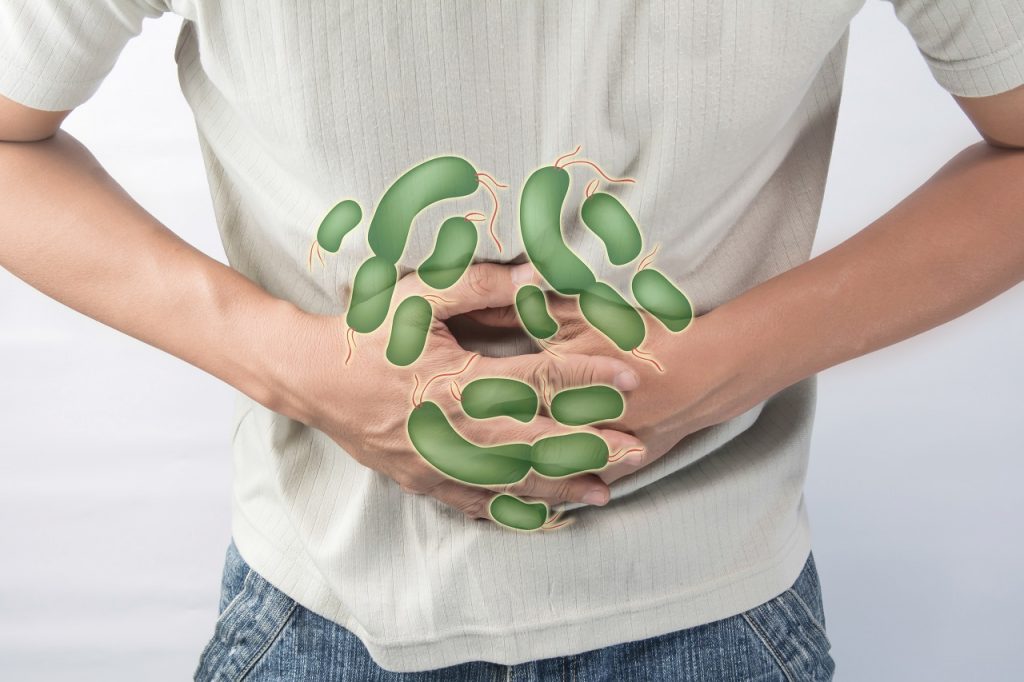
leaky gutThe gut is considered to be the “Gateway to Health”. It consists of approximately 80% of the immune system. 95% of “serotonin”, the “feel-good” hormone, is also produced in the Gut. Healing and improving your gut is of the utmost importance to lead a healthy and happy life. Your gut is responsible for stomach conditions, pain and even eagerness. Poor gut health can cause various issues such as a Leaky Gut.

A Leaky Gut is one of the most puzzling illnesses/diseases to be diagnosed and to get treated. It is a very puzzling disease or illness majorly due to the gut having a very extensive and complex structure. “There is still so much science that proceeds with finding newly developed methods, where the gut can have an impact on the health of the heart to brains being young and active,” says Dr. Alessio Fasano, Director of the Center for Celiac Research and Treatment with Harvard-affiliated Massachusetts General Hospital.

What is Leaky Gut?

The digestive system is where food is broken down and nutrients are absorbed. It also plays a major role in safeguarding your body from detrimental or dangerous substances. The intestinal walls act as a barrier/hurdle to check what is passing into the bloodstream, to be carried to different organs of the body.

Water and nutrients are passed into and out of the small holes (tight junctions) in the walls of the intestine when obstructing the movement of detrimental substances. Intestinal Permeability is defined as an easy passage of the substances through the walls of the intestine. When the small holes (tight junction) of the intestinal wall become loose, the permeability of the gut increases and results in bacteria and toxins passing from the gut into the bloodstream. This event is termed as “Leaky Gut”.  

Due to Leaky Gut, toxins and bacteria enter the blood-stream, resulting in inflammation and activating a reaction from the immunity. Proponents declare that it is one of the major causes of several medical conditions such as chronic fatigue syndrome, migraine, multiple sclerosis, fibromyalgia, food sensitivities, thyroid abnormalities, mood swings, skin conditions, and autism.

Many Health-care professionals say that an increase in the permeability of the intestine occurs in a few chronic diseases. It is a challenge to calculate the strength of an individual’s gut barrier, so it becomes difficult to identify whether a person has a leaky gut and what impact it will have on the body.

Symptoms to Watch Out For

As per Dr. Leo Galland, the director of the Foundation for Integrated Medicine, the symptoms below could indicate a Leaky Gut.

  • Digestive issues such as chronic diarrhea, constipation, gas or bloating or IBS (Irritable Bowel Syndrome)
  • Nutritional Deficiencies such as anemia, omega-3 fatty acids, vitamin deficiencies
  • Excess weight, obesity, diabetes
  • Poor immunity such as frequent cold, flu, and infection. Auto-immune disease such as rheumatoid arthritis, lupus, celiac disease or chron’s disease, Hashimoto’s thyroiditis
  • Brain: Headaches, brain fog and memory loss and Depression/Eagerness/ADHD (Attention Deficient Hyperactive Disorder)
  • Excessive tiredness or fatigue
  • Rashes on skin such as acne, eczema
  • Cravings for refined carbs or sugar
  • Bones: Arthritis or Joint Pain and Osteoporosis
  • Seasonal Allergies or Asthma
  • Imbalance in the hormones such as PMS or PCOD i.e. Pre-menstrual Syndrome and Polycystic Ovarian Syndrome
  • Diagnosis of candida overgrowth
  • Food Allergies, food sensitivities or intolerances

What Causes a Leaky Gut?

There are several factors that can cause a Leaky Gut. Gluten, food, infection and toxins being a few of them. The following factors can also be considered.

  • Food Sensitivities, Candida or yeast over-growth, Parasites, Medications and Drugs
  • Excessive sugar intake and other un-healthy food affect the barrier of the wall of the intestine
  • Non-steroidal anti-inflammatory drugs (NSAID’s): Excess and too much use of NSAID’s like ibuprofen leads to leaky gut due to an increase in the wall of intestinal permeability
  • Excess alcohol intake may also cause intestinal permeability
  • Nutritional Deficiencies: Deficiencies of Vitamins such as A, D and Zinc result in increases intestinal permeability
  • Inflammation: Can also result in the leaky gut
  • Stress: Excess Stress also results in gastro-intestinal disorder, leading to leaky gut
  • Poor Gut Condition: There is a mix of good and harmful bacteria which are almost in millions in the gut. If the balance of the good and harmful bacteria is affected, it can affect the intestinal wall.
  • Yeast Overgrowth: Natural existence of yeast is there in the gut, but excess growth of yeast can lead to leaky gut

Stay tuned and stay healthy. For more topics on Gut Health, click here. If you’re experiencing any of the above symptoms, consult a doctor or speak to our experts for lifestyle changes that will help you heal. 

#BeTheForce

Disclaimer: The information provided in this blog is for general awareness and educational purposes only. It is not intended to replace professional medical advice, diagnosis, or treatment. Always consult a qualified healthcare provider for personalised medical guidance or concerns related to your health.

February 25, 2026 By GOQii Leave a Comment

The Fiber Gap: Managing Digestion on GLP-1 Therapy

One of the most remarkable things about GLP-1 therapy is how it slows down “gastric emptying.” This is the magic behind the feeling of fullness it keeps food in your stomach longer, sending a constant signal to your brain that you are satisfied. However, a slower stomach means your digestive tract needs a different kind of support to keep things moving.
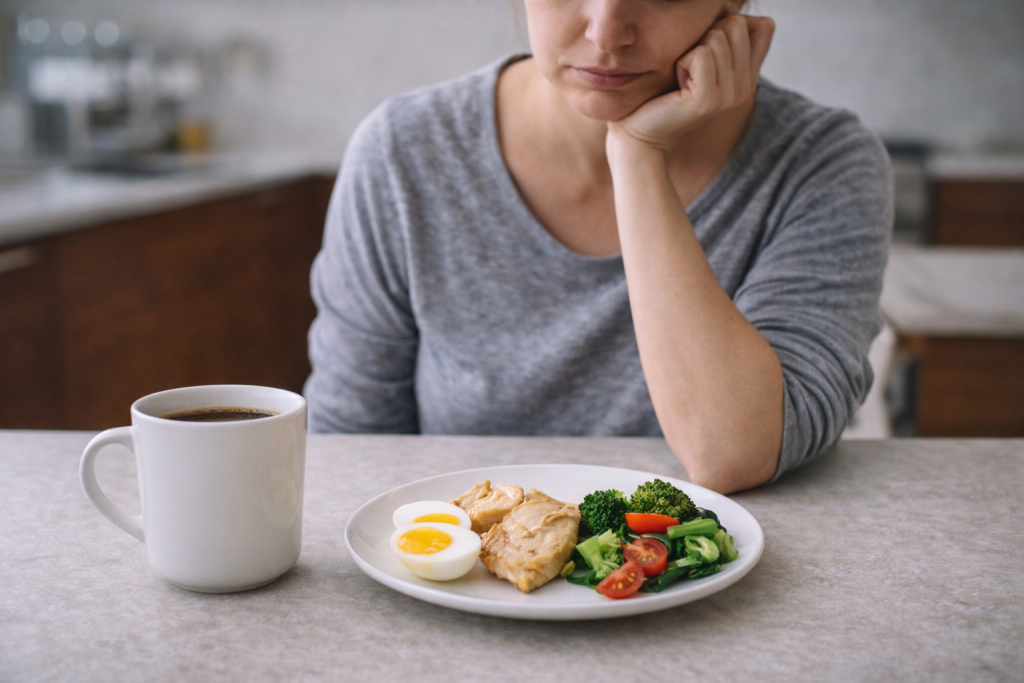
In the world of nutrition, fiber is usually the hero. But when your system is moving at a slower pace, not all fiber is your friend. This is what we call the “Fiber Gap.”

Soluble vs. Insoluble: Know the Difference

On a standard diet, we are told to eat lots of “roughage” think raw kale, bran, and heavy seeds. This is insoluble fiber. It’s like a broom that sweeps through your system. However, when digestion is slowed by GLP-1, too much “broom” can lead to bloating, gas, and discomfort.

Instead, you need to prioritize soluble fiber. This type of fiber dissolves in water to create a gel-like substance. It’s much gentler on a slow-moving gut and helps maintain a healthy microbiome without causing a “traffic jam” in your intestines.

Closing the Gap Safely

To keep your gut happy while on GLP-1 therapy, follow these digestive guidelines:

  • Peeled and Cooked: Raw vegetable skins can be tough to break down. Try peeling your apples and carrots, and steam your greens instead of eating them raw. This “pre-digests” the fiber, making it easier for your stomach to handle.
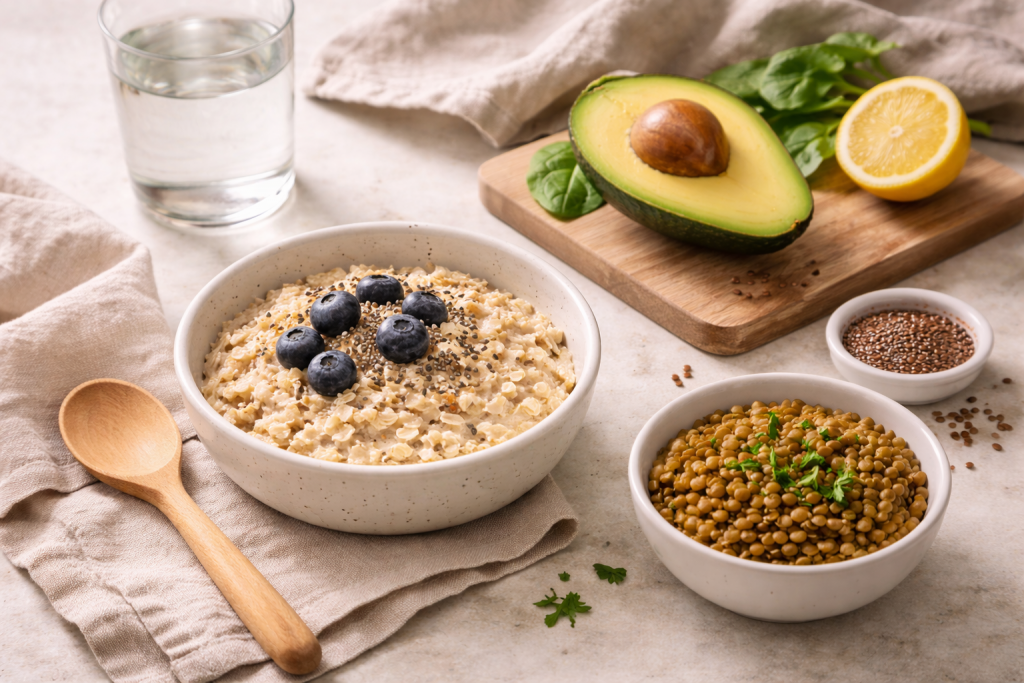
  • Focus on the “Gel” Builders: Incorporate oats, chia seeds, lentils, and avocados. These provide soluble fiber that moves smoothly through the digestive tract.
  • The Hydration Equation: Fiber is a sponge. If you eat fiber without drinking enough water, it will sit in your gut and harden. For every extra gram of fiber you add, make sure you’re adding an extra glass of water.
  • Natural Movement: Gentle movement, like a 15-minute post-meal walk, works in tandem with fiber to encourage “peristalsis” the natural contractions of your intestines.

Tip: If you experience significant slowing, try adding a tablespoon of ground flaxseeds to your morning yogurt. It’s a gentle, natural way to bridge the fiber gap without the bloat.

#BeTheForce

Disclaimer: GOQii is committed to providing accurate, up-to-date, and comprehensive health information. This article is intended for informational purposes only and should not be used as a substitute for professional medical advice, diagnosis, or treatment. Always consult a qualified healthcare professional before starting or changing any medication. Individual responses to treatment may vary.

February 21, 2026 By GOQii Leave a Comment

When Favorites Fade: Navigating Taste and Texture Changes on GLP-1

Have you noticed that your morning cup of coffee, once the highlight of your day, now tastes metallic or overly bitter? Or perhaps the thought of a juicy steak something you used to love now makes you feel slightly uneasy?



If you are on GLP-1 therapy, you aren’t imagining things. This phenomenon is known as “sensory-specific satiety” and texture aversion. It’s a fascinating, albeit sometimes frustrating, part of how your body’s chemistry is being rewritten for the better.

The Brain-Gut Rewiring

GLP-1 is a hormone that talks directly to the “reward center” of your brain (the mesolimbic system). This is the area responsible for cravings and the “pleasure” we get from high-fat or high-sugar foods. When you increase your GLP-1 levels, the brain’s dopamine response to certain foods changes. Essentially, the “volume” on food cravings is turned down.

Because your brain is no longer seeking a “hit” from food, your taste buds become more sensitive. Subtle bitterness or heavy textures that you used to ignore become much more apparent. This is why many people on this journey find themselves gravitating toward “cleaner,” simpler flavors.

Practical Strategies for Sensory Shifts

If you are struggling with taste changes or aversions, use these tactics to stay nourished:

  • Modify Temperatures: Aversions are often linked to the strong aromas of hot food. If a steaming dinner feels overwhelming, try “cold plates.” Chilled chicken salad, Greek yogurt bowls, or cold grain salads are often much better tolerated.
  • The “Neutral” Pivot: If bold flavors are off the table, stick to a “beige but healthy” palette for a few days. Foods like oats, cottage cheese, bananas, and sourdough bread provide nutrition without overwhelming the senses.
  • Hydration Hacks: Many find that plain water starts to taste “different.” Try infusing your water with mint, cucumber, or frozen berries. The subtle change can override the metallic taste some experience.
  • Check Your Zinc Levels: Sometimes, a persistent metallic taste can be linked to mineral shifts. Ensure you’re eating zinc-rich foods like pumpkin seeds or chickpeas, or speak to a coach about a multivitamin.

Tip: Don’t panic if you lose your “joy” for food temporarily. Think of this as a biological “reset button.” You are moving away from emotional eating and toward intuitive, functional nutrition.

#BeTheForce

Disclaimer: GOQii is committed to providing accurate, up-to-date, and comprehensive health information. This article is intended for informational purposes only and should not be used as a substitute for professional medical advice, diagnosis, or treatment. Always consult a qualified healthcare professional before starting or changing any medication. Individual responses to treatment may vary.

  • « Previous Page
  • 1
  • …
  • 8
  • 9
  • 10
  • 11
  • 12
  • …
  • 148
  • Next Page »

Search

Recent Posts

  • Our Kidneys, Our Planet: How Environmental Health Impacts Your Body
  • Caution: Smoking is Injurious to health!!
  • The Sleep-Metabolism Connection: Why Rest is Your Best GLP-1 Partner
  • Accelerate Action for Your Health: Why Self-Care Matters This International Women’s Day
  • 4 Reasons Why Affirmations Are Not Working For You

Stay Updated

Archives

  • March 2026 (5)
  • February 2026 (14)
  • January 2026 (14)
  • December 2025 (19)
  • November 2025 (15)
  • October 2025 (20)
  • September 2025 (6)
  • August 2025 (6)
  • July 2025 (12)
  • June 2025 (18)
  • May 2025 (16)
  • April 2025 (22)
  • March 2025 (23)
  • February 2025 (22)
  • January 2025 (25)
  • December 2024 (22)
  • November 2024 (23)
  • October 2024 (21)
  • September 2024 (24)
  • August 2024 (30)
  • July 2024 (21)
  • June 2024 (26)
  • May 2024 (31)
  • April 2024 (27)
  • March 2024 (29)
  • February 2024 (25)
  • January 2024 (21)
  • December 2023 (15)
  • November 2023 (11)
  • October 2023 (19)
  • September 2023 (22)
  • August 2023 (18)
  • July 2023 (22)
  • June 2023 (24)
  • May 2023 (24)
  • April 2023 (23)
  • March 2023 (23)
  • February 2023 (19)
  • January 2023 (15)
  • December 2022 (11)
  • November 2022 (15)
  • October 2022 (15)
  • September 2022 (12)
  • August 2022 (10)
  • July 2022 (17)
  • June 2022 (11)
  • May 2022 (10)
  • April 2022 (6)
  • March 2022 (6)
  • February 2022 (13)
  • January 2022 (11)
  • December 2021 (7)
  • November 2021 (3)
  • October 2021 (6)
  • September 2021 (3)
  • August 2021 (8)
  • July 2021 (7)
  • June 2021 (15)
  • May 2021 (16)
  • April 2021 (10)
  • March 2021 (7)
  • February 2021 (4)
  • January 2021 (4)
  • December 2020 (3)
  • November 2020 (4)
  • October 2020 (10)
  • September 2020 (3)
  • August 2020 (3)
  • July 2020 (2)
  • June 2020 (4)
  • May 2020 (10)
  • April 2020 (12)
  • March 2020 (10)
  • February 2020 (4)
  • January 2020 (4)
  • December 2019 (3)
  • November 2019 (7)
  • October 2019 (5)
  • September 2019 (4)
  • August 2019 (9)
  • July 2019 (9)
  • June 2019 (11)
  • May 2019 (4)
  • April 2019 (8)
  • March 2019 (8)
  • February 2019 (9)
  • January 2019 (8)
  • December 2018 (9)
  • November 2018 (3)
  • October 2018 (3)
  • September 2018 (5)
  • August 2018 (10)
  • July 2018 (6)
  • June 2018 (13)
  • May 2018 (8)
  • April 2018 (18)
  • March 2018 (9)
  • February 2018 (8)
  • January 2018 (15)
  • December 2017 (12)
  • November 2017 (19)
  • October 2017 (13)
  • September 2017 (15)
  • August 2017 (4)
  • July 2017 (8)
  • June 2017 (7)
  • May 2017 (6)
  • April 2017 (8)
  • March 2017 (6)
  • February 2017 (7)
  • January 2017 (9)
  • December 2016 (10)
  • November 2016 (7)
  • October 2016 (7)
  • September 2016 (7)
  • August 2016 (11)
  • July 2016 (9)
  • June 2016 (9)
  • May 2016 (12)
  • April 2016 (17)
  • March 2016 (17)
  • February 2016 (8)
  • January 2016 (6)
  • December 2015 (2)
  • November 2015 (9)
  • October 2015 (7)
  • September 2015 (9)
  • August 2015 (11)
  • July 2015 (9)
  • June 2015 (12)
  • May 2015 (9)
  • April 2015 (13)
  • March 2015 (8)
  • February 2015 (5)
  • January 2015 (12)
  • December 2014 (14)
  • November 2014 (11)
  • October 2014 (6)
  • September 2014 (13)
  • August 2014 (12)
  • July 2014 (6)
  • June 2014 (2)
  • May 2014 (7)
  • April 2014 (4)

From “Laddu Nawin” to Fit and Fierce: How a 25-Year-Old Insurance Advisor Shed 20 Kilos and Gained His Life Back

When 25-year-old Nawin Yadav from Hyderabad walked into his office every morning, he carried more than just his files and policy papers. He had the weight of fatigue, sluggish energy, and an ever-growing belly that was becoming the butt of jokes. “People … [Read More...]

“I’ve Challenged Myself to Live 100 Years” – The Story of Chandubhai Savani’s Second Chance at Life

At 67, most people start slowing down. Not Chandubhai Savani. A resident of Surat, Chandubhai, thought life was on track. “My life was going well till I had my bypass surgery,” he says. That surgery, back in 2021, was a wake-up call.  Medication was routine, but exercise wasn’t. His diet? What he calls ‘normal.’ “I […]

From Shimla’s Slopes to Chandigarh’s Sidewalks: Surinder Kaur Bhalla’s Journey from Chaos to Control

Some journeys start with a plan. Others begin with a stumble literally. Surinder Bhalla, a government professional, born and raised in the scenic hill town of Shimla, had always lived a life of movement. “In Shimla, you walked everywhere,” she reflects. “Walking was never an exercise. It was just life.” But after shifting to Chandigarh, […]

Ananda Mukherjee Health Story

From Terminal Illness To Complete Wellness! Ananda Mukherjee Health Story

As we observe World Cancer Day under the powerful theme ‘United by Unique’ (2025-2027)**, we are reminded that every individual’s journey with cancer is distinct, yet united by shared resilience, hope, and the collective fight against this disease. This theme places people at the centre of care and their stories at the heart of the […]

  • HOME
  • HEALTHY LIVING
  • FITNESS
  • HEALTHY RECIPES
  • USER STORIES
  • KARMA
  • BUY GOQii

Copyright ©2016 GOQii
