GOQii

Blog

  • HOME
  • HEALTHY LIVING
  • FITNESS
  • HEALTHY RECIPES
  • USER STORIES
  • KARMA
  • BUY GOQii

Search Results for: hormone

July 7, 2016 By Saba Mirza 3 Comments

Are you craving for Sugar?

addicted-to-sugar

If you are someone who is trying to control your urge of eating sweets but, in the end give in and eat them, then this article is apt for you.

To begin with I would like to clear the myth that ‘If you are craving for sweets it means that your body is in dire need of sugar’…this is an absolutely lame excuse by sugar lovers. If that was the case then your body is always in a need of other nutrients, then why don’t you ever crave for fruits, vegetables or cereals and pulses for that matter.

Her are few reasons you just want to grab that chocolate bar

  1. A) After the Meals

Sometimes you crave for sugar even after a filling meal- the reasons might be Habit, Your meal type and the signal from your brain.

HABIT: Studies suggest that regular consumption of sugar and sweets causes changes in your brain’s neurochemical network and it will always remind you to have that sweet even after you have had a complete meal.

MEAL TYPE: Evidence suggest that meals which are rich in carbohydrate tend to make you crave for more sugar rather than the meals rich in proteins and fats.

BRAIN CHEMISTRY: A Carbohydrate rich meal causes high levels of glucose in your body which in turn directs the brain to release ‘serotonin’ which is mood elevating neurotransmitter…it gives your body a sudden high and as the glucose levels from simple carbohydrates settle down immediately, your body again demands for that ‘high’ and as you know simple sugars immediately release glucose in the blood and you tend to binge on that sweet..

-Gradually stop that habit of eating sweets after each meal. Remember don’t do it too hastily otherwise you will end up eating a big bowl of ice cream after some time.

-Do make your meals balanced and rich in variety. Include the right amount of complex carbohydrates like whole grain, good amount of PROTEINS like chicken, fish or pulses and beans and ample amount of vegetables. PROTEINS have a strong ability to stimulate the ‘satiety centres’ of your brain thus giving you a feeling of fullness.

  1. B) WHEN HUNGRY

Being hungry for a long time is one of the major causes behind overeating of that sinful dessert.

SOLUTION you know…eat frequently and have nutritious snacks like fruits, raw vegetables, fruit smoothies, beans salad or chat etc.

  1. C) UNDER STRESS

Stress initiates our body’s ‘fight or flight ‘response…this causes release of glucocorticoids which try to replenish the body’s energy loss during the condition of stress by demanding more sugar.

The other reason is depletion of serotonins in our brain that makes us feel sad and miserable, this in turn triggers the body’s need to have more carbohydrates.

HOW TO FIGHT IT:

-Divert your attention, take deep breaths, take hot shower, go for a walk, read a good book and even after all this if you still feel hungry grab a fruit or munch on those nutritious nuts.

  1. D) YOU ARE CRAVING IT BECAUSE YOU ARE SIMPLY ADDICTED:

This is a never ending vicious cycle…you eat sugary food–tastes good, instant, brain is ‘happy’–Blood sugar spikes fast–hormones released in the blood to control this sudden increase in sugar levels–>Blood sugar drops rapidly–>insulin notices the sudden low in sugar levels–>Body takes the signal that it’s ‘starving’ and demands glucose–>Cravings restart.

NO,,that doesn’t mean that you are helpless 😉

HOW TO FIGHT:

-Keep yourself full-keep munching on nuts, dates, low fat cheese slices, fruits and vegetables like cucumber. This will help to not think about about that chocolate bar.

-Leave it gradually: Start having a small piece from that chocolate bar or a small scoop of your favorite ice cream whenever u feel that urge. This way you will not push your body into sudden deprivation

-Combine them: combine your favourite desert with some healthier options. Such as dip few apple slices in chocolate syrup or mix in fruits in your favourite ice cream

-Remove them away from your sight: Don’t keep any sweets in your purse, in your office desk or in your fridge.

-Make them healthier like have a whole wheat pancake sweetened with honey or fruit smoothie (sweeten it with honey or dates) or have fruit cream (with low fat cream).

So don’t give up and have a healthy and sweet life. To know more about GOQii and how it can help you control sugar click here.

June 24, 2016 By Trupti Hingad 2 Comments

Best Yoga Asanas for Hypothyrodism

3

One of the biggest battle for most people is ‘Weight Loss’. 90 % of the people are stressed and spend sleepless nights over not losing weight. The question in most individual’s mind is despite doing exercise and eating right why is it that I am unable to lose weight or maintain it?

Healthy foods, controlled portion sizes, regular exercise and peaceful sleep — these are the ingredients for losing weight.

One of the reason for not being able to lose weight could also be –Hypothyroidism, a condition where your thyroid gland function is impaired. Underactive thyroid gland plays a vital role in affecting the weight reduction journey.

It’s difficult for someone with hypothyroidism to lose or maintain a healthy weight balance as T3, the active thyroid hormone is low. T3 is a powerful hormone that regulates the body’s metabolism. The most important thing you can do for weight loss and for your overall health —is to get proper treatment for your hypothyroidism.

Losing weight is never easy, but, people can control it and shouldn’t struggle to lose weight. However, making a few dietary changes and regular exercise or Yoga may help in weight loss.

Here are some of the important yoga asanas which boosts the function of your thyroid gland and helps in weight loss.

To learn more about making positive changes in life get GOQii Subscription.

1.  VIPRITKARNI:

It is a Mudra.Viprit means: reverse and karni means “by which”. Viparitakarni helps to balance the functioning of thyroid and eases the complication caused by hypoactive thyroid. This is also one of the important Asanas for thyroid disorder. This can be done for 2minutes maximum.It is also called as half shoulder stand.

Method: 

Lie down on your back. Arms alongside of the body. As you inhale bend your knees and raise the legs and buttocks. Bring the palms under your hips to support the buttocks. Elbows remain on the floor. Straighten the legs vertically upwards. Relax the muscles of feet, legs, and hips. Shoulder and neck relaxed on the mat. Breathe normal. Remain in the position for few seconds and gradually increase it to 1-2min. Exhale, bend the knees towards your forehead and slowly lower the buttocks and legs and return to the starting position.

Limitation: Avoid with High BP and dizziness

viparita_karani_mudra-184x300

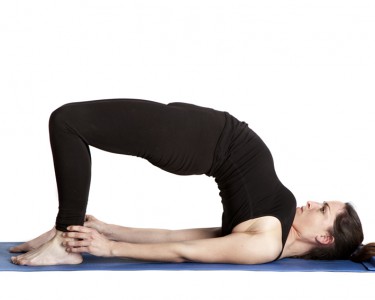
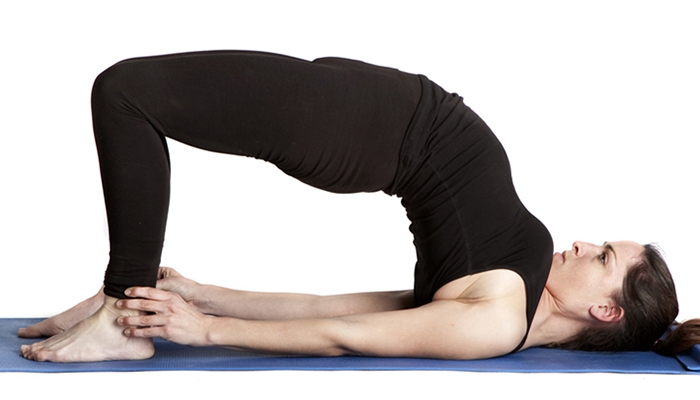
2. SETUBHANDASANA (BRIDGE POSE)

This asana provides appropriate stretch on the back and suitable massage to the neck. It helps to regulate the functions of thyroid gland thereby helpful in releasing thyroxin hormone.This can be done for 2-3 min maximum.

Lie flat on your back with arms at your sides, palms down. Bend your knees and place your feet flat on the floor. Keep your feet hip width apart, parallel to each other, and as close to the buttocks as possible. Simultaneously, press your upper arms and feet into the floor and begin lifting your hips towards the ceiling. Try to distribute your weight equally on the inside and outside of your feet.

Now, move your breastbone towards your chin, keeping your chin lifted only slightly as not to flatten the back of the neck. Firm your tailbone in towards the pubis and move your pubis slightly towards the belly. In order to keep the lower back extended, keep the knees over the ankles, perpendicular to the floor. Your buttocks should be firm, but not clasped.

Lift your hips as high as you are able without breaking position. If you are having trouble holding posture, you can clasp your hands behind your back and firm you arms into the floor, shoulder blades shifted down along the spine. Hold this pose for 5 to 15 breaths.

To come out of Bridge Pose, release on an exhalation, rolling your spine slowly down onto the floor.

Limitations: Avoid doing this pose if you are suffering from neck and back injuries.

setu-bandhasana

3. MATSYASANA (Fish pose):

Matsya means fish, in the final pose, the asana take the form of fish. Hence the name is Matsyasana. Matsyasana provides adequate stretching to the neck region thereby stimulate the thyroid gland. It increases blood supply to trunk and neck region.

This can be done for 1-2 minute maximum

Method:

Sit in Padmasana, lean back,using elbow and arms to help balance yourself, until your had rest comfortably on the mat and your body forms a low arc. Use a low cushion for comfort at first, if necessary. Now extend your arms and grasp your toes on either side. Breathe normal. Rest till you can hold the posture. Exhale using the support of elbow come to the original position.

Limitations: Knee joint problems, piles, dislocation of knee joints.

5732d9a9ab3cd

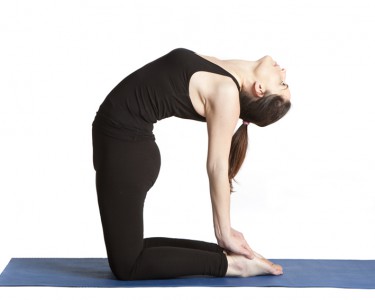
4. USTRASANA (Camel pose): This can be done maximum for 2 minutes.

Method: This asana also give stretch to the neck.

Assume a sitting posture as in kneeling. Support the body on the toes and knees and gradually lean backward, after having fixed the arms from behind, the palms to the ground, the fingers pointing outward and the thumbs towards the toes. Keep arms straight then slowly life the pelvis while taking in the breath. Press the body above the waist slowly both outward and upward, throwing the neck downward. Breathe normal. Exhaling slowly come back to original position.

Limitations: Those who have undergone any recent operation at the chest or abdomen, people with hernia problems, severe hypertension and low back must be cautious.

MG_8461-as-Smart-Object-1

5.  SARVANGASANA (Shoulder stand pose): Sarvangasana is the most important pose to stimulate thyroid gland and control thyroxin. This is the most effective yoga pose where blood flow from legs to head region due to its inverted condition thereby helps in curing of thyroid. This can be done maximum for 3 minutes.

Method:

Lie flat on the back with the feet together, the arms by the sides, and palms flat on the ground.Using the arms as levers, raise the legs and back to a vertical position.

Bend the elbows and use the arms as props to steady the back by pressing it with the palms.The trunk and legs should extend straight up, forming a right angle with the neck, the chest pressing against the chin.

Limitations: Excess obesity, Myopia, severe spinal problems, pregnancy.

sarvangasana9

6. SIMHASANA: Simhasana or the Lion Pose resembles a squatting lion in the final pose. In Sanskrit, ‘Simha’ means ‘Lion’ and ‘asana’ means ‘pose. It is an excellent pose for thyroid gland.

Sit in the kneeling position or Vajrasana. Move the knees apart so that they make almost a right angle between them.Tuck your palms, under your thighs. The palms should face downwards and point towards the body. An alternate way is to keep the palms on the knees stretched and spread wide apart.

Bend forward slightly, resting the weight of the body on the arms.Now, tilt the head backwards. Keep the eyes wide open. Open your mouth and draw the tongue forward and downwards as much as you can.

Gaze at the space between the eyebrows with eyes wide open. This is called Bhrumadhya Drishti. In Hatha Yoga Pradeepika, an alternate gaze for the eyes is given as Nasikagra Drishti or gazing at the tip of the nose.

Breathe normally and deeply in this position. During exhalation make a sound ‘ahhh…’, to imitate the breathing of a lion with tongue outside. You may also roar like a lion, few times in this position. Relax your muscles in the back, abdomen and chest in the final position.

Remain in this final position for as long as comfortable.In some variations, the tongue can also be moved from side to side making the sound ‘ahhh…’

Limitations: For those with weak knee or ankle joints, this asana should be practiced with caution.

This can be practiced for maximum 3 minutes.

Diet is equally important and utmost care should be paid to it. I have herewith chalked out diet tips which is a mix of yogic and modern diet.

Simhasana-yoga-pose

Yogic Diet tips for thyroid disorders

  • Diet with high fiber content should be taken.
  • Avoid excess eating of fats and carbohydrates.
  • Give more and more thrust on green and leafy vegetables.
  • Focus on eating seasonal fruits.
  • Ginger greatly enhances thyroid function. Chew ginger or have ginger tea.
  • Black walnut contains iodine, which nourishes the thyroid gland.
  • Foods like curd, fish, meat, eggs, radish, and oatmeal contain good amount of iodine. So take these foods regularly to control thyroid problems
  • It is recommended that you have Gomutra (Cow urine):Its anti-inflammatory, Anti- Bacterial, antibiotic and antimicrobial. It acts as an antidote. 10-15drops can be taken on an empty stomach in the morning. It works best if taken with Ashwagandha.
  • Bask in Sun: take sunlight /sun bath between 7am -8am.
  • Have 1 tbsp cold pressed virgin Coconut oil. It improves the function of thyroid hormone
  • Take foods such as carrots, pumpkin, sprouts, spinach, wheat grass seaweeds because of its iodine content.

Thyroid diet prevention & precaution

  • Cruciferous veggies can be eaten in limited quantity and should be cooked.Non veg foods such as fish —healthy omega 3 fatty acids present in oily fishes like salmon, tuna, sardines can be eaten. Even eggs are healthy protein rich options to be taken in meals.
  • Spicy foods should by far be avoided as they are tamasic and interferes with keeping the mind calm and in a balance state which is very necessary to deal emotionally with the people having thyroid.
  • Refined and Preserved foods should be avoided to keep the weight in check.
  • Caffiene should be avoided because it hampers the healing properties of thyroid medications. 

Begin with these yoga practices and maintain your thyroid hormones function and achieve a successful weight loss. Bring on a “new you” with these yoga Asanas.

Please Note: Sarvangasana and Vipritkarni needs to practice under guidance.

March 16, 2016 By Twinkle Thakkar 2 Comments

Psychology of good health: It’s all in your Mind!

Best-Habits-of-Highly-Healthy-People

Eat right, be active, sleep well seem to be the ultimate health mantra these days. Yet, when we look around we find people having the most nutritious diet and doing the right mix of cardio and strength training exercises along with well-balanced polarities of activity and rest; and yet end up falling ill or having some or the other lifestyle disease thereby reducing their life span eventually.

Most people then end up blaming their genes, lower immunity levels or toxic environment in general as the main cause for all the diseases. One rarely looks within to find the cause. The issue is largely about the way one thinks and feels. Yes, our ‘Beliefs create our Biology’!!!

Does this seem complicated to you? Let me explain this with the analogy of a car.

Good food is like quality fuel. The exercise we do to build stamina and muscles is akin to the strong car tyres or the car body. And sound sleep is like the idle engine or off road time of the car. Just as diet, exercise and sleep are essential for our health and well-being in the same way for a quality car to perform well requires fuel and maintenance. Just as the car requires a good driver to manoeuvre it, our body too requires a good functional brain and nervous system to run it smoothly.

NERVOUS SYSTEM

I am sure everyone is wondering why we are taking you back to your school days telling you about the nervous system but, it is essential to understand how a good nervous system goes a long way in keeping one healthy and happy.

It is very important to understand the way the autonomic nervous system (ANS) in our body works.ANS regulates the pulse, blood pressure and our breathing apart from being responsible for controlling the functions of internal organs and glands which secretes hormones. It is also involved in our ability to experience emotions.

ANS is made up of these 2 different branches…

  1. Sympathetic Nervous System–it prepares the body for any action – increased blood flow to the muscles and other responses known as “fight-or-flight (just like the gas pedal in a car).
  2. Parasympathetic Nervous System – it functions when the body is at rest and helps the body store energy for future use. (just like the brakes in a car)

For smooth functioning both these components of ANS operate in sync, example during exercise the sympathetic increases heart rate whereas after exercise the parasympathetic helps to slow down the heart rate.

However emotions like anger, anxiety or worry can cause the signals going to these two parts of the ANS to get out of sync with each other. (It’s like we have our foot on accelerator and other on brake pedal at the same time which causes jerky rides and burns more fuel) This disharmony can lead to stress, wear and tear of our body and depletes its energy.

DIGESTIVE SYSTEM

Continuing with the car analogy; the car definitely will not run longer if the fuel line is leaking or ruptured. Same way if the nutrients are not properly absorbed from the food we eat then even the most nutritious food will not make us healthy. This is exactly what happens when we are stressed. The brain is unable to distinguish between physical threat and mental tension. Body’s reaction to both is either flight or fight. The body prepares itself for flight or fight by supplying extra blood to our limbs and less to the visceral organs. This extra stimulation and inadequate blood flow causes improper digestion of even the most nutritious food.

IMMUNE SYSTEM

Immunity levels also decreases when we face stress for prolonged period of time. During such times the focus is to fight the external enemy or situation and not the virus attacking the body within. At most times it so happens that we keep thinking about a negative event of the past and feel stressed out both emotionally and physically. We unknowingly are making ourselves less immune because of our inability to correctly distinguish between the actual and virtual threat.

Thus, to end with the car analogy – the car can function only when it is run by a good driver who operates the accelerator and brakes in proper sync. The car surely requires good fuel, strong tyres along with enough engine idle time for a smooth drive; but most of all it requires is a good driver.

In the same way humans also need a sound mind which can distinguish between actual stressful situations and the trivial ones. It’s only then, we can keep ourselves calm and sleep well, eat right and move more for perfect health and longevity.

To achieve complete wellbeing we require a sound mind in a sound body.

This fact was very well exemplified by the oldest documented living person – a French woman Jeanne Clament who lived for almost 123 years without suffering any ill effects of her smoking habit of 100 years. As it’s said “Thought is more important than lifestyle”!!!


March 15, 2016 By Arooshi Garg 3 Comments

9 foods to boost brain functioning during exams

education_student_news

Just as the months of February and March draw near, parents and students both start getting jitters with the onset of examinations. Students spend all their energy and attention towards their studies. Exams are on and it is not just children who are under stress but parents alike.

At times like this, what you eat can make a huge difference in how children and parents deal with the stress. A good diet can significantly reduce stress levels, irritability and promote calmness. Thus, it becomes, even more, important for parents to give them a healthy and wholesome diet which in turn will boost their energy as well as their mental capacity.

Here is a list of foods proven to help in relieving exam stress and giving the much needed increased attention span:

  1. Green vegetables:

Boring and usual as it may sound, all green vegetables have a lot of iron, which helps in increasing memory with the help of increased neurotransmitter flow. Also, high levels of antioxidants keep your child’s brain sharper.

  1. Blue-black-red fruits:

Blackberries, black grapes, blueberries, plums, pomegranate and other fruits black-blue-red in color have high concentrations of antioxidants, vitamins and plant compounds called as phytochemicals which control and inhibit the action of various free radicals which can damage the brain.

  1. Dry fruits and seeds:

Walnuts, almonds, cashew nuts, flax seeds, pumpkin seeds, peanut butter, and hazelnuts are all super rich in vitamin-E. All these keep brain and eyes healthy and stress-free! So include loads of these in their daily diet in raw form, honey coated nuts, in shakes, and salads.

  1. Green Beans and pulses:

Green beans, broad beans, black beans, whole green lentils in sprouted form, soups or stews help in providing regular glucose supply to the brain. As brain can’t store energy for later use like some other organs, it needs continuous supply from glucose. All green beans, lentils help in providing the same.

  1. Strawberries!

Wow!so this is one berry that all kids love. So why not include this in their diet in the form of fruit salads, shakes, and smoothies! These contain compounds called as polyphenolics which reduce oxidative stress on body and brain, repair cell damage and refreshes at the same time!

  1. Soya

Active compounds like peptides in soybean considerably improve stress hormone unbalance, brain circulation and energy metabolism. A study has found high levels of estrogen in soy, which helps in mental alertness. So do add up good amounts of tofu, and soya products in your kid’s diets.

  1. Dark Chocolate:

Believe it or not, this is 100% true. Eating dark chocolate which is over 70% cocoa fights the stress hormone cortisol and has an overall relaxing effect on the body. Plus chocolate releases endorphins which act as a natural stress fighter. So, kids, this is good news, but remember not to go overboard with this one!

  1. Whole grains:

Choose whole grains such as oats, barley, brown rice, whole wheat and Quinoa, sprouted grains and wheat germ to ensure adequate intake of vitamin B and zinc.  B Vitamins and zinc are needed for the proper functioning of the central nervous system. It improves concentration, memory, balance and relieves irritability.

  1. Probiotics:

Yogurt, fermented foods like rice cakes, rice pancakes, and other probiotic foods and drinks are easy to digest, low in fat and high in beneficial gut bacteria, which help in enhancing brain receptors. Also fermented foods are rich in vitamin B-12, excellent for boosting immunity.

Some more pointers:

  • Outside eating is a strict NO-NO- stress levels are high and immune system is weak, so avoiding outside food is the safest bet to avoid infections.
  • Don’t go overboard on caffeine. Caffeine can make you feel anxious, which can contribute to feelings of stress and anxiety. Have a cup of coffee or tea, but don’t go overboard. Experts recommend getting no more than 400mg of caffeine per day for adults. Kids and teens should limit themselves to about 100mg per day (one cup of coffee). If you have had an excess of coffee or tea, try having lemon water for neutralizing effect.
  • Take frequent breaks. The average human brain can only focus on one task effectively for about 45 minutes. In addition, research in neuroscience suggests that focusing on the same thing for too long diminishes the brain’s ability to accurately process it. So take a break every hour and take a walk, listen to music, stretch and relax.
  • Stay hydrated.Be sure to drink plenty of water. Aim for at least 3 liters of water per day. Not drinking enough water can make you feel sluggish and stressed. Add coconut water, buttermilk, apple-beetroot juice, sweet lime juice, and lemon water for a change.
  • A cup of herbal tea can help you feel more relaxed and stay hydrated. Peppermint, chamomile, and green tea are safest and most effective.
  • Exercise regularly. Aerobic exercise can relieve stress, so if you find yourself a nervous wreck before an exam, go for a run, do some yoga or hit the gym.
  • Get enough sleep.Not getting a full night’s rest can contribute to feelings of fatigue, stress, and anxiety. Rest well, maintain a regular wake up and sleep time, read a book before sleeping and make your sleep environment calm and quiet.
  • Eat a proper exam day breakfast.Without a proper breakfast, your energy levels will quickly crash and may lead to stress, anxiety, and fatigue. Be sure to have a healthy, energy packed breakfast on exam day. Try eating foods that provide long lasting energy, such as eggs or oats. Avoid foods that are high in sugar, which will give temporary energy but may cause you to crash mid-exam
  • Remember to breathe.With your eyes closed, take three large breaths, then pause, exhale, and repeat the process. Large, deliberate breaths not only help relax the body but also increases the flow of oxygen to the brain. Use this technique both before the test and during difficult exams.
  • « Previous Page
  • 1
  • …
  • 56
  • 57
  • 58
  • 59
  • 60
  • …
  • 64
  • Next Page »

Search

Recent Posts

  • Water Intake Pre, During and Post Workout
  • India Leads in Longevity: GOQii Sanjeevini Named Top 40 in $101M XPRIZE
  • The Importance Of Knowing If You’re Thirsty Or Hungry
  • Best Foods To Alleviate Irritable Bowel Syndrome
  • ALL ABOUT VERTIGO!

Stay Updated

Archives

  • December 2025 (9)
  • November 2025 (15)
  • October 2025 (20)
  • September 2025 (6)
  • August 2025 (6)
  • July 2025 (12)
  • June 2025 (18)
  • May 2025 (16)
  • April 2025 (23)
  • March 2025 (23)
  • February 2025 (22)
  • January 2025 (26)
  • December 2024 (26)
  • November 2024 (25)
  • October 2024 (22)
  • September 2024 (24)
  • August 2024 (31)
  • July 2024 (21)
  • June 2024 (26)
  • May 2024 (31)
  • April 2024 (27)
  • March 2024 (29)
  • February 2024 (26)
  • January 2024 (25)
  • December 2023 (15)
  • November 2023 (11)
  • October 2023 (20)
  • September 2023 (22)
  • August 2023 (20)
  • July 2023 (22)
  • June 2023 (24)
  • May 2023 (24)
  • April 2023 (24)
  • March 2023 (23)
  • February 2023 (20)
  • January 2023 (16)
  • December 2022 (12)
  • November 2022 (15)
  • October 2022 (15)
  • September 2022 (12)
  • August 2022 (10)
  • July 2022 (17)
  • June 2022 (11)
  • May 2022 (10)
  • April 2022 (6)
  • March 2022 (6)
  • February 2022 (13)
  • January 2022 (12)
  • December 2021 (7)
  • November 2021 (3)
  • October 2021 (6)
  • September 2021 (3)
  • August 2021 (8)
  • July 2021 (7)
  • June 2021 (15)
  • May 2021 (16)
  • April 2021 (10)
  • March 2021 (7)
  • February 2021 (4)
  • January 2021 (4)
  • December 2020 (3)
  • November 2020 (4)
  • October 2020 (10)
  • September 2020 (3)
  • August 2020 (3)
  • July 2020 (2)
  • June 2020 (4)
  • May 2020 (10)
  • April 2020 (12)
  • March 2020 (10)
  • February 2020 (4)
  • January 2020 (4)
  • December 2019 (3)
  • November 2019 (7)
  • October 2019 (5)
  • September 2019 (4)
  • August 2019 (9)
  • July 2019 (9)
  • June 2019 (11)
  • May 2019 (4)
  • April 2019 (9)
  • March 2019 (8)
  • February 2019 (9)
  • January 2019 (8)
  • December 2018 (9)
  • November 2018 (3)
  • October 2018 (3)
  • September 2018 (5)
  • August 2018 (10)
  • July 2018 (6)
  • June 2018 (13)
  • May 2018 (8)
  • April 2018 (18)
  • March 2018 (9)
  • February 2018 (8)
  • January 2018 (15)
  • December 2017 (12)
  • November 2017 (19)
  • October 2017 (13)
  • September 2017 (15)
  • August 2017 (4)
  • July 2017 (8)
  • June 2017 (7)
  • May 2017 (6)
  • April 2017 (8)
  • March 2017 (6)
  • February 2017 (7)
  • January 2017 (9)
  • December 2016 (10)
  • November 2016 (7)
  • October 2016 (7)
  • September 2016 (7)
  • August 2016 (11)
  • July 2016 (9)
  • June 2016 (9)
  • May 2016 (12)
  • April 2016 (17)
  • March 2016 (17)
  • February 2016 (8)
  • January 2016 (6)
  • December 2015 (2)
  • November 2015 (9)
  • October 2015 (7)
  • September 2015 (9)
  • August 2015 (11)
  • July 2015 (9)
  • June 2015 (12)
  • May 2015 (9)
  • April 2015 (13)
  • March 2015 (8)
  • February 2015 (5)
  • January 2015 (12)
  • December 2014 (14)
  • November 2014 (11)
  • October 2014 (6)
  • September 2014 (13)
  • August 2014 (12)
  • July 2014 (6)
  • June 2014 (2)
  • May 2014 (7)
  • April 2014 (5)

From “Laddu Nawin” to Fit and Fierce: How a 25-Year-Old Insurance Advisor Shed 20 Kilos and Gained His Life Back

When 25-year-old Nawin Yadav from Hyderabad walked into his office every morning, he carried more than just his files and policy papers. He had the weight of fatigue, sluggish energy, and an ever-growing belly that was becoming the butt of jokes. “People … [Read More...]

“I’ve Challenged Myself to Live 100 Years” – The Story of Chandubhai Savani’s Second Chance at Life

At 67, most people start slowing down. Not Chandubhai Savani. A resident of Surat, Chandubhai, thought life was on track. “My life was going well till I had my bypass surgery,” he says. That surgery, back in 2021, was a wake-up call.  Medication was routine, but exercise wasn’t. His diet? What he calls ‘normal.’ “I […]

From Shimla’s Slopes to Chandigarh’s Sidewalks: Surinder Kaur Bhalla’s Journey from Chaos to Control

Some journeys start with a plan. Others begin with a stumble literally. Surinder Bhalla, a government professional, born and raised in the scenic hill town of Shimla, had always lived a life of movement. “In Shimla, you walked everywhere,” she reflects. “Walking was never an exercise. It was just life.” But after shifting to Chandigarh, […]

Ananda Mukherjee Health Story

From Terminal Illness To Complete Wellness! Ananda Mukherjee Health Story

As we observe World Cancer Day under the powerful theme ‘United by Unique’ (2025-2027)**, we are reminded that every individual’s journey with cancer is distinct, yet united by shared resilience, hope, and the collective fight against this disease. This theme places people at the centre of care and their stories at the heart of the […]

  • HOME
  • HEALTHY LIVING
  • FITNESS
  • HEALTHY RECIPES
  • USER STORIES
  • KARMA
  • BUY GOQii

Copyright ©2016 GOQii