GOQii

Blog

  • HOME
  • HEALTHY LIVING
  • FITNESS
  • HEALTHY RECIPES
  • USER STORIES
  • KARMA
  • BUY GOQii

Search Results for: muscle

February 20, 2023 By Farhat Khan 3 Comments

How Does Omega 3 Help Muscle Building and Recovery

Omega 3

As we all know Omega 3 fatty acids are essential fats required by our body & we must get it from diet because our body cannot produce them on its own. There are 3 most important types of fatty acids which are:

  1. Alpha Linolenic Acid (ALA)
  2. Docosahexaenoic Acid (DHA)
  3. Eicosapentaenoic Acid (EPA)

Among this ALA is mostly found in plant oil like Flaxseeds oil, Soya bean and canola oils. While DHA & EPA are found in Animal food, mostly in fish and other sea foods. Our body can convert a small amount of ALA into DHA & EPA but it’s still not the optimum amount requirement by the body.

We all connect Omega 3’s with heart & brain health but we neglect the fact that it is essential for athletes and for people to lead an active lifestyle. Yes, from protecting our heart and brain, it plays a vital role in blood vessels, lungs, immune system, endocrine system and easing recovery after a workout.

As we know, protein is the main nutrient for athletes or sports persons, regardless of the workout whether it is weight lifting, cycling, running, swimming or muscle building. But do we know that Omega 3 fatty acids are equally involved in muscle protein synthesis? It is the process our body goes through to convert the protein we take, into fuel which is required by the muscles to grow, repair and stay strong after a workout. Having a good level of these fatty acids in your muscles during exercise seems to help muscle growth and recovery.

Food Sources for Omega 3

We can get adequate amount of Omega 3 fatty acids by eating variety of foods such as

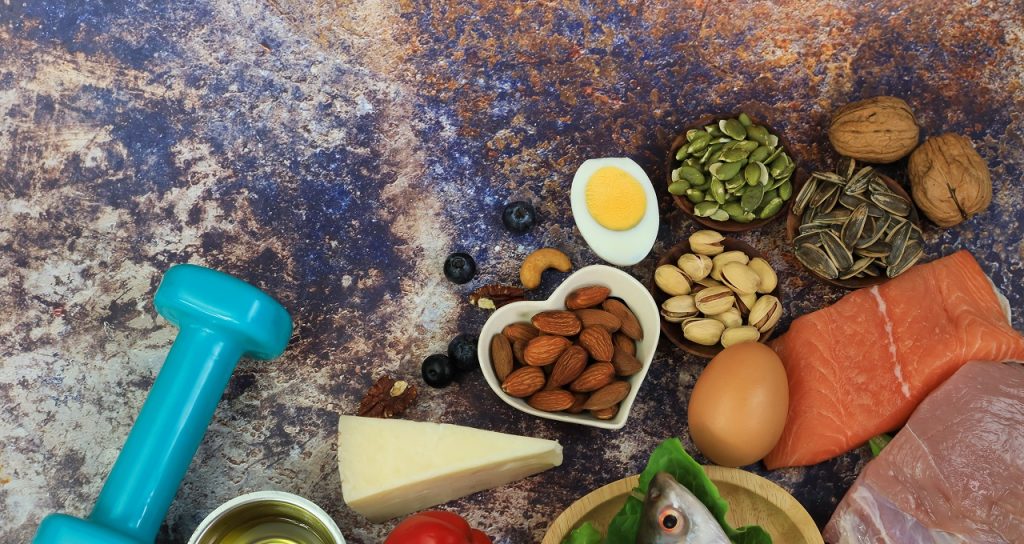
  • Fish & other sea foods: Especially cold water fish such as Salmon, Tuna, Mackerel, Herring and Sardines
  • Plant oils: Flaxseeds oil, soya bean oil & canola oil
  • Nuts & seeds: Chia seeds, walnuts & flaxseeds
  • Some fortified foods also contain Omega 3’s. These include yogurt, milk, soy beverages, eggs and juices.

Why Do We Need Omega 3 Fatty Acids Before a Workout? 

  • It Improves endurance
  • Helps one perform better
  • Builds muscle
  • Helps increase lean body mass and decrease fat mass
  • Improves recovery time by reducing Inflammation

It’s common to feel sore post a workout. In fact, some people start to feel sore and stiff 2 days after a heavy workout. This is referred to as Delayed Onset Muscles Soreness (DOMS). It can affect workout motivation and performance and is caused by inflammation in muscle cells. Omega 3 helps inhibit the onset of DOMS and additionally helps in temporary muscle strength loss as well, improving workout performance.

Omega 3s increase muscles building response to amino acid (protein) & insulin too – both of which are normally released by the body during exercise. It means the more Omega 3 we have, the better the chances are in maintaining muscles and rebuilding them.

With increase in age, we can see progressive loss of muscle mass. It becomes more difficult to maintain and build muscles. The main cause can be a decreased response to both resistance training and protein intake. The Anti inflammatory properties of Omega 3 plays a role here by enhancing muscle sensitivity to protein and resistance training that will allow for greater gains in muscle size and strength with increasing age.

Omega 3 fatty acids can also help in decreasing the need for oxygen during exercise, which means that the body will work more efficiently and require less energy for the workout. This will directly help in improving recovery time.

Omega 3 fatty acids also play a great role for the person whose goal is to lose weight. Omega 3 fatty acids can help you burn fat by using it as energy. Here, the thumb rule is the more omega 3s you have, the better your body will function as it burns more fat for energy as you exercise.

Requirement

Requirement of Omega 3 fatty acids changes from person to person. Athletes and people who live an active lifestyle tend to have higher omega 3 needs than the average person. The required range varies from 1g to 8g per day of EPA & DHA. It is also advised to take it before an exercise session for better results.

We hope this article helps you! Do leave your thoughts and queries in the comments below! For more on fitness and nutrition, click here or speak to an expert by subscribing for GOQii’s Personalised Health Coaching here.  

#BeTheForce 

January 2, 2023 By Tanmaya Patil 4 Comments

5 Muscle Building Mistakes Which Might Be Keeping You From Your Goal

muscle buildingIf you’ve been looking at motivational posters on social media or your local gyms which have “go hard or go home” or “work until your muscles hurt” or “no gain without pain” or something to the effect of relating success to extreme weight training, then you’ve clearly been looking at the wrong posters. We come over so many cases where users claim that they’ve been at it in the gym for so long without ever achieving their desired result. In order to help you avoid the same fate, we’re sharing this article on muscle building mistakes!

Common Muscle Building Mistakes to Avoid

1. Prioritising Quantity Over Quality
We live in an age where we believe more is better. A gaze around the gym might show mindless addition of reps and set backed by piling unreasonably more plates (mostly on the leg press machine and rarely the squat rack if not for 1/100th partial rep squats). Most folks aiming to add muscle might believe training seven days a week must undeniably be better than three. What these people fail to realise is the foundation of quality muscle building still rests upon what it used to be about a hundred years ago – Getting stronger. Becoming stronger is neural training. The central nervous system demands its necessary share of rest before it is ready to tackle new challenges in your next workout. In the words of the Bodybuilding Legend Lee Haney: “Stimulate, not annihilate!”

Pro Tip: Build Movement Quality in a lift before gradually adding volume (sets and reps), before gradually adding weight.

2. Chasing The Pump
If you are a true meathead, you remember the first time you curled that lonely barbell in the gym and the immediate next thing you did was flex your arms before the nearest mirror. It’s okay if you did. Pursuit of the ‘pump’ or build-up of metabolic fluid as a result of high volume resistance training in a muscle has fascinated millions of people entering muscle building. The degree to which pump helps increase muscle size fades as quickly as the pump itself a few hours after training. Don’t get me wrong, metabolic and high rep training has its place, though making every exercise in your program a high rep per set one in order to feel the temporary pump at the expense of actually getting stronger (refer to point 1 above) would be a big miss.

Pro Tip: Focus more on documented progress in weight lifted and the volume for which it is lifted rather than an arbitrary goal like ‘feeling the pump’.

3. Pain is (the only way to) Gain
Most people wearing the ‘Pain is Gain’ t-shirts have a very myopic vision of their training years. Most of them belong to the late teens to late twenties. Fast forward ten years and they may soon begin to laugh at their idea of ‘balls-to-the-walls’ intensity every workout, week after week. As we age, especially as we enter 30s, training revolves more about recovery than making unending progress. Joints and connective tissue take a solid hit if we are really lifting seriously. As such, making every workout a masochistic fiesta can seriously hamper our joints’ ability to outperform them later.

Pro Tip: It’s okay if a workout didn’t leave you hurt and devastated. Try to make a majority of your workouts in a year energizing and your training longevity might increase by several years.

4. Taking Supplements Is Like Pressing A Switch
All of us know that someone who swears by his or her shelf full of powders and pills claiming to transform them into a machine. Supplements have their place in the life of serious strength and physique athlete. However, replacing natural, real food with doses of meal replacement drinks is a strategy that might fail to deliver real robust and healthy changes in your physique. Quality, natural and fresh nutritional food would always beat sole supplementation.

Pro Tip: Make a select handful of supplements such as Whey and Creatine Monohydrate a tool to fill in the gaps in your nutrition wherever or whenever you see it, rather than a staple in your diet.

5. I Need To Train Like A Pro
In the pursuit of ‘Big Guns’, an amateur might look up the internet for the training split of an eight time Mr. Olympia winner and begin to emulate it in his training. The efforts might soon begin to be outweighed by the stopping of gains through either injury or incorrect loading parameters and the trainee might soon end up in dire frustration before switching to an altogether new program, this time followed by a multiple ‘World’s Strongest Man’ title winner.

Many individuals fail to understand that it might take more than a decade of continual solid and consistent effort with the big lifts in order to come anywhere near being called a pro. And we aren’t even talking about ‘pharmaceutical aids’ yet.

Pro Tip: Aim for Health first, followed by getting stronger, followed by improvement in appearance whenever drawing out your training strategy or designing a muscle building program.

We hope this article helps you avoid these common muscle building mistakes and aids you in making the right choices. For more on fitness, check out Healthy Reads or tune in to LIVE sessions on GOQii PRO within the GOQii App, where you can get one-on-one guidance in real time by certified fitness experts.

#BeTheForce 

November 7, 2022 By Soni Thakur 3 Comments

Do Your Muscles Turn Into Fat When You Stop Weight Training?

musclesBeing indoors for this long has given people a lot of time to do some research. If you have been researching fitness, weight training and muscles, I’m sure the thought of  – “will my muscles turn into fat if I stop weight training” has crossed your mind. While you might watch your fitness levels, maintain a healthy weight and improve strength, etc, it is equally important to understand what happens once you stop weight training in order to preserve muscle mass. 

What Do Muscles Mean? 

Muscle is a tissue in animal bodies. Their main purpose is to help us move our body parts. When a muscle is activated via exercise, it contracts, making itself shorter and thicker i.e. it grows in size.

  • When you exercise, your body does not create new muscles. Instead, your existing muscles grow larger and stronger.
  • With regular exercise, muscles also develop more mitochondria (this is where biochemical processes of respiration and energy production occur in the cell). The result is larger and more muscle mass.
  • When you stop weight training/adopt a sedentary lifestyle, then the increased blood flow previously needed to fuel your cells during exercise is no longer required, so your body begins to contract and reduce the size of your capillaries. As a consequence, muscles shrink and decrease in mass.

Points To Consider 

Muscle cells and fat cells are different structures and are not interchangeable at all. They will become smaller and weaker if you stop weight training because they lose muscle mass. Although, it will not happen in a short period of time as the process of losing muscle mass is slow and gradual which may take  4-6 weeks. Fat may be produced if your diet provides your body with more calories than required based on the activity levels you maintain.

You can preserve and maintain your muscle mass by keeping yourself active. By active I do not mean hitting the gym everyday but by just walking in between breaks, using the staircase instead of the lift, stretching your body every 2 hours, walking while being on a call instead of just sitting at one place, walking after every meal whether it’s your main meal or just snacks in between and obviously by eating a well- balanced healthy diet.

Keep an eye on your protein intake because the protein requirement of your body is directly associated with building and losing muscle mass as well. Don’t overtrain as this can also lead to decreased muscle. Leaving weight training alone should not be blamed for decreased muscle mass. 40-45 minutes of exercise 5-6 days a week is recommended and 1 day should be dedicated for rest and recovery.

We hope this article helps you. For more useful information on muscles, strength training, etc. check out Healthy Reads or tune in to LIVE, interactive workout classes by experts on GOQii PRO within the GOQii App. 

To get these tips directly from your GOQii Coach, subscribe for Personalised Health Coaching here: https://goqiiapp.page.link/bsr

#BeTheForce

May 11, 2017 By Farida Gohil 2 Comments

Nutritional facts to help preserve muscles in Seniors

senior-citizen-exercise

As you grow older it become imperative to work towrads building strength. The elderly need strength training more and more as they grow older to stay mobile for their everyday activities. The less active a person’s lifestyle, the earlier age-related changes will manifest.

According to International Osteoporosis Foundation (IOF), Nutrition working Group examines role of Nutrition in Sarcopenia, with focus on protein, vitamin D and B, and acid-based diet.

Age-related muscle loss, called sarcopenia, is a natural part of aging. An article published in Harvard Health said that after age 30, you begin to lose as much as 3% to 5% per decade. Sarcopenia is a common consequence of aging, and poses a significant risk factor for disability in older adults. As muscle strength plays an important role in the tendency to fall, sarcopenia leads to an increased risk of fractures and other injuries.

Quoting from an article in Harvard Health, according to Dr. Thomas W. Storer, director of the exercise physiology and physical function lab at Harvard-affiliated Brigham and Women’s Hospital, just because you lose muscle does not mean its gone forever. The elderly can increase muscle mass lost as a consequence of aging. “

The International Osteoporosis Foundation (IOF) Nutrition Working Group has published a new review which identifies nutritional factors that contributes to loss of muscle mass, or conversely, are beneficial to the maintenance of muscle mass. The Group reviewed evidence on worldwide studies on the role of nutrition in sarcopenia, specifically looking at protein, acid-base balance, vitamin D/calcium, and other minor nutrients like B vitamins.

The most obvious intervention against sarcopenia is exercise in the form of resistance training. However, adequate nutritional intake and an optimal dietary acid-base balance are also very important elements of any strategy to preserve muscle mass and strength during aging.

The review discusses and identifies the following important nutritional factors that have been shown to be beneficial to the maintenance of muscle mass and the treatment and prevention of sarcopenia:

  • Protein: Your diet also plays a role in building muscle mass. Protein is the king of muscle food. The body breaks it down into amino acids, which it uses to build muscle. The authors of the study propose an intake of 1.0-1.2 g/kg of body weight per day as optimal for skeletal muscle and bone health in elderly people without severely impaired renal function. .”While food sources are the best, supplemental protein can help if you struggle with consuming enough calories and protein from your regular diet,” says Dr. Storer.
  • Vitamin D: As many studies indicate a role for vitamin D in the development and preservation of muscle mass and function, adequate Vitamin D should be ensured through exposure to sunlight and/or supplementation if required. Vitamin D supplementation in seniors, and specially in institutionalized elderly, is recommended for optimal musculoskeletal health.
  • Avoiding dietary acid loads: Excess intake of acid-producing nutrients (meat and cereal grains) in combination with low intake of alkalizing fruits and vegetable may have negative effects on musculoskeletal health. Modifying the diet to include more fruits and vegetables is likely to benefit both bones and muscles. Emerging evidence also suggests that vitamin B12 and/or folic acid play a role in improving muscles function and strength.

The Review discusses non-nutritional interventions such as hormones, and calls for more studies to identify the potential of antioxidants and anti-inflammatory compounds in the prevention of Sarcopenia.

Strategies to reduce the numbers of falls and fractures within aging populations must include measures to prevent sarcopenia. At present, the available evidence suggests that combining resistance training with optimal nutritional status has a synergistic effect in preventing and treating sarcopenia.

Check with your doctor before embarking on any kind of strength-training routine. Then have a well-qualified personal trainer to help set up a detailed routine and supervise your initial workouts to ensure you perform them safely and in the best manner.


  • « Previous Page
  • 1
  • 2
  • 3
  • 4
  • 5
  • …
  • 113
  • Next Page »

Search

Recent Posts

  • Healthy Eating: Paneer Stuffed Palak Paratha
  • 5 Simple Lifestyle Changes To Manage Hypertension
  • Vegging Out: My Unexpected Journey to Veganism
  • Natural Skincare For Healthy, Glowing Skin!
  • The Early Signs & Symptoms of Diabetes

Stay Updated

Archives

  • November 2025 (3)
  • October 2025 (20)
  • September 2025 (6)
  • August 2025 (6)
  • July 2025 (12)
  • June 2025 (18)
  • May 2025 (16)
  • April 2025 (23)
  • March 2025 (24)
  • February 2025 (23)
  • January 2025 (26)
  • December 2024 (26)
  • November 2024 (26)
  • October 2024 (22)
  • September 2024 (24)
  • August 2024 (31)
  • July 2024 (22)
  • June 2024 (27)
  • May 2024 (31)
  • April 2024 (27)
  • March 2024 (29)
  • February 2024 (26)
  • January 2024 (26)
  • December 2023 (17)
  • November 2023 (15)
  • October 2023 (23)
  • September 2023 (23)
  • August 2023 (21)
  • July 2023 (22)
  • June 2023 (24)
  • May 2023 (25)
  • April 2023 (24)
  • March 2023 (23)
  • February 2023 (20)
  • January 2023 (16)
  • December 2022 (12)
  • November 2022 (15)
  • October 2022 (15)
  • September 2022 (13)
  • August 2022 (11)
  • July 2022 (17)
  • June 2022 (11)
  • May 2022 (10)
  • April 2022 (6)
  • March 2022 (6)
  • February 2022 (13)
  • January 2022 (12)
  • December 2021 (7)
  • November 2021 (3)
  • October 2021 (6)
  • September 2021 (3)
  • August 2021 (8)
  • July 2021 (7)
  • June 2021 (15)
  • May 2021 (16)
  • April 2021 (10)
  • March 2021 (7)
  • February 2021 (4)
  • January 2021 (4)
  • December 2020 (3)
  • November 2020 (4)
  • October 2020 (10)
  • September 2020 (3)
  • August 2020 (3)
  • July 2020 (2)
  • June 2020 (4)
  • May 2020 (10)
  • April 2020 (12)
  • March 2020 (10)
  • February 2020 (4)
  • January 2020 (4)
  • December 2019 (3)
  • November 2019 (7)
  • October 2019 (5)
  • September 2019 (4)
  • August 2019 (9)
  • July 2019 (9)
  • June 2019 (11)
  • May 2019 (4)
  • April 2019 (9)
  • March 2019 (8)
  • February 2019 (9)
  • January 2019 (8)
  • December 2018 (9)
  • November 2018 (3)
  • October 2018 (3)
  • September 2018 (5)
  • August 2018 (10)
  • July 2018 (6)
  • June 2018 (13)
  • May 2018 (8)
  • April 2018 (18)
  • March 2018 (9)
  • February 2018 (8)
  • January 2018 (15)
  • December 2017 (12)
  • November 2017 (19)
  • October 2017 (13)
  • September 2017 (15)
  • August 2017 (4)
  • July 2017 (8)
  • June 2017 (7)
  • May 2017 (6)
  • April 2017 (8)
  • March 2017 (6)
  • February 2017 (7)
  • January 2017 (9)
  • December 2016 (10)
  • November 2016 (7)
  • October 2016 (7)
  • September 2016 (7)
  • August 2016 (11)
  • July 2016 (9)
  • June 2016 (9)
  • May 2016 (12)
  • April 2016 (17)
  • March 2016 (17)
  • February 2016 (8)
  • January 2016 (6)
  • December 2015 (2)
  • November 2015 (9)
  • October 2015 (7)
  • September 2015 (9)
  • August 2015 (11)
  • July 2015 (9)
  • June 2015 (12)
  • May 2015 (9)
  • April 2015 (13)
  • March 2015 (8)
  • February 2015 (5)
  • January 2015 (12)
  • December 2014 (14)
  • November 2014 (11)
  • October 2014 (6)
  • September 2014 (13)
  • August 2014 (12)
  • July 2014 (6)
  • June 2014 (2)
  • May 2014 (7)
  • April 2014 (5)

From “Laddu Nawin” to Fit and Fierce: How a 25-Year-Old Insurance Advisor Shed 20 Kilos and Gained His Life Back

When 25-year-old Nawin Yadav from Hyderabad walked into his office every morning, he carried more than just his files and policy papers. He had the weight of fatigue, sluggish energy, and an ever-growing belly that was becoming the butt of jokes. “People … [Read More...]

“I’ve Challenged Myself to Live 100 Years” – The Story of Chandubhai Savani’s Second Chance at Life

At 67, most people start slowing down. Not Chandubhai Savani. A resident of Surat, Chandubhai, thought life was on track. “My life was going well till I had my bypass surgery,” he says. That surgery, back in 2021, was a wake-up call.  Medication was routine, but exercise wasn’t. His diet? What he calls ‘normal.’ “I […]

From Shimla’s Slopes to Chandigarh’s Sidewalks: Surinder Kaur Bhalla’s Journey from Chaos to Control

Some journeys start with a plan. Others begin with a stumble literally. Surinder Bhalla, a government professional, born and raised in the scenic hill town of Shimla, had always lived a life of movement. “In Shimla, you walked everywhere,” she reflects. “Walking was never an exercise. It was just life.” But after shifting to Chandigarh, […]

Ananda Mukherjee Health Story

From Terminal Illness To Complete Wellness! Ananda Mukherjee Health Story

As we observe World Cancer Day under the powerful theme ‘United by Unique’ (2025-2027)**, we are reminded that every individual’s journey with cancer is distinct, yet united by shared resilience, hope, and the collective fight against this disease. This theme places people at the centre of care and their stories at the heart of the […]

  • HOME
  • HEALTHY LIVING
  • FITNESS
  • HEALTHY RECIPES
  • USER STORIES
  • KARMA
  • BUY GOQii

Copyright ©2016 GOQii