GOQii

Blog

  • HOME
  • HEALTHY LIVING
  • FITNESS
  • HEALTHY RECIPES
  • USER STORIES
  • KARMA
  • BUY GOQii

Search Results for: muscle

October 4, 2017 By Trupti Hingad Leave a Comment

Know the exercises for pool workouts –Part 2

water spinning 2

In my previous blog, I explained how pool exercises are beneficial and what precautions should be taken before starting off on them. In the current blog, I am going to tell you about few aqua exercise that you can do.

Let’s get started with some amazing Pool exercises

  1. Aqua walking: You might start with water walking. In water about waist high, walk across the pool swinging your arms as you do when walking on land. Avoid walking on your tip toes, and keep your back straight. Tighten your abdominal muscles to avoid leaning too far forward or to the side.
  2. Aqua jogging: This is deep water running and mimics. You wear a buoyancy belt, which helps you maintain an upright position as you jog or you would also need to wear a flotation vest as a beginner. One of the easiest and most effective pool workouts is water jogging. At a high intensity, you’ll burn 17 calories per minute — more than on land. It also makes you stronger.
  1. Water spinning: Stationary bikes are placed in a pool and one has to combat the waters resistance and pedal to go faster which can pose a challenge. Water cycling gives your legs good massage as the water hits the fat deposits on the leg and thigh muscles. It’s a high-value workout where you may burn 750 calories in just 45 minutes.
  1. Spiderman— Climb the pool wall like Spiderman climbs buildings. How do you do this: Stand in the water on the side of the pool. Stabilize your upper body by sweeping your hands back and forth as you run your legs up the side of the pool and back down to the pool floor. Do four Spiderman exercises, alternating the leading leg each time you reach the end of one jogging circuit.
  2. Arm exercise using hand webs: Hand webs can help you strengthen your biceps and triceps in the water. Wearing hand webs, stand in waist-high water with your arms down, your palms facing forward and your elbows close to your body. Raise your forearms to the level of the water, keeping your elbows close to your body and your wrists straight. Then switch direction and push your hands down until your arms are straight again. Repeat 12 to 15 times or until you’re fatigued.
  1. Pool plank: Planks are a proven core-strengthener on land. But, if you don’t have a strong upper body it’s hard to hold it long enough to give abdominal muscles a good workout. All that changes in a pool. Hold the noodle in front of you. Lean forward in a plank position. The noodle will be submerged under the water, and your elbows should be straight down towards the pool floor. Your feet should still be on the pool floor. Hold as long as comfortable, 15-60 seconds depending on your core strength. Repeat 3-5 times.
  1. One-Legged Balance

This strengthens your leg and core muscles and helps in balance. Standing in waist-high water, lift your left knee up and place the middle of a noodle under your left foot. (Its sides will float up into a U-shape.) Keep your hands by your side and balance with your left foot on the noodle for one minute. Then move your left knee out to the side and balance for another minute. Switch legs and repeat with the right knee lifted and the right foot resting on the noodle. For an extra challenge, lift both arms up over your head as you balance.

8. Fly-Backs

In the water, as on land, fly-backs work the muscles in the upper chest, back and arms. They also improve posture. Start in a lunge position with your right knee bent and your left leg extended straight behind you in the pool. Reach your arms straight out in front of you at chest height — palms touching, fingers extended and thumbs up. Open your arms straight out to the sides in the water, then return them to the starting position to complete one rep.

  1. Forward and side lunges:  Stand near the pool wall for support, if necessary, take an oversized lunge step in a forward direction. Do not let the forward knee advance past the toes. Return to the starting position and repeat with the other leg. For a side lunge, face the pool wall and take an oversized step to the side. Toes should be kept facing forward. Repeat on the other side. Try 3 sets of 10 lunge steps. For variation, lunge walk in a forward or sideways direction instead of staying in place.
  2. Leg exercise using a noodle: To strengthen your leg muscles, tie a water noodle into a knot around your foot or water shoe. Stand with your back to the side of the pool in waist-high water, placing your arms on the edge of the pool for stability. Straighten your leg in front of you, and then flex your knee to about a 90-degree position. Return to the starting position and repeat 12 to 15 times or until you’re fatigued. Tie the water noodle into a knot around your other foot or water shoe and repeat with the other leg.
  1. Resistance exercise using a kickboard: Kickboards provide another type of resistance. Standing up straight with your legs comfortably apart, and tighten your abdominal muscles. Extend your right arm and hold the kickboard on each end. Keeping your left elbow close to your body, move the kickboard toward the centre of your body. Return to the starting position and repeat 12 to 15 times or until you’re fatigued. Then extend your left arm and repeat the exercise on the other side.
  1. Pool kickboxing: It is great for sculpting arms and torso. Lift one knee and kick the foot upwards which you punch forward with your other hand. Punch throughout the water resistance and kick without worrying about keeping your balance.
  1. Deepwater bicycle: In deeper water, loop 1-2 noodles around the back of your body and rest your arms on top of the noodle for support in the water. Move your legs as if you are riding a bicycle. Continue for 3-5 minutes.
  1. Push-ups: While standing in the pool by the poolside, place arms shoulder-width apart on pool edge. Press weight through your hands and raise your body up and halfway out of the water, keeping elbows slightly bent. Hold 3 seconds and slowly lower back into the pool. (Easier variation: Wall push up on side of pool: place hands on edge of pool shoulder width apart, bend elbows, and lean chest toward the pool wall.

15. Aqua Tai Chi: This water inspired version of tai chi. It involves series of deep breathing, relaxing movements that challenge balance using tai chi and Qigong (breathing techniques).Try the arms uplifting pose, moving arms from side to centre, and floating. The slow, fluid exercises reduce tension, stretch the spine and allow the chi (life force) to flow through the body. They reduce fibromyalgia and chronic pain.

Aquatic exercise can be fun at any age, size or fitness level — whether you practice it on your own or sign up for a class. Jump in. The water’s fine! Stay healthy and stay fit!
October 3, 2017 By Trupti Hingad Leave a Comment

Burn fat with pool workouts-Part 1

water spinning 2

Today, to counter their stress filled lifestyle, people are shifting their focus to health and fitness. There are many fitness methods that one can adopt such as running, cycling swimming, yoga, aerobics etc. Most of these are popular among people who are taking to fitness or are already into fitness. However, there is a new form of exercise- Aquatic exercise and Aqua aerobics that is getting popular.

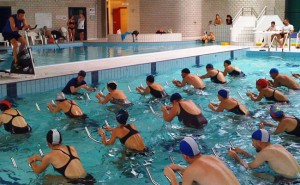
Aqua aerobics or exercise arrived almost over two decades ago but, it has gained popularity in India only 5-6 years ago. Aqua aerobics uses the buoyancy of water coupled with your own body weight as a training tool to build endurance and get into shape.

Aquatic exercise is a low impact exercise that takes the pressure off your bones, joints and muscles. Water offers natural resistance which helps to strengthen the muscles. It provides almost 14% more resistance than air, which means your muscles get more toned in water and there is almost no impact on the bones, joints and muscles.

Why Aqua exercise?

You weigh only 10% of your body weight when you are in the water. When a person weighing 100kg or who has arthritis in joints or cannot do any exercise while on land due to the gravitational pull, as he enters the water, the load is lifted off the joints and he can do exercise without any pain.

For elderly who have difficulty in walking, sitting and moving, this is the best way to work out and stay fit. And, the best part is you can do these exercises even if you don’t know how to swim.

Aquatic exercise has amazing benefits: Here is a list

  • It improves muscle endurance and strength. Pool water provides resistance which strengthens the muscles and boosts cardio intensity and improves flexibility.
  • Water exercise is good for people with joint injuries or infections or who have had a recent surgery –great way to stay fit and shorten recovery time and heal faster.
  • A pool workout gives better balance, agility and endurance.
  • Pool workouts are great fat burners. You can burn much higher level of calories in a shorter time in the pool. You can burn about 400-500calories in one hour.
  • Working out in the pool doesn’t feel like an arduous task, you enjoy doing it and thus there are higher chances that you will stick to this routine. Since aquatic exercise is a low impact exercise there is no age bar for it. Water is therapeutic and removes the pain. Water has a healing effect and can distress the body and mind too!
  • Water resistance is not only for muscles, in fact, water pressure actually works with your blood as well and enables good blood circulation decreasing blood pressure and keeps the heart also in good condition.
  • Aqua aerobics can satisfy that need to feel cool in warmer temperatures while still enabling us to exercise.

Aqua exercises have a great bonding effect as it can be done together and there are positive benefits to be derived from these workouts.

Precautions for the Pool Workout:

Before starting any pool exercise program, always check with your physician to make sure pool exercises are right for you.

Here are some tips to get you started:

  • Water shoes will help to provide traction on the pool floor.
  • Water level can be waist or chest high. This way your feet will have good contact with the pool floor and your leg muscles will be able to support some of your weight.
  • Use a Styrofoam noodle or floatation belt/vest to keep you afloat in deeper water.
  • Slower movements in the water will provide less resistance than faster movements.
  • You can use webbed water gloves, Styrofoam weights, inflated balls, or kickboards for increased resistance.
  • Never push your body through pain during any exercise.

Although you will not notice that you sweat with pool exercises, it is still important to drink plenty of water. Drink water before and after your water workout to avoid dehydration

In my next blog..I will share the various pool workouts and procedure to do it. Stay tuned!


September 28, 2017 By Anusha Subramanian Leave a Comment

Know your ‘Heart’ and its risks

Know your heart

Mahesh Agrawal was the happiest man as he watched his only daughter walk down the stairs in her bright red bridal dress. His eyes were moist. Father and daughter posed happily for photographs, laughed and joked. Amidst all the happiness and laughter, Mr Agrawal suddenly realized a strange discomfort in his chest. It was more likely an excruciating pain and he started to profusely sweat. The pain had now moved to his neck and he developed shortness of breath almost feeling choked. He held his hand tightly on his chest and slowly settled himself on a chair without letting anyone know.

At this point in time, he remembered his father had a similar heart attack. But, he did not want that scene to cloud the happy scene of watching his daughter getting married. As he watched his daughter get married he bid her a silent goodbye and passed away peacefully with a smile on his face. Unfortunately, it was too late before a doctor was called in.

When everybody got to know what had happened there was a sudden atmosphere of gloom. Nobody was aware what had happened. Today, on World heart Day, let’s try and understand more about our hearts and through this story we could exactly understand what happened to Mr Agrawal and why?

On doctor’s examination, the doctor revealed that Mr Agrawal had suffered a heart attack and that was because he had a Coronary Heart Disease (CHD). A heart attack occurs if the flow of oxygen-rich blood to a section of heart muscle is cut off. If blood flow isn’t restored quickly, the section of heart muscle begins to die. Without quick treatment, a heart attack can lead to serious health problems or death. CHD is the most common of all heart diseases. In the United States, CHD is the #1 cause of death for both men and women. India is not far behind. According to an article by Dr Arvind Kohli, a Cardiac Surgeon, there has been a dramatic rise in heart disease in India.

India will soon be the largest burden of heart disease globally. In India, out of the estimated population of more than 1.27 billion dispersed across various geographical regions, about 45 million people suffer from coronary artery disease. According to current estimates, India will soon have the highest number of cases of cardiovascular disease in the world. It is estimated to account for 35.9 percent deaths by the year 2030, said the article.

Over time, CHD can weaken the heart muscle and lead to heart failure and arrhythmias (ah-RITH-me-ahs). Heart failure is a condition in which your heart can’t pump enough blood to meet your body’s needs. Arrhythmias are problems with the rate or rhythm of the heartbeat.

Knowing the warning symptoms of a heart attack and how to take action can save your life or someone else’s say, doctors. In many cases patients are unaware of the risk factors and that this could be a problem that has developed over the years due to pre-existing heart disease. Several factors such as genetic, metabolic, early-life, conventional and non-conventional risk factors are suspected to cause high CHD morbidity and mortality rates among Indians. Knowing who is at risk helps a great deal. Men have a greater risk of heart attack than women do, and men have heart attacks earlier in life than women. However, beginning at Age 70, the risk is equal for men and women.

Many are of the opinion that heart disease is a lifestyle disease that occurs because one is not maintaining a proper healthy lifestyle. But, you are mistaken. Heart disease could also be due to family history. Here is where the nature vs nurture concept comes in. Did you develop a heart disease over the years, did you already have it and it went undiagnosed or did someone give it to you. In fact, you have an increased risk of developing heart disease if you have a parent with a history of heart disease, especially if they were diagnosed before Age 50. Ask your doctor when it’s appropriate for you to start screenings for heart disease so it can be detected and treated early.

The other common risk factors could include cigarette smoking and exposure to tobacco smoke, high blood cholesterol, and high triglycerides – especially high LDL (“bad”) cholesterol over 100 mg/dL and low HDL (“good”) cholesterol under 40 mg/dL. Some patients who have existing heart or blood vessel disease, and other patients who have a very high risk, should aim for an LDL level less than 70 mg/dL. Your doctor can provide specific guidelines.

The risk of heart disease is also highest among the urban population. A 2013 study concluded that over 70 percent of the Urban Indian population is at the risk of being diagnosed with heart disease. This is mainly due to unhealthy eating habits, lack of physical activity and stress.

High blood pressure (140/90 mmHg or higher), uncontrolled diabetes (HbA1c >7.0), physical inactivity and being overweight (body mass index [BMI] 25–29 kg/m2) or being obese (BMI higher than 30 kg/m2) are other risks for heart diseases. The population of diabetics in India is about 50.8 million, making India the diabetic capital of the world. The prevalence is higher in urban areas (6-8 percent) compared to rural areas (2-3 percent), according to statics provided in Dr Kohli’s article. The increase in hypertension prevalence has been steady over the last 50 years, more in urban than in rural areas. Hypertension is about 25-30 percent in urban and 10-15 percent in rural individuals.

You might be surprised but uncontrolled stress and anger could also lead to CHD. Staying calm helps. Indians like Americans have a higher degree of obesity due to bad food habits. Diet high in saturated fat and cholesterol apart from drinking too much alcohol are also a major risk factor for CHD. The more risk factors you have, the greater your risk of developing coronary artery disease.

Hence knowing the symptoms and risk factors is very important. The most common symptom of CHD is angina (also called angina pectoris). Angina is often referred to as chest pain. It is also described as chest discomfort, heaviness, tightness, pressure, aching, burning, numbness, fullness, or squeezing. It can be mistaken for indigestion or heartburn. Angina is usually felt in the chest, but may also be felt in the left shoulder, arms, neck, back or jaw. All of these symptoms were witnessed by Mr Agrawal.

Other symptoms that may occur with coronary artery disease include:

  • Shortness of breath
  • Palpitations (irregular heartbeats, skipped beats or a “flip-flop” feeling in your chest)
  • A faster heartbeat
  • Dizziness
  • Nausea
  • Extreme weakness
  • Sweating

Cardiac surgeons opine that the treatment for CHD involves reducing your risk factors. Change your lifestyle. Get active, exercise and eat right and sleep well. If lifestyle changes aren’t enough to control your heart disease, taking medications as prescribed to treat certain risk factors, such as high cholesterol or high blood pressure helps. Possibly undergoing invasive and/or surgical procedures, and seeing your doctor for regular visits is also good. Treating CHD is important to reduce your risk of a heart attack or stroke. If the problem is detected early lifestyle changes, medicines, and medical procedures can help prevent or treat CHD. These treatments may reduce the risk of related health problems.

September 23, 2017 By Anushree Ashtekar 3 Comments

10 Lifestyle Changes for Fat Loss and Healthy Living

healthy-living

  • Choose and learn to like healthy food options: Many people who aim to lose fat and live a healthy life go on crash diets or have boiled meals thinking that their only way to achieve their goal is to eat bland food. It’s just a myth that “healthy” foods are not very appetizing. There are many recipes which are very healthy and also very delicious. The best way to start a healthy living is to do some research and make a list of some healthy recipes that are low in processed ingredients and are appetizing.
  • Always start your day with a nutritious breakfast: Breakfast is the most important meal of the day. After a long gap of 6-7 hours of sleep, our body needs the fuel (calories) to get our metabolism going and give us the sustained energy throughout the day. Breakfast should be a combination of quality carbohydrates, proteins and fats.
  • Mid- meal snacking: If you have the habit of snacking between meals during the day, select healthy snacking options. Opt for a serving of fruit or a handful of nuts that have good fibre content, vitamins and minerals. Avoid having snacks made out of refined flour, refined sugar and deep fried snacks.
  • Eat at regular intervals: Missing meals and eating after long gaps is a big no-no! A log gap between two meals switches our body to “starvation mode”. While in starvation mode, the BMR of the body reduces drastically to save energy. This environment in the body makes it very difficult to lose fat. Having meals at regular intervals keeps the BMR on the higher side and helps a lot in giving effective fat loss. It also avoids one from binge eating.
  • Opt for whole foods: Whole foods include whole grains and products made out of whole grains, fruits and vegetables. These foods are rich in Fibre, do not spike blood sugar levels and fill the stomach. They give satiety for a long period of time without adding on unnecessary calories. Fibrous foods are heavy to digest, increase the BMR of the body and hence give effective fat loss. Enjoying an occasional treat sometimes is fine, but, make it a habit to eat more whole foods.
  • Load your plate with salads and soups: Water-rich vegetables like cucumbers, gourds, tomatoes etc. gives satiety and avoids consumption of too many calories. Soups are also very water-rich foods but, choose clear soups over creamy soups. Having water-rich foods does not mean that one needs to ignore the good old water!
  • Practice mindful eating: It is very important that we concentrate on the food we eat and enjoy it. Mind and body connection is very powerful. Never eat sitting in front of a TV, while working on gadgets, when angry, depressed or tensed. In such times we tend to eat more and add on unnecessary calories. Chew the food well; it improves the process of digestion. Portion control is very important; it prevents adding on unnecessary calories. Also, guilt-eating is bad! Giving self an occasional treat will cut too much temptation and avoid binge eating.
  • Avoid stocking tempting foods at home: Never stock at home tempting, unhealthy foods like biscuits, cookies, cream crackers, chips, ice-creams, milk chocolates and deep fried snacks because, if you don’t have these in the house, you won’t be tempted to eat them.
  • Avoid “white” or “refined” foods: Foods made out of refined flour and refined sugars are of “low benefit and high risk”! They tend to increase the blood sugar levels drastically causing fat gain and diabetes. They also rob the body of certain vitamins. Refined foods are very low in fibre content and cause digestive disorders like hyperacidity, constipation, haemorrhoids, anal fissures etc.
  • Drink plenty of water throughout the day: Water is the best fat burner. 70% of our body is made up of water. Water acts as a catalyst, a reactant and a solvent in almost all the biochemical reactions taking place in the body. This keeps the body functions going on and helps in keeping the BMR on the higher side thus, giving effective fat loss. People believe that water should be had only when thirsty but that is not true. Thirst is, actually, a late indicator of dehydration. It’s best to drink water before feeling thirsty. Our mind sometimes registers thirst as hunger. At such times, instead of eating something just drink a big glass of water. Water acts as a medium through which toxins produced in the body are flushed out. Water enhances the production of new blood cells and muscle cells. Drinking good amounts of water also prevents digestive tract ailments such as hyperacidity, constipation, haemorrhoids, etc.
  • « Previous Page
  • 1
  • …
  • 85
  • 86
  • 87
  • 88
  • 89
  • …
  • 113
  • Next Page »

Search

Recent Posts

  • Water Intake Pre, During and Post Workout
  • India Leads in Longevity: GOQii Sanjeevini Named Top 40 in $101M XPRIZE
  • The Importance Of Knowing If You’re Thirsty Or Hungry
  • Best Foods To Alleviate Irritable Bowel Syndrome
  • ALL ABOUT VERTIGO!

Stay Updated

Archives

  • December 2025 (9)
  • November 2025 (15)
  • October 2025 (20)
  • September 2025 (6)
  • August 2025 (6)
  • July 2025 (12)
  • June 2025 (18)
  • May 2025 (16)
  • April 2025 (23)
  • March 2025 (23)
  • February 2025 (22)
  • January 2025 (26)
  • December 2024 (26)
  • November 2024 (25)
  • October 2024 (22)
  • September 2024 (24)
  • August 2024 (31)
  • July 2024 (21)
  • June 2024 (26)
  • May 2024 (31)
  • April 2024 (27)
  • March 2024 (29)
  • February 2024 (26)
  • January 2024 (25)
  • December 2023 (15)
  • November 2023 (11)
  • October 2023 (20)
  • September 2023 (22)
  • August 2023 (20)
  • July 2023 (22)
  • June 2023 (24)
  • May 2023 (24)
  • April 2023 (24)
  • March 2023 (23)
  • February 2023 (20)
  • January 2023 (16)
  • December 2022 (12)
  • November 2022 (15)
  • October 2022 (15)
  • September 2022 (12)
  • August 2022 (10)
  • July 2022 (17)
  • June 2022 (11)
  • May 2022 (10)
  • April 2022 (6)
  • March 2022 (6)
  • February 2022 (13)
  • January 2022 (12)
  • December 2021 (7)
  • November 2021 (3)
  • October 2021 (6)
  • September 2021 (3)
  • August 2021 (8)
  • July 2021 (7)
  • June 2021 (15)
  • May 2021 (16)
  • April 2021 (10)
  • March 2021 (7)
  • February 2021 (4)
  • January 2021 (4)
  • December 2020 (3)
  • November 2020 (4)
  • October 2020 (10)
  • September 2020 (3)
  • August 2020 (3)
  • July 2020 (2)
  • June 2020 (4)
  • May 2020 (10)
  • April 2020 (12)
  • March 2020 (10)
  • February 2020 (4)
  • January 2020 (4)
  • December 2019 (3)
  • November 2019 (7)
  • October 2019 (5)
  • September 2019 (4)
  • August 2019 (9)
  • July 2019 (9)
  • June 2019 (11)
  • May 2019 (4)
  • April 2019 (9)
  • March 2019 (8)
  • February 2019 (9)
  • January 2019 (8)
  • December 2018 (9)
  • November 2018 (3)
  • October 2018 (3)
  • September 2018 (5)
  • August 2018 (10)
  • July 2018 (6)
  • June 2018 (13)
  • May 2018 (8)
  • April 2018 (18)
  • March 2018 (9)
  • February 2018 (8)
  • January 2018 (15)
  • December 2017 (12)
  • November 2017 (19)
  • October 2017 (13)
  • September 2017 (15)
  • August 2017 (4)
  • July 2017 (8)
  • June 2017 (7)
  • May 2017 (6)
  • April 2017 (8)
  • March 2017 (6)
  • February 2017 (7)
  • January 2017 (9)
  • December 2016 (10)
  • November 2016 (7)
  • October 2016 (7)
  • September 2016 (7)
  • August 2016 (11)
  • July 2016 (9)
  • June 2016 (9)
  • May 2016 (12)
  • April 2016 (17)
  • March 2016 (17)
  • February 2016 (8)
  • January 2016 (6)
  • December 2015 (2)
  • November 2015 (9)
  • October 2015 (7)
  • September 2015 (9)
  • August 2015 (11)
  • July 2015 (9)
  • June 2015 (12)
  • May 2015 (9)
  • April 2015 (13)
  • March 2015 (8)
  • February 2015 (5)
  • January 2015 (12)
  • December 2014 (14)
  • November 2014 (11)
  • October 2014 (6)
  • September 2014 (13)
  • August 2014 (12)
  • July 2014 (6)
  • June 2014 (2)
  • May 2014 (7)
  • April 2014 (5)

From “Laddu Nawin” to Fit and Fierce: How a 25-Year-Old Insurance Advisor Shed 20 Kilos and Gained His Life Back

When 25-year-old Nawin Yadav from Hyderabad walked into his office every morning, he carried more than just his files and policy papers. He had the weight of fatigue, sluggish energy, and an ever-growing belly that was becoming the butt of jokes. “People … [Read More...]

“I’ve Challenged Myself to Live 100 Years” – The Story of Chandubhai Savani’s Second Chance at Life

At 67, most people start slowing down. Not Chandubhai Savani. A resident of Surat, Chandubhai, thought life was on track. “My life was going well till I had my bypass surgery,” he says. That surgery, back in 2021, was a wake-up call.  Medication was routine, but exercise wasn’t. His diet? What he calls ‘normal.’ “I […]

From Shimla’s Slopes to Chandigarh’s Sidewalks: Surinder Kaur Bhalla’s Journey from Chaos to Control

Some journeys start with a plan. Others begin with a stumble literally. Surinder Bhalla, a government professional, born and raised in the scenic hill town of Shimla, had always lived a life of movement. “In Shimla, you walked everywhere,” she reflects. “Walking was never an exercise. It was just life.” But after shifting to Chandigarh, […]

Ananda Mukherjee Health Story

From Terminal Illness To Complete Wellness! Ananda Mukherjee Health Story

As we observe World Cancer Day under the powerful theme ‘United by Unique’ (2025-2027)**, we are reminded that every individual’s journey with cancer is distinct, yet united by shared resilience, hope, and the collective fight against this disease. This theme places people at the centre of care and their stories at the heart of the […]

  • HOME
  • HEALTHY LIVING
  • FITNESS
  • HEALTHY RECIPES
  • USER STORIES
  • KARMA
  • BUY GOQii

Copyright ©2016 GOQii