 In the quest to lead a healthier and fitter life, we do end up reading and talking a lot about it. While exchanging information is good, the kind of information you exchange also matters. Are we following the right advice? Is this correct? Can this be verified? Is this information about nutrition and exercise coming from a trusted source?
There is no harm in reading about nutrition and exercise and following through, provided that it comes from a reliable source. Doing your own research on a topic can save you from following myths and sabotaging your own journey.
Keeping that in mind, let’s explore some common myths around exercise and nutrition.
Myth #1: Some Fruits Shouldn’t Be Given to Diabetic & Weight Loss Cases
Fact: Mango, Grapes, Chikoo and Bananas are often considered as enemies for diabetics and weight loss cases, considering their natural sugar content. Yes, I agree they are naturally loaded with sugar content, although best in class when it comes to nutrients. One should always consider the nutrients in a food rather than the natural sugar content or calories.
These food, when consumed at the right time and right quantity, provide fruitful benefits! For instance, Mango being high on Fiber, when consumed as an in-between meal gives you fullness and makes you not munch on the otherwise unhealthy stuff. Studies have proven that Mangoes have anti-inflammatory & antioxidant properties, which help obese people lose weight and in turn is helpful to diabetics. Bananas‘ high levels of B6 helps Type 2 Diabetics due to its anti-glycatic properties.
Myth #2: Rice is Fattening
Fact: Rice is high on carbohydrates and not high on Fat. When taken in right quantities and timing, it will get utilized by the body and will not end up being stored in the form of Fat. Again, rice is not responsible for weight gain. It is how our body processes food and reacts to excessive food, irrespective of whether that food is Rice, Quinoa, Oats, Whole Wheat or even Protein.
The best way to eat rice is to combine it with some protein source or fiber. For instance, Rice + Dal or Rice+ Fish Curry. Timing is equally important. You can have rice post a workout for your lunch, wherein your body can burn it off during the rest of the day. We can enjoy it for dinner too, provided the dinner is around 7-7.30pm.
Myth #3: Spot Reduction
Fact: There is nothing like spot reduction! As and when we lose or gain weight, it happens overall and not in one place. When we lose, it is as per the fat cells in the specific area which may have a tendency to lose more or gain more, depending upon your genes. When we train our muscles to be stronger, body burns more to repair and maintain them. While doing so, it does not take fat from the local area, it will take fat from all over to burn.
Myth #4: Ghee (Homemade Butter) Makes One Fat
Fact: Homemade Cow’s Milk Butter (Ghee) contains CLA (Conjugated Linoleic Acid) which helps you mobilize the stubborn fat in your body to help you energize. It has added benefits like anti-ageing, sexual vitality, healthy skin and eyes, etc. Want to lose weight? Add a spoon of homemade ghee to the plate.
Myth #5: Multigrain Biscuits and Fat-Free Snacks Are Healthy
Fact: We often get fooled with the marketing gimmicks that Multigrain is healthy, fat-free is the best snack, etc. If we get into more details, we can clearly see the facts. Just turn the packet of these foods around and read the label. The ingredient list goes in a descending order of the content of the food and the first ingredient is wheat, which we end up thinking to be whole wheat, where as it is the processed form of wheat which is Maida.
Majority of the contents are not healthy, it is just that they are given fancy names to fool us like Demerara Sugar, which is actually just normal sugar. The marketing names used are often the least in the percentage in the food, like Ragi, Multigrain, Oats, etc.
Myth #6: More Cups of Green Tea = More Fat Burned
Fact: Green tea, when taken in the right quantity and at the right time, can help you burn fat. This is due to its caffeine content. When people have it in larger amounts like 6-8 cups or more in a day, it ends up making them dehydrated and acidic. Rather than increasing the metabolism, it slows it down. Thus, there is no extra ‘burning’ that will happen if one has it more. As we always say, anything in excess is not good, even if it is healthy.
Myth #7: Skipping Meals Helps One Lose Fat
Fact: Skipping meals will make you lose weight for sure. Although there is a difference between weight loss and fat loss. What do we do when our mom is not at home to give us food and we are very hungry and you cannot place an order for food? We look for easy options at home to kill the hunger, right?
Our body does the same when we skip meals. It will look out for options within the body. The easiest one is the muscle glycogen storage, it will opt for that first and when one loses muscle content, there is a loss in body weight too, as muscle weighs a lot naturally. Although, metabolism goes down and fat content remains the same or increases. Skipping meals helps you lose precious muscle content while the fat still sticks around, in fact, increases too at times.
Myth #8: Only Running Helps in Weight Loss & Maintenance
Fact: Running is a great sport/exercise. It has its own high due to the endorphin rush it gives you, especially when running outside. No doubt it gives you great results with regards to weight loss, although it is majorly muscle loss that happens if the pre and post run meal is not taken care of.
If one keeps running for a long time without strengthening workouts, they are bound to lose more and more muscle. Thus, weight loss will surely be seen but not in a healthy way. Later, when one stops running, they will gain all that weight quickly as the metabolism is low. Running will help one lose fat only when combined with strengthening workouts over the week.
Myth #9: Eating Extra Protein Helps Build Muscles
Fact: Given the fact that muscles need protein to survive, everyone assumes if you have extra protein, the body will keep it only for the muscles. This is not the case. At any given point, our body will take as much as required and the rest goes in to excess. Let that be Carbohydrates, Proteins or Fats. Whatever is excess and that which the body doesn’t require will go to storage, which is fat.
Myth #10: Lifting Weights Isn’t a Good Way to Lose Weight Because It’ll Make Me Bulk Up
Fact: Weight training will break your muscle and repair it back to be a little stronger and denser than the last time. Yes! This process will add up on your body weight but not fat. You will start adding bulk depending upon the type of training you take and the type of nutrition support you have. The bulk up can happen only if you aim at it and train accordingly. If we are not looking at bulking up, one can train as per that. For instance, lesser weights and basic reps of 15-20.
Myth #11: Physical Activity Only Counts If I Do It for Longer Periods of Time
Fact: Workouts done the right way, at the right time, give us the right benefits! Some have a notion that if one trains for longer hours, the results will be better and faster. When one trains for longer hours, our body starts secreting Cortisol, which is a stress hormone. Due to excess cortisol, the body will store more fat and start losing muscle. This will in turn make metabolism slower. Thus, the quality of workout matters rather than the timings.
Myth #12: People Who Are Thin Don’t Need Exercise
Fact: One exercises because they want to be healthy and fit, not to lose weight. Majority think only those who want to lose weight need to workout. Everyone needs to workout. However, the type of exercise and its intensity will vary depending upon the person’s health and fitness goals. Thin people need to aim at gaining muscles. Often, thin people have the same percentage of fat as the person who actually looks fat. This is because the person who looks thin usually has least amount of muscles and thus, the body weight is lesser (as muscles are very dense).
Myth #13: If You Binge and Detox Later, It Nullifies The Binging.
Fact: This is like punishing your body! First you eat a lot and then you make it starve by detox methods or working out for hours. Rather than doing this, while eating out, one can practice mindful eating. Mindful eating involves chewing well and enjoying the food. It will end up in portion control too as your mind knows where to stop. If you binge, you eat fast. You eat the food with guilt and later punish it. Which is completely wrong! By practicing mindful eating we can eat out and not punish the body. We do need a detox at times to cleanse toxins but not as a punishment for binging.
If this article helped you identify myths and clear all your doubts on nutrition and exercise with facts, let us know in the comments below! You can find more articles on making a healthier lifestyle change here.
To bust more myths and get the right information from a certified expert, speak to a GOQii Coach by subscribing for Personalised Health Coaching here.
#BeTheForce
Disclaimer: The information provided in this blog is for general awareness and educational purposes only. It is not intended to replace professional medical advice, diagnosis, or treatment. Always consult a qualified healthcare provider for personalised medical guidance or concerns related to your health. Images shown are for representation purposes only and may not depict the exact recommendations or outcomes.
 Go Sugar-Free for a Month. Come Back Smarter. It’s not about quitting forever, it’s about learning what your body needs, when it needs it.
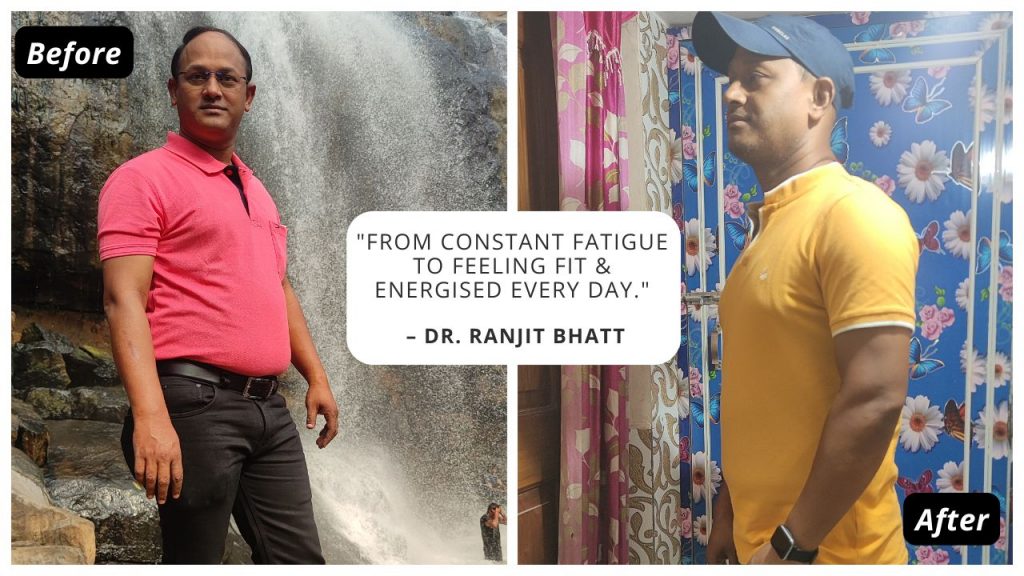 Dr Ranjit Bhatt has spent years tending to others. A practising doctor in Odisha, his days were packed with patients, surgeries, and emergencies. From the outside, it looked like a life lived in service. But on the inside, something wasn’t right.