
GOQii

Blog

  • HOME
  • HEALTHY LIVING
  • FITNESS
  • HEALTHY RECIPES
  • USER STORIES
  • KARMA
  • BUY GOQii

April 23, 2026 By GOQii Leave a Comment

The GOQii India Fit Report 2026: Why Living Longer Isn’t Enough Anymore

“India is living longer than ever before. That should be a moment of national pride, and it is. But here’s the uncomfortable truth: living longer is not the same as living well. For too many Indians, the last 10 to 12 years of life are spent fighting preventable disease, relying on medication, or depending on family for the simplest daily tasks. That is not the future any of us want.” – Vishal Gondal, Founder & CEO, GOQii

India stands at a pivotal moment in its health journey. In 1975, the average Indian lived to 52. Today, life expectancy has crossed 70, adding nearly two extra decades within a single generation. However, the newly released GOQii India Fit Report 2026 reveals an uncomfortable reality: while lifespan has increased, our “healthspan” the years we live in good physical, mental, and emotional health has not kept pace.

It is time to rethink what healthy ageing actually looks like in modern India.

Quick Takeaways: The Healthspan Gap

  • The 12-Year Deficit: Life expectancy in India is ~70.4 years , but Healthy Life Expectancy (HALE) is only ~59 years. Indians lose almost 12 years of healthy life to chronic illness or disability.
  • The Ageing Population: By 2050, one in five Indians, nearly 300 million people, will be over 60.
  • The True Threat: 63% of deaths in India are from Non-Communicable Diseases (NCDs).
  • The Good News: 80% of premature heart disease and diabetes is entirely preventable.

What is the Healthspan Gap?
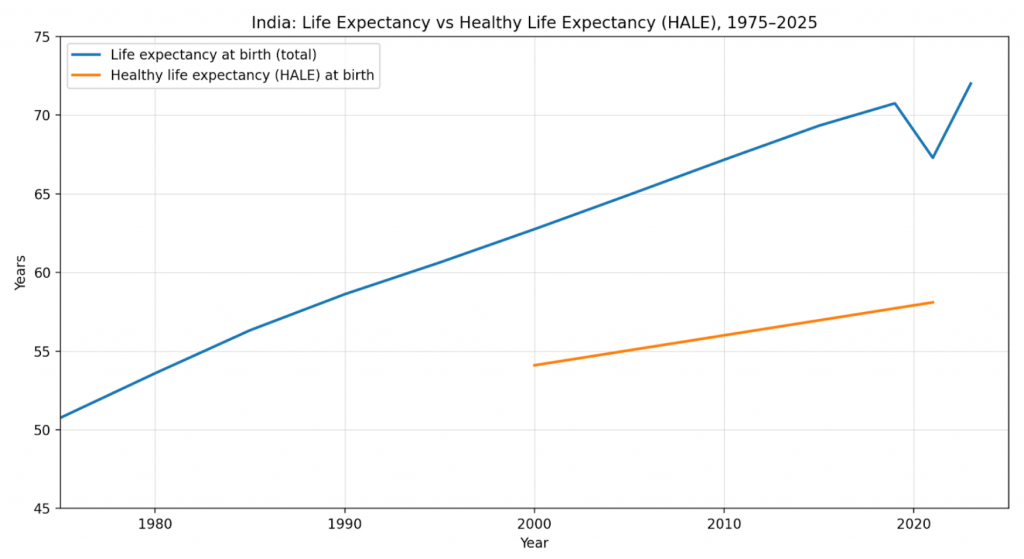
Ageing itself is a sign of progress. The real challenge we face is unhealthy ageing. The healthspan gap is the distance between how long we live and how well we live.

This gap does not happen by accident. We reward productivity and punish rest. Stress, poor sleep, sedentary work, and irregular diets have been completely normalised. Healthcare remains treatment-centric rather than prevention-led.

The Life-Stage Map: Healthspan is Not Built at 60
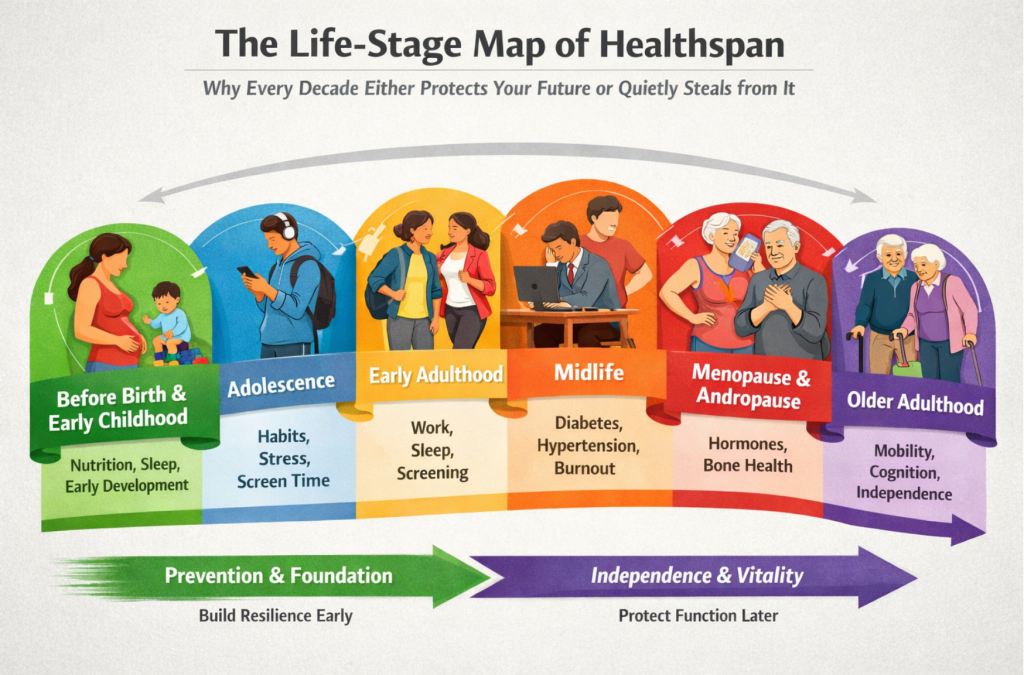
Perhaps the biggest misconception about lifestyle disease is that it is an old-age issue. Healthspan is not built at 60. It is built quietly and cumulatively across decades. Here is how healthspan is won or lost at every stage of life:

  • Adolescence (Where Habits Harden): This is the period when risks like long sedentary time, sleep disruption, poor diets, and emotional stress quietly rise. Health behaviours begin to harden into identity.
  • Early Adulthood (The “I’m Fine” Decade): In our 20s and 30s, weight gain feels manageable and poor sleep feels like a phase. Yet, this is exactly when insulin resistance, rising blood pressure, and inflammation begin to quietly accumulate .
  • Midlife (The Tipping Point): For most Indians, working life is the biggest driver of healthspan loss. Midlife is where silent epidemics like diabetes, hypertension, obesity, and high cholesterol begin to surface.
  • Menopause and Andropause: For women, the menopause transition changes metabolism, muscle mass, bone density, cardiovascular risk, sleep quality, and emotional regulation. Without guidance, it leads to accelerated weight gain and bone loss; with guidance, it can become a powerful health stabiliser.
  • Older Adulthood (Independence is the Goal): Old age does not automatically lead to decline. The most meaningful measures of healthy ageing here are functional: Can you walk independently? Can you climb stairs without fear?

The Rise of “Silent” Epidemics and Multi-Morbidity

The illnesses shortening our healthspan rarely announce themselves with sudden panic. High blood pressure rarely causes discomfort until it damages the heart, kidneys, or brain. High cholesterol builds arterial plaque silently over years.

The true threat is how these conditions compound over time, a process known as multi-morbidity. It follows a predictable chain: Sedentary Lifestyle → Weight Gain, Obesity → Diabetes Risk → Heart Disease. By the time multiple conditions take hold, healthspan shrinks rapidly.

The Hidden Costs of Ignoring Healthspan
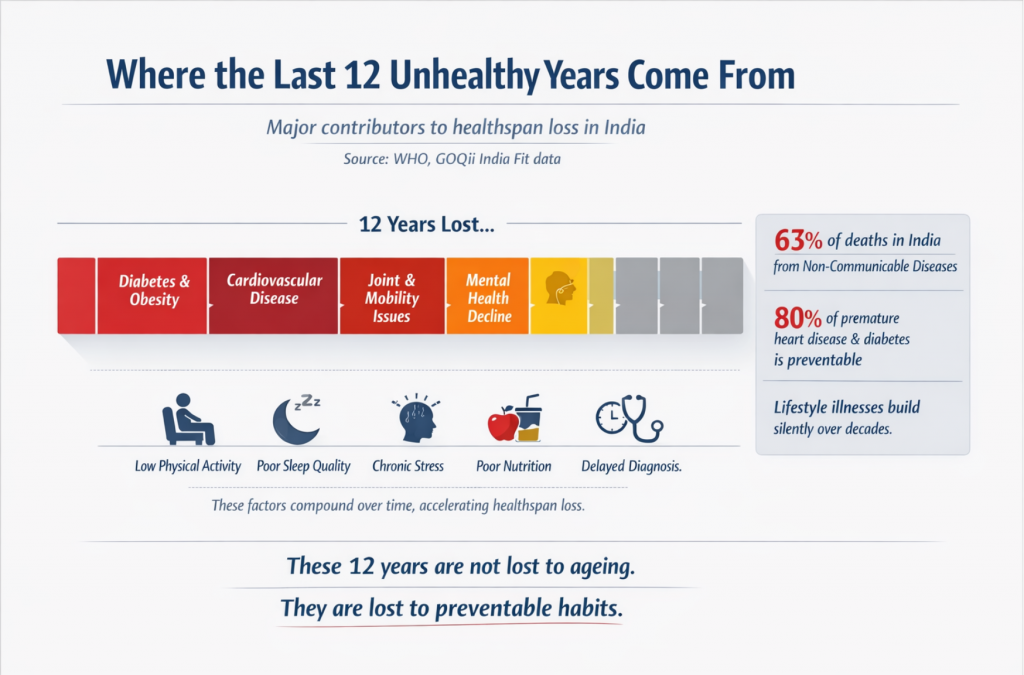
When healthspan is neglected, the costs are borne not just by individuals but by families, workplaces, and the national economy:

  • The Caregiving Burden: Chronic illness in older age often shifts care responsibility to family members, most commonly women. This unpaid caregiving leads to lost income and emotional burnout.
  • Workforce Exits: Early onset of lifestyle diseases forces many adults to exit the workforce years before retirement age.
  • Healthcare Strain: Managing advanced diabetes, heart disease, kidney failure, and stroke consumes far more resources than preventing them.

Reclaim Your Healthspan

The GOQii India Fit Report 2026 calls for a decisive shift: from lifespan as a metric to healthspan as a goal.

Prevention does not require extreme discipline or perfect routines. It requires consistency. Ten minutes of daily movement is more powerful than an hour once a week, and stable sleep routines outperform weekend recovery. Healthspan is shaped by what you do on your most average days.

Are you ready to see where you stand and how you can protect your future?

Click Here to Download the GOQii India Fit Report 2026 to explore the complete data, uncover national trends on stress, sleep, and nutrition, and learn how to take charge of your health today.

Frequently Asked Questions (FAQs)

  1. What is the difference between lifespan and healthspan?

Lifespan refers to the total number of years a person lives. Healthspan refers to the number of those years lived in good physical, mental, and emotional health, free from chronic disease and disability. While India’s life expectancy is ~70.4 years, our healthy life expectancy is only ~59 years.

  1. What are the biggest threats to healthspan in India?

The biggest threats are “silent epidemics” or non-communicable diseases (NCDs) like diabetes, hypertension, obesity, and high cholesterol. These are heavily driven by lifestyle factors such as chronic stress, sedentary behavior, and poor sleep.

  1. When should I start worrying about healthy ageing?

Healthy ageing begins long before retirement. Habits formed in adolescence and early adulthood (like sleep routines and daily movement) dictate your metabolic risk in midlife. The earlier you focus on preventive health, the longer your healthspan will be.

#BeTheForce

Disclaimer: The content provided in this blog, including all statistics, insights, and recommendations, is based on the findings of the GOQii India Fit Report 2026 . This information is intended for educational and general informational purposes only and should not be construed as professional medical advice, diagnosis, or treatment. Every individual’s health journey is unique. Always consult with a qualified healthcare provider or a certified medical professional before making any significant changes to your diet, exercise routine, sleep schedule, or lifestyle, especially if you have pre-existing medical conditions.

March 21, 2026 By GOQii Leave a Comment

The Future of Longevity in India: Why Healthspan is the New Lifespan

For decades, the ultimate goal of modern medicine was simple: help people live longer. And by most metrics, we have succeeded. Thanks to advancements in medical science and technology, the average life expectancy in India has surged over the past few decades. But as we celebrate these extra years on our calendars, a new, more urgent question has emerged: Are we actually living better, or are we just taking longer to die?
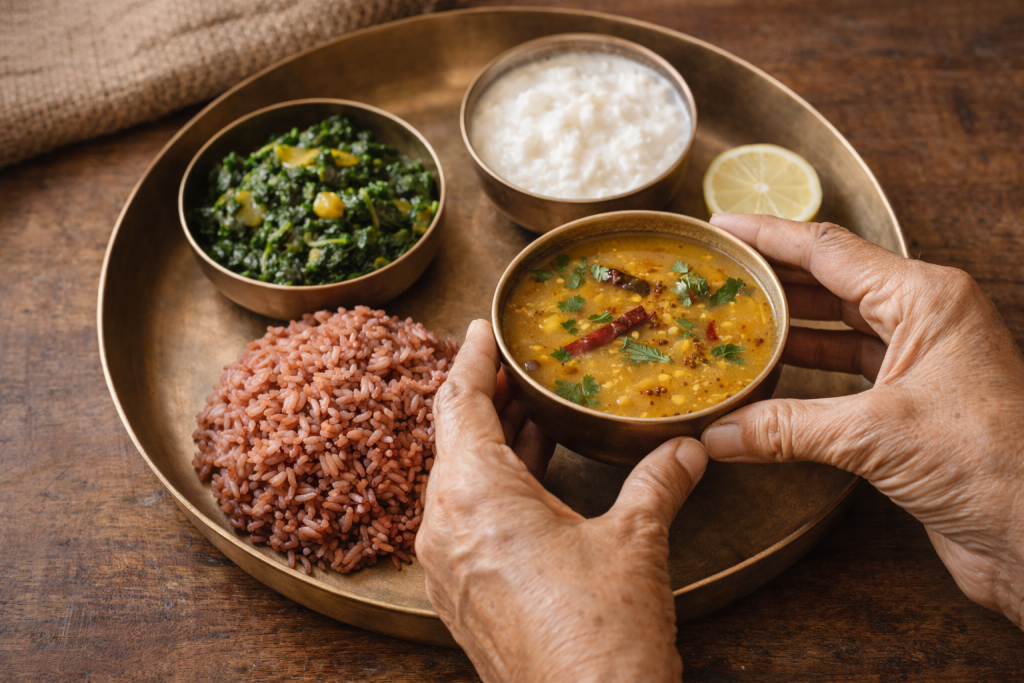
This question is actively reshaping the landscape of Longevity in India. The conversation is no longer just about adding years to our lives; it is about adding life to our years. Welcome to the era where Healthspan is the new Lifespan.

The Lifespan Paradox in India

Lifespan refers to the total number of years a person is alive. Healthspan, on the other hand, refers to the period of life spent in good health, free from chronic diseases and debilitating age-related conditions.

Currently, India is facing a “Lifespan Paradox.” While we are living longer, a significant portion of our later years is often spent battling lifestyle conditions like Type 2 diabetes, cardiovascular diseases, and declining mobility. If a person lives to be 85 but spends the last 15 years managing severe chronic illnesses, their lifespan is long, but their healthspan is critically compromised.

Why Healthspan is the New Focus

The future of healthcare is shifting from reactive (treating you when you get sick) to preventive (optimizing your health so you don’t get sick in the first place). Here is why focusing on healthspan is the ultimate longevity strategy:

  • Quality over Quantity: A high healthspan means you retain your independence, cognitive function, and physical mobility well into your 70s, 80s, and beyond. It means playing with your grandchildren, traveling, and living actively, rather than being confined to hospital visits.
  • Economic Impact: Chronic disease management takes a massive financial toll on families. Maximizing healthspan reduces long-term medical costs and reliance on the healthcare system.
  • Mental and Emotional Wellbeing: Physical decline takes a heavy toll on mental health. Maintaining vitality protects against age-related depression and cognitive decline.

The Future of Longevity in India: Proactive, Not Reactive

The longevity landscape in India is undergoing a massive transformation, driven by technology and a growing awareness of preventive wellness:

  • Wearable Technology & Data: Devices like GOQii smart trackers are putting the power of continuous monitoring into the hands of the consumer. Tracking your sleep architecture, resting heart rate, and daily movement is the first step in extending your healthspan.
  • Personalised Nutrition: The one-size-fits-all diet is dead. The future is about understanding how your unique biology responds to food, focusing on blood sugar management, and preventing metabolic syndrome.
  • Focus on Muscle Mass: Sarcopenia (the age-related loss of muscle mass) is a silent healthspan killer. The fitness narrative in India is successfully shifting from just “losing weight” to building lean muscle and improving bone density through strength training.

4 Ways to Maximize Your Healthspan Today

You do not need to wait for futuristic anti-aging pills to start increasing your healthspan. The foundation is built on daily habits:

  1. Prioritize Metabolic Health: Limit refined sugars and processed foods. A stable blood sugar level is one of the strongest predictors of a long, disease-free life.
  2. Move for Mobility, Not Just Calorie Burn: Incorporate strength training to protect your joints and maintain muscle mass, alongside daily steps for cardiovascular health.
  3. Protect Your Sleep: Deep sleep is when your brain clears out toxins and your cells repair themselves. Chronic sleep deprivation directly accelerates biological aging.
  4. Manage Chronic Stress: Prolonged cortisol exposure creates systemic inflammation in the body, which is the root cause of almost all age-related diseases. Daily meditation or mindfulness is a non-negotiable longevity tool.

Frequently Asked Questions (FAQs)

What is the difference between lifespan and healthspan?
Lifespan is the total number of years you live, regardless of your health condition. Healthspan is the number of years you live in optimal health, free from chronic disease and physical decline.

Can you increase your healthspan at any age?
Yes. Whether you are 30 or 60, adopting preventive lifestyle habits such as strength training, a nutrient-dense diet, and stress managementcan immediately begin to improve your metabolic health and increase your functional years.

How is longevity tracking changing in India?
With the rise of preventive healthcare ecosystems and smart wearables, Indians can now track their biological age, heart health, and sleep quality in real-time, allowing for early interventions long before chronic diseases develop.

Are you ready to optimize your healthspan and take control of your future? For personalized guidance on nutrition, fitness, and healthy aging, consult a certified expert by subscribing to GOQii’s Personalised Health Coaching here.

#BeTheForce

Disclaimer: The information provided in this blog is for general awareness and educational purposes only. It is not intended to replace professional medical advice, diagnosis, or treatment. Always consult a qualified healthcare provider for personalised medical guidance or concerns related to your health. Images shown are for representation purposes only and may not depict the exact recommendations or outcomes.

February 2, 2026 By GOQii Leave a Comment

The Longevity Plate: A Guide to Assembling a Functional Diet at 80 Years Old

Most dietary advice seems to be fixated on labels: “keto”, “vegan”, “paleo”, “low fat”, “high protein”, “clean eating.”



But let’s be honest. If your actual aim in eating better is to be 80 years old and still be able to climb stairs, carry groceries, get up from the floor, and travel with confidence, then you must look at food through another filter.

Longevity food isn’t about looking like you’re following a strict plan on Instagram. It is about defending two things that ageing takes first: Muscle Mass and Metabolic Flexibility.

The meal that helps you accomplish that objective is not deserving of a name. It is deserving of a structure.

Here are the 5 Non-Negotiables for a longevity plate. These can be incorporated into an everyday Indian diet without turning your kitchen into a laboratory.

  1. Protein Target: Your “Retirement Fund”

Past middle age, muscle tissue has a purpose that reaches beyond strength. It is your glycogen storehouse, your stabiliser, and your protector against frailty. Older people actually need more protein than the standard recommendations.

While studies suggest at least 1.0 to 1.2 g/kg/day for those over 65, it should be higher if you are physically active.

Make It Practical:

  • Target a protein intake of 25 to 35 grams in a major meal most days.
  • Do not flood the dinner plate. Distribute protein throughout the day to send your body the repeated signal to build muscle.

Indian Plate Examples:

  • Dal + Curd: Add a bowl of sabzi and top with a tsp of roasted seeds or peanuts.
  • Paneer or Tofu Bhurji: Mix with veggies and have with one roti.
  • Eggs: Scrambled with sautéed greens and a serving of sprouts.
  • Non-Veg: Fish or chicken with plenty of curry veggies; go easy on the rice/roti.
  1. Colour Variety: Micronutrients Run the System

To make a longevity plate look like it’s had a life, you must include greens, reds, oranges, and purple foods. Colour is a shortcut for diversity in nutrients—polyphenols, carotenoids, and folate—that support your heart, brain, and immune system.

Make It Practical:

  • Aim for 3 colours in a single meal (not just in a week).
  • Use what is local and seasonal. It is less expensive and more nutritious.

Indian Plate Examples:

  • Palak or methi, tomato, and carrots in one mixed sabzi.
  • Beetroot raita with cucumber and sautéed capsicum.
  • Vegetable sambar with drumstick, pumpkin, and brinjal.
  • Fruits: Berries are great, but so are Guava, Amla, Jamun, and Pomegranate.
  1. Slow Carbs: Stable Sugar Protects Your Future Self

Carbs don’t make you fat. Fast, refined carbs are the problem. They act like sugar in your system, forcing insulin levels on a rollercoaster ride. Harvard guidelines specifically recommend whole grains over refined ones to prevent rapid blood sugar spikes.

Make It Practical:

  • Choose one slow carb per meal, NOT five sources of carbs in one sitting.
  • This is not calorie counting. This is glycaemic common sense.

Better Slow Carb Choices:

  • Millets (Jowar, Bajra, Ragi), Brown Rice, Quinoa, or Oats.
  • Legumes: Chana, Rajma, Lobia, and Lentils (these count as both protein and slow carbs!).
  • Sweet potato instead of white bread/aloo when you can.
  1. Anti-Inflammatory Spices: Managing the “Background Noise”

Low-grade chronic inflammation is associated with almost every age-related disease. Spices won’t replace medical treatment, but they are the simplest, most powerful daily “input” you can make.

Curcumin (in Turmeric) has been clinically proven to fight oxidative stress.

Make It Practical:

  • Consume Turmeric + Black Pepper + Fat (ghee/oil) regularly. The pepper helps absorption by 2000%.
  • Think of spices as everyday protective maintenance, not just flavour.

Easy Additions:

  • Ginger-Garlic paste in generous amounts for curries.
  • Cinnamon in your morning oats or curd bowl.
  • Jeera, Ajwain, Hing for digestion.
  1. Fermented Foods: Train Your Gut

If you wish to age well, you must have a gut that is resilient to stress, antibiotics, and travel. A Stanford Medicine study revealed that a high-fermented-food diet increased microbiome diversity and reduced inflammation.

Make It Practical:

  • Add a little bit a day. You don’t need a massive “cleanse.”
  • “Fermented food is not about a trend. It is about resilience.”

Indian Friendly Options:

  • Curd, Chaas, Lassi (without added sugar).
  • Idli & Dosa batter (properly fermented).
  • Kanji: The traditional tangy probiotic drink made from black carrots/beetroot and mustard seeds.

Putting It All Together: The Check-In

Do this quick check at each main meal:

  1. Where is my Protein?
  2. Where are my Colours?
  3. What is my Slow Carb (and is it portioned)?
  4. Did I add Spices?
  5. Where is the Fermented part?

You will notice something: This method crowds out ultra-processed foods without you having to fight yourself.

Eat For Capability, Not Control

The biggest nutrition myth is that ageing is controlled by willpower. It is controlled by systems.

The Longevity Plate is a system you can replicate in any city, any cuisine, and at any price range. Put that plate together most days of the week, and you’re not just eating for the next weigh-in. You’re eating for the “You” at 80 who still has a life to live.

Need help building a diet plan that fits your lifestyle? Reach out to our certified experts by subscribing to GOQii’s Personalised Health Coaching here.

#BeTheForce

Disclaimer: The information provided in this blog is for general awareness and educational purposes only. It is not intended to replace professional medical advice, diagnosis, or treatment. Always consult a qualified healthcare provider for personalised medical guidance or concerns related to your health.

Search

Recent Posts

  • 10 Everyday Habits That Could Be Hurting Your Health
  • Why Good Nutrition Matters: Benefits of Healthy Eating for a Healthy Life
  • Monsoon Health Tips: How to Boost Your Immunity During Seasonal Changes
  • Yoga for Healthy Ageing: Simple Practices to Add Life to Your Years
  • Calming Your Mind: Breathing Techniques for ADHD

Stay Updated

Archives

  • June 2026 (22)
  • May 2026 (20)
  • April 2026 (24)
  • March 2026 (18)
  • February 2026 (14)
  • January 2026 (14)
  • December 2025 (19)
  • November 2025 (15)
  • October 2025 (20)
  • September 2025 (6)
  • August 2025 (6)
  • July 2025 (11)
  • June 2025 (18)
  • May 2025 (16)
  • April 2025 (22)
  • March 2025 (27)
  • February 2025 (21)
  • January 2025 (25)
  • December 2024 (22)
  • November 2024 (23)
  • October 2024 (20)
  • September 2024 (23)
  • August 2024 (29)
  • July 2024 (20)
  • June 2024 (25)
  • May 2024 (26)
  • April 2024 (27)
  • March 2024 (27)
  • February 2024 (23)
  • January 2024 (21)
  • December 2023 (14)
  • November 2023 (10)
  • October 2023 (19)
  • September 2023 (22)
  • August 2023 (18)
  • July 2023 (21)
  • June 2023 (23)
  • May 2023 (20)
  • April 2023 (19)
  • March 2023 (23)
  • February 2023 (19)
  • January 2023 (15)
  • December 2022 (11)
  • November 2022 (15)
  • October 2022 (15)
  • September 2022 (12)
  • August 2022 (10)
  • July 2022 (17)
  • June 2022 (11)
  • May 2022 (10)
  • April 2022 (6)
  • March 2022 (6)
  • February 2022 (13)
  • January 2022 (11)
  • December 2021 (7)
  • November 2021 (3)
  • October 2021 (6)
  • September 2021 (3)
  • August 2021 (8)
  • July 2021 (7)
  • June 2021 (15)
  • May 2021 (16)
  • April 2021 (10)
  • March 2021 (7)
  • February 2021 (4)
  • January 2021 (4)
  • December 2020 (3)
  • November 2020 (4)
  • October 2020 (10)
  • September 2020 (3)
  • August 2020 (3)
  • July 2020 (2)
  • June 2020 (4)
  • May 2020 (10)
  • April 2020 (12)
  • March 2020 (10)
  • February 2020 (4)
  • January 2020 (4)
  • December 2019 (3)
  • November 2019 (7)
  • October 2019 (5)
  • September 2019 (4)
  • August 2019 (9)
  • July 2019 (9)
  • June 2019 (11)
  • May 2019 (4)
  • April 2019 (8)
  • March 2019 (8)
  • February 2019 (9)
  • January 2019 (8)
  • December 2018 (9)
  • November 2018 (3)
  • October 2018 (3)
  • September 2018 (5)
  • August 2018 (10)
  • July 2018 (6)
  • June 2018 (13)
  • May 2018 (8)
  • April 2018 (18)
  • March 2018 (9)
  • February 2018 (8)
  • January 2018 (15)
  • December 2017 (12)
  • November 2017 (19)
  • October 2017 (13)
  • September 2017 (15)
  • August 2017 (4)
  • July 2017 (8)
  • June 2017 (7)
  • May 2017 (6)
  • April 2017 (8)
  • March 2017 (6)
  • February 2017 (7)
  • January 2017 (9)
  • December 2016 (10)
  • November 2016 (7)
  • October 2016 (7)
  • September 2016 (7)
  • August 2016 (11)
  • July 2016 (9)
  • June 2016 (9)
  • May 2016 (12)
  • April 2016 (17)
  • March 2016 (17)
  • February 2016 (8)
  • January 2016 (6)
  • December 2015 (2)
  • November 2015 (9)
  • October 2015 (7)
  • September 2015 (9)
  • August 2015 (11)
  • July 2015 (9)
  • June 2015 (11)
  • May 2015 (9)
  • April 2015 (13)
  • March 2015 (8)
  • February 2015 (5)
  • January 2015 (12)
  • December 2014 (14)
  • November 2014 (11)
  • October 2014 (6)
  • September 2014 (13)
  • August 2014 (12)
  • July 2014 (6)
  • June 2014 (2)
  • May 2014 (7)
  • April 2014 (4)

From Shimla’s Slopes to Chandigarh’s Sidewalks: Surinder Kaur Bhalla’s Journey from Chaos to Control

Some journeys start with a plan. Others begin with a stumble literally. Surinder Bhalla, a government professional, born and raised in the scenic hill town of Shimla, had always lived a life of movement. “In Shimla, you walked everywhere,” she reflects. … [Read More...]

From “Laddu Nawin” to Fit and Fierce: How a 25-Year-Old Insurance Advisor Shed 20 Kilos and Gained His Life Back

When 25-year-old Nawin Yadav from Hyderabad walked into his office every morning, he carried more than just his files and policy papers. He had the weight of fatigue, sluggish energy, and an ever-growing belly that was becoming the butt of jokes. “People had even started calling me Laddu Nawin,” he says with a laugh, but […]

From Burnout to Balance: How Dr. Ranjit Reclaimed His Health

Dr Ranjit Bhatt has spent years tending to others. A practising doctor in Odisha, his days were packed with patients, surgeries, and emergencies. From the outside, it looked like a life lived in service. But on the inside, something wasn’t right. “I had no control over my schedule. I’d sleep late, eat at odd hours, […]

Ananda Mukherjee Health Story

From Terminal Illness To Complete Wellness! Ananda Mukherjee Health Story

As we observe World Cancer Day under the powerful theme ‘United by Unique’ (2025-2027)**, we are reminded that every individual’s journey with cancer is distinct, yet united by shared resilience, hope, and the collective fight against this disease. This theme places people at the centre of care and their stories at the heart of the […]

  • HOME
  • HEALTHY LIVING
  • FITNESS
  • HEALTHY RECIPES
  • USER STORIES
  • KARMA
  • BUY GOQii

Copyright ©2016 GOQii
