GOQii

Blog

  • HOME
  • HEALTHY LIVING
  • FITNESS
  • HEALTHY RECIPES
  • USER STORIES
  • KARMA
  • BUY GOQii

October 3, 2025 By Nilakhi Nath Leave a Comment

4 Reasons Why Rest Is As Important As Training

4 Reasons Why Rest Is As Important As TrainingOur world is becoming healthier with people opting for a healthier lifestyle that involves clean eating and staying active. The first attempt to keep ourselves healthy begins by being active. However, being active also means taking good rest after any physical activity. Our body requires a rest period between our workout days. But, there are a few who tend to overdo it. You may see this group of people working out all seven days intensely without a rest day.

Why Is Rest So Important?

Rest means a state when the body is inactive. Inactivity helps the body relax and gives it time to recover strength after any kind of exertion. Our body requires rest because every time we workout, we are tearing our muscles and continuous workout without a rest period may cause further injury to the muscles.

Why Is It Important To Rest After Training?

Resting your body helps in repairing and healing of the torn muscle fibers and enhances the performance. If you don’t rest, you could be prone to facing any of the issues below:

  1. Injuries & drop in performance: Muscle sustains tiny tears when we workout. Rest after training helps in healing those tears. When we do not give rest to the muscle and over-train, then it leads to serious injuries. What happens when you do not sleep for more than 24 hours? You are drowsy, concentration drops and so does your performance. This is exactly what happens with your body when you over train it. The performance drops due to injuries and inadequate rest of the muscles.
  2. Longer recovery time: Due to over training of a muscle, the amount of time taken for recovery increases. If you are working out 4-5 days a week and taking rest for 2-3 days, the time taken to recover is shorter. Whereas, when you do not take rest, the body needs extra time to repair the damages caused by over training. Bigger the damage, longer the recovery time. You can keep your rest period short by taking adequate rest in between your training sessions.
  3. Loss of motivation to train: As you over train the muscles, the performance drops and it also affects your motivation level. Due to inadequate rest, the muscle loses the capacity to grow and instead bear severe injuries. These negative changes in the body affect a person’s motivation levels and leads to loss of interest in the training program. With low interest, one might feel forced to do the workout instead of looking forward to it.
  4. Immunity: When your muscles are over trained and injured, the energy reserved for the proper functioning of your immune system is directed towards the repair of the damaged muscles and bones. As a result your immune system doesn’t function optimally.

To train at your optimum level, take a break and relax your muscles. If this article helped you, let us know your thoughts in the comments below. You can find more articles on fitness and training here. You can also speak to our experts to develop a training schedule as per your needs by subscribing to GOQii’s Personalised Health Coaching here.

Train Smart and #BeTheForce 

Disclaimer: The information provided in this blog is for general awareness and educational purposes only. It is not intended to replace professional medical advice, diagnosis, or treatment. Always consult a qualified healthcare provider for personalised medical guidance or concerns related to your health. Images shown are for representation purposes only and may not depict the exact recommendations or outcomes.

September 27, 2025 By GOQii Leave a Comment

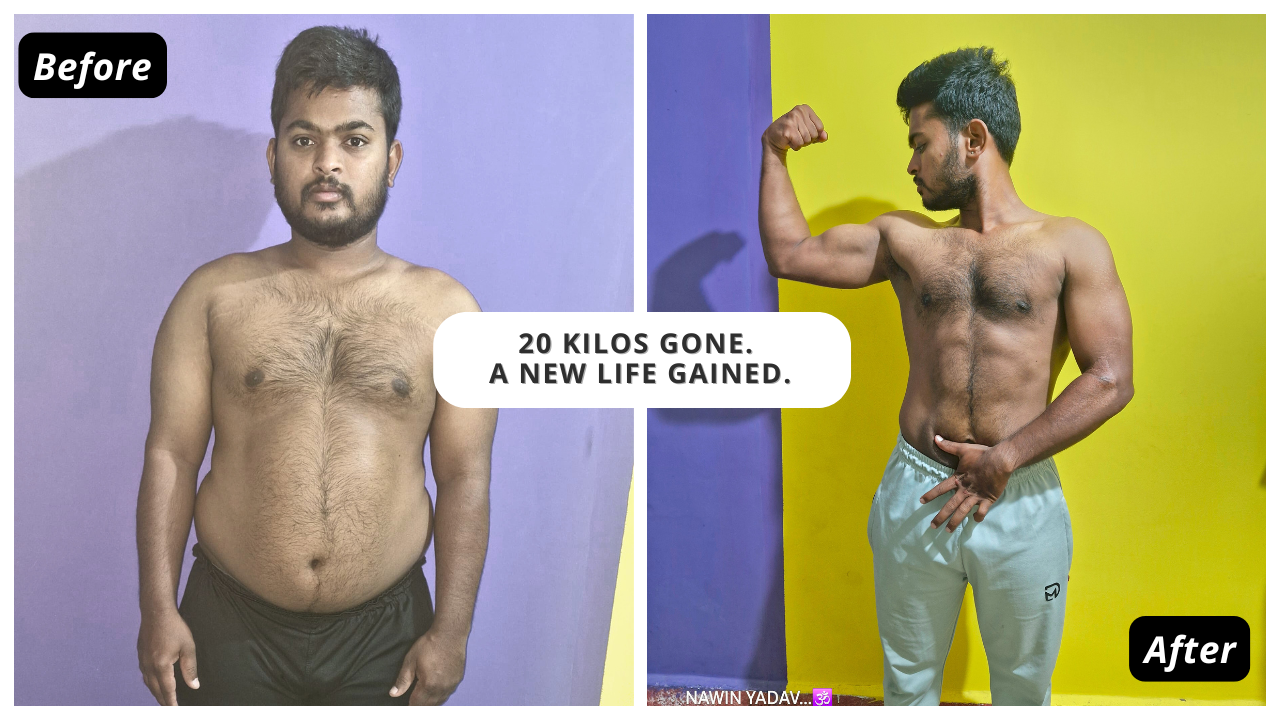
From “Laddu Nawin” to Fit and Fierce: How a 25-Year-Old Insurance Advisor Shed 20 Kilos and Gained His Life Back

When 25-year-old Nawin Yadav from Hyderabad walked into his office every morning, he carried more than just his files and policy papers. He had the weight of fatigue, sluggish energy, and an ever-growing belly that was becoming the butt of jokes.

“People had even started calling me Laddu Nawin,” he says with a laugh, but the sting behind the nickname was real. “I was too fat, my energy was low, and I couldn’t even play a sport for more than two hours. That’s when I realised I had to change something.”

The Breaking Point

As an insurance advisor, Nawin spent long hours sitting at his desk. His meals were mostly idlis, rice, chutney, and endless cups of chai. No thought was given to calories, protein, or regular activity. Slowly, his weight crept up to 82 kilos, his belly expanded to 38 inches, and his energy levels hit rock bottom.

“I knew I wasn’t sick, but my body wasn’t healthy either. I didn’t go to a doctor. I knew the solution was in my lifestyle.”

Last October, Navin was gifted a GOQii Smart Watch. For the first two months, though, it stayed tucked away in his cupboard rather than on his wrist. It wasn’t until January 2025 that he finally unboxed it, activated it with the code, and decided to give it a try. By February, he was paired with a personal coach who began guiding him step by step on his health journey, and that’s when everything started to change.

Enter the Coaches

With Coach Priti Shah guiding him and Expert Coach Arooshi Garg stepping in with advice, Nawin found himself looking at food and fitness in a whole new light.

“What I liked the most was that everything they suggested was regular food from my kitchen,” he explains. “Nothing exotic, nothing fancy. Just learning how to balance macros, include activity, and rest well. They even taught me how to adjust every meal so I wouldn’t feel deprived.”

His coach started him off with simple, achievable changes: a 30-minute daily walk, mindful portion sizes, and tweaks to reduce bloating and improve digestion. Slowly, his sleep improved, his energy picked up, and his waistline began to shrink.

The Transformation

Fast forward a few months- 6 to be precise, and the difference is staggering.

“I’ve dropped 20 kilos. From 82, I’m now around 60–61. My belly went from 38 inches to 30.5. But more than the numbers, it’s the energy and confidence that matter,” says Nawin, his voice lighting up.

His transformation wasn’t just about weight loss. It was about discovering what his body was capable of. He proudly recalls winning a Burnout Challenge at his gym:

  • Plank for 3 minutes 15 seconds
  • Wall sit for 5 minutes and 45 seconds
  • Battle rope for 1 minute 38 seconds
  • 50–70 push-ups, back-to-back

“I never thought I could do this before. Now my body feels solid, my face has changed, and I feel like a completely different person.”

In the beginning, even his gym trainer wasn’t convinced he could turn things around quickly. The trainer told him it would take a year to shed all the extra weight and insisted he cut rice out of his meals. “Being a South Indian, I found that difficult,” Nawin recalls. “Then Coach Priti explained that I didn’t need to cut rice completely. Portion control was the key.”

Family and Friends React

The reactions from his circle have been priceless. “People look at me and say, ‘Is this Nawin or his younger brother?’” he laughs. “They can’t believe the muscular body I’ve built.”

Looking Ahead

Nawin’s current goal is to stay steady at 60 kilos. “I could probably go down to 58kgs, so my abs are more clearly visible,” he chuckles. For him, GOQii wasn’t just about losing weight; it was about discovering a way of living he could sustain for life. “Now I know how to take care of myself. It’s not about dieting, it’s about balance. And that’s what my coaches gave me.”

His journey proves that transformation doesn’t require exotic superfoods or punishing diets. With the right guidance, steady discipline, and consistent effort, even someone once nicknamed Laddu can become an inspiration to others.

As Nawin puts it, “If I can do it, anyone can. You just need to take that first step.”

#BeTheForce 

Disclaimer: The information provided in this blog is for general awareness and educational purposes only. It is not intended to replace professional medical advice, diagnosis, or treatment. Always consult a qualified healthcare provider for personalised medical guidance or concerns related to your health. Images shown are for representation purposes only and may not depict the exact recommendations or outcomes.

April 16, 2025 By Roopa Tandur 1 Comment

6 Tips and Tricks to Help You Stay Motivated

stay motivatedMotivation is a tricky thing. One moment it’s with you, and the next, it vanishes. The enthusiasm you began with slowly fades, and before you know it, your drive to work towards your goal has dwindled. We’ve all been there.



Whether it’s your health, work, or personal goals—staying motivated isn’t just about initial excitement. It’s about creating the conditions for consistency and success. Motivation—be it driven by a desire for better health, more energy, or a sense of achievement—needs a bit more than just enthusiasm.

Factors Which Help One Stay Motivated

While discipline is a key factor, there are many other tips and tricks that can help you stay on track with your goals. Let’s look at them in detail.

1. Set Defined and Realistic Goals
Setting goals that are too ambitious or misaligned with your lifestyle can set you up for failure. Instead, focus on goals that are meaningful to you—not ones based on someone else’s expectations.

Start small and achievable. For example:

  • “I’ll walk for 30 minutes, three days a week”
  • “I’ll begin with 5,000 steps a day”

Jumping to 10,000 steps a day may be overwhelming, while aiming for 1,000 won’t offer much benefit. Keep it challenging, but doable.

2. Break Goals into Smaller Tasks
The mind is often the first barrier. You might find yourself saying, “I just don’t have time.” But big goals are simply small tasks stacked together.

If 30 minutes of exercise seems like too much, break it down:

  • Three 10-minute movement sessions spread through the day
  • A mix of morning walking and stair exercises at work

Little changes go a long way.

3. Make It Fun and Avoid Distractions
Switch up your walking routes. Try new exercises. Add variety to keep things engaging.

And most importantly—avoid comparison. What works for someone else might not work for your body. Stick to the plan tailored for you—especially if you’re working with a health coach.

Involve family, especially kids. Their energy is contagious! You could also go live on social media—it adds positive pressure and builds accountability.

4. Reward Yourself
Celebrate your wins—big or small. Rewards don’t need to be extravagant. A kind message to yourself, a new skipping rope, or even a quiet moment of reflection can be powerful motivators.

Plan these rewards ahead of time—they’ll give you something to look forward to, and they’ll make the journey more enjoyable.

5. Visualise Your Success
Take a moment to picture where you want to be in six months. What does your healthier, stronger self look like?

  • Set that image as your phone wallpaper
  • Stick up a photo of your past self when you felt your best
  • Surround yourself with quotes, music, or visuals that uplift and remind you why you started

Mental imagery is a powerful tool.

6. Know Your Shortcomings—and Challenge Them
Identify your personal roadblocks. Is it snacking? Weekends? Lack of planning?

Then, plan around them:

  • Keep healthy snacks at home
  • Prep your meals in advance to avoid ordering out
  • Choose social settings with healthy options
  • Embrace the sweet pain of new workouts—your body is getting stronger!

New routines take time, and muscle soreness is normal. The trick is to keep going, not give up.

Motivation is easier to build when you mix in a bit of fun and laughter. Whether you’re working out alone or with company, the key is to enjoy the process. Consistency is important, but without joy, the journey can feel like a chore.

So smile more, celebrate your effort—not just the results—and take pride in every step forward.

Even the smallest progress is still progress. Keep showing up. Keep moving. Keep going.

#BeTheForce 

Disclaimer: The information provided in this blog is for general awareness and educational purposes only. It is not intended to replace professional medical advice, diagnosis, or treatment. Always consult a qualified healthcare provider for personalised medical guidance or concerns related to your health.

September 2, 2024 By Vandana Juneja 1 Comment

Strength Training Benefits For Aging Bodies

strength trainingStrength training is essential for everyone, serving not just to enhance muscle strength but also to bolster overall health regardless of age. Whether you are 25 or 65, incorporating some form of strength training into your daily routine is beneficial, though the specifics of the exercises may vary depending on one’s age group.

In this blog post, I will discuss the changes that begin to occur in our bodies as we enter our thirties and forties—changes that are often less than welcome. More importantly, I’ll explore how strength training plays a crucial role in counteracting these changes and significantly enhancing the quality of our lives.

I have experienced the positive changes, that my body has undergone over the last 4-5 years, just by incorporating a strength training routine in the form of workouts with weights, and using my own body weight, as I do in my yoga practice. One can even use resistance bands, the various gym equipment, or own body weight for resistance, by doing push-ups, pull-ups, crunches, leg squats or push-ups against a wall etc.

What Happens As We Age?

The human body goes through changes as we age, and some of the effects are obvious, as we cross middle age. Even healthy, normal ageing includes:

  • A Slower metabolism
  • Decreased muscle mass and strength
  • Increased body fat
  • Reduced bone density
  • Increased bone porosity
  • Stiff joints
  • Slower reflexes and reaction times
  • Decreased aerobic capacity

These are normal changes that we may experience as we age, though the severity varies from person to person. One of the most important reasons to exercise, and specifically include strength training, is to slow and minimize these changes.  

Benefits of Strength Training

1. Increases Muscle Mass
As you age, muscle mass gradually decreases – a condition known as Sarcopenia. Individuals who are less active can expect to lose between 3% to 5% of their muscle mass each decade after turning 30, with this rate accelerating after age 65. By age of 70, the average adult may have lost up to 25% of their muscle mass primarily due to disuse and inactivity. However, this loss isn’t irreversible. Engaging in any form of exercise can help regain muscle mass and strength, but weight lifting, strength training, and resistance training are particularly effective. Research shows that after just six months of strength training twice a week, the biochemical, physiological, and genetic characteristics of older muscles can be rejuvenated by nearly 15 to 20 years.

2. Improves Bone Health
Bone fractures and breaks are quite prevalent among older adults due to decreased bone density and osteoporosis. While there are various causes of osteoporosis that may require medical intervention, substantial evidence suggests that exercise can significantly enhance bone density. Moreover, osteoporosis can be both prevented and managed through strength training. Just as muscles grow stronger with activity, bones also gain strength when engaged in physical exercise. Weight-bearing exercises, in particular, bolster bone health by stimulating the production of new cells.

3. Improves Functional Ability/Movement
Increasing strength through training is crucial for enhancing everyday functionality. Regular strength training enables older adults to enhance their mobility, walk longer distances, and potentially decrease their reliance on assistive devices such as canes and walkers.

Additionally, building strength supports a variety of functional movements, including walking, sitting down and standing up from chairs or beds, climbing stairs or escalators, and carrying groceries. These improvements in physical capabilities make daily life more manageable and empower individuals to engage in a wider range of activities that they desire to pursue.

4. Increases Metabolism
Strength training is highly effective for enhancing your metabolism, which is the rate at which your body burns calories while at rest. Engaging in strength training causes your body to require more energy based on the intensity of the exercise. This not only leads to calories being burned during the workout but also increases calorie burn after the workout as your body returns to a resting state. Additionally, hormones like Testosterone and DHEA, which are vital for strength and energy, naturally decrease with age. However, regular strength training can significantly boost these hormone levels within 8-12 weeks.

5. Improves Brain Health
Aging can increase the risk of loneliness, social isolation, depression, and other mental health challenges. However, building strength enhances mobility and functionality, which can significantly improve overall health, elevate mood, and enhance the quality of life. Additionally, resistance training has been shown to slow cognitive decline associated with aging. Studies indicate that lifting weights can improve memory, attention span, and conflict resolution skills.

6. Improves Health Conditions
Type 2 Diabetes: Strength training effectively lowers blood sugar levels and enhances insulin sensitivity. This improvement helps facilitate the transport of blood sugar into cells, thereby optimizing how the body utilizes glucose.

Cardiovascular Health: When properly executed, strength training benefits both the muscular and cardiovascular systems. Strengthened muscles reduce the workload on the heart, enabling the lungs to process oxygen more efficiently with less effort. This efficiency leads to the heart pumping more blood with fewer beats, which in turn increases the blood supply to the muscles.

How Often Should You Do It? 

It is recommended to engage in strength training three to five times per week for 20 to 30 minutes at a moderate intensity or two to three times per week for 15 to 20 minutes at a high intensity. However, always consult your doctor before starting any workout regimen, particularly if you have any pre-existing medical conditions, and seek professional guidance to ensure the correct technique. This helps in preventing injuries and maximizing the benefits of your workouts, especially when focusing on larger muscle groups which offer greater returns.

Let’s move beyond using age as an excuse and start prioritizing muscle health to enhance both our physical health and psychological well-being!

We hope this article helps you care for your muscles a little more and helps you improve your physical and psychological well-being as well. If you’re about to begin your strength training routine or need help, speak to a certified expert by subscribing to GOQii’s Personalised Health Coaching here.

Want to explore more articles on fitness? Click here.

#BeTheForce

  • 1
  • 2
  • 3
  • 4
  • Next Page »

Search

Recent Posts

  • India Leads in Longevity: GOQii Sanjeevini Named Top 40 in $101M XPRIZE
  • The Importance Of Knowing If You’re Thirsty Or Hungry
  • Best Foods To Alleviate Irritable Bowel Syndrome
  • ALL ABOUT VERTIGO!
  • PCOS and Anxiety: Discover Relief with the 54321 Technique

Stay Updated

Archives

  • December 2025 (8)
  • November 2025 (15)
  • October 2025 (20)
  • September 2025 (6)
  • August 2025 (6)
  • July 2025 (12)
  • June 2025 (18)
  • May 2025 (16)
  • April 2025 (23)
  • March 2025 (23)
  • February 2025 (22)
  • January 2025 (26)
  • December 2024 (26)
  • November 2024 (25)
  • October 2024 (22)
  • September 2024 (24)
  • August 2024 (31)
  • July 2024 (21)
  • June 2024 (26)
  • May 2024 (31)
  • April 2024 (27)
  • March 2024 (29)
  • February 2024 (26)
  • January 2024 (25)
  • December 2023 (15)
  • November 2023 (11)
  • October 2023 (20)
  • September 2023 (22)
  • August 2023 (20)
  • July 2023 (22)
  • June 2023 (24)
  • May 2023 (24)
  • April 2023 (24)
  • March 2023 (23)
  • February 2023 (20)
  • January 2023 (16)
  • December 2022 (12)
  • November 2022 (15)
  • October 2022 (15)
  • September 2022 (12)
  • August 2022 (10)
  • July 2022 (17)
  • June 2022 (11)
  • May 2022 (10)
  • April 2022 (6)
  • March 2022 (6)
  • February 2022 (13)
  • January 2022 (12)
  • December 2021 (7)
  • November 2021 (3)
  • October 2021 (6)
  • September 2021 (3)
  • August 2021 (8)
  • July 2021 (7)
  • June 2021 (15)
  • May 2021 (16)
  • April 2021 (10)
  • March 2021 (7)
  • February 2021 (4)
  • January 2021 (4)
  • December 2020 (3)
  • November 2020 (4)
  • October 2020 (10)
  • September 2020 (3)
  • August 2020 (3)
  • July 2020 (2)
  • June 2020 (4)
  • May 2020 (10)
  • April 2020 (12)
  • March 2020 (10)
  • February 2020 (4)
  • January 2020 (4)
  • December 2019 (3)
  • November 2019 (7)
  • October 2019 (5)
  • September 2019 (4)
  • August 2019 (9)
  • July 2019 (9)
  • June 2019 (11)
  • May 2019 (4)
  • April 2019 (9)
  • March 2019 (8)
  • February 2019 (9)
  • January 2019 (8)
  • December 2018 (9)
  • November 2018 (3)
  • October 2018 (3)
  • September 2018 (5)
  • August 2018 (10)
  • July 2018 (6)
  • June 2018 (13)
  • May 2018 (8)
  • April 2018 (18)
  • March 2018 (9)
  • February 2018 (8)
  • January 2018 (15)
  • December 2017 (12)
  • November 2017 (19)
  • October 2017 (13)
  • September 2017 (15)
  • August 2017 (4)
  • July 2017 (8)
  • June 2017 (7)
  • May 2017 (6)
  • April 2017 (8)
  • March 2017 (6)
  • February 2017 (7)
  • January 2017 (9)
  • December 2016 (10)
  • November 2016 (7)
  • October 2016 (7)
  • September 2016 (7)
  • August 2016 (11)
  • July 2016 (9)
  • June 2016 (9)
  • May 2016 (12)
  • April 2016 (17)
  • March 2016 (17)
  • February 2016 (8)
  • January 2016 (6)
  • December 2015 (2)
  • November 2015 (9)
  • October 2015 (7)
  • September 2015 (9)
  • August 2015 (11)
  • July 2015 (9)
  • June 2015 (12)
  • May 2015 (9)
  • April 2015 (13)
  • March 2015 (8)
  • February 2015 (5)
  • January 2015 (12)
  • December 2014 (14)
  • November 2014 (11)
  • October 2014 (6)
  • September 2014 (13)
  • August 2014 (12)
  • July 2014 (6)
  • June 2014 (2)
  • May 2014 (7)
  • April 2014 (5)

From “Laddu Nawin” to Fit and Fierce: How a 25-Year-Old Insurance Advisor Shed 20 Kilos and Gained His Life Back

When 25-year-old Nawin Yadav from Hyderabad walked into his office every morning, he carried more than just his files and policy papers. He had the weight of fatigue, sluggish energy, and an ever-growing belly that was becoming the butt of jokes. “People … [Read More...]

“I’ve Challenged Myself to Live 100 Years” – The Story of Chandubhai Savani’s Second Chance at Life

At 67, most people start slowing down. Not Chandubhai Savani. A resident of Surat, Chandubhai, thought life was on track. “My life was going well till I had my bypass surgery,” he says. That surgery, back in 2021, was a wake-up call.  Medication was routine, but exercise wasn’t. His diet? What he calls ‘normal.’ “I […]

From Shimla’s Slopes to Chandigarh’s Sidewalks: Surinder Kaur Bhalla’s Journey from Chaos to Control

Some journeys start with a plan. Others begin with a stumble literally. Surinder Bhalla, a government professional, born and raised in the scenic hill town of Shimla, had always lived a life of movement. “In Shimla, you walked everywhere,” she reflects. “Walking was never an exercise. It was just life.” But after shifting to Chandigarh, […]

Ananda Mukherjee Health Story

From Terminal Illness To Complete Wellness! Ananda Mukherjee Health Story

As we observe World Cancer Day under the powerful theme ‘United by Unique’ (2025-2027)**, we are reminded that every individual’s journey with cancer is distinct, yet united by shared resilience, hope, and the collective fight against this disease. This theme places people at the centre of care and their stories at the heart of the […]

  • HOME
  • HEALTHY LIVING
  • FITNESS
  • HEALTHY RECIPES
  • USER STORIES
  • KARMA
  • BUY GOQii

Copyright ©2016 GOQii