GOQii

Blog

  • HOME
  • HEALTHY LIVING
  • FITNESS
  • HEALTHY RECIPES
  • USER STORIES
  • KARMA
  • BUY GOQii

November 29, 2025 By Srini Leave a Comment

Breathing – A Forgotten Art

breathingWe eat 3-4 times a day, about 1.5kg of food, but we breathe 20,000 to 25,000 times a day – we intake about 20-25kg of air – We are not fully knowledgeable on breathing. Since it is an autonomous process, we do not – My research with Sleep naturally took me to research about “Breathing” and what I found out, woke me up (pun intended) and I decided to continue my blogs on Breathing.

3 external physical objects are consumed by us regularly. Life critically depends on them. Food, Water and Air. Food and Water can be paused through fasting for some time. But breathing cannot be paused beyond 10 minutes. Life will cease.

Only Free Divers can hold their breath for a maximum time of 10 minutes. We cannot and should not. Unlike eating food or drinking water, which are conscious activities, breathing is an  autonomous process. It is controlled by the medulla oblongata, a part of the brain stem. 

However, Both Indian and Chinese ancient wisdom has clearly found out that “Conscious Breathing” is the only process which can be used by human action to influence the brain functions and hence, the mind.

As evolving human beings, we have forgotten what is the natural and correct way of breathing. 

Our modern lifestyle has robbed us of natural breathing. We have got to relearn 

  • Correct Breathing 
  • Conscious Breathing

Unfortunately, there is little or no focus on breathing from modern medical science. 

Other than just asking you to breathe deep while checking heart/lung function using the stethoscope, I am not aware of any doctor visually observing or inquiring about how the patient is breathing!

My research into sleep took me naturally to breathing. So, I read James Nestor, the author of a recent bestseller on “Breath, the New Science of a Last Art”, Anders Olsson on “Conscious Breathing” and Wim Hof about the Wim Hof Method of breathing. 

I acknowledge the above authors in taking up the cause of breathing and explaining lucidly about the science behind breathing, the anatomy concerning breathing and some breathing techniques which have given me massive improvement in my health and attitude to life over the past few months.

Correct Breathing 

First let us learn about Correct Breathing and then I will talk about Conscious Breathing. So, what exactly is incorrect about breathing? All 3 aspects: 

  1. Breathing through the Nose
  2. Using Abdomen and Diaphragm for breathing
  3. Breathing Rhythmically and Slowly

Breathing through the Nose:
I wonder why I even should talk about this. Is this such a big thing? Then I really started observing the world around me – Shocking when I observed that my wife was breathing through her mouth during sleep (how I worked on it and corrected is a separate story).

We believe that it is ok to breathe through the mouth – this is as correct as eating through your nose! Nose is created to be the sole instrument of breathing! Period. Google it or look around when people are sleeping. Surveys and research says that at least 50% of people are breathing through their mouth during sleep! Add to this the percentage of people who have choked noses, COPD and other breathing issues! 

We are talking about a VERY LARGE proportion of the human population incorrectly breathing.

How do you breathe? Do you know? Ask your partner to observe while you breathe.

If you have a dry mouth when you wake up, if you  have a V-shaped upper palate (as against a U-shaped palate), If your tonsils are removed when you were a child, if you are snoring then IT IS QUITE LIKELY THAT YOU ARE BREATHING THROUGH YOUR MOUTH.

See what you are missing out if you breathe through your mouth?

  • Your nose captures impurities, particles, bacteria and viruses using the hair mucous surface in the nose when the inhaled air is going through.
  • Your nose heats up the air and moistens it using the moist mucous surface. Why is this important? The incredible process of Gas exchange in the lungs happens optimally only when the air is hot and humid (more about Gas exchange and the process/chemistry of breathing later).
  • It also adds the magical element of Nitric Oxide which is secreted in the sinuses. Nitric Oxide dilates the blood vessels as well as the air tubes of lungs, reducing blood pressure.

Tip: When you do Bhramari Pranayam (humming), you are releasing 15 times more Nitric Oxide into the breathed air and hence, practicing Bhramari Pranayama a few times a day during these days of the pandemic, can help you avoid getting infected. 

So, why not simply hum and breathe through your nose?

PS: All of what is stated above is a summary of reading so many research articles and you can google about any of them.

I will be sharing more on breathing in the articles to come! Stay tuned. For more breathing exercises, check out Healthy Reads. To learn breathing techniques with the right guidance from a certified expert, subscribe to Personalised Health Coaching here.

#BeTheForce 

Disclaimer: The information provided in this blog is for general awareness and educational purposes only. It is not intended to replace professional medical advice, diagnosis, or treatment. Always consult a qualified healthcare provider for personalised medical guidance or concerns related to your health. Images shown are for representation purposes only and may not depict the exact recommendations or outcomes.
November 24, 2025 By Vandana Juneja Leave a Comment

5 Breathing Exercises To Relieve Anxiety In An Instant

breathing exercises to relieve anxiety Many individuals experience anxiety, which can have a significant impact on their lives. When feeling anxious, symptoms such as increased heart rate, shallow and rapid breathing, and heightened tension often arise. However, there are effective methods to alleviate anxiety, such as engaging in breathing exercises.
Breathing exercises are straightforward yet potent techniques that enable individuals to regulate their breathing and achieve a state of mental calmness. By directing attention to the breath, it becomes possible to slow down the heart rate, reduce blood pressure, and alleviate muscle tension. Here are a few breathing exercises that can help relieve anxiety.

1. Diaphragmatic Breathing

Also referred to as belly breathing or deep breathing, diaphragmatic breathing involves inhaling deeply into the abdomen. This technique aids in slowing down the breathing process and activating the relaxation response.

To practice diaphragmatic breathing, find a comfortable position by lying down on your back or sitting on a chair with your feet flat on the ground. Then, place one hand on your chest and place the other on your belly. Inhale slowly and deeply through your nostrils, noticing the expansion of your belly as you breathe in. Now, exhale through your mouth slowly while feeling your belly contract. Repeat this exercise for a few minutes, concentrating on your breath and the sensations in your body.

2. Box Breathing

Box breathing, also known as square breathing, involves following a pattern of inhaling for four counts, holding the breath for four counts, exhaling for four counts, and holding the breath again for four counts. This technique aids in regulating breathing and calming the mind.

To practice box breathing, assume a comfortable position with a straight back and your feet flat on the ground. Take a gradual breath in through your nostrils, ensuring a slow count to four. Hold your breath for four counts. Next, exhale through the mouth slowly for four counts. Before you inhale again, pause and hold your breath for a count of four. Repeat this exercise for a few minutes. Be sure to focus on your breath and the sensations in your body.

3. Coherent Breathing

The goal of coherent breathing is to slow down the breathing rate to five breaths per minute. This pattern of breathing helps lower heart rate and blood pressure, resulting in a calmer nervous system.

Sit comfortably and inhale through your nose, expanding your belly for a count of five. Without pausing at the top of the inhale, immediately begin exhaling to a count of six. Repeat this sequence at least five times to complete a full-minute cycle. If inhaling or exhaling for this length of time is challenging, start with a three-count and gradually increase.

4. Alternate Nostril Breathing

Also known as Nadi Shodhana in Sanskrit, alternate nostril breathing involves inhaling and exhaling through one nostril at a time to balance the flow of energy. This technique helps quiet the mind and emotions.

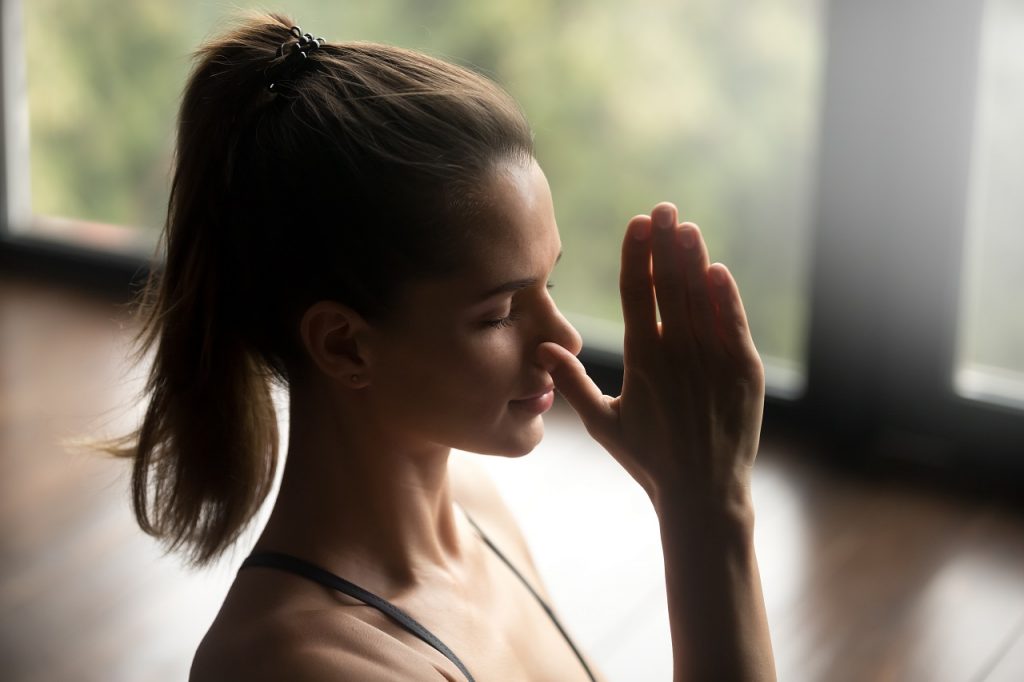
To practice Nadi Shodhana, sit upright in a comfortable position with a straight spine. Bring your right hand in front of your face, placing your index and middle fingers between your eyebrows for stability. During the exercise, you will block either the left or right nostril using your thumb and ring finger. Close your eyes and block the right nostril with your thumb. Inhale slowly through the left nostril for a count of four, take a brief pause, and exhale through the right nostril for a count of four. Perform this cycle for a minimum of five repetitions.

5. Victory Breath

Victory breath, also known as Ujjayi Breath, derives its name from the Sanskrit term and is often associated with the soothing sound resembling waves crashing against the shore, hence referred to as ocean breath.

To practice this technique, find a comfortable upright position with a straight spine and hands resting in your lap. Keep your mouth closed and begin by inhaling through your nose for a count of 4, gently constricting the airflow to the back of your throat during the inhale. After reaching the top of the inhale, pause for a second before exhaling. Constrict your throat slightly and exhale slowly to a count of 6. Repeat this exercise for 5-10 repetitions.

In conclusion, breathing exercises provide a simple yet effective means to manage anxiety. Through regular practice, you can develop the ability to regulate your breathing and cultivate a calm mind, ultimately promoting a sense of relaxation and ease. So, take a few moments each day to focus on your breath and embrace the numerous benefits of these powerful techniques.

If this article helped you, let us know in the comments below! Find more articles on breathwork and yoga here. You can also get these techniques and more from a GOQii Coach by subscribing for Personalised Health Coaching here.

#BeTheForce 

Disclaimer: The information provided in this blog is for general awareness and educational purposes only. It is not intended to replace professional medical advice, diagnosis, or treatment. Always consult a qualified healthcare provider for personalised medical guidance or concerns related to your health. Images shown are for representation purposes only and may not depict the exact recommendations or outcomes.

February 17, 2025 By Sunita Arora 3 Comments

Deep Breathing Techniques to Help You Beat Stress

deep breathingPicture this: You’re sitting at your desk, tackling mountains of paperwork and crunching numbers on Excel like a keyboard wizard. Just when you thought you had it all under control, bam! You’re summoned to a meeting and bombarded with even more projects. Your desk is now drowning in a sea of paperwork, and you find yourself juggling tasks like a stressed-out circus performer. Deadlines loom ominously, and stress levels skyrocket. It’s like being trapped in a never-ending desk nightmare. Yikes! But fear not, for there is a simple solution to vanquish stress in this chaotic scenario: Deep Breathing!


Deep breathing is the secret weapon you’ve been searching for, and it doesn’t require any fancy equipment or a specific time and place. It’s a stress-busting technique that works wonders! When you take a moment to breathe deeply, your brain sends signals to your body, coaxing it to relax. By incorporating deep breathing into your routine, you can reap all the incredible benefits it has to offer.

What Are These Magical Benefits?

  • Zen-like Calm: Deep breathing has the power to soothe your mind and nervous system. You can literally feel the stress melt away!
  • Oxygen Boost: Ah, sweet oxygen! Deep breathing helps you take in more of this life-giving gas, nourishing your body and brain.
  • Heart Party: Your heart deserves some love, and deep breathing delivers. It lowers your heart rate, respiratory rates, and blood pressure, giving your ticker a much-needed break.
  • Sleepy Time: Need to catch some Z’s? Deep breathing is your go-to sandman. It helps you drift off to dreamland, soothes your muscles, and even speeds up your meditation mojo.
  • Stress Ninja: When tension strikes during exams, interviews, or dreaded deadlines, deep breathing comes to the rescue. Consider it your trusty stress-busting sidekick.
  • Energy Flow: Deep breathing helps clean and rejuvenate your body’s energy channels, like a refreshing spa day for your inner chi. It keeps your heating and cooling cycles in check, so you can stay balanced and invigorated.
  • Breath of Fresh Air: Say goodbye to shortness of breath! Deep breathing prevents pesky air from getting trapped in your lungs, making you feel refreshed, centered, and ready to take on the world.

Now that you’re armed with this knowledge, let’s dive into two simple yet effective deep breathing exercises.

1. Simple Abdominal Breathing Exercise

Feeling anxious? No problem! Try this relaxation technique that you can perform anywhere, anytime – standing, sitting, or lying down.

To practice this technique, you need to:

  • Inhale slowly and deeply through your nose. Keep your shoulders relaxed. Your abdomen should expand and your chest should rise slightly.
  • Exhale slowly through your mouth. As you blow the air out, purse your lips slightly, but keep your jaw relaxed. You may hear a soft “whooshing” sound as you exhale.
  • Repeat this breathing exercise for several minutes.

Begin with just 5 minutes. If you feel 5 minutes are too long, you can start with just 2 minutes. Increase the time when you begin finding it easier and comfortable. You can practice this multiple times a day.

2. Equal Breathing

Now, let’s take deep breathing to the next level with some equal breathing magic. This technique focuses on inhales and exhales of the same duration, usually between 3 and 5 counts. Once you’ve mastered it, you can do it during yoga, or even while conquering your daily activities.

To practice this technique:

  • Take a comfortable seated position and breathe in and out through your nose only.
  • Count during each inhale and exhale to make sure they are even in duration. Alternatively, choose a word or short phrase to repeat during each inhale and exhale.
  • You can take a slight pause after each inhale and exhale if you feel comfortable (normal breathing involves a natural pause).
  • Continue practicing this breathing technique for at least 5 minutes and you can increase the duration up to 10-15 minutes.

So there you have it! Deep breathing is your ticket to a calmer, more relaxed you. Remember, stress may try to trap you at your desk, but with these breathing exercises in your arsenal, you’ll be the master of stress, deadlines, and paperwork mayhem. Take a deep breath and let the relaxation flow through your veins like a cool breeze on a sunny day. You’ve got this!

If this article helped you, let us know your thoughts in the comments below. You can find more articles and techniques to beat stress here. You can also reach out to a GOQii Coach for expert guidance by subscribing to Personalised Health Coaching here.

#BeTheForce  

November 20, 2024 By GOQii 5 Comments

3 Breathing Exercises To Strengthen Your Lungs

breathing exercisesHave you ever thought about the number of breaths you take in a lifetime? On average, we take about 675 million breaths in 80 years. Breathing patterns vary throughout our lives, influenced by age, environment, lifestyle, and health conditions such as COPD (Chronic Obstructive Pulmonary Disease). For those managing COPD or looking to maintain lung health, strengthening lung function is essential for overall well-being.

Our lungs are responsible for oxygen (O2) and carbon dioxide (CO2) exchange, ensuring that our body functions smoothly. Lung capacity and efficiency are key to respiratory health, and certain breathing exercises can help enhance this capacity. Here are three effective techniques to support lung function and improve breathing, especially beneficial for individuals with respiratory challenges like COPD.

1. Pursed Lip Breathing

This simple exercise helps slow down breathing and completely empties the lungs, which is particularly helpful during moments of shortness of breath—common among those with COPD.

How to Do it:

  • Sit comfortably, relax your shoulders, neck, and close your eyes gently.
  • Inhale through your nose for 2–3 seconds.
  • Purse your lips as if blowing out a candle, then exhale slowly through them for 4–6 seconds.
  • Repeat for about 5 minutes to experience relief and improved lung capacity.

This technique is beneficial during or after physical activity, as it lets plenty of air flow through the lungs, restoring normal breathing patterns.

2. Diaphragmatic or Belly breathing

How often in a day do we pay attention to our breathing pattern? Do you do shallow breathing or deep breathing? The diaphragm is the main sheet of muscle in between the chest and the abdomen that helps in respiration. But, usually, we develop the habit of breathing through chest, neck and shoulder muscles which limits the amount of air filling in and out of our lungs. Belly breathing strengthens the diaphragm and enhances the pulmonary efficiency. Here is the best way to train yourself for diaphragmatic breathing.

How to Do it:

  • Lie down on your back on a flat surface with the knees bent or sit comfortably on a chair with neck, shoulder and head relaxed
  • Place your one hand lightly on your abdomen and the other hand on the chest
  • Inhale deeply through the nose for 2-3 seconds as you fill all the air towards your abdomen
  • Pay attention to the hand on the abdomen moving up while making sure hand on the chest is not moving up
  • Now exhale all the air through the mouth (Pursed lips) while tightening the abdomen inwards. Make sure the hand on your abdomen is moving down
  • Repeat this breathing for 5-10 minutes to get the maximum benefits

3. Alternate Nostril breathing

This is a type of deep and slow breathing in Yoga in which inhaling, and exhaling happens through alternate nostrils.  Long term practice of this breathing improves the total capacity of the lungs while boosting the pulmonary function markers. It is also meant to purify the lungs and the circulatory system throughout the body.

How to Do it:

  • Sit straight on a flat surface with relaxed shoulders and neck
  • Start with deep inhalation and slow exhalation couple of times or for a minute
  • While folding the index and middle fingers of the right hand, make Vishnu mudra to close the right nostril with right thumb and left nostril with ring finger
  • At first, close the right nostril and slowly exhale through left nostril
  • Keep the right nostril closed and slowly inhale through the left nostril and feel all the air going upwards while filling all the air deep down till the abdomen
  • Once you inhale all the air possible, pause briefly for 2 seconds
  • Now close the left nostril with the ring finger and release thumb to open the right nostril
  • Exhale out all the air through the right nostril with a pause of 2 second at the end
  • As your still closing the left nostril, inhale slowly through the right nostril letting all the air into right side of the body with a short pause of 2 seconds at the end
  • Again, close the right nostril and open the left nostril to exhale all the air out

This is considered as one round of alternate nostril breathing. Continue this pattern for 5-10 minutes to get the maximum benefits.

Enhancing Lung Health with Breathing Exercises

Consistently practicing one or more of these breathing techniques on an empty stomach can help build lung strength and may aid in boosting immunity. These simple yet effective exercises can support your lung function, whether you’re managing COPD or simply aiming to breathe better.

Find more breathing exercises, meditation techniques and yoga here. You can also get these tips directly from your GOQii Coach by subscribing to Personalised Health Coaching here.

#BeTheForce

Disclaimer: The information provided in this blog is for general awareness and educational purposes only. It is not intended to replace professional medical advice, diagnosis, or treatment. Always consult a qualified healthcare provider for personalised medical guidance or concerns related to your health.

  • 1
  • 2
  • Next Page »

Search

Recent Posts

  • PCOS and Anxiety: Discover Relief with the 54321 Technique
  • Navigating the Maze of Nutrition: Finding Clarity Amidst Confusion
  • Get children active and keep them healthy
  • What Gestational Diabetes Can Do To You & Your Unborn Child
  • Breathing – A Forgotten Art

Stay Updated

Archives

  • December 2025 (4)
  • November 2025 (15)
  • October 2025 (20)
  • September 2025 (6)
  • August 2025 (6)
  • July 2025 (12)
  • June 2025 (18)
  • May 2025 (16)
  • April 2025 (23)
  • March 2025 (23)
  • February 2025 (22)
  • January 2025 (26)
  • December 2024 (26)
  • November 2024 (25)
  • October 2024 (22)
  • September 2024 (24)
  • August 2024 (31)
  • July 2024 (21)
  • June 2024 (26)
  • May 2024 (31)
  • April 2024 (27)
  • March 2024 (29)
  • February 2024 (26)
  • January 2024 (25)
  • December 2023 (15)
  • November 2023 (11)
  • October 2023 (22)
  • September 2023 (22)
  • August 2023 (20)
  • July 2023 (22)
  • June 2023 (24)
  • May 2023 (24)
  • April 2023 (24)
  • March 2023 (23)
  • February 2023 (20)
  • January 2023 (16)
  • December 2022 (12)
  • November 2022 (15)
  • October 2022 (15)
  • September 2022 (12)
  • August 2022 (10)
  • July 2022 (17)
  • June 2022 (11)
  • May 2022 (10)
  • April 2022 (6)
  • March 2022 (6)
  • February 2022 (13)
  • January 2022 (12)
  • December 2021 (7)
  • November 2021 (3)
  • October 2021 (6)
  • September 2021 (3)
  • August 2021 (8)
  • July 2021 (7)
  • June 2021 (15)
  • May 2021 (16)
  • April 2021 (10)
  • March 2021 (7)
  • February 2021 (4)
  • January 2021 (4)
  • December 2020 (3)
  • November 2020 (4)
  • October 2020 (10)
  • September 2020 (3)
  • August 2020 (3)
  • July 2020 (2)
  • June 2020 (4)
  • May 2020 (10)
  • April 2020 (12)
  • March 2020 (10)
  • February 2020 (4)
  • January 2020 (4)
  • December 2019 (3)
  • November 2019 (7)
  • October 2019 (5)
  • September 2019 (4)
  • August 2019 (9)
  • July 2019 (9)
  • June 2019 (11)
  • May 2019 (4)
  • April 2019 (9)
  • March 2019 (8)
  • February 2019 (9)
  • January 2019 (8)
  • December 2018 (9)
  • November 2018 (3)
  • October 2018 (3)
  • September 2018 (5)
  • August 2018 (10)
  • July 2018 (6)
  • June 2018 (13)
  • May 2018 (8)
  • April 2018 (18)
  • March 2018 (9)
  • February 2018 (8)
  • January 2018 (15)
  • December 2017 (12)
  • November 2017 (19)
  • October 2017 (13)
  • September 2017 (15)
  • August 2017 (4)
  • July 2017 (8)
  • June 2017 (7)
  • May 2017 (6)
  • April 2017 (8)
  • March 2017 (6)
  • February 2017 (7)
  • January 2017 (9)
  • December 2016 (10)
  • November 2016 (7)
  • October 2016 (7)
  • September 2016 (7)
  • August 2016 (11)
  • July 2016 (9)
  • June 2016 (9)
  • May 2016 (12)
  • April 2016 (17)
  • March 2016 (17)
  • February 2016 (8)
  • January 2016 (6)
  • December 2015 (2)
  • November 2015 (9)
  • October 2015 (7)
  • September 2015 (9)
  • August 2015 (11)
  • July 2015 (9)
  • June 2015 (12)
  • May 2015 (9)
  • April 2015 (13)
  • March 2015 (8)
  • February 2015 (5)
  • January 2015 (12)
  • December 2014 (14)
  • November 2014 (11)
  • October 2014 (6)
  • September 2014 (13)
  • August 2014 (12)
  • July 2014 (6)
  • June 2014 (2)
  • May 2014 (7)
  • April 2014 (5)

From “Laddu Nawin” to Fit and Fierce: How a 25-Year-Old Insurance Advisor Shed 20 Kilos and Gained His Life Back

When 25-year-old Nawin Yadav from Hyderabad walked into his office every morning, he carried more than just his files and policy papers. He had the weight of fatigue, sluggish energy, and an ever-growing belly that was becoming the butt of jokes. “People … [Read More...]

“I’ve Challenged Myself to Live 100 Years” – The Story of Chandubhai Savani’s Second Chance at Life

At 67, most people start slowing down. Not Chandubhai Savani. A resident of Surat, Chandubhai, thought life was on track. “My life was going well till I had my bypass surgery,” he says. That surgery, back in 2021, was a wake-up call.  Medication was routine, but exercise wasn’t. His diet? What he calls ‘normal.’ “I […]

From Shimla’s Slopes to Chandigarh’s Sidewalks: Surinder Kaur Bhalla’s Journey from Chaos to Control

Some journeys start with a plan. Others begin with a stumble literally. Surinder Bhalla, a government professional, born and raised in the scenic hill town of Shimla, had always lived a life of movement. “In Shimla, you walked everywhere,” she reflects. “Walking was never an exercise. It was just life.” But after shifting to Chandigarh, […]

Ananda Mukherjee Health Story

From Terminal Illness To Complete Wellness! Ananda Mukherjee Health Story

As we observe World Cancer Day under the powerful theme ‘United by Unique’ (2025-2027)**, we are reminded that every individual’s journey with cancer is distinct, yet united by shared resilience, hope, and the collective fight against this disease. This theme places people at the centre of care and their stories at the heart of the […]

  • HOME
  • HEALTHY LIVING
  • FITNESS
  • HEALTHY RECIPES
  • USER STORIES
  • KARMA
  • BUY GOQii

Copyright ©2016 GOQii

