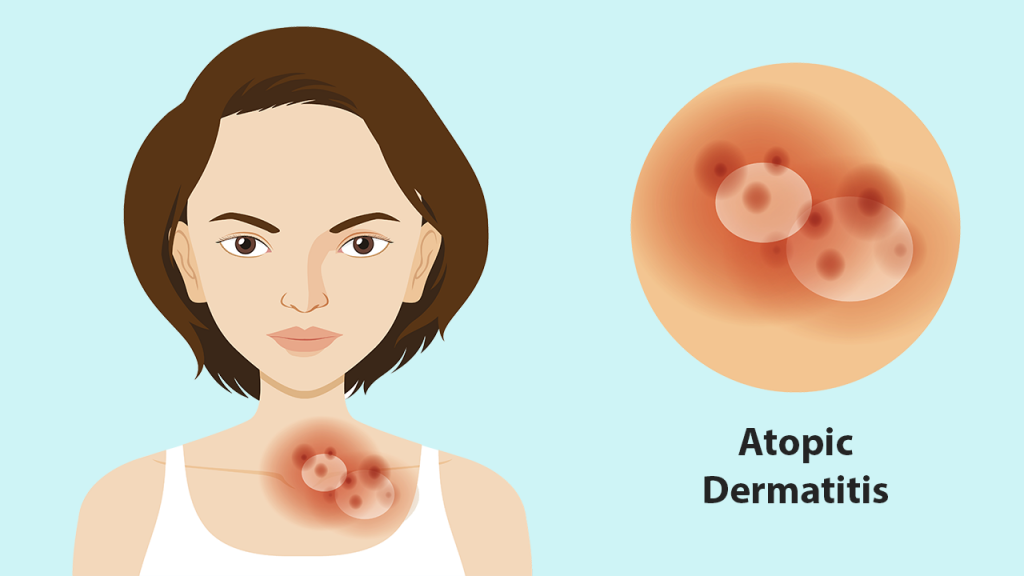
 Do relentless red, itchy, and parched patches frequently mar your skin, perhaps across your face or hidden in the bends of your body? Are allergies your constant, unwelcome companions, manifesting as persistent runny noses, morning sneezes, or reactions to certain foods? Or maybe you find yourself combatting the tell-tale wheeze of asthma? If these experiences resonate with you, it’s time to uncover the layers of Atopic Dermatitis (AD).
Atopic Dermatitis, a specific form of eczema, commonly makes its debut in childhood and can persist well into adult years in some cases. This condition is visually marked by red, inflamed, and dry and itchy eczematous lesions on the face & body. The origins of AD are complex, rooted in a combination of genetic predispositions and environmental elements, and it behaves in a cycle of exacerbations and calm.
This condition is best described as chronic and relapsing, which means that there may be periods of flareups (disease aggravation) and remissions (disease free period). Early diagnosis & therapeutic intervention play a crucial role in disease remission.
Understanding and identifying what ignites AD is critical. Triggers vary widely—some dwell within the body like a compromised skin barrier, while others lurk in our surroundings, such as dietary allergens or the sun’s harsh rays, climatic changes, physical exertion and sweating. These triggers can be very specific and subjective and recognising these culprits is pivotal. Thus, keeping a detailed skin diary can be instrumental in mastering an individual’s condition. It will really aid in disease control and management. These triggers if not monitored, lead to a FLARE.
A flare-up, or ‘flare’, signifies a severe intensification of symptoms that disrupts life and demands immediate medical attention. In such phases, the skin’s plight worsens: redness ravages, and itchiness intensifies, often leading to infected, weeping wounds.
This event often hampers the individual’s quality of life. Thus, trigger management and flare prevention are two very important parts in treating AD. But there’s a beacon of hope. Through meticulous trigger management and prevention strategies, flare-ups can be mitigated or reduced. Simple adjustments to one’s lifestyle and dietary habits can pave the way to managing this irksome condition.
With the collaborative efforts of a dermatologist, a dietician or nutritionist, and a physician, the goal is not just to treat but to transform lives. The objective is clear – enhance the quality of life through prolonged remission, navigating each individual towards a smoother journey with Atopic Dermatitis.
We hope this article helps you. For further information or guidance, reach out to your GOQii Skin Coach.
#BeTheForce
Reference – Girolomoni G, Busà VM. Flare management in atopic dermatitis: from definition to treatment. Ther Adv Chronic Dis. 2022 Jan 13;13:20406223211066728. doi: 10.1177/20406223211066728. PMID: 35070252; PMCID: PMC8771745.
Kolb L, Ferrer-Bruker SJ. Atopic Dermatitis. [Updated 2023 Aug 8]. In: StatPearls [Internet]. Treasure Island (FL): StatPearls Publishing; 2024 Jan-. Availabatopic-dermatitis-triggers-managementle from: https://www.ncbi.nlm.nih.gov/books/NBK448071


 Who doesn’t want a radiant, glowing and youthful complexion? Little do we know, our skin is like the blueprint of what goes inside the body, stress levels, sleep and lifestyle in general!
 With winter around the corner, we all look forward to the beautiful, exciting days ahead! Despite the cold weather, winters bring a warm feeling that compels us to spend time with friends, family, outdoor picnics, get-togethers coupled with good food and warm drinks! Ah! You get the picture.
  Using Sunscreen during winter! What? Well, even in winters, the UV Rays are powerful enough to damage and age your skin. Before you step outside, apply a moisturizing, broad-spectrum sunscreen with an SPF of 15 or higher to all exposed areas of your body. To know which sunscreen you should pick,
  Shrug off the winter chills by keeping your energy levels up by staying active! Exercising regularly improves blood circulation and removes toxins from our system. This helps keep the skin healthy, beside other numerous health benefits. Don’t wait till New Years to join a gym. Start now!
 Remember to cover yourself up well before moving out to avoid overexposure to the cold air. Use scarves, hats, gloves, etc. to cover your head, neck and hands. If your skin is already irritated, avoid synthetic woolens and use soft, comfortable and loose-fitting clothes instead.


