GOQii

Blog

  • HOME
  • HEALTHY LIVING
  • FITNESS
  • HEALTHY RECIPES
  • USER STORIES
  • KARMA
  • BUY GOQii

December 10, 2025 By Neha Goyal Leave a Comment

Best Foods To Alleviate Irritable Bowel Syndrome

irritable bowel syndromeIrritable Bowel Syndrome (IBS) is a common gastrointestinal disorder making mealtimes a challenge for many people. With such a condition, you may notice that certain foods trigger uncomfortable digestive symptoms like irregular bowel movements, cramping, gas, bloating, diarrhoea or constipation. It’s no surprise that living with IBS can have a significant effect on a person’s quality of life.

While there are foods which help prevent the symptoms of IBS, everyone responds to food differently. One has to be their own food detective by recording their intake and symptoms so as to rule out trigger foods that your gut may not be able to handle easily. 

Foods Which Help Alleviate Irritable Bowel Syndrome 

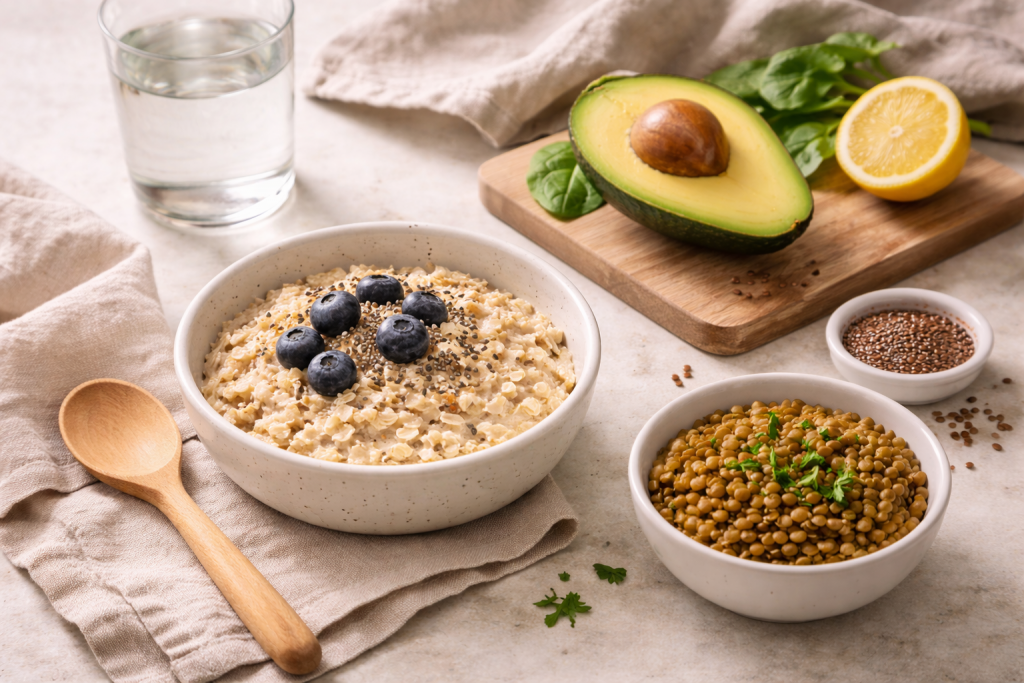
Here is a list of food you can stock as they are gentle on your system. You can use them to create satisfying, healthy meals and snacks without upsetting your stomach. 

  1. Cooked Vegetables: Vegetables are high in fibre and may worsen symptoms for IBS in some people. But cooked vegetables are safe to eat as cooking makes them easy to digest. Eggplant, carrots, sweet potato, yam, broccoli, bell peppers, potato, zucchini, baby spinach, pumpkin, bottle gourd, green beans and celery in cooked form with some added herbs like basil, coriander, mint, ginger, lemongrass, rosemary, parsley and thyme enhance flavour and are safe to eat for most people.
  2. Fruits with low Fructose: Fructose in fruits can cause discomfort if you have Irritable Bowel Syndrome. So choose low fructose fruits like banana, blueberry, cranberry, kiwi, strawberry, lemon, lime, raspberry, pineapple and papaya. Make sure you don’t eat too many fruits at a time or you may overwhelm your body’s ability to absorb fruit sugars without fermentation.
  3. Gluten-free/Low Gluten Grains: People with IBS can safely tolerate gluten to some extent. Some gluten-free grains can be a great addition to a hassle-free IBS diet.  You can enjoy rice, cooked oatmeal, quinoa, tapioca and millet every day without being worried about IBS flares.
  4. Eggs: can easily be a part of your breakfast, lunch or dinner. However, some people report sensitivity with protein in egg whites or fat in egg yolk, but for most people, they are easy to digest.
  5. Lean Meats: They are easy to digest due to low fat and negligible fibre content. They provide a good amount of protein.
  6. Fish: Being rich in anti-inflammatory omega-3 fatty acids, fish can be a great addition to your diet. Since an inflamed gut may be a reason for your IBS, consuming fish can actually help. Good fish sources are anchovies, sardines, mackerel, black cod, herring, rainbow trout and salmon.
  7. Lactose-free Milk: Most people can handle small amounts of lactose found in dairy unless they have lactose intolerance. But if you have more than your intestines can handle, it may cause bloating and gas. Some lactose-free milk options can be used in such conditions like oat milk, rice milk and soy milk as an alternative to cow’s milk.
  8. Nuts and Seeds: are high in fibre, protein and omega-3 – which are good for overall health and your gut flora. They are especially good for IBS. You can add them to your salads, smoothies or oatmeal. Safer options in limited amounts for IBS are almonds, Brazil nuts, sesame seeds, flaxseeds, pumpkin seeds, sunflower seeds, walnuts, pine nuts, hazelnuts, pecans and macadamia nuts.

Along with carefully choosing food that suits you, a healthy lifestyle with a low fat diet, regular exercise, managing stress and mindful eating often makes a great difference. Before you begin consuming any of the above foods, do consult your doctor, nutritionist or dietitian. 

For more information or tips to alleviate Irritable Bowel Syndrome, speak to a GOQii Coach by subscribing for Personalised Health Coaching here.

#BeTheForce 

Disclaimer: The information provided in this blog is for general awareness and educational purposes only. It is not intended to replace professional medical advice, diagnosis, or treatment. Always consult a qualified healthcare provider for personalised medical guidance or concerns related to your health.

December 8, 2025 By Saaimah Parkar 1 Comment

ALL ABOUT VERTIGO!

It came across as strange initially when I said that the world around me was spinning and that my entire room seemed to be in constant motion. Basically, I used to find the floor of my bedroom, the bed, and the room itself were in constant motion (not literally spinning or in constant motion, but I felt that way). I had to walk around supporting myself using the wall, furniture, anything that was close by, and if nothing was available, I literally had to crawl. Finally, I was diagnosed with something called Vertigo.

Vertigo is the feeling that you or your environment is moving or spinning. It differs from dizziness in that vertigo describes an illusion of movement. When you feel as if you are moving, it’s called subjective vertigo, and the perception that your surroundings are moving is called objective vertigo.

A few causes and types of Vertigo:

Benign Paroxysmal Positional Vertigo (BPPV): Tiny calcium particles called canaliths clump up in the canals of the inner ear. This could also be caused due to sudden movement of the head, resulting in the dislodgement of the crystalline structures in the ear’s balance detectors.

Meniere’s Disease: This is an inner ear disorder caused by changing pressure in the ear and a buildup of fluid in the ear.

Labrynthitis: Inner ear viral or bacterial infection

Bleeding in the brain: Vertigo can be caused by decreased blood flow to the base of the brain. Bleeding into the back of the brain (cerebellar hemorrhage) is characterized by vertigo, headache, difficulty walking, and an inability to look toward the side of the bleed. The result is that the person’s eyes gaze away from the side with the problem. Walking is also extremely impaired.

Some other less evident causes: 

Head or neck injury.

Stroke, tumour, diabetes mellitus, atherosclerosis

Migraine

Certain medications

Hormonal fluctuations in menopausal women.

Most common symptoms are: Spinning, loss of balance, headache, sweating, nausea, and yes I have experienced all of this at one go.

Treatment for Vertigo:  Treatment depends mainly on what’s causing it. There are a variety of treatments for vertigo, including self-care remedies, medications, and physical therapy maneuvers.

Let us look at some of the treatments

Benign Paroxysmal Positional Vertigo: Posture correction exercises, head and neck strengthening exercises help with this type of vertigo. It has helped me too. Apart from this, Vitamin D supplementation may be beneficial for patients diagnosed with benign paroxysmal positional vertigo. However, before that, you need to check if you have a Vitamin D deficiency.

Meniere’s Disease and Labyrinthitis: These two are usually treated with anti-inflammatory and diuretic medicines. However, natural foods like ginger root and curcumin aid in speeding up the recovery process.

Stroke, Atherosclerosis, Diabetes, Hypertension: Dietary modifications like avoiding junk, simple sugars, refined flours, and incorporating complex carbohydrates, more fruits and vegetables, and whole grains can help improve symptoms of vertigo.

Avoiding red meats, packaged and preserved foods like frozen meats like salamis and sausages, various sauces, chips and wafers (foods high in sodium), and replacing them with fatty fish and lean meats can improve both vertigo and any of the cardiovascular and lifestyle diseases mentioned above.

Understanding vertigo and its various causes can help in managing and treating it effectively. By incorporating lifestyle changes and seeking appropriate medical care, individuals can find relief from the discomfort and distress caused by vertigo. Remember, with the right approach, you can manage vertigo and lead a healthier, more balanced life.

#BeTheForce

Disclaimer: The information provided in this blog is for general awareness and educational purposes only. It is not intended to replace professional medical advice, diagnosis, or treatment. Always consult a qualified healthcare provider for personalised medical guidance or concerns related to your health.

December 6, 2025 By Sweta Jaiswal Leave a Comment

PCOS and Anxiety: Discover Relief with the 54321 Technique

PCOS and Anxiety: Discover Relief with the 54321 TechniqueA huge section, which is 70% of women and girls of reproductive age, remains undiagnosed in the primary (stage 1) care of PCOS globally. The recent WHO (World Health Organization) data suggests that 116 million women (3.4%) are affected globally. In India itself, the range is 3.7-22.5% of the female population. Though there is a rapid rise in cases, not much is given or taken in terms of awareness.

PCOS (Polycystic Ovary/Ovarian Syndrome) is the most prevalent female endocrine disorder and the preeminent cause of infertility. It is not only characterized by a cystic ovary but also by ovarian dysfunction and androgen excess. It is a combination of signs and symptoms related to an imbalance of hormones. This imbalance leads to hirsutism (hair growing in areas where men typically grow hair, e.g.- face, abdomen, chest, and back), balding, acne, and oily skin. Ovarian dysfunction looks like a complete absence of menstruation (amenorrhea) to menstruation delayed to 35 days or more (oligomenorrhea) to heavy bleeding (menorrhagia).

Due to all these dermatological, metabolic, and reproductive disturbances, PCOS affects the psychological and sleep areas in a woman’s life, leading to acute anxiety, depression, sleep apnea, disturbed sleep, and obesity. Women with PCOS are four times more likely to be at risk for depression compared with women without PCOS.

If you’ve been told you have PCOS, you may feel frustrated and sad as well, but then there will be relief that there are reasons and possible treatments for the symptoms that you have been having such a hard time dealing with— e.g., keeping a healthy weight, managing stress related to it, hirsutism, acne, or irregular periods. It can be difficult to have a diagnosis without an exact cure. However, it’s important for women with PCOS to know they are not alone.

Finding a support network and a healthcare provider who knows a lot about PCOS and is someone you feel comfortable talking with is very important. Even though the results may take a long time, it is important to keep working on a healthy lifestyle and not let PCOS get you down. Many PCOS sufferers claim that discussing their worries with a counsellor can be beneficial because it lowers their burden.

Along with diet and lifestyle modifications to maintain a healthy weight, the 54321 technique can really help battle the high levels of anxiety and depression in women facing PCOS. This technique is the best form of self-care for females who find it hard to focus on other important issues apart from the everyday mental struggles that PCOS offer.

PCOS and Anxiety: Discover Relief with the 54321 Technique

The 54321 technique is a fun and easy way to practice mindfulness. It is so much more than the counts of breathing which we use to calm anger and nervousness. It keeps the 5 senses in play like the eyes, nose, ears, skin and tongue. It is Simple, Practical and Therapeutic.

Let’s understand it. You need to Focus on –

  1. 5 things you see – From the 1000 things that you see, zero it down to five which relate well to your present situation and how it does wonders to the environment/surroundings.
  2. 4 things you can touch – Give priority to touches that give you comfort like massaging your ears, your water bottle, a plant, or a pen. Feel its texture, weight and shape.
  3. 3 things you Hear – This can be a challenge as you will tend to listen to the loudest sounds /noise first. Listen to quieter and soft sounds or music/songs that you enjoy.
  4. 2 things you Smell – Differentiate between pleasant and unpleasant smells. Smell the only 2 things that will make you feel relaxed, like perfume in your napkin, your favourite hand lotion or an odour that you want to move away from.
  5. 1 thing you can taste – This is just as easy as popping a mint or gum in your mouth or drinking your plain/flavoured water.

Being able to apply this natural, easy-to-remember remedy for anxiety and being grounded will help interrupt the nervousness and make you feel instantly re-energised and supported.

In conclusion, the 54321 technique is a powerful mindfulness practice that offers significant relief from the anxiety and depression often experienced by women with PCOS. It provides a simple yet effective way to reconnect with the present moment, using our senses to ground ourselves and break free from the grip of anxiety.

Living with PCOS can be challenging, but it’s crucial to remember that you’re not alone in this journey. Finding a support network and seeking guidance from healthcare providers who specialise in PCOS can make a world of difference. While there may not be a definitive cure, there are ways to manage and alleviate the symptoms, allowing you to lead a fulfilling and healthy life.

At GOQii, we believe in holistic well-being, and that includes mental health. If you’ve found this information helpful, we’d love to hear your thoughts in the comments below. Remember, you can explore more articles on topics like these in our Healthy Reads section. For personalised guidance and support on managing PCOS, consider subscribing to GOQii’s Personalised Health Coaching here.

#BeTheForce 

Disclaimer: The information provided in this blog is for general awareness and educational purposes only. It is not intended to replace professional medical advice, diagnosis, or treatment. Always consult a qualified healthcare provider for personalised medical guidance or concerns related to your health. Images shown are for representation purposes only and may not depict the exact recommendations or outcomes.

December 5, 2025 By Meenal Kapoor Leave a Comment

Navigating the Maze of Nutrition: Finding Clarity Amidst Confusion

In today’s information-rich age, the quest for sound nutrition advice can feel like a labyrinthine journey. We are bombarded daily with a deluge of dietary information, often contradictory and bewildering. The result? Nutrition confusion can leave us feeling overwhelmed and uncertain about what to put on our plates. Nutrition misinformation can be harmful to our health and wallet.

Misinformation is the bane of the modern era, and nutrition is no exception. Social media, fad diets, and anecdotal success stories often drown out evidence-based advice. What’s even more concerning is that these sources can promote diets that may not only be ineffective but potentially harmful. This confusion can lead to poor dietary choices, contributing to health problems like obesity, heart disease, and diabetes.

Question everything. Just because something is trending on social media or endorsed by a celebrity doesn’t make it valid. Look for claims backed by well-designed studies. Be cautious of quick fixes and miraculous results. Sound nutrition is about long-term habits, not magic solutions.

Also, remember that one size does not fit all. Nutrition should be personalised to your individual needs, goals, and preferences. Seek guidance from a qualified healthcare professional who can tailor advice to your unique circumstances.

Empower yourself with knowledge. Learn to interpret food labels, understand macronutrients, and recognise hidden sugars and unhealthy fats. A basic understanding of nutrition principles can help you make informed choices. A balanced diet remains at the core of good nutrition. Moderation is key, and no single food should be demonised or idolised.

So, how do we cut through the noise and find reliable nutrition guidance? When evaluating nutrition advice, consider the source. Registered dietitians, certified nutritionists, and reputable health organisations like the WHO and the Academy of Nutrition and Dietetics are trusted sources.

Look out for the following to make well-informed nutrition choices:

  1. Source of information – check whether the website or article is certified/verified.
  2. Do look for the relevant degree of the author – if there is no listed author (unless it is on a site that is a government or university site), the information may not be trusted. If the author is mentioned, verify that he or she holds the relevant degree to post it.
  3. Motive of the site/person – check if the motive is to sell a product or service and not to provide information.
  4. Information Validation – the information on the website should be backed by research and statistics and not just based on testimonials and personal information.
  5. How personalised is the guidance or is it generic using some buzzwords – Each individual body is unique. A blanket nutritional advice for everyone is often not authentic. If the website or author is just giving out buzzwords, the advice is mostly generic and not best suited to your health conditions and body.
  6. Watch out for key ingredients/hidden ingredients/nutrition facts on the labels of the products. Definitely dig for the small print while buying products from websites or through influencers.
  7. In the case of a website article – sources of information should be mentioned – reliable sites/books/opinions of doctors or registered dietitians.
  8. Does it promote a fad diet or a quick fix for your health issue? – If any article or website is making unrealistic promises based on products, seek the advice of a professional before using it.
  9. Watch out for Influencers with no nutrition background, selling products – this is increasingly common these days.

Some reliable sources of information:

  1. Books by registered dieticians (RD) or practising nutritionists/doctors.
  2. Some reliable websites:
    • National Institutes of Health Office of Dietary Supplements
    • National Institutes of Health (NIH)
    • World Health Organisation (WHO)
    • ICMR – National Institute of Nutrition
    • WebMD

Nutritional misinformation leads to wrong dietary patterns, taking up fad diets/quick diets detrimental to health, buying products that have harmful side effects, and following diet patterns that cause toxicity/deficiency of nutrients – all of these have long-term health effects and aggravation of the health issue.

To make well-informed decisions:

  1. Take advice from certified professionals.
  2. Look out for personalised advice based on your medical history and body stats.
  3. A diet or fitness pattern that is lifestyle change-based and not merely product-based.
  4. Lastly remember: Dr Google is not always reliable.

To conclude, in an era of rampant nutrition confusion and misinformation, it’s crucial to rely on evidence-based advice from trusted sources. By cultivating a critical mindset, personalising your approach, and staying informed, you can navigate the maze of nutrition and make choices that promote your long-term health and well-being.

We hope this article helps you. For further information or guidance, reach out to our certified experts by subscribing to GOQii’s Personalised Health Coaching here.

#BeTheForce

Disclaimer: The information provided in this blog is for general awareness and educational purposes only. It is not intended to replace professional medical advice, diagnosis, or treatment. Always consult a qualified healthcare provider for personalised medical guidance or concerns related to your health. Images shown are for representation purposes only and may not depict the exact recommendations or outcomes.

  • 1
  • 2
  • 3
  • …
  • 100
  • Next Page »

Search

Recent Posts

  • Best Foods To Alleviate Irritable Bowel Syndrome
  • ALL ABOUT VERTIGO!
  • PCOS and Anxiety: Discover Relief with the 54321 Technique
  • Navigating the Maze of Nutrition: Finding Clarity Amidst Confusion
  • Get children active and keep them healthy

Stay Updated

Archives

  • December 2025 (6)
  • November 2025 (15)
  • October 2025 (20)
  • September 2025 (6)
  • August 2025 (6)
  • July 2025 (12)
  • June 2025 (18)
  • May 2025 (16)
  • April 2025 (23)
  • March 2025 (23)
  • February 2025 (22)
  • January 2025 (26)
  • December 2024 (26)
  • November 2024 (25)
  • October 2024 (22)
  • September 2024 (24)
  • August 2024 (31)
  • July 2024 (21)
  • June 2024 (26)
  • May 2024 (31)
  • April 2024 (27)
  • March 2024 (29)
  • February 2024 (26)
  • January 2024 (25)
  • December 2023 (15)
  • November 2023 (11)
  • October 2023 (22)
  • September 2023 (22)
  • August 2023 (20)
  • July 2023 (22)
  • June 2023 (24)
  • May 2023 (24)
  • April 2023 (24)
  • March 2023 (23)
  • February 2023 (20)
  • January 2023 (16)
  • December 2022 (12)
  • November 2022 (15)
  • October 2022 (15)
  • September 2022 (12)
  • August 2022 (10)
  • July 2022 (17)
  • June 2022 (11)
  • May 2022 (10)
  • April 2022 (6)
  • March 2022 (6)
  • February 2022 (13)
  • January 2022 (12)
  • December 2021 (7)
  • November 2021 (3)
  • October 2021 (6)
  • September 2021 (3)
  • August 2021 (8)
  • July 2021 (7)
  • June 2021 (15)
  • May 2021 (16)
  • April 2021 (10)
  • March 2021 (7)
  • February 2021 (4)
  • January 2021 (4)
  • December 2020 (3)
  • November 2020 (4)
  • October 2020 (10)
  • September 2020 (3)
  • August 2020 (3)
  • July 2020 (2)
  • June 2020 (4)
  • May 2020 (10)
  • April 2020 (12)
  • March 2020 (10)
  • February 2020 (4)
  • January 2020 (4)
  • December 2019 (3)
  • November 2019 (7)
  • October 2019 (5)
  • September 2019 (4)
  • August 2019 (9)
  • July 2019 (9)
  • June 2019 (11)
  • May 2019 (4)
  • April 2019 (9)
  • March 2019 (8)
  • February 2019 (9)
  • January 2019 (8)
  • December 2018 (9)
  • November 2018 (3)
  • October 2018 (3)
  • September 2018 (5)
  • August 2018 (10)
  • July 2018 (6)
  • June 2018 (13)
  • May 2018 (8)
  • April 2018 (18)
  • March 2018 (9)
  • February 2018 (8)
  • January 2018 (15)
  • December 2017 (12)
  • November 2017 (19)
  • October 2017 (13)
  • September 2017 (15)
  • August 2017 (4)
  • July 2017 (8)
  • June 2017 (7)
  • May 2017 (6)
  • April 2017 (8)
  • March 2017 (6)
  • February 2017 (7)
  • January 2017 (9)
  • December 2016 (10)
  • November 2016 (7)
  • October 2016 (7)
  • September 2016 (7)
  • August 2016 (11)
  • July 2016 (9)
  • June 2016 (9)
  • May 2016 (12)
  • April 2016 (17)
  • March 2016 (17)
  • February 2016 (8)
  • January 2016 (6)
  • December 2015 (2)
  • November 2015 (9)
  • October 2015 (7)
  • September 2015 (9)
  • August 2015 (11)
  • July 2015 (9)
  • June 2015 (12)
  • May 2015 (9)
  • April 2015 (13)
  • March 2015 (8)
  • February 2015 (5)
  • January 2015 (12)
  • December 2014 (14)
  • November 2014 (11)
  • October 2014 (6)
  • September 2014 (13)
  • August 2014 (12)
  • July 2014 (6)
  • June 2014 (2)
  • May 2014 (7)
  • April 2014 (5)

From “Laddu Nawin” to Fit and Fierce: How a 25-Year-Old Insurance Advisor Shed 20 Kilos and Gained His Life Back

When 25-year-old Nawin Yadav from Hyderabad walked into his office every morning, he carried more than just his files and policy papers. He had the weight of fatigue, sluggish energy, and an ever-growing belly that was becoming the butt of jokes. “People … [Read More...]

“I’ve Challenged Myself to Live 100 Years” – The Story of Chandubhai Savani’s Second Chance at Life

At 67, most people start slowing down. Not Chandubhai Savani. A resident of Surat, Chandubhai, thought life was on track. “My life was going well till I had my bypass surgery,” he says. That surgery, back in 2021, was a wake-up call.  Medication was routine, but exercise wasn’t. His diet? What he calls ‘normal.’ “I […]

From Shimla’s Slopes to Chandigarh’s Sidewalks: Surinder Kaur Bhalla’s Journey from Chaos to Control

Some journeys start with a plan. Others begin with a stumble literally. Surinder Bhalla, a government professional, born and raised in the scenic hill town of Shimla, had always lived a life of movement. “In Shimla, you walked everywhere,” she reflects. “Walking was never an exercise. It was just life.” But after shifting to Chandigarh, […]

Ananda Mukherjee Health Story

From Terminal Illness To Complete Wellness! Ananda Mukherjee Health Story

As we observe World Cancer Day under the powerful theme ‘United by Unique’ (2025-2027)**, we are reminded that every individual’s journey with cancer is distinct, yet united by shared resilience, hope, and the collective fight against this disease. This theme places people at the centre of care and their stories at the heart of the […]

  • HOME
  • HEALTHY LIVING
  • FITNESS
  • HEALTHY RECIPES
  • USER STORIES
  • KARMA
  • BUY GOQii

Copyright ©2016 GOQii