
GOQii

Blog

  • HOME
  • HEALTHY LIVING
  • FITNESS
  • HEALTHY RECIPES
  • USER STORIES
  • KARMA
  • BUY GOQii

August 2, 2017 By Dr Ashwin Nanda Leave a Comment

Understanding Autism


I have had firsthand contact with 2 children with autism in my complex and hence I wish to share my experience with these children and talk about Autism. An autistic child lives in her/his own world and finds it quite difficult to associate and relate to the external world. The child takes a long time to bond with another person, even the mother child bonding takes very long to develop. Children with autism seldom establish eye contact, do handshakes and give high fives like their counterparts. They seem extremely shy but the issue is deeper than just being plain simple shy.

Let me take you through these kids’ stories and also in the process talk about what is Autism?

This is the story of Rudraesh, 13. He is the second son and his mother recalls that when he was brought home from the maternity ward after 4 days, he cried a lot for the next 2 days. This behaviour of his was peculiar as she remembers her elder son never reacted this way. In hindsight, she says that it was typical of an autistic child to be uncomfortable in a new environment. When her son did not develop the social milestone of smiling at another person which her elder one had, she got worried and consulted the paediatrician who confirmed her fear that he was autistic.

Autism is a spectrum of disorders in which the difficulty to adapt to the world and be able to take care of oneself varies from mild to severe. Rudraesh is severely autistic since it took 12 years for him to get toilet trained and hygiene conscious. Since his elder brother is normal, his mother feels the reason for his autism is the undue emotional stress she had while she was pregnant with him.

The exact cause of autism still eludes mankind. Researchers are trying to find possible associations which lead to autism. A strong belief is that MMR vaccine (Measles, Mumps and Rubella) predisposes a child to autism. Indiscriminate use of antibiotics during pregnancy and infancy is also suspected to increase the chances of autism. It appears that autism runs in families since many extended families have more than one child affected by it.

Rudraesh has the good fortune of having a dedicated and caring mother and a father who is earning well. She has painstakingly ensured that he picks up basic survival skills and his father spares no expense in getting best possible assistance in the form of special schooling and occupational therapy. Their dream is that Rudraesh can earn a living for himself and be self-sustained. It’s a challenging dream but with the hard work that both parents are putting in, it looks like a reality albeit in distant future.

The second story is that of Madhav, 5. Madhav’smom was heartbroken when the paediatrician diagnosed him to be a mildly autistic child. Initially, she thought her son was mentally retarded. Unlike mentally retarded children, autistic children usually are gifted e.g a few of them have a drawing and painting talent and some are excellent with numbers. Remember Dustin Hoffman’s character in the epic movie Rainman?

Hoffman played an autistic adult who won his brother millions in the casino because of his mathematical gift of predicting permutations in the card deck. Madhav is a mild case because he was able to do a lot of other activities which kids his age did except that he didn’t know his name was Madhav, something a normal 8 months old definitely knows. He wouldn’t respond when his name was called out. Since his autistic trait was diagnosed in time and his parents took help from a good team of therapists who treat children with developmental delays, at age 4 years he is now at par with other normal children. The therapy involves multiple innovative ways of stimulating the child’s brain to grow and learn and catch up.

To summarize, autistic individuals need a lot of support and patience from the society so that their troubles can be minimized.Occupational and behaviour therapy specialists along with parents of these children make a lot of efforts to help them learn to integrate with the world around them and we as mature citizens also need to support them by being non-judgemental and understanding.
January 9, 2017 By Dr Ashwin Nanda 1 Comment

You are as ‘Old’ as your Prostate

Untitled-1Mr Rebello, sitting in front of me recalled his plight of waking up 2-3 times every night to void urine instead of only once as before. Initially, he assumed it was due to winter but, when the problem persisted in summer as well, he blamed it on his poorly controlled diabetes. He was 65 yrs of age when he began to experience this. He didn’t bother visiting his physician since he had made peace with his high blood sugars as he had no control over his eating habits.

How he wished he hadn’t assumed and instead consulted his physician. After 2 yrs he moved to another city and didn’t feel up to the task of finding a new physician to follow up with. Five years down the line, after his 70th birthday, he began experiencing lower back pain which he again concluded was due to ageing. Only when the pain became persistent and unbearable, he met an Orthopedic who after examination and X-rays diagnosed him with a collapsed vertebral fracture. He was crestfallen when the cause of his vertebral fracture was pinned down to ‘PROSTATE CANCER’.

Going back to the time when Mr Rebello was 65 yrs old, he overlooked the fact that the frequency of urination was normal during the day. Had high sugar been the cause, the issue would have bothered him during the day as well. Actually, this was the first symptom that his prostate gland was enlarged. Undiagnosed and untreated over 5 yrs the non-cancerous enlargement of the prostate had turned cancerous and spread to his backbone.

Let’s try to make sense about what the prostate gland is, its enlargement and when does it translate into cancer.

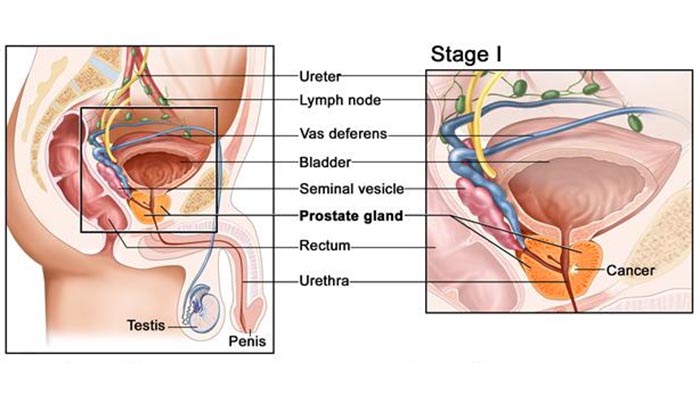
The Prostate Gland: Location in the body and function.

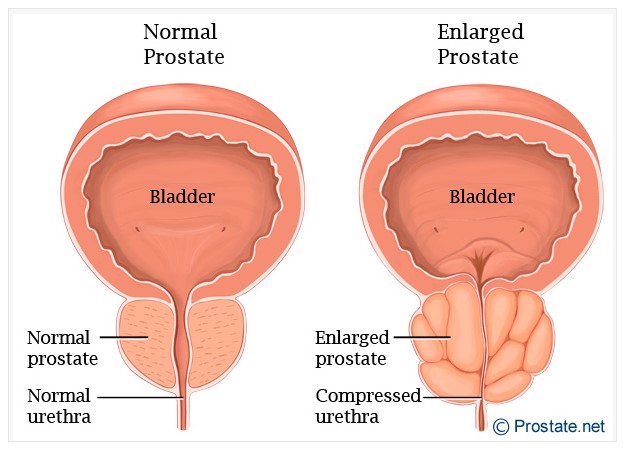
The image below shows the location of the prostate gland in the body which is present only in males. It is located below the urinary bladder. The prostate secretes the fluid that nourishes and protects sperms. During ejaculation, the prostate squeezes this fluid into the urethra, and it’s expelled with sperms as semen. In the prostatic cells, the male sex hormone testosterone gets converted to dihydrotestosterone (DHT) which causes the cells to grow resulting in an increase in its size.

Normally, the prostate gland is approximately the size of a walnut. As the size increases with age (which can start as early as 40 yrs) it starts to obstruct the urine outflow as shown in the image.

prostrate cancer-image 1


Symptoms of Prostatic enlargement:

  • A weak or slow urinary stream.
  • A feeling of incomplete bladder emptying.
  • Difficulty starting urination.
  • Frequent urination.
  • The urgency to urinate.
  • Getting up frequently at night to urinate.
  • A urinary stream that starts and stops.
  • Straining to urinate.

Medically enlarged prostate which is not cancerous is called Benign Prostatic Hyperplasia (BPH).

As the gland keeps getting enlarged, there are mutations in the DNA of its cells causing it to grow uncontrolled and abnormally resulting in cancer.

The saving grace in this entire process is that prostatic enlargement can be diagnosed early and controlled thereby preventing cancer.

DIAGNOSTIC MODALITIES:

  1. Sonography of the prostate gland is advised once a man turns 50 yrs to establish if enlargement has started. If there is a family history of prostate cancer then it should be done as early as 40 yrs.
  2. A blood test called Prostate Specific Antigen(PSA) should be done. Very high values are suggestive of cancer whereas in the enlargement phase the values remain < 4 units.

If you are facing any of the above symptoms, you must visit a Urologist who will diagnose and prescribe medication for the same. Incase medicines are not effective, one might have to opt for surgery.

In Mr Rebello’s case, since cancer had already developed, radiotherapy was first given to shrink the size of the prostate, post which surgery was performed to remove the cancerous gland. Cancer which had spread to his backbone was controlled by a combination of chemo and hormonal therapy.

Risk Factors for prostatic enlargement and cancer:

Age – prevalence increases markedly with age. The gland grows at a rate of 2 – 2.5 % annually in older men.

Genetics – 50% men undergoing surgery for BPH < 60 yrs of age have inheritable form of the disease.

PREVENTION:

Apart from timely diagnosis and treatment, being physically active, controlling Diabetes and weight are known to reduce enlargement of the gland. Diet rich in antioxidants and vitamins is also beneficial in prevention along with avoiding red meat.

Image credit – prostate.net

November 14, 2016 By Dr Ashwin Nanda 2 Comments

DECODING DIABETES

Diabetes-Day

Last month, I had 2 patients on the same day diagnosed with Diabetes- one an overweight 34 year old IT professional and the other a 6-year-old girl. The reason, why this incident comes to my mind today is because they were both diabetics but, had different diabetes and even their course of treatments was different.

But, the first question I was asked in both the cases was whether they will need to be put on insulin injections immediately. Well, this is a common question asked by patients. To understand this condition better, let me try and explain a bit about the different types of diabetes on the basis of which the required treatment is normally recommended.

Diabetes is a group of metabolic disorders in which the person has high blood glucose (blood sugar), either because insulin production is inadequate, or because the body’s cells do not respond properly to insulin or both. Common symptoms of either diabetes are unexplained weight loss, excess hunger, and excess thirst and delayed wound healing.

Today, I would like to take you through specifically 3 major types of diabetes namely, Type 1, Type 2 and gestational Diabetes.

Let’s talk about

Type 1 Diabetes: is caused by a loss or malfunction of the insulin-producing cells in the pancreas, called beta cells. Damage to beta cells results in absence or insufficient production of insulin. Most cases of Type 1 Diabetes have an autoimmune basis in which immune system mistakenly attacks and destroys its own beta cells. These cases are detected either in childhood or teenage years. There are many theories about what causes type 1 diabetes like autoimmune disease, viral infection, genetic predisposition and environmental factors may also play a role.

Whatever be the cause, this missing insulin has to be replaced as insulin is necessary to sustain life. It is responsible for entry of glucose into the body cells from where the glucose is further utilized for energy and other activities. This glucose which is not entering the cells is circulating in the blood which gets detected as high blood sugar. The replacement insulin is administered by injection using a syringe or an insulin pump. Thanks to the invention of Insulin clubbed with a healthy lifestyle, a Type 1 diabetic is able to lead a happy good quality life.

Coming to Type 2 diabetes most often than not your tissues will be resistant to insulin, so the insulin is being produced but unfortunately not being utilized properly. It is the most common form of diabetes worldwide and accounts for 90-95% of the cases.

Insulin resistance in type 2 diabetes means the signal insulin gives to a cell is weakened. This results in less glucose uptake by muscle and fat cells and a reduction in insulin mediated activities inside cells.

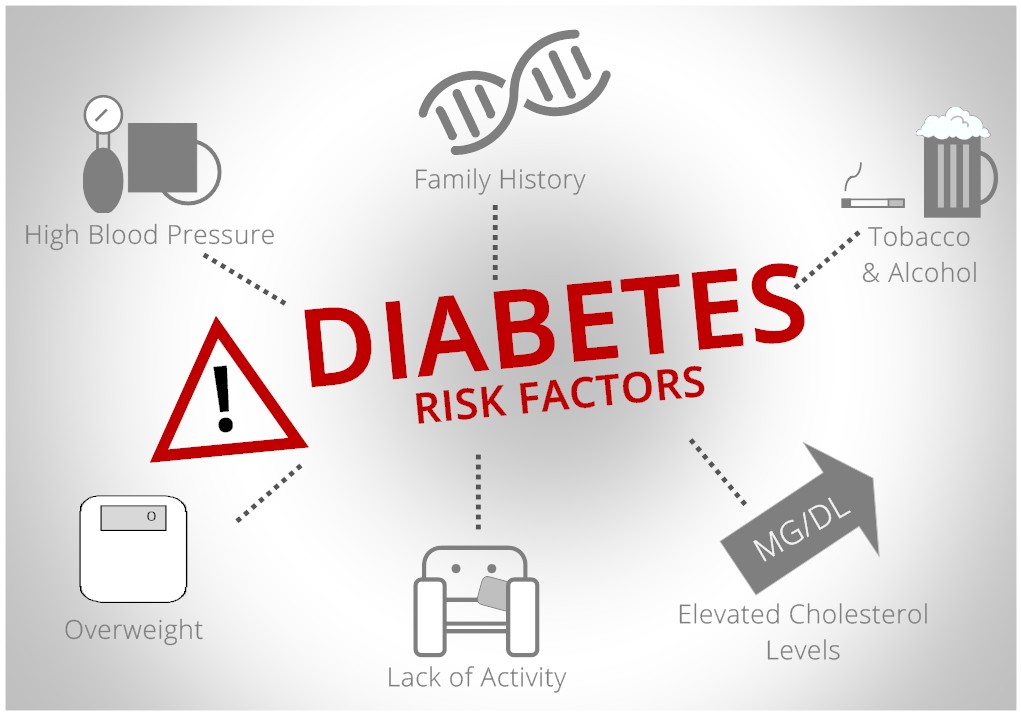
Risk factors for Type 2 Diabetes include an Unhealthy Lifestyle (being physically inactive or less active, erratic food and sleep habits, stress), being overweight or obese and importantly family history of diabetes in close relatives.

Diabetes-Risk

We have ample medicine combinations for type 2 diabetes like tablets which keep the blood sugar under control. But if sufficient sugar control is not achieved in spite of oral medications and a healthy lifestyle, then insulin might be required for further management.

Another type of Diabetes I would like to talk about is Gestational diabetes which basically refers to diabetes diagnosed during pregnancy.

Pregnancy hormones can interfere with the way insulin works in the mother’s body which can lead to elevated blood glucose levels during pregnancy. Women are typically screened for gestational diabetes at 24-28 weeks of pregnancy, however, women who have risk factors may be screened earlier.

Risk factors for developing gestational diabetes include having a family history of diabetes, being overweight, or over 28 years old. Blood glucose control during pregnancy is critical as elevated maternal glucose levels can lead to pregnancy complications and pose risks to the health of the baby. Gestational diabetes is likely to recur during subsequent pregnancies.

Gestational diabetes requires specialized treatment for the rest of the pregnancy. After the pregnancy is over, most women will have normal blood sugars again; however, up to 20-50 % can develop type 2 diabetes within 10 years. Regular screening is recommended.

A study conducted on people at risk of type 2 diabetes, it was seen that those who lost just 7% of their weight and exercised about 30 minutes a day cut their risk of diabetes by nearly 60%. In a nutshell, irrespective of the type of diabetes the best prevention or diabetes management strategy is to eat healthy, stay active and keep a check on your weight.

Reference: University of California, San Francisco – Diabetes online Education website.

October 10, 2016 By Dr Ashwin Nanda 1 Comment

SHEDDING LIGHT ON DEPRESSION

depression

Last year, when the famous Bollywood actress Deepika Padukone opened the lid on her struggle with anxiety and depression and admitted to the world that she was on medication for the same, it became the talk of the town. Everyone started discussing mental health, there were articles in Newspapers, TV channels interviewing the actress and asking her to tell her story. Padukone became an example for many to come out and discuss their issue without fear. Why so? Because depression and mental illness isn’t usually talked about. There is shame and stigma attached to talking about depression. Today, on world health day, I would like to share some insights into depression and what needs to be done when in that situation.

My first experience in dealing with depression was when I was still in Medical school. My very close friend from medical school went through depression. It was then I realized that one needs a lot of empathy and patience to understand what someone is going through in depression. The extreme low mood during depression is such a bad feeling that no one chooses to be depressed by choice …it’s either circumstances or medical conditions that push an individual into depression.

My friend had slipped into depression due to a heart break. The impact was so huge that he withdrew himself from studies, friends and family. He slept longer than usual 8 hours, ate less and experienced terrible mood swings. He refused to talk to anyone and eventually turned suicidal. It is at this point that we had to rush him to the psychiatry department of our college hospital.

The psychiatrist talked to my friend privately for 15 minutes and then to his parents and me privately for another 10 minutes. Then, called us all in and sat us down and explained to us that my friend was suffering from an episode of major depression and medication was a must.

None of us were comfortable that he needed medication to recover from depression but, as counseled by the doctor, avoiding medicines wasn’t an option as he was feeling suicidal. Fifteen days later he started feeling better by 10% and the counselor started weekly sessions with him on the recommendation of the Psychiatrist to expedite recovery. Thankfully my friend recovered completely to his normal self in 6 months’ time and medicines and counseling were discontinued.

It is said that one in every four people suffer from anxiety and depression. According to WHO (World Health Organization) 350 million people worldwide suffer from depression in a year. By the year 2020, it will be the second most common disorder after heart disease. The chemical changes occurring in the brain during depression is a reduction in the level of Serotonin, dopamine and nor adrenaline – these are neurotransmitters (Chemicals which are produced by brain cells).

SOME COMMON SYMPTOMS OF DEPRESSION:

  1. Loss of interest / pleasure in activities which were previously enjoyable.
  2. Decreased energy.
  3. Feelings of guilt and low self – worth.
  4. Disturbed sleep and appetite.
  5. Poor concentration.
  6. Substantial impairment in the person’s ability to handle his/her daily responsibilities.
  7. At its worst it can make the person suicidal.

All symptoms are mild in the beginning and gradually increase in intensity over time.

RISK FACTORS:

  1. Genetics – If you have an immediate family member who has experienced major depression, there is a likelihood that you will also have an episode in your lifetime.
  2. Financial hardships and low education levels.
  3. Female Gender – depression is two to three times more likely in women as compared to men. Depression setting in after delivery of child occurs in some cases.
  4. Chronic illnesses like diabetes, tuberculosis, arthritis.
  5. Exposure to violence / Abuse especially in childhood.
  6. Being separated / divorced especially for men.

MANAGING DEPRESSION:

It is important to recognize depression and take it seriously. Going to a psychiatrist is a must

Mild cases can improve with counseling and psychological therapy (depending on the cause of depression, the person is taught coping mechanisms). Severe cases need anti-depressants along with psychological therapy. Self help is equally essential.

Some self help tips:

  1. Create a daily routine and try to stick to it.
  2. Exercise releases endorphins in the brain which give a feeling of happiness, hence daily exercise is a must to recover and prevent depression.
  3. Try to eat a healthy and balanced diet daily.
  4. Openly communicate with family members and loved ones about what you are experiencing to foster relationships and get support.
  5. Avoid alcohol and recreational drugs as they worsen depression.
  6. Be patient with yourself. For someone with depression even the smallest tasks can seem impossible.

Depression is treatable and plenty of help is available to assist a person cope with it and get back to leading a normal and enjoyable life.

  • « Previous Page
  • 1
  • 2

Search

Recent Posts

  • Navigating the Maze of Nutrition: Finding Clarity Amidst Confusion
  • Get children active and keep them healthy
  • What Gestational Diabetes Can Do To You & Your Unborn Child
  • Breathing – A Forgotten Art
  • The Incredible Benefits Of Milk You Might Not Know

Stay Updated

Archives

  • December 2025 (3)
  • November 2025 (15)
  • October 2025 (20)
  • September 2025 (6)
  • August 2025 (6)
  • July 2025 (12)
  • June 2025 (18)
  • May 2025 (16)
  • April 2025 (23)
  • March 2025 (23)
  • February 2025 (22)
  • January 2025 (26)
  • December 2024 (26)
  • November 2024 (25)
  • October 2024 (22)
  • September 2024 (24)
  • August 2024 (31)
  • July 2024 (21)
  • June 2024 (26)
  • May 2024 (31)
  • April 2024 (27)
  • March 2024 (29)
  • February 2024 (26)
  • January 2024 (25)
  • December 2023 (15)
  • November 2023 (11)
  • October 2023 (22)
  • September 2023 (22)
  • August 2023 (20)
  • July 2023 (22)
  • June 2023 (24)
  • May 2023 (24)
  • April 2023 (24)
  • March 2023 (23)
  • February 2023 (20)
  • January 2023 (16)
  • December 2022 (12)
  • November 2022 (15)
  • October 2022 (15)
  • September 2022 (12)
  • August 2022 (10)
  • July 2022 (17)
  • June 2022 (11)
  • May 2022 (10)
  • April 2022 (6)
  • March 2022 (6)
  • February 2022 (13)
  • January 2022 (12)
  • December 2021 (7)
  • November 2021 (3)
  • October 2021 (6)
  • September 2021 (3)
  • August 2021 (8)
  • July 2021 (7)
  • June 2021 (15)
  • May 2021 (16)
  • April 2021 (10)
  • March 2021 (7)
  • February 2021 (4)
  • January 2021 (4)
  • December 2020 (3)
  • November 2020 (4)
  • October 2020 (10)
  • September 2020 (3)
  • August 2020 (3)
  • July 2020 (2)
  • June 2020 (4)
  • May 2020 (10)
  • April 2020 (12)
  • March 2020 (10)
  • February 2020 (4)
  • January 2020 (4)
  • December 2019 (3)
  • November 2019 (7)
  • October 2019 (5)
  • September 2019 (4)
  • August 2019 (9)
  • July 2019 (9)
  • June 2019 (11)
  • May 2019 (4)
  • April 2019 (9)
  • March 2019 (8)
  • February 2019 (9)
  • January 2019 (8)
  • December 2018 (9)
  • November 2018 (3)
  • October 2018 (3)
  • September 2018 (5)
  • August 2018 (10)
  • July 2018 (6)
  • June 2018 (13)
  • May 2018 (8)
  • April 2018 (18)
  • March 2018 (9)
  • February 2018 (8)
  • January 2018 (15)
  • December 2017 (12)
  • November 2017 (19)
  • October 2017 (13)
  • September 2017 (15)
  • August 2017 (4)
  • July 2017 (8)
  • June 2017 (7)
  • May 2017 (6)
  • April 2017 (8)
  • March 2017 (6)
  • February 2017 (7)
  • January 2017 (9)
  • December 2016 (10)
  • November 2016 (7)
  • October 2016 (7)
  • September 2016 (7)
  • August 2016 (11)
  • July 2016 (9)
  • June 2016 (9)
  • May 2016 (12)
  • April 2016 (17)
  • March 2016 (17)
  • February 2016 (8)
  • January 2016 (6)
  • December 2015 (2)
  • November 2015 (9)
  • October 2015 (7)
  • September 2015 (9)
  • August 2015 (11)
  • July 2015 (9)
  • June 2015 (12)
  • May 2015 (9)
  • April 2015 (13)
  • March 2015 (8)
  • February 2015 (5)
  • January 2015 (12)
  • December 2014 (14)
  • November 2014 (11)
  • October 2014 (6)
  • September 2014 (13)
  • August 2014 (12)
  • July 2014 (6)
  • June 2014 (2)
  • May 2014 (7)
  • April 2014 (5)

From “Laddu Nawin” to Fit and Fierce: How a 25-Year-Old Insurance Advisor Shed 20 Kilos and Gained His Life Back

When 25-year-old Nawin Yadav from Hyderabad walked into his office every morning, he carried more than just his files and policy papers. He had the weight of fatigue, sluggish energy, and an ever-growing belly that was becoming the butt of jokes. “People … [Read More...]

“I’ve Challenged Myself to Live 100 Years” – The Story of Chandubhai Savani’s Second Chance at Life

At 67, most people start slowing down. Not Chandubhai Savani. A resident of Surat, Chandubhai, thought life was on track. “My life was going well till I had my bypass surgery,” he says. That surgery, back in 2021, was a wake-up call.  Medication was routine, but exercise wasn’t. His diet? What he calls ‘normal.’ “I […]

From Shimla’s Slopes to Chandigarh’s Sidewalks: Surinder Kaur Bhalla’s Journey from Chaos to Control

Some journeys start with a plan. Others begin with a stumble literally. Surinder Bhalla, a government professional, born and raised in the scenic hill town of Shimla, had always lived a life of movement. “In Shimla, you walked everywhere,” she reflects. “Walking was never an exercise. It was just life.” But after shifting to Chandigarh, […]

Ananda Mukherjee Health Story

From Terminal Illness To Complete Wellness! Ananda Mukherjee Health Story

As we observe World Cancer Day under the powerful theme ‘United by Unique’ (2025-2027)**, we are reminded that every individual’s journey with cancer is distinct, yet united by shared resilience, hope, and the collective fight against this disease. This theme places people at the centre of care and their stories at the heart of the […]

  • HOME
  • HEALTHY LIVING
  • FITNESS
  • HEALTHY RECIPES
  • USER STORIES
  • KARMA
  • BUY GOQii

Copyright ©2016 GOQii