
GOQii

Blog

  • HOME
  • HEALTHY LIVING
  • FITNESS
  • HEALTHY RECIPES
  • USER STORIES
  • KARMA
  • BUY GOQii

Archives for April 2025

April 7, 2025 By GOQii Leave a Comment

Building a Healthier Future: Why Maternal and Infant Health Must Be a Global Priority

When a mother embraces her infant for the first time, it is the most profound moment and a delight that every woman should be able to feel. The mother and her baby should have the opportunity to flourish rather than just survive. Strong families and resilient communities are built on the foundation of maternal and infant health. In India and other parts of the world, protecting mothers’ and infants’ health is not only a medical concern but also a fundamental human right.

It’s time to consider the tragic fact that far too many mothers and infants continue to perish from preventable causes as we commemorate World Health Day today on April 7th, 2025.

The Stark Numbers We Cannot Ignore

As per the World Health Organisation (WHO), pregnancy and delivery problems claim the lives of about 300,000 women annually. In the first month of life, more than 2 million babies pass away, and another 2 million are stillborn. That is around one avoidable death every seven seconds.

The stories of a lady with hope and a child whose destiny was never given a chance lie behind each of these figures.

Though awareness has grown and medical technology has advanced, improvement has been too slow. Four out of five nations will fall short of their 2030 maternal survival improvement goals if present trends continue.

One in three nations will not meet their targets for lowering the number of neonatal fatalities.

India’s Progress and Remaining Challenges

India has made noteworthy progress in improving maternal health as per a UNICEF India programme. The programme report suggests that the Maternal Mortality Ratio (MMR) declined from 130 per 100,000 live births in 2014–16 to 97 in 2018–20, reflecting stronger healthcare systems, better antenatal care, and dedicated policy interventions.

Yet, significant challenges remain. There are persistent disparities in access to healthcare and nutrition, particularly across rural and marginalized communities. Many maternal deaths are still due to preventable causes such as severe bleeding, infections, and complications during delivery that can be managed with timely and appropriate care.

Helping Every Woman and Baby Survive and Thrive

This is an important—and completely doable—task. We can easily solve the problems.

We must make sure that every woman and her family receive respectful, high-quality care before, during, and after childbirth. This entails treating mental health, noncommunicable diseases, and family planning access in addition to direct obstetric difficulties.

Listening to Women, Supporting Families

A dedication to listening to women must be at the core of this movement. Their opinions are much too frequently ignored when choices about their health and welfare are being made. To raise new lives in secure, healthy settings, families also require financial, emotional, and physical support.

Health systems need to change to become more people-centred and responsive. We must make investments in maternity and neonatal care that enhance quality of life while lowering mortality.

This World Health Day, we join the global movement to:

  • Raise awareness about the gaps in maternal and newborn survival—and the urgent need to close them.
  • Advocate for investments that prioritise the health and long-term well-being of women and babies.
  • Encourage collective action, supporting both families and health workers who provide critical care under challenging conditions.
  • Provide vital information about pregnancy, childbirth, and the postnatal period, empowering individuals to make informed health choices.

Maternal and infant deaths are not inevitable—they are preventable. With the right care, policies, and support systems, we can change the story for millions of women and children around the world.

On this World Health Day, let’s commit to building a world where every birth is safe, every life is valued, and every mother and baby has the opportunity to thrive.

#BeTheForce

April 7, 2025 By GOQii Leave a Comment

Put Your Fat on Flame with Interval Training

We all want to lose fat — but when it comes to taking action, the usual excuses show up:
“No time!”
“Too hard!”
“Same routine gets boring!”

It’s time to ditch the excuses and ignite your fitness with a workout that’s quick, dynamic, and highly effective — Interval Training.

What Is Interval Training?

Interval training is a style of workout that alternates bursts of high-intensity effort with periods of lower-intensity recovery. This method pushes your cardiovascular system to work harder in short intervals, burning more calories in less time compared to steady-state exercise.

Think of it as a cardio blast with rest built in — making it manageable yet highly effective.

How Does It Work?

When you alternate intensity during exercise, it creates what’s known as “muscle confusion” — your body doesn’t get used to a single pace. Here’s what happens:

  • Your heart rate increases rapidly
  • More oxygen is delivered to your muscles
  • Fat combustion improves significantly in the presence of oxygen

Think of it like this: just as a candle stops burning when you cut off oxygen, fat burn requires oxygen too. Interval training enhances oxygen supply and boosts fat oxidation — making it a favourite in fat loss routines.

Examples of Interval Training You Can Try

You can apply interval training to almost any type of physical activity. Here are a few easy ways to begin:

Activity Interval Format
Walking Walk fast for 2 minutes, then slow for 1 minute — repeat
Running Run for 2 minutes, walk for 1 minute — repeat
Swimming Alternate fast laps with slow-paced strokes
Cycling Sprint on your bike for 30 seconds, then pedal slowly for 1 minute
Strength Exercises (e.g. Tabata) 20 seconds of intense work, 10 seconds rest, repeated 8 times per round

You can also use interval training for dance workouts, skipping, stairs, HIIT circuits, and more. The options are endless — and you set the pace based on your fitness level.

Key Guidelines for Safe and Effective Interval Training

  • ✅ Warm up for at least 5–10 minutes before starting
  • ✅ Push yourself beyond your comfort zone during high-intensity bursts
  • ✅ Cool down and stretch after every session
  • 🚫 Avoid if you have chronic conditions (e.g., uncontrolled hypertension, cardiovascular illness) — check with your doctor first
  • 🧘 Start slow if you’re new to exercise — begin with steady-state cardio for a few weeks before adding intervals

💡 Tip: Once a week is a great way to begin integrating interval training into your routine. As your fitness improves, increase frequency or intensity gradually.

Interval training is one of the most time-efficient ways to burn fat, improve stamina, and keep workouts exciting. No more excuses — just smarter workouts.

So, lace up your shoes, pick your activity, and start torching fat one interval at a time.

Disclaimer: If you have any medical conditions or haven’t exercised in a while, consult your physician or a certified trainer before beginning interval training.

April 7, 2025 By GOQii Leave a Comment

What is High-Intensity Interval Training?

HIIT, or High-Intensity Interval Training, is a training technique where you give all-out, one hundred percent effort through quick, intense bursts of exercise, followed by short, sometimes active, recovery periods.
This type of training gets your heart rate up and keeps it up, which helps burn more fat in less time. The key is the ratio of intense work to recovery. A great starting point for beginners is a 1:2 work-to-rest ratio (e.g., 30 seconds of work followed by 60 seconds of rest). As you get fitter, you can progress to a more challenging 1:1 ratio (e.g., 30 seconds of work, 30 seconds of rest).

Because it’s so intense, it’s best to do HIIT 2-3 times per week on non-consecutive days to allow your body to recover. While the principles of HIIT can be adapted for many fitness levels, it’s always a good idea to consult with a doctor before starting, especially if you have any pre-existing health conditions.

A Quick & Correct HIIT Routine to Follow

This beginner-friendly routine uses a 1:1 work-to-rest ratio for a great cardio challenge. If you find it too difficult at first, simply increase your rest time to 60 seconds after each exercise.

  1. Warm-Up (5 minutes) Never skip the warm-up.
  • Jogging in place (2 minutes)
  • Arm circles (30 seconds forward, 30 seconds back)
  • Leg swings (30 seconds per leg)
  • Bodyweight squats (10-12 reps)
  1. The HIIT Workout (12 Minutes) Perform each exercise at maximum effort for 30 seconds, followed by 30 seconds of rest. Complete the full circuit two times.
  • WORK: 30 seconds of High Knees
  • REST: 30 seconds of marching or walking in place
  • WORK: 30 seconds of Jumping Jacks
  • REST: 30 seconds of marching or walking in place
  • WORK: 30 seconds of Burpees (or Squat Thrusts for a lower-impact option)
  • REST: 30 seconds of marching or walking in place
  • WORK: 30 seconds of Mountain Climbers
  • REST: 30 seconds of marching or walking in place

After completing all four exercises, rest for 1-2 minutes, then repeat the entire circuit one more time.

  1. Cool-Down (5 minutes) Don’t forget to stretch after your workout.
  • Quad Stretch: Hold for 30 seconds per leg.
  • Hamstring Stretch: Hold for 30 seconds per leg.
  • Calf Stretch: Hold for 30 seconds per leg.
  • Chest Stretch: Hold for 30 seconds.

Intensity is the key. Push yourself during high-effort intervals and use recovery periods to catch your breath without coming to a complete stop.

Important Tips Before You Begin

  • Start slow and safe if you’re new to exercise
  • Maintain proper form and posture to avoid injury
  • Stay hydrated
  • Warm up before and cool down after each session
  • If you have any medical conditions (especially heart, joint, or respiratory concerns), consult your doctor first

Disclaimer: This article is intended for educational purposes only. Always consult with a doctor, physiotherapist, or certified trainer before starting a new fitness program.

April 5, 2025 By GOQii Leave a Comment

Reversing Type 2 Diabetes Through a Low-Carbohydrate Lifestyle

Type 2 diabetes is often seen as a lifelong condition, but research and real-world experience show that it can be managed—and even reversed—with the right dietary approach. One of the most effective strategies is adopting a low-carbohydrate lifestyle, which not only helps regulate blood sugar levels but also improves insulin sensitivity.
Unlike traditional high-carb diets that lead to frequent glucose spikes, a low-carb approach stabilises energy levels, reduces cravings, and supports long-term health. If you’re looking for a sustainable way to take control of your diabetes, reducing your carbohydrate intake might be the key.

Why Reduce Carbohydrates?

Carbohydrates break down into glucose in the bloodstream. For individuals with type 2 diabetes, the pancreas struggles to produce enough insulin to move glucose into cells for energy. This results in persistently high blood sugar levels, which can eventually lead to complications such as nerve damage, kidney issues, and cardiovascular disease.

By reducing carbohydrate intake to 60–130g per day, you prevent large spikes in blood glucose after meals, easing the pressure on your pancreas. Over time, this can allow your pancreatic beta cells to recover and improve insulin sensitivity, helping your body regulate blood sugar more effectively.

The Ideal Process:

  1. Carb-controlled meals → lower glucose load
  2. Less strain on pancreas → beta cells recover
  3. Improved insulin sensitivity → glucose absorbed into cells
  4. Stable, healthy blood sugar levels

Which Carbohydrates to Avoid?

Starchy foods are typically high in carbohydrates and should be limited:

  • Bread (white, whole grain, multigrain)
  • Pasta
  • Rice (white, brown, basmati)
  • Potatoes (including sweet potatoes)
  • Grains (wheat, oats, barley, corn, quinoa)

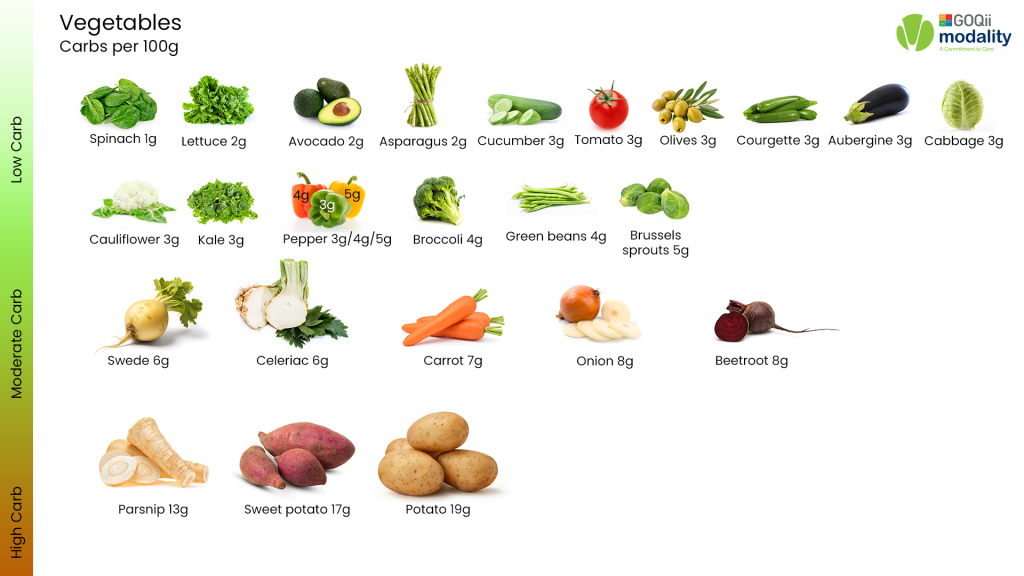
The general rule: vegetables that grow underground (e.g., potatoes, carrots) contain more carbs than those that grow above ground.

Best Low-Carb Vegetables (per 100g)

Leafy Greens
Lettuce (2g), Spinach (1g), Arugula (1.6g), Kale (3g), Swiss Chard (1.8g)

Cruciferous Vegetables
Broccoli (4g), Cauliflower (3g), Brussels Sprouts (5.1g), Cabbage (3g)

Other Non-Starchy Vegetables
Asparagus (2g), Courgette (3g), Aubergine (3g), Tomatoes (3g),
Mushrooms (3.3g), Bell Peppers (4.6g), Onions (8g), Garlic (33.1g),
Radishes (3.4g), Cucumbers (3g), Celery (3g), Green Beans (4g), Artichokes (10.5g)

Focus on nutrient-dense, high-fibre, low-carb vegetables to meet your nutritional needs while keeping carbohydrate intake low.

What Are Net Carbs?

You may come across the term “net carbs,” which refers to the total carbs minus fibre and sugar alcohols—the carbs that actually raise blood sugar.

Net Carbs = Total Carbs – Fibre – Sugar Alcohols

While this can offer a more accurate reflection of how food impacts blood glucose, we recommend focusing on total carbohydrate intake for now, as calculating net carbs can be confusing in the early stages.

Protein: An Essential Nutrient

Protein supports muscle maintenance, satiety, and metabolism. On a low-carb diet, protein should be moderate, not excessive.

Target: 1.5–2.0g per kg of body weight per day

Portion Guide:

  • Women: ~85g cooked meat/tofu, 1 cup Greek yoghurt/cottage cheese, 2 whole eggs
  • Men: ~115g cooked meat/tofu, 1 cup Greek yoghurt/cottage cheese, 2 whole eggs

Low-Carb Dairy Options

Milk (per 240 ml / 1cup):

  • Whole or Semi-Skimmed: 12g carbs
  • Unsweetened Almond Milk: 1g carbs

Cheese (30g / 1oz):

  • Cheddar: 0.4g, Brie: 0.1g, Feta: 0.8g, Cream Cheese: 0.8g

Yoghurt (170g / 6oz):

  • Full-Fat Greek: 5g, Low-Fat Greek: 7g

Cream (30ml/ 1fl oz):

  • Double Cream: 0.6g, Single Cream: 0.7g

Butter (14g / 1 tbsp):

  • Salted/Unsalted: 0.1g

Avoid flavoured yoghurts and sweetened milk which can have hidden sugars.

Alcohol on a Low-Carb Diet

You can enjoy alcohol occasionally by choosing low-carb options:

Wines (per 5oz glass):

  • Dry White (e.g., Sauvignon Blanc, Pinot Grigio): 2–4g carbs
  • Dry Red (e.g., Merlot): 2–4g carbs

Beers (per 12oz):

  • Bud Light: 4.6g, Michelob Ultra: 2.6g, Beck’s Premier Light: 3.9g, Brewdog Pale Ale: 7 g

Spirits (per 1oz):

  • Gin, Vodka, Rum, Tequila, Whisky: 0g (when consumed neat)
  • Add low-carb mixers like soda water, diet tonic, diet ginger ale

Low-Carb Cocktails:

  • Vodka Soda with lime, Gin & Diet Tonic, Whisky Ginger with diet ginger ale, Rum & Diet Coke

❗ Note: Avoid beer and cider unless opting for very light versions. Also, steer clear of sugary mixers, juices, and syrups which can add a substantial carb load to your drink.

Don’t Forget to Keep a Food Diary

Tracking what you eat helps in:

  1. Increasing awareness and mindfulness
  2. Identifying hidden sugars and carbs
  3. Tracking progress over time
  4. Identifying behavioural patterns
  5. Ensuring accountability and better food choices

You can use your phone, an app, or even a journal to keep track. Share it with your nutritionist or coach to get tailored guidance.

A low-carbohydrate lifestyle, when well-planned, can help reverse type 2 diabetes by addressing the root causes—excessive glucose and insulin resistance.

By:
✔ Lowering carbs to 60–130g per day
✔ Prioritising non-starchy vegetables and whole foods
✔ Including moderate protein and healthy fats
✔ Avoiding sugary, starchy, and processed foods
✔ Tracking food intake and blood sugar

…you can achieve stable glucose levels, improved insulin sensitivity, and potentially reduce or eliminate medication.

It’s not about perfection—it’s about consistency and sustainability. And remember: you’re not alone on this journey.

💬 Have you tried a low-carb approach to manage your diabetes or weight? Share your experience in the comments below!

#BeTheForce

  • « Previous Page
  • 1
  • …
  • 3
  • 4
  • 5
  • 6
  • Next Page »

Search

Recent Posts

  • PCOS and Anxiety: Discover Relief with the 54321 Technique
  • Navigating the Maze of Nutrition: Finding Clarity Amidst Confusion
  • Get children active and keep them healthy
  • What Gestational Diabetes Can Do To You & Your Unborn Child
  • Breathing – A Forgotten Art

Stay Updated

Archives

  • December 2025 (4)
  • November 2025 (15)
  • October 2025 (20)
  • September 2025 (6)
  • August 2025 (6)
  • July 2025 (12)
  • June 2025 (18)
  • May 2025 (16)
  • April 2025 (23)
  • March 2025 (23)
  • February 2025 (22)
  • January 2025 (26)
  • December 2024 (26)
  • November 2024 (25)
  • October 2024 (22)
  • September 2024 (24)
  • August 2024 (31)
  • July 2024 (21)
  • June 2024 (26)
  • May 2024 (31)
  • April 2024 (27)
  • March 2024 (29)
  • February 2024 (26)
  • January 2024 (25)
  • December 2023 (15)
  • November 2023 (11)
  • October 2023 (22)
  • September 2023 (22)
  • August 2023 (20)
  • July 2023 (22)
  • June 2023 (24)
  • May 2023 (24)
  • April 2023 (24)
  • March 2023 (23)
  • February 2023 (20)
  • January 2023 (16)
  • December 2022 (12)
  • November 2022 (15)
  • October 2022 (15)
  • September 2022 (12)
  • August 2022 (10)
  • July 2022 (17)
  • June 2022 (11)
  • May 2022 (10)
  • April 2022 (6)
  • March 2022 (6)
  • February 2022 (13)
  • January 2022 (12)
  • December 2021 (7)
  • November 2021 (3)
  • October 2021 (6)
  • September 2021 (3)
  • August 2021 (8)
  • July 2021 (7)
  • June 2021 (15)
  • May 2021 (16)
  • April 2021 (10)
  • March 2021 (7)
  • February 2021 (4)
  • January 2021 (4)
  • December 2020 (3)
  • November 2020 (4)
  • October 2020 (10)
  • September 2020 (3)
  • August 2020 (3)
  • July 2020 (2)
  • June 2020 (4)
  • May 2020 (10)
  • April 2020 (12)
  • March 2020 (10)
  • February 2020 (4)
  • January 2020 (4)
  • December 2019 (3)
  • November 2019 (7)
  • October 2019 (5)
  • September 2019 (4)
  • August 2019 (9)
  • July 2019 (9)
  • June 2019 (11)
  • May 2019 (4)
  • April 2019 (9)
  • March 2019 (8)
  • February 2019 (9)
  • January 2019 (8)
  • December 2018 (9)
  • November 2018 (3)
  • October 2018 (3)
  • September 2018 (5)
  • August 2018 (10)
  • July 2018 (6)
  • June 2018 (13)
  • May 2018 (8)
  • April 2018 (18)
  • March 2018 (9)
  • February 2018 (8)
  • January 2018 (15)
  • December 2017 (12)
  • November 2017 (19)
  • October 2017 (13)
  • September 2017 (15)
  • August 2017 (4)
  • July 2017 (8)
  • June 2017 (7)
  • May 2017 (6)
  • April 2017 (8)
  • March 2017 (6)
  • February 2017 (7)
  • January 2017 (9)
  • December 2016 (10)
  • November 2016 (7)
  • October 2016 (7)
  • September 2016 (7)
  • August 2016 (11)
  • July 2016 (9)
  • June 2016 (9)
  • May 2016 (12)
  • April 2016 (17)
  • March 2016 (17)
  • February 2016 (8)
  • January 2016 (6)
  • December 2015 (2)
  • November 2015 (9)
  • October 2015 (7)
  • September 2015 (9)
  • August 2015 (11)
  • July 2015 (9)
  • June 2015 (12)
  • May 2015 (9)
  • April 2015 (13)
  • March 2015 (8)
  • February 2015 (5)
  • January 2015 (12)
  • December 2014 (14)
  • November 2014 (11)
  • October 2014 (6)
  • September 2014 (13)
  • August 2014 (12)
  • July 2014 (6)
  • June 2014 (2)
  • May 2014 (7)
  • April 2014 (5)

From “Laddu Nawin” to Fit and Fierce: How a 25-Year-Old Insurance Advisor Shed 20 Kilos and Gained His Life Back

When 25-year-old Nawin Yadav from Hyderabad walked into his office every morning, he carried more than just his files and policy papers. He had the weight of fatigue, sluggish energy, and an ever-growing belly that was becoming the butt of jokes. “People … [Read More...]

“I’ve Challenged Myself to Live 100 Years” – The Story of Chandubhai Savani’s Second Chance at Life

At 67, most people start slowing down. Not Chandubhai Savani. A resident of Surat, Chandubhai, thought life was on track. “My life was going well till I had my bypass surgery,” he says. That surgery, back in 2021, was a wake-up call.  Medication was routine, but exercise wasn’t. His diet? What he calls ‘normal.’ “I […]

From Shimla’s Slopes to Chandigarh’s Sidewalks: Surinder Kaur Bhalla’s Journey from Chaos to Control

Some journeys start with a plan. Others begin with a stumble literally. Surinder Bhalla, a government professional, born and raised in the scenic hill town of Shimla, had always lived a life of movement. “In Shimla, you walked everywhere,” she reflects. “Walking was never an exercise. It was just life.” But after shifting to Chandigarh, […]

Ananda Mukherjee Health Story

From Terminal Illness To Complete Wellness! Ananda Mukherjee Health Story

As we observe World Cancer Day under the powerful theme ‘United by Unique’ (2025-2027)**, we are reminded that every individual’s journey with cancer is distinct, yet united by shared resilience, hope, and the collective fight against this disease. This theme places people at the centre of care and their stories at the heart of the […]

  • HOME
  • HEALTHY LIVING
  • FITNESS
  • HEALTHY RECIPES
  • USER STORIES
  • KARMA
  • BUY GOQii

Copyright ©2016 GOQii



