GOQii

Blog

  • HOME
  • HEALTHY LIVING
  • FITNESS
  • HEALTHY RECIPES
  • USER STORIES
  • KARMA
  • BUY GOQii

September 11, 2025 By GOQii Leave a Comment

Body Doubling: The Surprisingly Simple Focus Hack That Works

Ever noticed how it’s easier to concentrate when someone else is in the room, even if they’re just reading a book or quietly working on something else? You’re not imagining it. That quiet presence isn’t just company it’s a powerful productivity strategy.

Welcome to the world of body doubling, a deceptively simple technique that’s become a go-to for many people, especially those with ADHD.

What Exactly Is Body Doubling?

Body doubling is the simple act of performing a task in the presence of another person. They could be working on the same thing, something completely unrelated, or simply keeping you company. The best part? It doesn’t have to be in person; a virtual session on a video call works just as well.

This presence, subtle as it is, creates a gentle sense of accountability and structure. Think of it as a mental anchor; it helps quiet the internal chatter, makes you less likely to wander off, and keeps you on track.

It’s not about pressure. It’s about support.

Here’s what body doubling can look like:

  • You’re finishing a report while your flatmate reads a book nearby.
  • You and a friend are on a video call, each working on separate projects.
  • A family member is watching TV while you catch up on emails beside them.
  • You get more done in a calm, open-plan office than when you’re working from home alone.

Your body double can be anyone: a classmate, sibling, co-worker, or even a friend who doesn’t mind sitting silently while you work. It’s not about talking; it’s about presence.

The Simple Psychology: Why Does It Work?

For many people, especially those with neurodivergent brains, just getting started on a task can feel like the hardest part. You know what you need to do, but your brain resists. That’s where a body double steps in.

Having someone else there, even silently, adds just enough gentle social presence to help your brain shift gears. It creates a focused energy in the space, making you feel less isolated, less likely to start endlessly scrolling, and more likely to dive in.

You Don’t Need a Study Buddy, Just a Body

Here’s the best part: your body double doesn’t need to be doing the same thing as you. They could be working on their own tasks, cooking, journaling, or just sitting nearby with a cup of tea.

And if you can’t find someone to be with you physically, virtual body doubling works just as well. Plenty of online communities offer co-working sessions where you simply log on, say hello, and then mute yourselves while you work quietly together. Some people even find that having a pet in the room brings the same calming, grounding effect.

Ready to Try It? Here’s How to Get Started

  1. Ask a friend or colleague if they’d be up for a co-working session, in person or online. Even 30 minutes can help you build momentum.
  2. Look for online communities. There are dedicated platforms, ADHD forums, and even YouTube live streams designed specifically for body doubling.
  3. Try it with family. If your child is doing homework, sit beside them and work on your own tasks. The effect is often mutual.
  4. Use pets as quiet companions. They won’t help with your to-do list, but their silent company might be all you need to settle down and focus.

If you struggle with focus or motivation, especially when you’re alone, body doubling might just be your secret weapon. It’s simple, it’s free, and it can completely change how you work.

So next time you’re stuck in a spiral of procrastination, don’t tough it out solo. Find your body double. You’ll be amazed at the difference a little shared silence can make.

#BeTheForce

Disclaimer: This blog is for informational purposes only and is not a substitute for professional medical advice, diagnosis, or treatment. Please consult a doctor for personalised guidance and recommendations related to ADHD.

August 4, 2025 By GOQii Leave a Comment

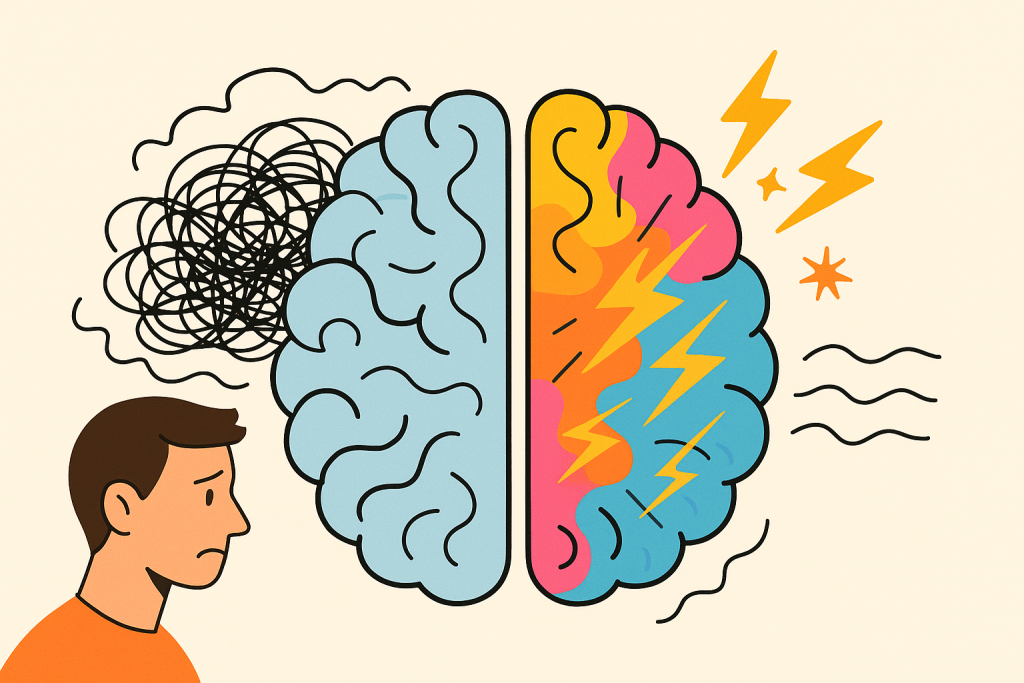
ADHD Brain Basics: Not Broken, Just Brilliantly Wired

Ever felt like your mind is ten steps ahead of the world, and sometimes even ten steps ahead of you? Thoughts racing, ideas bursting at the seams, yet the simplest task feels like trying to climb a mountain in flip-flops?

If that sounds familiar, you’re not alone. And no, your brain is not broken. You may just have an ADHD brain one that is wired differently, not defectively.

The ADHD Brain: A Race Car with Unpredictable Brakes

Here’s a metaphor that often hits home: think of the ADHD brain as a high-performance race car. The engine roars with power, the design is sleek, and the potential is immense. But the brakes? They can be a bit unreliable.

That’s ADHD in a nutshell. The spark, creativity, and momentum are all there in abundance. The challenge appears when it’s time to pause, shift gears, or tune into something that isn’t immediately engaging. This isn’t about laziness or a lack of discipline; it’s about the brain’s executive functions like planning, organisation, and impulse control which simply operate on a different system and require different kinds of support.

Why This Understanding Changes Everything

Many people say that when they first understand this concept, it reframes their entire life. ADHD isn’t about having less ability; it’s about having a different kind of ability.

The core issue isn’t an inability to focus. It’s that focus doesn’t always turn up on cue or for the “right” things. The same brain that can’t recall where it left the house keys can dive into hours of intense, joyful hyperfocus on something it finds meaningful, urgent, or exciting.

That’s not dysfunction. That’s divergence. And with the right approach, it’s a gift that can be channelled into incredible things.

Start with Understanding, Not Shame

When ADHD is met with curiosity instead of judgment, something powerful begins to unfold. The behaviours that once felt like personal flaws start to make perfect sense.

  • Struggling to get started? That’s not laziness; it’s often executive dysfunction causing a feeling of being overwhelmed.
  • Chronic lateness? It’s rarely rudeness; it’s more likely a different internal sense of time, sometimes called “time blindness.”
  • Forgetting things often? It’s probably not carelessness; it’s an overloaded working memory struggling to hold onto too many details at once.

The more we understand the “why” behind the behaviour, the more compassion we can build for ourselves and for the people around us who live with ADHD.

The Superpowers: Real, Tangible Strengths

Brains with ADHD can be:

  • Intensely creative and innovative problem-solvers.
  • Emotionally intuitive and empathetic.
  • Unusually perceptive, noticing things others miss.
  • Fiercely passionate and driven when engaged.

The goal isn’t to “fix” someone. It’s to help them understand their unique wiring so they can partner with their brain, not battle against it.

Not Alone, Just Wired Differently

ADHD doesn’t define you, but understanding it can be life-changing. Your brain is full of power, insight, and potential. The journey ahead isn’t about becoming someone new it’s about learning how to become more authentically you.

So stay curious. Be gentle with yourself. And know this: a whole world of insight, support, and possibility is waiting for you.

#BeTheForce

Disclaimer: This blog is for informational purposes only and is not a substitute for professional medical advice, diagnosis, or treatment. Please consult a doctor for personalised guidance and recommendations related to ADHD.

August 1, 2025 By GOQii Leave a Comment

Navigating the Anxiety and ADHD: Daily Struggles, Coping Strategies

If you’re living with ADHD, you’ve likely met its constant companion: anxiety. The two are like old acquaintances, often showing up together in the background of your daily life. ADHD brings its vibrant mix of curiosity and distraction, while anxiety adds a layer of restlessness, self-doubt, and that nagging sense that something might go wrong.

It’s no surprise, really. The unpredictable nature of ADHD – missed deadlines, impulsive decisions, and forgotten appointments—can create a daily rhythm filled with uncertainty. And uncertainty is anxiety’s favourite playground.

But here’s the hopeful part: understanding how ADHD and anxiety interact is half the battle. With the right strategies, support, and a little self-compassion, you can learn to manage both with more confidence.

Why Do ADHD and Anxiety So Often Overlap?

Think of the ADHD brain as one that’s wired for interest-based focus. This means you might find it hard to stick with tasks that don’t feel engaging or urgent. When the demands of a world designed for neurotypical processing start to pile up—misunderstood instructions, forgotten chores, a backlog of emails anxiety naturally creeps in.

You may find yourself constantly worrying about forgetting something crucial. Ruminating over past conversations. Or feeling overwhelmed at the thought of making choices that seem easy for others.

This isn’t a weakness. It’s the experience of a neurodivergent mind navigating a world that isn’t always built for it.

Common Daily Triggers for ADHD-Related Anxiety

For many with ADHD, anxiety doesn’t just come from big life events. It often bubbles up from everyday moments:

  • Feeling overwhelmed by choices, even simple ones.
  • Struggling to start a task because you don’t know where to begin.
  • Having difficulty concentrating at work or school.
  • Fearing you’ve misread social cues or said the wrong thing.
  • Feeling like you’re constantly behind, no matter how hard you try.

These moments can feel isolating, but you are not alone.

Coping Strategies That Work

Managing ADHD and anxiety takes practice and patience, but small, consistent changes can make a vast difference.

  • Establish Simple Routines

Structure can be incredibly calming for an ADHD brain. Start with small morning or evening rituals. Something as simple as making your tea the same way each morning or laying out your clothes the night before can create a reassuring sense of control.

  • Break Down Overwhelming Tasks

Instead of writing “finish report” on your to-do list, break it down into smaller steps: Open laptop, write introduction, outline key points. Clear, actionable steps reduce the feeling of being overwhelmed.

  • Use External Reminders

Don’t rely on your memory alone. Use phone alarms, sticky notes, or visual planners. These external cues can serve as gentle, non-judgmental reminders throughout the day.

  • Practice Mindful Breathing

When you feel anxiety building, just one minute of intentional breathing can help reset your nervous system. Inhale deeply, hold for a moment, and exhale slowly. Repeat.

  • Try Body Doubling

Working on a task alongside someone else (even if they’re working on something different, either in-person or remotely) can significantly improve focus and quiet the mental chatter that fuels anxiety.

  • Practice Self-Compassion

ADHD and anxiety often bring a loud inner critic. Experiment with changing that voice. “I’m doing my best with the tools I have” goes much further than, “Why can’t I just get my act together?”

You Don’t Have to Choose Between Functioning and Feeling Okay

It’s easy to fall into the trap of thinking you must push yourself endlessly to manage ADHD, or that anxiety is just something you have to live with.

But the reality is, it’s okay to slow down. It’s okay to ask for help. It’s okay to celebrate the small victories.

You’re not lazy. You’re not broken. You’re navigating a brain that works differently, and it’s okay for things to feel hard sometimes.

When it comes to managing ADHD and anxiety, there is no one-size-fits-all approach. What works for one person might not work for another and that’s okay. The most important thing is to remain curious. Experiment. And treat yourself with the same kindness you would offer to someone you truly love.

Because even though the path may feel tumultuous, it’s yours. And you’re more on track than you realise.

#BeTheForce

Disclaimer: This blog is for informational purposes only and is not a substitute for professional medical advice, diagnosis, or treatment. Please consult a doctor for personalised guidance and recommendations related to ADHD.

March 28, 2025 By Rajashree Hota 6 Comments

9 Tips For Self-Motivation

9 Tips for Self-MotivationAs part of my regular conversation, I asked one of my players about exercise.

“I don’t feel like it!” He replied swiftly.

Seeing his lack of motivation, I nudged him a little gently to give it a try. He sulkily replied with an “Okay!”

The same episode unfolded the next day with him being unenthusiastic about exercising. It didn’t matter how hard I tried to motivate him day after day. After a while, I realised that the player completely lacked intrinsic or self-motivation i.e the motivation that comes from within.

Self-Motivation emanates from one’s own sheer willingness to achieve a goal that has been set for oneself. Many times, we promise ourselves that from next week or next month we will start exercising, leave sugar or work towards a healthier lifestyle, but how many times do we sincerely stick to these goals? Of course, the desire to change our lifestyle for our own good has to be self-motivated, but seldom are we able to maintain the interest levels to achieve a goal.

Self-Motivation is quite important when it comes to being fit. We start well by following a routine of waking up early and going for walk, a run or to the gym. The first few days of the week go by as per routine but suddenly there is a radical dip in the levels of our motivation. In most cases, the loss of motivation occurs when we step on a weighing scale and see no change. Another reason could be negative, self-criticising thought patterns where we compare ourselves to skinny models  or chiselled athletes, thinking we’ll never be like them, instantly hammering our motivation into a million pieces.

If you’ve been seeking self-motivation and aren’t able to find it, here are 9 surefire ways to stay motivated!

1. Do It Only If You Want To
If you are exercising for the sake of it, let’s embrace the truth, it won’t work. Motivation levels will drop easily when you do something you don’t want to. To keep going and feel motivated from within, you need to enjoy your workout. To stay fit, experiment and find out what activity you like the most.

2. Stop Criticising Yourself
If you start comparing yourself with someone you think is perfect, then your motivation will bite the dust. Realise that the person next to you who is in perfectly good shape took the time and effort to look like that. Instead of dwelling in self-degrading thoughts and criticising yourself, put in a fair effort.

3. Picture Yourself a Few Years From Now
Picture a healthier you, a slimmer or better-looking you. How would you like to see yourself a year from today? This thought itself can motivate you from within.

4. Get Over Your Laziness
“Not now”, “Maybe tomorrow”, “I will start from Monday”, “Maybe next month”… Do you recognise these statements? They are evident signs of procrastination and laziness. Very soon, the “not now” becomes “never” and we hardly try to achieve any pending health goals we may have. What should we do? Get over it and start moving! Try playing some energetic music around you, change your lazy-looking, comfort-filled environment and get yourself going.

5. Focus on the Goal
This is the most important thing you need to do. Focus on your goals, whether it is to achieve balance in your lifestyle, eat healthy or lose your weight, start focusing on your goal. More than often, we divert from our original goals and start overthinking. For instance, if your goal is to lose weight, stop thinking about the clothes that you are not fitting in right now, or what will happen if you do and do not lose weight. Just tame your mind and focus on your ultimate goal!

6. Set Small Targets and Give Yourself a Reward
Reward plays a very important role in self-motivation. Start with small goals, or what we like to call S.M.A.R.T (Specific, Measurable, Attainable, Relevant and Timely) goals and reward yourself every time you achieve one of them. For example, if your ultimate goal is to lose 25kg, have a “S.M.A.R.T” goal to lose 4 to 5 kg per month and when you manage to achieve it successfully, reward yourself with something you like. Be it new clothes or even a new mobile phone.

7. Set Penalties
If Rewards work then penalties work as well. By penalties, I don’t actually mean punishing yourself to the extent of starvation when you eat junk food or excessively working out every time you skip exercise. Instead, do it in a positive way. Like every time you miss exercise or eat something unhealthy, put a certain amount of money in a penalty box, which will ultimately go to your friend/ spouse/ kids or colleagues. That will motivate you enough to not skip exercise the next time.

8. Pen It Down
If you write your goals and dreams on a regular basis, you are 42% more likely to achieve those goals, says a study conducted by Dr. Gail Matthews – a psychology professor at the Dominican University of California. Try maintaining a journal and write your goals as well as achievements down on a daily basis.

9. Do It For the Selfies!
It may sound funny but if you like to take pictures and post them on social media, you might actually likes this idea. Going for a workout? Take a selfie! Bought yourself new gym clothes? Take a selfie! Lost two inches? Take a selfie! Apart from the shares and likes, you will also be able to map your progress through pictures. So give it a try. It definitely worked for me!

In closing, remember that being self-motivated takes a lot of willpower. You need to feel good about yourself as well as better yourself on a daily basis. No amount of external motivation is enough if you don’t have the inclination to accomplish your own goals.

We hope these motivational tips will ignite the self-motivated fire within you. If you found these strategies valuable and have your own motivational techniques to share, please do so in the comments section below.

Remember, your path to self-motivation and a healthier you starts with the first step.

#BeTheForce

Disclaimer: The information provided in this blog is for general awareness and educational purposes only. It is not intended to replace professional medical advice, diagnosis, or treatment. Always consult a qualified healthcare provider for personalised medical guidance or concerns related to your health.

  • 1
  • 2
  • Next Page »

Search

Recent Posts

  • Healthy Eating: Paneer Stuffed Palak Paratha
  • 5 Simple Lifestyle Changes To Manage Hypertension
  • Vegging Out: My Unexpected Journey to Veganism
  • Natural Skincare For Healthy, Glowing Skin!
  • The Early Signs & Symptoms of Diabetes

Stay Updated

Archives

  • November 2025 (3)
  • October 2025 (20)
  • September 2025 (6)
  • August 2025 (6)
  • July 2025 (12)
  • June 2025 (18)
  • May 2025 (16)
  • April 2025 (23)
  • March 2025 (24)
  • February 2025 (23)
  • January 2025 (26)
  • December 2024 (26)
  • November 2024 (26)
  • October 2024 (22)
  • September 2024 (24)
  • August 2024 (31)
  • July 2024 (22)
  • June 2024 (27)
  • May 2024 (31)
  • April 2024 (27)
  • March 2024 (29)
  • February 2024 (26)
  • January 2024 (26)
  • December 2023 (17)
  • November 2023 (15)
  • October 2023 (23)
  • September 2023 (23)
  • August 2023 (21)
  • July 2023 (22)
  • June 2023 (24)
  • May 2023 (25)
  • April 2023 (24)
  • March 2023 (23)
  • February 2023 (20)
  • January 2023 (16)
  • December 2022 (12)
  • November 2022 (15)
  • October 2022 (15)
  • September 2022 (13)
  • August 2022 (11)
  • July 2022 (17)
  • June 2022 (11)
  • May 2022 (10)
  • April 2022 (6)
  • March 2022 (6)
  • February 2022 (13)
  • January 2022 (12)
  • December 2021 (7)
  • November 2021 (3)
  • October 2021 (6)
  • September 2021 (3)
  • August 2021 (8)
  • July 2021 (7)
  • June 2021 (15)
  • May 2021 (16)
  • April 2021 (10)
  • March 2021 (7)
  • February 2021 (4)
  • January 2021 (4)
  • December 2020 (3)
  • November 2020 (4)
  • October 2020 (10)
  • September 2020 (3)
  • August 2020 (3)
  • July 2020 (2)
  • June 2020 (4)
  • May 2020 (10)
  • April 2020 (12)
  • March 2020 (10)
  • February 2020 (4)
  • January 2020 (4)
  • December 2019 (3)
  • November 2019 (7)
  • October 2019 (5)
  • September 2019 (4)
  • August 2019 (9)
  • July 2019 (9)
  • June 2019 (11)
  • May 2019 (4)
  • April 2019 (9)
  • March 2019 (8)
  • February 2019 (9)
  • January 2019 (8)
  • December 2018 (9)
  • November 2018 (3)
  • October 2018 (3)
  • September 2018 (5)
  • August 2018 (10)
  • July 2018 (6)
  • June 2018 (13)
  • May 2018 (8)
  • April 2018 (18)
  • March 2018 (9)
  • February 2018 (8)
  • January 2018 (15)
  • December 2017 (12)
  • November 2017 (19)
  • October 2017 (13)
  • September 2017 (15)
  • August 2017 (4)
  • July 2017 (8)
  • June 2017 (7)
  • May 2017 (6)
  • April 2017 (8)
  • March 2017 (6)
  • February 2017 (7)
  • January 2017 (9)
  • December 2016 (10)
  • November 2016 (7)
  • October 2016 (7)
  • September 2016 (7)
  • August 2016 (11)
  • July 2016 (9)
  • June 2016 (9)
  • May 2016 (12)
  • April 2016 (17)
  • March 2016 (17)
  • February 2016 (8)
  • January 2016 (6)
  • December 2015 (2)
  • November 2015 (9)
  • October 2015 (7)
  • September 2015 (9)
  • August 2015 (11)
  • July 2015 (9)
  • June 2015 (12)
  • May 2015 (9)
  • April 2015 (13)
  • March 2015 (8)
  • February 2015 (5)
  • January 2015 (12)
  • December 2014 (14)
  • November 2014 (11)
  • October 2014 (6)
  • September 2014 (13)
  • August 2014 (12)
  • July 2014 (6)
  • June 2014 (2)
  • May 2014 (7)
  • April 2014 (5)

From “Laddu Nawin” to Fit and Fierce: How a 25-Year-Old Insurance Advisor Shed 20 Kilos and Gained His Life Back

When 25-year-old Nawin Yadav from Hyderabad walked into his office every morning, he carried more than just his files and policy papers. He had the weight of fatigue, sluggish energy, and an ever-growing belly that was becoming the butt of jokes. “People … [Read More...]

“I’ve Challenged Myself to Live 100 Years” – The Story of Chandubhai Savani’s Second Chance at Life

At 67, most people start slowing down. Not Chandubhai Savani. A resident of Surat, Chandubhai, thought life was on track. “My life was going well till I had my bypass surgery,” he says. That surgery, back in 2021, was a wake-up call.  Medication was routine, but exercise wasn’t. His diet? What he calls ‘normal.’ “I […]

From Shimla’s Slopes to Chandigarh’s Sidewalks: Surinder Kaur Bhalla’s Journey from Chaos to Control

Some journeys start with a plan. Others begin with a stumble literally. Surinder Bhalla, a government professional, born and raised in the scenic hill town of Shimla, had always lived a life of movement. “In Shimla, you walked everywhere,” she reflects. “Walking was never an exercise. It was just life.” But after shifting to Chandigarh, […]

Ananda Mukherjee Health Story

From Terminal Illness To Complete Wellness! Ananda Mukherjee Health Story

As we observe World Cancer Day under the powerful theme ‘United by Unique’ (2025-2027)**, we are reminded that every individual’s journey with cancer is distinct, yet united by shared resilience, hope, and the collective fight against this disease. This theme places people at the centre of care and their stories at the heart of the […]

  • HOME
  • HEALTHY LIVING
  • FITNESS
  • HEALTHY RECIPES
  • USER STORIES
  • KARMA
  • BUY GOQii

Copyright ©2016 GOQii